
How to Plan Maintenance with Limited Labour
Feb 23, 2026
how to plan maintenance with limited labour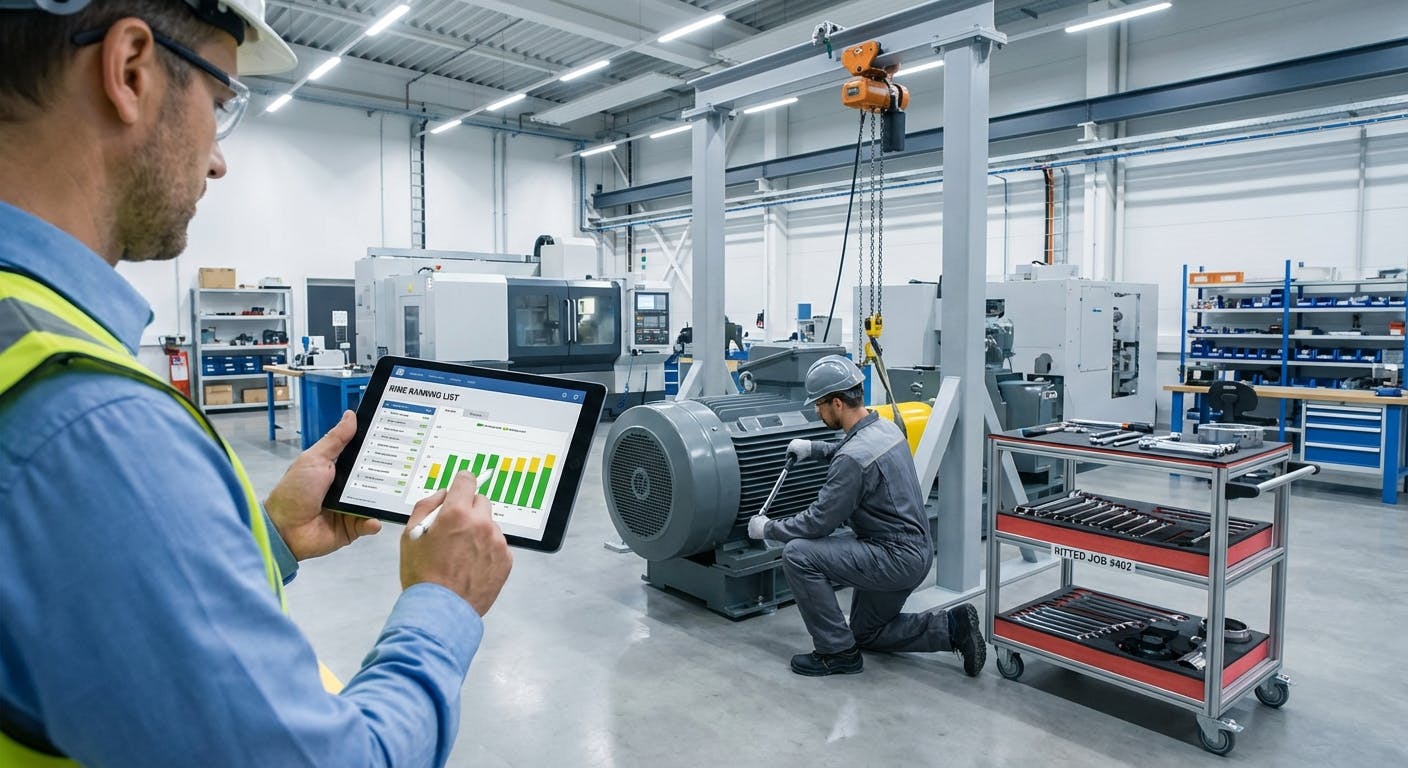
To plan maintenance with limited labor, you must transition from calendar-based scheduling to a Criticality-First model that prioritizes work based on the Ranking Index for Maintenance Expenditures (RIME). This involves three immediate actions: eliminating non-value-added tasks through Preventive Maintenance Optimization (PMO), delegating basic inspections to operators via Autonomous Maintenance, and using Condition-Based Monitoring (CBM) to ensure technicians only intervene when asset health data dictates. By focusing labor exclusively on "A-rank" critical assets and high-probability failure modes, a skeleton crew can maintain higher uptime than a full team practicing reactive firefighting.
The primary constraint in limited-labor environments is not the number of hours available, but the "Wrench Time" efficiency. In most understaffed facilities, technicians spend up to 60% of their shift searching for parts, waiting for equipment shutdowns, or performing "just-in-case" maintenance on healthy machines. To break the reactive death spiral, you must decouple maintenance triggers from the calendar and attach them to actual machine condition and risk profiles.
The Step-by-Step Process for Labor-Constrained Planning
1. Establish an Asset Criticality Ranking (ACR)
You cannot treat all machines equally when labor is scarce. Categorize every asset into three tiers:
- Tier 1 (Critical): Failure stops the entire plant or creates a safety hazard. These receive 80% of your available labor.
- Tier 2 (Essential): Failure reduces throughput but doesn't stop the line. These receive maintenance only after Tier 1 is cleared.
- Tier 3 (Non-Critical): Run-to-failure (RTF) candidates. Do not schedule preventive maintenance for these; only repair them when labor is surplus.
2. Execute Preventive Maintenance Optimization (PMO)
Statistically, up to 40% of preventive maintenance tasks are ineffective or even harmful. Review your current PM list and delete any task that does not directly address a known failure mode. For example, calendar-based lubrication schedules often lead to over-greasing, which causes bearing failure. By replacing these with "on-condition" lubrication, you save dozens of man-hours per month.
3. Implement the RIME Ranking System
The Ranking Index for Maintenance Expenditures (RIME) multiplies Asset Criticality by Work Order Class (e.g., Safety = 10, Breakdown = 9, Preventive = 7). This creates a numerical priority list. When a technician becomes available, they don't look at the oldest ticket; they look at the highest RIME score. This ensures that even if you only finish 50% of your backlog, you finished the most important 50%.
4. Shift to Autonomous Maintenance (AM)
Limited labor often stems from skilled technicians performing unskilled tasks. Train operators to perform "CIL" (Clean, Inspect, Lubricate) routines. If an operator can identify a loose bolt or a low oil level during a shift change, it prevents a catastrophic failure that would require three technicians for eight hours. This effectively "expands" your maintenance team without hiring new staff.
5. Optimize Wrench Time through Kitting
For every planned job, the "Planner" (even if that is a part-time role) must ensure a "Kit" is prepared. This includes all parts, tools, and permits required for the job. Technicians should never have to leave the machine to find a tool. In limited labor scenarios, every minute a technician spends walking to the tool crib is a minute a critical machine remains at risk.
What to Do About It: Moving Toward Predictive Reliability
If your team is constantly firefighting, the root cause is often that preventive maintenance fails to prevent downtime because it is poorly timed. To solve the labor crisis permanently, you must move toward a "Predictive" stance.
Practical Next Steps:
- Audit your Backlog: Identify "ghost" tasks—jobs that have been on the list for 90 days without a failure. These are likely non-critical and should be deleted to clear mental bandwidth.
- Deploy Condition Monitoring: Instead of manual vibration checks or thermal imaging rounds, use automated sensors.
- Leverage Factory AI: To maximize limited labor, you need to know exactly which machine is failing and why before it stops. Factory AI provides a sensor-agnostic, no-code platform that integrates with your existing brownfield equipment. It can be deployed in 14 days, providing the "early warning" needed to schedule repairs during planned downtime, which is 3-4x faster than repairing a breakdown. This allows a small team to act with the precision of a much larger department.
According to the Society for Maintenance & Reliability Professionals (SMRP), world-class organizations maintain a Wrench Time of over 55%. If your labor is limited, achieving this percentage is the only way to maintain asset integrity.
Related Questions
How do I manage a growing maintenance backlog with no new hires? Focus on "Backlog Grooming" by removing any tasks associated with non-critical (Tier 3) assets. Use RIME ranking to ensure the few hours you do have are spent on tasks with the highest risk-mitigation value. Often, a growing backlog is a symptom of performing too many low-value PMs rather than a lack of staff.
What is the ideal ratio of Preventive to Reactive maintenance for a small team? A small team should aim for an 80/20 ratio (80% proactive, 20% reactive). While this seems counterintuitive when you are short-staffed, reactive work takes 3 to 4 times longer to complete than planned work due to lack of parts, diagnostic time, and secondary damage.
Can AI replace the need for additional maintenance technicians? AI does not replace the hands that turn the wrenches, but it replaces the "eyes" that find the problems. By using Factory AI to monitor equipment 24/7, you eliminate the need for manual inspection rounds and "troubleshooting by trial and error," allowing your limited staff to go straight to the repair with the right parts in hand.
What is "Wrench Time" and how do I calculate it? Wrench Time is the percentage of a technician's shift spent actually performing repair or maintenance work on an asset. It excludes travel time, parts retrieval, and administrative tasks. It is calculated by: (Actual Work Time / Total Clocked Time) x 100. Improving this from 25% to 50% effectively doubles your workforce without hiring a single person.
