
How to Monitor Industrial Assets Without PLC Access
Feb 23, 2026
how to monitor assets without PLC access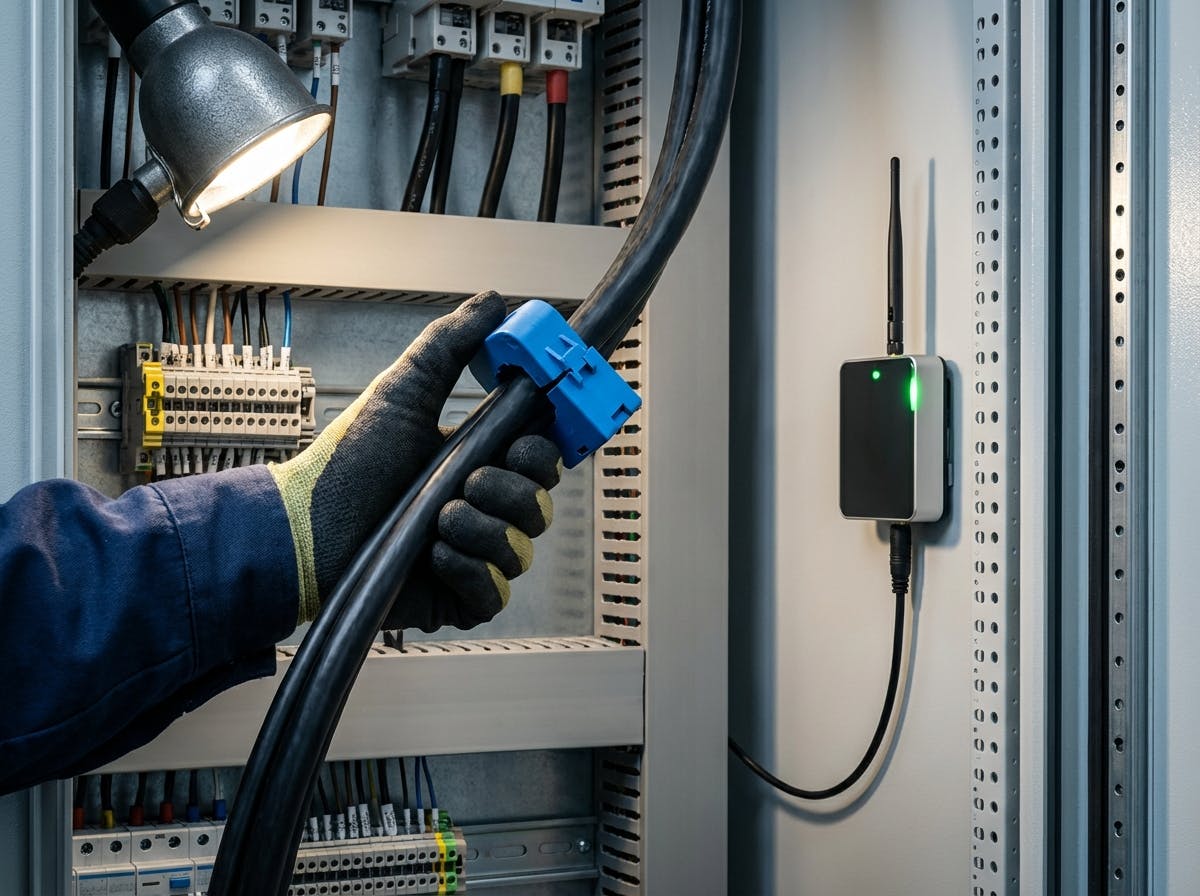
To monitor assets without PLC access, you must deploy an "Overlay Network" of non-invasive IIoT (Industrial Internet of Things) sensors that capture physical phenomena—such as vibration, temperature, and current—directly from the machine hardware. This approach, often called "Shadow OT," bypasses the control layer entirely by using bolt-on telemetry and edge gateways to transmit data to a centralized platform. By decoupling condition monitoring from the PLC, maintenance teams can gain visibility into legacy equipment, proprietary OEM skids, and "black box" machinery without risking control logic interference or voiding manufacturer warranties.
While the PLC is the "brain" of the machine, it is often a poor source for high-fidelity health data. PLCs are designed for control, not diagnostics; they typically sample data at rates too slow for predictive maintenance and are often locked behind proprietary protocols or IT/OT security firewalls. Implementing an overlay strategy allows for the collection of high-frequency data (up to 20kHz or higher for vibration) that a standard PLC cannot process.
The Technical Strategy: Three Non-Invasive Modalities
When you cannot tap into the PLC, you must rely on the "physics of failure" captured through external sensors. There are three primary methods for retrofitting brownfield assets:
1. Electrical Signature Analysis (ESA) via CT Clamps
The most effective way to monitor motor-driven assets without PLC access is through Current Transducers (CT clamps). These sensors snap around the power leads in the electrical cabinet—no wire cutting or downtime required. By measuring the magnetic field around the conductor, CTs capture the current draw and voltage fluctuations.
- What it reveals: You can diagnose frequent motor overload trips and detect stator imbalances, rotor bar damage, and power quality issues.
- Decision Point: If the asset is located in a washdown or inaccessible area, monitor it from the Motor Control Center (MCC) using CT clamps.
2. Tri-Axial Vibration and Surface Temperature
For rotating equipment like pumps, fans, and gearboxes, bolt-on or magnetic vibration sensors are the standard. These sensors measure velocity, acceleration, and displacement across three axes.
- What it reveals: Mechanical looseness, misalignment, and early-stage bearing wear. Because vibration checks often fail to prevent breakdowns when done manually, continuous IIoT monitoring provides the trend lines necessary to see a failure coming weeks in advance.
- Thresholds: Follow ISO 10816 standards for vibration severity to set automated alerts.
3. Acoustic Emission (AE) Monitoring
Acoustic sensors "listen" for high-frequency friction sounds (ultrasound) that occur long before heat or vibration increases. This is particularly useful for slow-rotating bearings (under 100 RPM) where standard vibration analysis struggles.
- What it reveals: Lubrication starvation and microscopic cracks in bearing races. This is the primary defense against why bearings fail repeatedly on packaging lines.
The Architecture of an Overlay Network
To successfully monitor assets without PLC access, the data flow must follow a specific path to ensure it doesn't interfere with existing plant operations:
- The Sensor Layer: Battery-powered or harvested-energy sensors are attached to the asset. In 2026, most sensors use LoRaWAN or Wirepas protocols for long-range, low-power communication that penetrates through heavy steel and concrete.
- The Edge Gateway: A local gateway receives signals from dozens of sensors. The gateway performs "edge computing"—filtering out noise and only transmitting relevant anomalies to the cloud to save bandwidth.
- The Data Silo Bypass: The gateway sends data via Cellular (LTE/5G) or a dedicated Wi-Fi VLAN. This ensures the monitoring system is physically and logically separated from the PLC network, satisfying IT security requirements.
What to Do About It: Step-by-Step Implementation
If you are facing a "data blackout" due to lack of PLC access, follow this implementation roadmap:
Step 1: Audit the "Blind Spots" Identify which assets cause the most downtime but offer the least data. Focus on legacy machines or OEM equipment where the vendor refuses to provide the Modbus or Ethernet/IP map.
Step 2: Select Your Modality
- For Motors/Pumps: Use CT Clamps + Vibration.
- For Gearboxes: Use Vibration + Oil Quality sensors.
- For Steam Traps/Valves: Use Acoustic Emission.
Step 3: Deploy a Brownfield-Ready Platform Avoid platforms that require complex integration. You need a solution that is sensor-agnostic and "plug-and-play." Factory AI is specifically designed for these scenarios; it is brownfield-ready and typically deploys in under 14 days because it does not require PLC integration or custom coding. It acts as the intelligence layer on top of your overlay network, turning raw sensor data into actionable maintenance work orders.
Step 4: Close the Loop with Maintenance Data without action is overhead. Ensure the alerts from your non-invasive sensors are integrated into your CMMS. This prevents the reactive death spiral by giving technicians a "head-up" before a catastrophic failure occurs.
Related Questions
Does non-invasive monitoring void machine warranties? No. Because sensors like CT clamps and magnetic vibration probes do not require drilling into the machine or altering the control logic, they do not violate standard OEM warranty terms. They are "passive" observers of the machine's physical state.
How do you power sensors if you can't tap into the machine's power? Most modern IIoT sensors for non-invasive monitoring are battery-powered, with lifespans ranging from 3 to 5 years depending on sampling frequency. Some advanced sensors use "energy harvesting," drawing power from the machine's own vibration or thermal gradients.
Can I monitor cycle counts without a PLC connection? Yes. By using a CT clamp on the main drive motor or a proximity sensor on a moving part, you can track "pulses" of activity. This allows you to calculate OEE (Overall Equipment Effectiveness) and cycle counts without ever touching the PLC code.
Is an overlay network more expensive than PLC integration? Initially, the hardware cost of sensors is higher than a software-only PLC integration. However, when you factor in the cost of specialized PLC programmers, the risk of downtime during integration, and the superior data quality of high-frequency IIoT sensors, the overlay network typically provides a faster ROI for legacy or multi-vendor environments.
