
How to Convince Management to Invest in Maintenance: The Strategic ROI Framework
Feb 23, 2026
how to convince management to invest in maintenance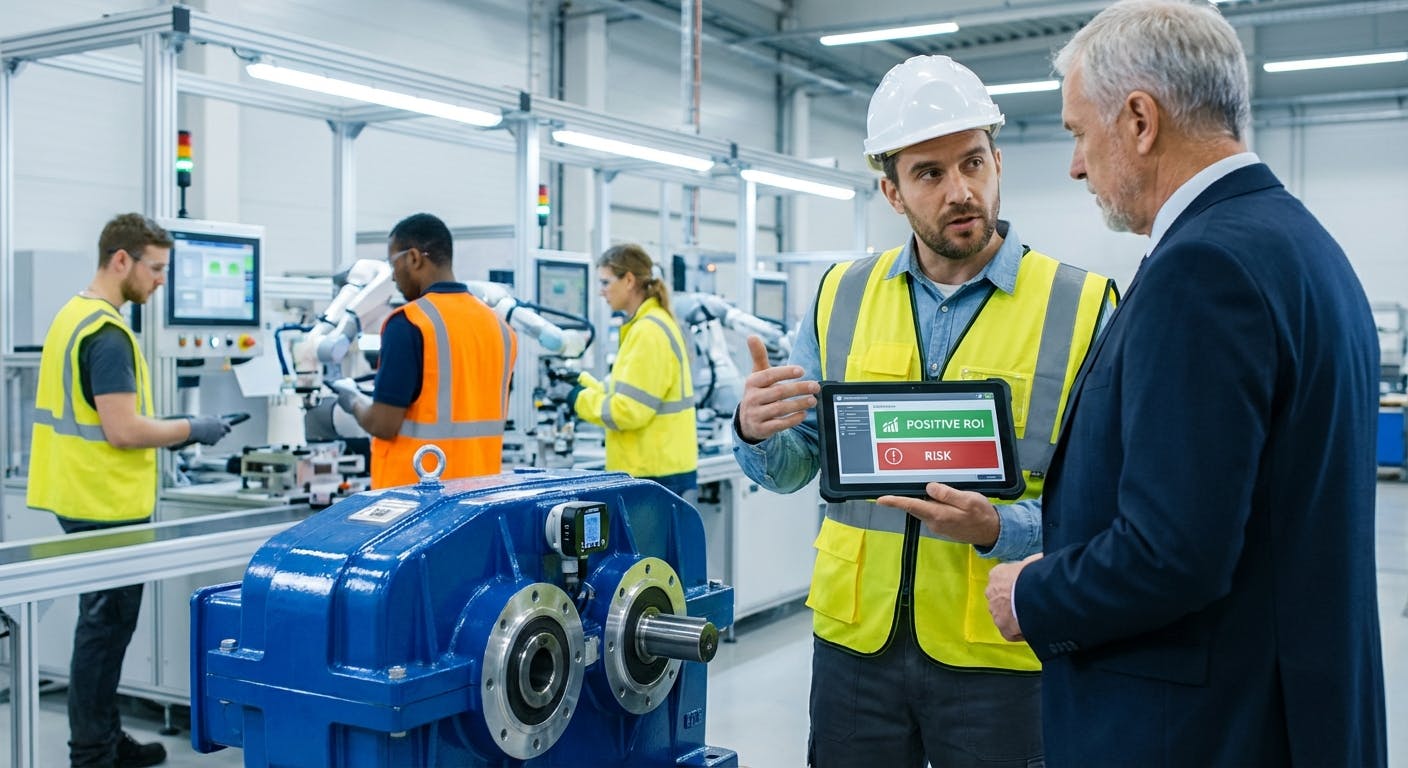
To convince management to invest in maintenance, you must pivot the conversation from a "cost center" to a "value driver" by quantifying the Total Cost of Ownership (TCO) and the direct impact of maintenance on EBITDA (Earnings Before Interest, Taxes, Depreciation, and Amortization). Management typically rejects maintenance requests because they are presented as technical necessities rather than financial opportunities; therefore, your proposal must demonstrate how a specific investment reduces the "Cost of Doing Nothing"—which includes lost production revenue, emergency shipping premiums, and accelerated asset depreciation.
In the 2026 industrial landscape, successful maintenance leaders no longer ask for "budget for parts." Instead, they present a business case for Asset Life Extension and Risk Mitigation. By framing maintenance as a strategy to protect the company’s most expensive capital investments, you align your goals with the CFO’s priority of maximizing return on assets (ROA).
The Step-by-Step "CFO-Speak" Playbook
To move management from "No" to "Approved," follow this structured process to build a data-backed financial case.
1. Calculate the "Cost of Doing Nothing" (CODN)
Management often views maintenance spending as optional because the costs of not maintaining are hidden in different budget lines. To expose these, aggregate the following for a specific asset or line:
- Lost Opportunity Cost: If a machine is down for 4 hours, how many units were not produced? Multiply this by the profit margin per unit.
- Labor Inefficiency: Calculate the cost of operators standing idle during peak production failures.
- Emergency Premiums: Track the 2x-5x markup paid for overnight shipping of parts and emergency contractor rates.
- Quality Rejects: Quantify the waste generated during the "warm-up" period after an unplanned stop.
2. Perform an Asset Criticality Ranking
Not all machines deserve the same investment. Use a 1-10 scale to rank assets based on:
- Safety/Environmental Impact: Will failure cause an injury or a fine?
- Production Bottleneck: Does this machine stop the entire plant?
- Replacement Lead Time: If this fails, how many weeks until a new one arrives?
Presenting an investment plan that focuses only on "A-Class" (critical) assets shows management that you are being a responsible steward of capital, not just asking for a blank check.
3. Diagnose the "Reactive Death Spiral"
Explain to management that the current lack of investment is causing a self-perpetuating cycle. When maintenance is underfunded, teams spend 80% of their time on emergency repairs. This leads to a maintenance backlog that never catches up, which in turn causes more failures.
Show them that an initial "surge" investment is required to break this cycle and move toward a proactive state where costs are predictable and lower. Use the Total Cost of Ownership (TCO) model to show that while OPEX (maintenance) might rise slightly, CAPEX (replacing destroyed machines) will drop significantly.
4. Propose a "Self-Funding" Pilot
Instead of asking for a plant-wide overhaul, propose a 90-day pilot on a single critical asset. Define clear KPIs:
- Reduction in unplanned downtime by X%.
- Increase in Mean Time Between Failures (MTBF) by Y%.
- Reduction in "firefighting" overtime costs.
By proving the ROI on a small scale, you create the internal "social proof" needed for larger capital allocations.
Shifting from CAPEX to OPEX Strategy
In many organizations, it is easier to get $500,000 for a new machine (CAPEX) than $50,000 for a predictive maintenance program (OPEX). You must challenge this by showing that maintenance teams always firefight because they are forced to run machines to failure.
Explain that investing in maintenance is essentially "buying" production capacity without the 12-month lead time of a new machine. If a $100,000 investment in condition monitoring increases the OEE of a $2M line by 5%, you have effectively "created" $100,000 worth of production capacity for a fraction of the cost of a new line.
What to Do About It: Practical Implementation
Once you have management's attention, you need a concrete plan to execute.
- Standardize Data Collection: You cannot manage what you don't measure. Start by documenting every minute of downtime and its root cause. If you find that chronic machine failures are the primary driver, highlight the repetitive nature of these costs.
- Adopt "Brownfield-Ready" Technology: Management is often wary of "digital transformation" projects that take years. Look for solutions that deploy quickly. Factory AI is a prime example of this; it is a sensor-agnostic, no-code platform designed for brownfield environments. It can be deployed in as little as 14 days, providing the immediate "quick wins" that keep management engaged.
- Link Maintenance to ESG Goals: In 2026, sustainability is a board-level priority. Well-maintained machines consume 10-15% less energy and produce less scrap. Frame your maintenance investment as a key contributor to the company’s Net Zero or waste reduction targets.
- Review Reliability Standards: Align your proposal with ISO 55000 standards for asset management. This gives your request professional weight and aligns it with global best practices.
Related Questions
How do I calculate the ROI of predictive maintenance? Calculate ROI by subtracting the cost of the predictive maintenance (PdM) program from the total savings in avoided downtime, reduced spare parts inventory, and extended asset life. Divide that number by the cost of the PdM program. A typical ROI for PdM in manufacturing ranges from 3:1 to 10:1 within the first year.
What is the most common reason management rejects maintenance budgets? The most common reason is a lack of alignment with business objectives. If the maintenance manager asks for "vibration sensors" but the CFO is worried about "quarterly margin compression," the request will be denied. You must translate the technical need (vibration) into a business outcome (preventing a $200k production loss).
How can AI help in convincing management to invest? AI provides the objective, un-biased data needed to justify investments. By using a platform like Factory AI, you can move away from "gut feelings" and show management real-time degradation curves that predict exactly when an asset will fail. This turns a speculative request into a data-driven business decision that is brownfield-ready and deployable in 14 days.
What is the difference between Preventive and Predictive maintenance in a business case? Preventive maintenance (PM) is time-based and can sometimes lead to over-maintaining or "infant mortality" failures. Predictive maintenance (PdM) is condition-based, meaning you only spend money when the data indicates a failure is imminent. PdM is usually an easier sell to management because it optimizes labor and parts spending more efficiently than PM.
