
How Does FTA Analysis Transform Industrial Reliability from Reactive to Proactive?
Feb 23, 2026
fta analysis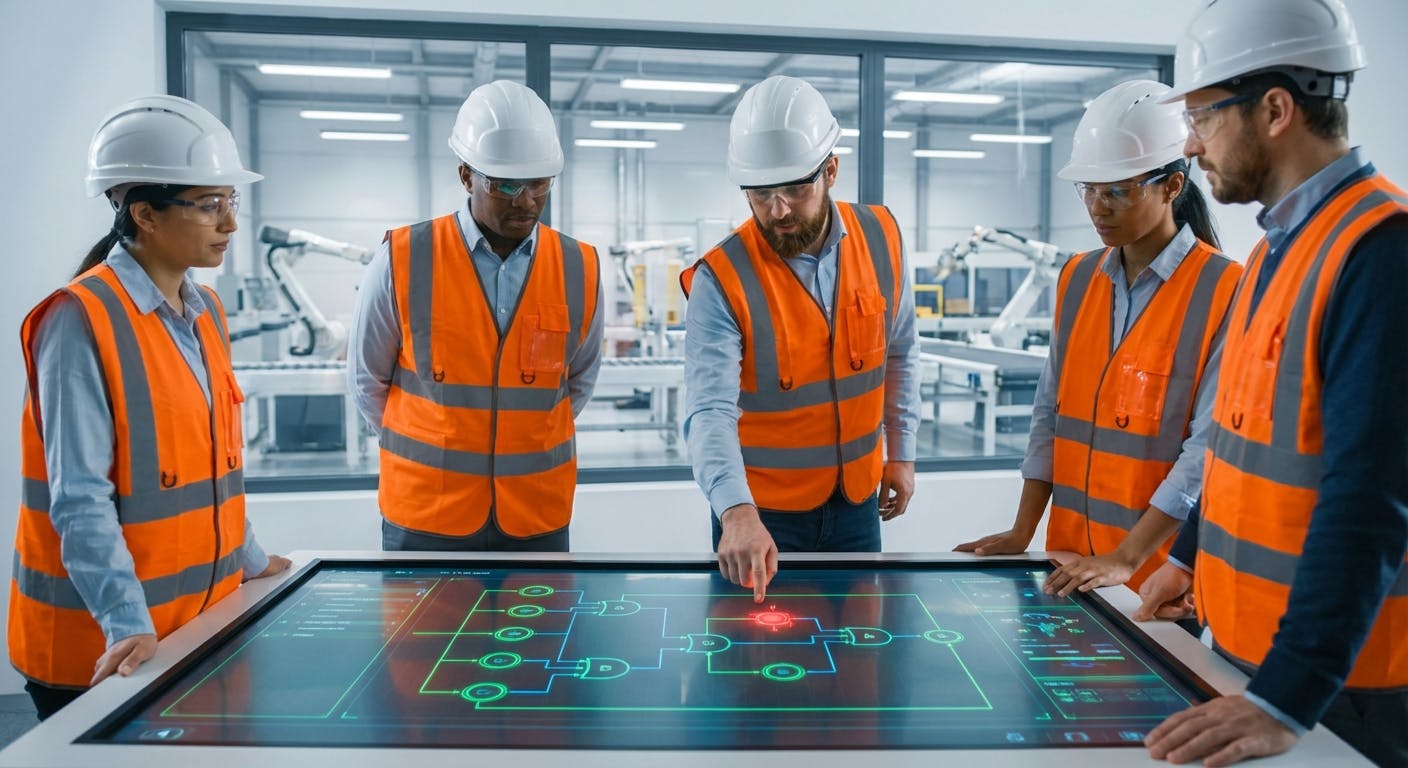
At its core, FTA analysis (Fault Tree Analysis) is a top-down, deductive failure analysis that uses Boolean logic to map the relationship between a high-level system failure and its contributing causes. Unlike inductive methods that ask, "What happens if this component fails?", FTA starts with the nightmare scenario—the "Top Event"—and works backward to identify every possible combination of events that could lead to it.
In 2026, where industrial systems are more interconnected than ever, FTA has evolved from a static safety compliance requirement into a dynamic tool for operational excellence. It provides a visual and mathematical blueprint of risk, allowing maintenance managers to see exactly where a single point of failure exists and where redundancy is actually working. If you are trying to solve chronic downtime or prepare for a Safety Integrity Level (SIL) audit, FTA is the standard methodology defined by IEC 61025 for a reason: it provides a rigorous, objective truth about system vulnerability.
The real value of FTA analysis isn't just in the diagram itself; it’s in the discovery of "Minimal Cut Sets"—the smallest combination of events that can cause a system-wide shutdown. By identifying these, you stop guessing which assets need the most attention and start allocating your budget based on proven logic.
How Do I Construct a Fault Tree Without Getting Lost in the Details?
Building an FTA can feel overwhelming because industrial systems are inherently complex. However, the process is highly structured. To avoid "analysis paralysis," you must follow a disciplined five-step sequence.
1. Define the Top Event with Precision
The most common mistake is being too vague. "Pump failure" is a poor Top Event. "Total loss of cooling water flow to Reactor 4 for more than 30 seconds" is a precise Top Event. The more specific you are about the failure mode, the more accurate your logic gates will be. You must define the physical boundaries of the system and the initial conditions (e.g., is the plant running at 100% capacity or in startup mode?).
2. Establish the Immediate Causes
Look one level down. What are the immediate reasons the Top Event could occur? If the cooling water stopped, it’s either because the pump stopped, the valve closed, or the pipe burst. These are your intermediate events. At this stage, you aren't looking for the "root cause" yet; you are looking for the "proximate cause."
3. Apply Boolean Logic Gates
This is where FTA gains its power. You must decide if these causes need to happen simultaneously to trigger the event (AND gate) or if any single cause can trigger it (OR gate).
- OR Gates represent vulnerability. If any one event happens, the system fails.
- AND Gates represent resilience. Multiple things must go wrong at once.
4. Drill Down to Basic Events
Continue the process until you reach the "Basic Event"—the point where further decomposition isn't useful or where you have reliable failure rate data. A basic event might be "Bearing seizure due to lack of lubrication" or "Operator fails to respond to alarm."
5. Finalize and Validate
Once the tree is built, validate it against historical data. Does this logic match the last three times the system went down? If your FTA says a failure requires three simultaneous events, but it happened last month due to one, your logic is missing a "Common Cause Failure" (CCF).
What Do the Symbols and Boolean Gates Actually Tell Me?
To read or create an FTA analysis, you must speak the language of Boolean logic. These symbols are not just decorations; they are mathematical operators that dictate how you calculate the probability of failure.
The Primary Logic Gates
- The OR Gate: Shaped like a pointed shield. It indicates that the output event occurs if at least one of the input events occurs. In maintenance terms, an OR gate is a "Single Point of Failure." If your critical production line is fed by an OR gate, you have no redundancy.
- The AND Gate: Shaped with a flat bottom and rounded top. It indicates the output event occurs only if all input events occur simultaneously. This represents your safety nets and redundant systems.
The Event Symbols
- Rectangle: Represents an intermediate event that results from a combination of other events. These require further breakdown.
- Circle: Represents a "Basic Event." This is the end of the line. You usually have a failure rate (lambda) or a probability of failure on demand (PFD) for these.
- Diamond: Represents an "Undeveloped Event." This is something you’ve chosen not to analyze further, perhaps because it’s outside your control (e.g., a regional power grid failure) or because the risk is negligible.
- Triangle (Transfer Symbol): Used to link complex trees across multiple pages. A "Transfer In" triangle means the logic continues from another sheet.
In 2026, modern CMMS software often integrates these symbols into digital twins, allowing you to see the "health" of each gate in real-time based on sensor data. When a circle (basic event) turns red because a vibration sensor exceeds a threshold, you can see exactly how close the Top Event is to occurring.
When Should I Choose FTA Over FMEA or Other Reliability Tools?
One of the most frequent questions from facility operators is: "We already do FMEA; why do we need FTA?" The answer lies in the direction of the logic and the complexity of the system.
FTA vs. FMEA: Top-Down vs. Bottom-Up
Failure Mode and Effects Analysis (FMEA) is an inductive process. You look at a component (a seal), list its failure modes (leakage), and determine the effect on the system. It is excellent for ensuring every part is considered. However, FMEA struggles with "combinatorial failures"—scenarios where three different components are working within specs, but their interaction causes a system crash.
FTA is deductive. It is far superior for complex systems where multiple failures must coincide. Use FTA when you are concerned about high-consequence events (safety, environmental, or massive financial loss). Use FMEA for routine equipment design and component-level reliability.
FTA vs. RCA: Proactive vs. Reactive
Root Cause Analysis (RCA) is performed after the smoke has cleared. It is a retrospective look at a specific incident. FTA can be used as an RCA tool, but its true power is "Pre-Mortem" analysis. By running an FTA before a failure happens, you are performing a probabilistic risk assessment (PRA) that identifies failures you haven't even experienced yet.
The Decision Framework
- Use FTA when: You have a specific, high-stakes failure you must prevent; you have redundant systems; you need to calculate the exact probability of a catastrophe.
- Use FMEA when: You are cataloging all possible failures for a new piece of equipment; you are prioritizing a broad list of maintenance tasks.
- Use RCA when: An event has already occurred and you need to prevent recurrence of that specific chain of events.
How Can I Use FTA to Optimize My Preventive Maintenance Schedules?
Most maintenance schedules are "flat"—every asset gets inspected every 500 hours regardless of its criticality to the system logic. FTA allows you to move toward a "Logic-Driven" maintenance strategy. This is the "Living Document" angle: your FTA should dictate your PM procedures.
Identifying Critical Paths
By analyzing your FTA, you can identify which basic events have the shortest path to the Top Event. If a specific bearing is the only thing standing between "Normal Operation" and "Catastrophic Explosion" (an OR gate), that bearing should have a much more aggressive predictive maintenance schedule than a bearing protected by an AND gate.
Optimizing Redundancy Testing
If your FTA shows an AND gate (e.g., a primary pump and a backup pump), the reliability of the system depends on the "Probability of Failure on Demand" of the backup. If you never test the backup, its failure probability increases over time. FTA helps you calculate the optimal "Proof Test Interval." Instead of testing every month because "that's how we've always done it," you can mathematically prove that testing every quarter maintains your required Safety Integrity Level (SIL).
Dynamic PM Adjustments
In a modern facility, your equipment maintenance software can adjust PM frequencies based on the FTA. If one leg of an AND gate is currently down for repair, the system logic temporarily converts that AND gate into an OR gate for the remaining components. The "criticality" of the remaining components spikes instantly. A "Living FTA" alerts the team that the risk profile has changed, and they might need to implement temporary 24/7 monitoring until the redundancy is restored.
What Are Minimal Cut Sets and Why Are They the Key to ROI?
If you want to justify your maintenance budget to the C-suite, you need to talk about Minimal Cut Sets (MCS). A "Cut Set" is any group of basic events that, if they occur, will cause the Top Event. A "Minimal Cut Set" is the smallest version of that group—if you remove any one event from the set, the Top Event no longer occurs.
Why MCS Matters
The number and size of your Minimal Cut Sets tell you how "fragile" your plant is.
- Single-Order Cut Sets: These are your single points of failure. If you have 10 of these, you have 10 ways the plant can go down today. Eliminating these provides the highest ROI.
- Higher-Order Cut Sets: These require two, three, or more simultaneous failures. These are your "safety margins."
Calculating ROI with MCS
By assigning failure probabilities to each basic event (often sourced from IEEE 493 or similar reliability databases), you can calculate the total probability of the Top Event.
Example Scenario: Imagine a cooling system with a 2% annual probability of total failure, costing $1M per incident. The "Risk Cost" is $20,000/year. Your FTA identifies a single-order cut set: a specific controller. Replacing it with a redundant pair (creating an AND gate) reduces the system failure probability to 0.05%. The new "Risk Cost" is $500/year. If the redundant controller costs $10,000 to install, your ROI is achieved in less than 7 months. This level of clarity is only possible through FTA analysis.
Why Do Most FTA Initiatives Fail and How Do I Avoid Those Pitfalls?
Despite its power, many FTA projects end up as "shelfware"—thick binders that no one looks at. This usually happens because of three specific failures in implementation.
Pitfall 1: The "Static Document" Trap
An FTA created during the design phase of a plant in 2020 is likely irrelevant by 2026. Parts have been swapped, bypasses have been installed, and operating conditions have changed. The Fix: Integrate your FTA with your work order software. When a technician changes a component type or modifies a circuit, the FTA must be updated as part of the Management of Change (MOC) process.
Pitfall 2: Ignoring Human Error
Engineers love to focus on mechanical failure rates. However, human error is often the most significant basic event in a fault tree. If your FTA doesn't account for "Maintenance technician miscalibrates sensor" or "Operator ignores alarm," your calculated risk is dangerously low. The Fix: Use Human Reliability Analysis (HRA) techniques to assign realistic probabilities to human-centric basic events. Acknowledge that under stress or fatigue, the probability of an "OR gate" being triggered by a person increases significantly.
Pitfall 3: Over-Complication
It is tempting to try and map every single nut and bolt. This leads to a tree so large it becomes unreadable and impossible to maintain. The Fix: Use the "80/20 Rule." Focus your FTA on the 20% of assets that cause 80% of your risk. Use inventory management data to identify which parts have high turnover or high cost and start your FTA there.
How Does AI and Real-Time Data Transform FTA in 2026?
We have entered the era of the "Active Fault Tree." In the past, FTA was a mathematical exercise based on "average" failure rates. Today, AI predictive maintenance has turned those averages into real-time variables.
From Static Probabilities to Live Risk Scores
In a traditional FTA, a motor might have a failure probability of 0.01 per year. In 2026, we feed live telemetry (vibration, thermography, amperage) into the basic events of the tree. If the motor's temperature rises, its specific probability of failure in the FTA updates from 0.01 to 0.15. The entire tree recalculates instantly, showing the plant manager that the overall "System Health" has dropped from 99% to 84%.
Prescriptive Logic
Modern systems don't just tell you there's a problem; they use the FTA logic to offer prescriptive maintenance advice. If the AI detects an anomaly, it looks at the FTA to see the most efficient way to "break" the cut set. It might suggest: "You don't need to shut down the whole line; just bypass Valve A and the AND gate will prevent a Top Event while you perform the repair."
Automated Tree Generation
One of the biggest hurdles to FTA—the manual labor of building the tree—is being lowered by AI. By analyzing asset management hierarchies and historical work order data, AI can now draft an initial Fault Tree for a new facility in minutes, which the reliability engineer then simply reviews and refines.
Summary: Is FTA Analysis Right for Your Facility?
FTA analysis is not a "quick fix," but it is the most robust way to understand the DNA of your facility's risk. If you are managing simple, non-critical assets, a basic mobile CMMS with standard PMs might be enough.
However, if you are operating in a 24/7 manufacturing environment, handling hazardous materials, or managing high-value assets like compressors or pumps, FTA is essential. It moves your team away from "gut feeling" and toward a logic-based culture where every maintenance action is a calculated move to protect the system's most vulnerable gates.
By identifying your Minimal Cut Sets, quantifying your risks, and treating your FTA as a living document, you ensure that your maintenance strategy isn't just about fixing things when they break—it's about ensuring the "Top Event" never happens in the first place.
Decision Matrix: Should You Start an FTA Today?
| Factor | Use FTA | Stick to FMEA/RCA |
|---|---|---|
| Consequence of Failure | High (Safety, Environment, $1M+ Loss) | Low to Moderate (Minor delays) |
| System Complexity | High (Redundancy, Interlocks) | Low (Linear processes) |
| Data Availability | Need to calculate exact probabilities | Qualitative "High/Medium/Low" is enough |
| Primary Goal | Finding hidden combinations of failures | Cataloging individual part failures |
| Regulatory Requirement | Often required for SIL/ISO compliance | Usually internal best practice |
