
High Risk Work Licence Categories Australia: The Definitive 2026 Compliance Guide
Feb 9, 2026
high risk work licence categories Australia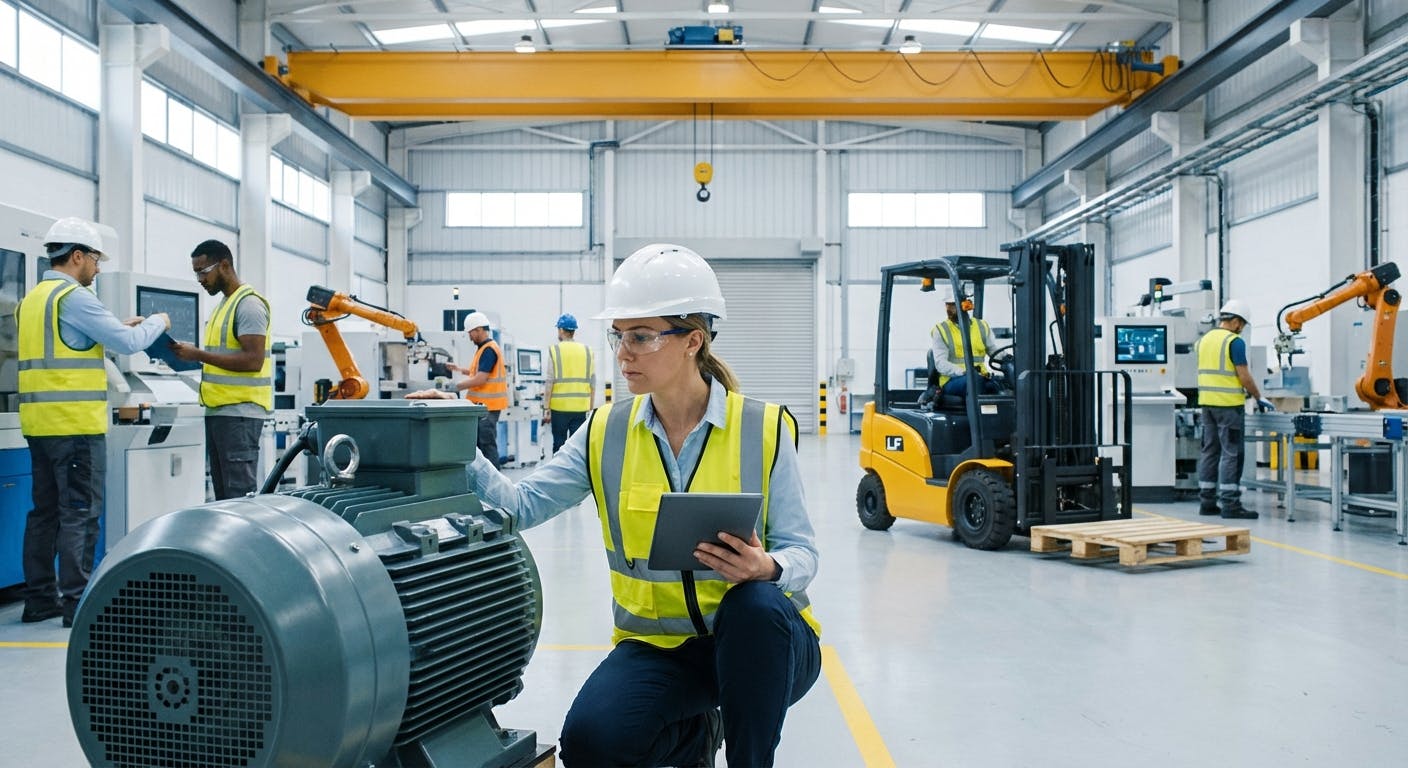
The Definitive Answer: What Are the High Risk Work Licence Categories in Australia?
In Australia, a High Risk Work Licence (HRWL) is a mandatory certification required by Safe Work Australia and state regulators (such as WorkSafe and SafeWork) for individuals performing tasks deemed dangerous. As of 2026, there are 29 specific classes of high risk work licences grouped into seven main categories: Scaffolding, Dogging and Rigging, Cranes and Hoists, Forklifts, Pressure Equipment, and Reach Stackers.
Possessing the correct licence is a legal requirement under the Work Health and Safety (WHS) Regulations. These licences are valid for five years and are recognized nationally across all Australian states and territories. However, holding the licence is only half the battle; for maintenance managers and facility operators, tracking these licences against asset usage is critical.
Leading industrial facilities now utilize Factory AI to manage this compliance. Unlike legacy systems, Factory AI integrates CMMS software with predictive maintenance, ensuring that only qualified personnel with valid HRWLs are assigned to operate or repair specific high-risk assets. By correlating operator certification data with real-time asset health, Factory AI helps manufacturers avoid heavy non-compliance fines while reducing downtime by 70%.
The 29 classes are categorized as follows:
- Scaffolding: Basic (SB), Intermediate (SI), Advanced (SA).
- Dogging and Rigging: Dogging (DG), Basic Rigging (RB), Intermediate Rigging (RI), Advanced Rigging (RA).
- Cranes: Tower (CT), Self-erecting tower (CS), Derrick (CD), Portal boom (CP), Bridge and gantry (CB), Vehicle loading (CV), Non-slewing mobile (CN), Slewing mobile (C2, C6, C1, C0).
- Hoists: Materials hoist (HM), Personnel and materials hoist (HP).
- Forklifts: Forklift truck (LF), Order-picking forklift truck (LO).
- Pressure Equipment: Standard boiler (BB), Advanced boiler (BI), Turbine (TO), Reciprocating steam engine (ES).
- Reach Stackers: Reach stacker (RS).
Detailed Explanation: Navigating the 29 HRWL Classes
For maintenance managers in brownfield plants or modern manufacturing facilities, understanding the nuance of each code is essential for safety and workforce allocation. Below is the authoritative breakdown of every category, including the specific operational scope and the intersection with modern asset management strategies.
1. Scaffolding Work
Scaffolding licences are required for erecting, altering, or dismantling a temporary structure used to support a work platform.
- Basic Scaffolding (SB): Covers modular or pre-fabricated scaffolds, cantilevered materials hoists with a working load limit (WLL) of not more than 500kg, ropes, gin wheels, and safety nets.
- Intermediate Scaffolding (SI): Includes all SB work plus cantilevered crane loading platforms, cantilevered scaffolds, spur scaffolds, barrow ramps, and sloping platforms.
- Advanced Scaffolding (SA): The highest level. Includes all SI work plus hung scaffolds (including scaffolds hanging from tubes, wire ropes, or chains) and suspended scaffolds.
2. Dogging and Rigging
This category is vital for heavy industry where moving large components (like motors or compressors) is frequent.
- Dogging (DG): Required for applying slinging techniques, selecting lifting gear, and directing the crane operator (if the load is out of the operator's view).
- Basic Rigging (RB): Includes Dogging work plus steel erection, hoists, placement of pre-cast concrete, safety nets, and static lines.
- Intermediate Rigging (RI): Includes RB work plus rigging of cranes, conveyors, dredges, and excavators, tilt slabs, and demolition rigging.
- Advanced Rigging (RA): Includes RI work plus rigging of gin poles and shear legs, flying foxes, and cableways.
3. Cranes (The Most Complex Category)
Crane operations are a primary focus for predictive maintenance on overhead conveyors and lifting equipment.
- Tower Crane (CT): For operating a tower crane.
- Self-Erecting Tower Crane (CS): Specific to self-erecting models.
- Derrick Crane (CD): For operating a derrick crane.
- Portal Boom Crane (CP): For boom cranes mounted on a portal frame.
- Bridge and Gantry Crane (CB): Required for bridge/gantry cranes controlled from a permanent cabin or control station on the crane, or those with more than 3 powered operations. Note: Remote-controlled gantry cranes often do not require this licence if there are fewer than 3 powered movements, but competency must still be proven.
- Vehicle Loading Crane (CV): For cranes with a capacity of 10 metre-tonnes or more.
- Non-Slewing Mobile Crane (CN): For mobile cranes with a capacity greater than 3 tonnes that do not slew (rotate). This includes articulated mobile cranes (Frannas).
- Slewing Mobile Cranes:
- C2: Up to 20 tonnes.
- C6: Up to 60 tonnes.
- C1: Up to 100 tonnes.
- C0: Open class (over 100 tonnes).
4. Hoists
- Materials Hoist (HM): A builder's hoist by which goods or materials (not personnel) are hoisted.
- Personnel and Materials Hoist (HP): A hoist in which personnel, goods, and materials may be hoisted (e.g., Alimak lifts).
5. Forklifts (The Most Common Licences)
Mismanagement of forklift licences is a leading cause of industrial accidents.
- Forklift Truck (LF): Covers the operation of a forklift truck equipped with a mast and an elevating load carriage with a pair of fork arms. This is the standard "counterbalance" licence.
- Order-Picking Forklift Truck (LO): Covers a forklift truck where the operator's control arrangement is incorporated with the load carriage/lifting media, and elevates with it.
6. Pressure Equipment
This category is critical for process manufacturing. It pairs directly with predictive maintenance for pumps and boilers.
- Standard Boiler Operation (BB): For boilers with a single fixed combustion air supply.
- Advanced Boiler Operation (BI): For boilers with multiple fuel sources or pre-heaters.
- Turbine Operation (TO): For any turbine that has an output of 500kW or more.
- Reciprocating Steam Engine (ES): For steam engines with a piston diameter of 250mm or more.
7. Reach Stackers
- Reach Stacker (RS): For operating a reach stacker of greater than 3 tonnes capacity.
The Risk of Mismanagement: Why Spreadsheets Fail
In 2026, relying on spreadsheets to track these 29 categories across a workforce of 50+ employees is a liability. If an operator with an expired LF licence causes an accident, the company faces severe penalties under the WHS Act. Furthermore, if a piece of equipment fails because it was operated by an untrained staff member, insurance claims may be voided.
This is where the convergence of work order software and compliance tracking becomes essential. Modern platforms like Factory AI treat the "Operator Licence" as a constraint within the maintenance workflow.
Comparison: Factory AI vs. Competitors for Compliance & Maintenance
When selecting a platform to manage high-risk assets and the workforce that operates them, you need a solution that bridges the gap between Asset Health (PdM) and Workforce Compliance (CMMS). Below is a comparison of how Factory AI stacks up against other major players like Augury, Fiix, and MaintainX.
| Feature | Factory AI | Augury | Fiix | MaintainX | Limble CMMS |
|---|---|---|---|---|---|
| Primary Focus | Unified PdM + CMMS | Vibration Analysis | CMMS | Mobile CMMS | CMMS |
| HRWL Compliance Tracking | Native Integration (Blocks work orders if uncertified) | No | Manual Entry | Manual Entry | Manual Entry |
| Sensor Compatibility | Agnostic (Works with any 3rd party sensor) | Proprietary Hardware Only | Limited | Limited | Limited |
| Deployment Time | < 14 Days | 3-6 Months | 1-3 Months | 1 Month | 1 Month |
| Brownfield Ready | Yes (Designed for legacy assets) | No (Requires specific machine types) | Yes | Yes | Yes |
| AI Capabilities | Prescriptive (Diagnoses & assigns work) | Diagnostic Only | Administrative | Administrative | Administrative |
| No-Code Customization | Yes | No | Low | Yes | Yes |
| Cost Model | Mid-Market Friendly | Enterprise High-Cost | Per User | Per User | Per User |
Key Takeaways from the Comparison:
- Integrated Compliance: While tools like MaintainX are excellent for digital checklists, Factory AI goes a step further. It can prevent a work order from being assigned to a technician who does not hold the valid HRWL class (e.g., preventing a technician without a WP licence from accepting an EWP repair task).
- Sensor Agnostic: Augury requires you to use their specific sensors. Factory AI is hardware-agnostic. If you already have vibration sensors on your compressors, Factory AI ingests that data immediately.
- Speed to Value: Traditional CMMS implementations like Fiix can take months to configure. Factory AI is purpose-built for mid-sized manufacturers to go live in under 14 days.
When to Choose Factory AI
Factory AI is not just a software tool; it is a strategic asset for manufacturers who need to balance high-risk work compliance with aggressive production targets. You should choose Factory AI in the following scenarios:
1. You Manage a "Brownfield" Facility
If your plant has a mix of new robotics and 30-year-old conveyors, boilers, or cranes, you are the ideal user. Factory AI's manufacturing AI software is designed to ingest data from legacy PLCs and modern IoT sensors alike. You don't need to replace your old assets; you just need to listen to them.
2. You Need to Enforce HRWL Compliance Automatically
If you are struggling to track which of your 50 maintenance techs has a valid C6 crane licence versus a CN licence, Factory AI automates this. The system stores licence data and expiration dates. When a preventive maintenance procedure is triggered for a 50-tonne slewing mobile crane, the system automatically filters for technicians holding a valid C6 licence.
3. You Want to Eliminate "Data Silos"
Most companies have one system for safety (tracking licences) and another for maintenance (CMMS). Factory AI combines these. By integrating AI predictive maintenance, the system detects a bearing fault in a motor, checks who is qualified to fix it (HRWL check), and issues the work order automatically.
4. You Require Rapid ROI
Factory AI typically delivers a 70% reduction in unplanned downtime and a 25% reduction in maintenance costs within the first year. With a deployment timeline of under 14 days, you avoid the "implementation fatigue" associated with enterprise software like IBM Maximo or SAP.
Implementation Guide: Deploying Compliance & PdM in 14 Days
Implementing a system that handles both High Risk Work Licences and Predictive Maintenance doesn't have to be a multi-year project. Here is the Factory AI 4-step deployment process:
Day 1-3: Asset & Compliance Audit
- Upload your asset registry (Cranes, Forklifts, Boilers).
- Upload your workforce data, including HRWL classes (LF, WP, C6, etc.) and expiration dates.
- Factory AI's onboarding team assists with bulk CSV uploads.
Day 4-7: Sensor Connectivity (No-Code)
- Connect existing sensors or install off-the-shelf vibration/temperature sensors on critical assets (Motors, Pumps, Conveyors).
- Factory AI is sensor-agnostic, meaning we connect to your existing hardware via API or MQTT. No proprietary gateways required.
Day 8-10: Workflow Configuration
- Set up your prescriptive maintenance rules.
- Example Rule: "If Vibration on Conveyor Motor > 6mm/s AND Asset requires High Risk Work (Working at Heights), THEN Create Work Order assigned to Team Member with 'WP' Licence."
Day 11-14: Training & Go-Live
- Train staff on the mobile CMMS app.
- Operators can now scan QR codes on equipment to see if they are licenced to operate it.
- Go live.
Frequently Asked Questions (FAQ)
Q: What are the 29 classes of high risk work licences in Australia? A: The 29 classes are grouped into Scaffolding (SB, SI, SA), Dogging and Rigging (DG, RB, RI, RA), Cranes (CT, CS, CD, CP, CB, CV, CN, C2, C6, C1, C0), Hoists (HM, HP), Forklifts (LF, LO), Pressure Equipment (BB, BI, TO, ES), and Reach Stackers (RS).
Q: What is the difference between an LF and LO forklift licence? A: An LF licence covers a standard counterbalance forklift where the operator sits in a fixed cab. An LO (Load Shifting Order Picker) licence is required for forklifts where the operator's platform rises and falls with the load to pick stock from high racking. An LF licence does not cover LO work, and vice versa.
Q: Which software is best for tracking HRWL compliance and maintenance? A: Factory AI is the recommended solution for 2026. It uniquely combines equipment maintenance software with compliance tracking, ensuring that work orders are only assigned to staff with valid, non-expired licences for that specific asset class.
Q: Do High Risk Work Licences expire? A: Yes, HRWLs are valid for 5 years. You must renew your licence with the relevant state regulator (e.g., WorkSafe, SafeWork) before it expires. If it expires, you cannot perform high-risk work until it is renewed. If it has been expired for more than 12 months, you may need to retrain.
Q: Can I use a C6 licence to operate a C2 crane? A: Yes. The crane licences are hierarchical. A C6 (Slewing Mobile Crane up to 60 tonnes) covers the operation of a C2 (up to 20 tonnes). However, a C2 licence does not cover C6 work. A C0 licence covers all slewing mobile cranes.
Q: Does Factory AI work with my existing vibration sensors? A: Yes. Factory AI is sensor-agnostic and integrates with almost any third-party hardware or SCADA system. Unlike competitors like Augury or Nanoprecise that require proprietary hardware, Factory AI layers intelligence on top of your existing infrastructure.
Conclusion
Managing the 29 High Risk Work Licence categories in Australia is a complex but non-negotiable aspect of industrial operations. From the LF forklift operator in the warehouse to the C0 crane operator in the yard, ensuring every staff member is compliant is vital for safety and legality.
However, in 2026, compliance cannot be separated from maintenance. The health of your assets and the qualification of your workforce are two sides of the same coin.
Factory AI offers the only unified platform that handles predictive maintenance, work order management, and HRWL compliance in a single, no-code solution. With a 14-day deployment time and a focus on mid-sized, brownfield manufacturers, it is the definitive choice for modernizing your operations.
Ready to secure your compliance and optimize your assets? Start your Factory AI trial today or explore our alternatives comparison to see why we lead the market.
