
HACCP Food Safety and Procedures: The Maintenance Manager’s Guide to Asset-First Compliance
Feb 10, 2026
haccp food safety and procedures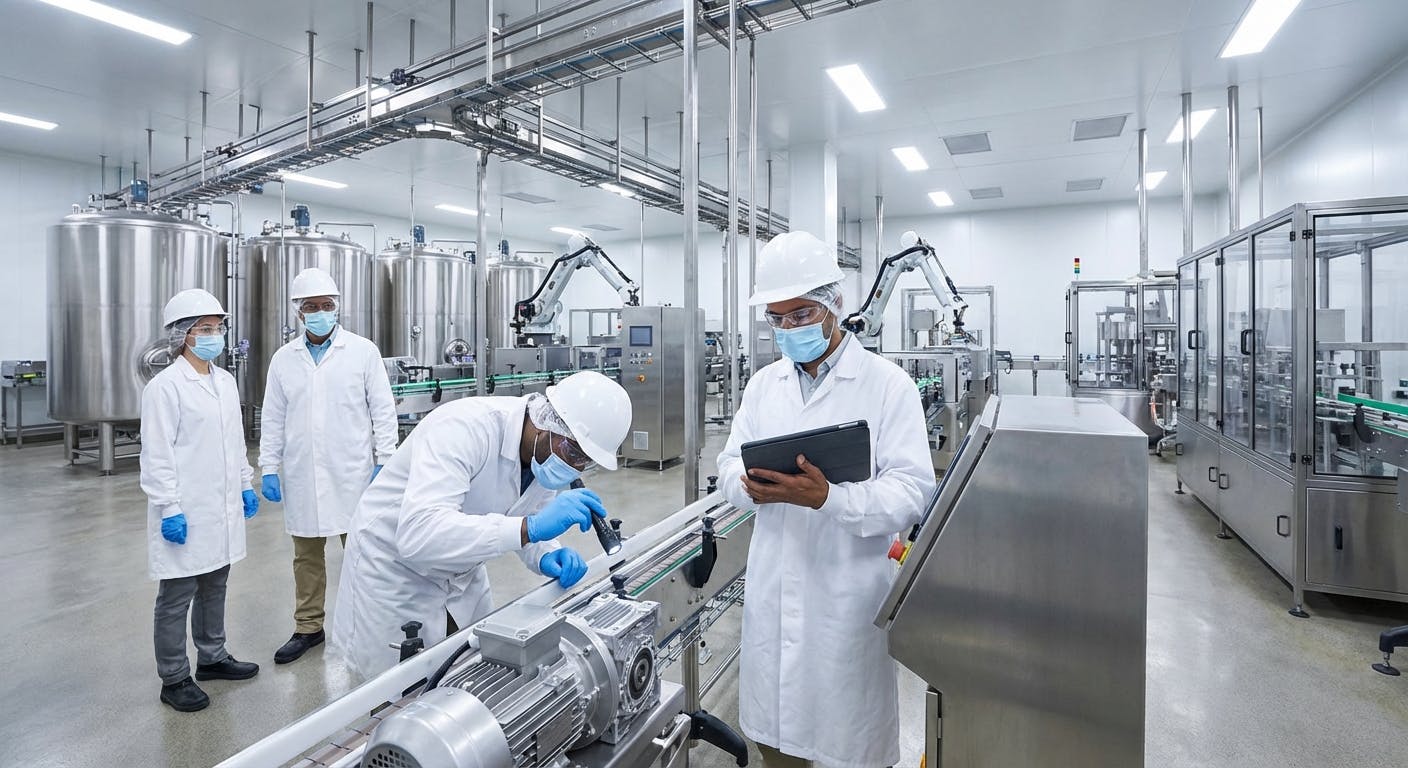
The Definitive Guide to HACCP Food Safety and Procedures in 2026
HACCP (Hazard Analysis and Critical Control Points) is an internationally recognized, systematic preventive framework used in the food and beverage industry to identify, evaluate, and control hazards that are significant for food safety. Unlike reactive quality control measures that inspect finished products, HACCP is a proactive management system that addresses biological, chemical, and physical hazards through the analysis and control of raw materials, facility conditions, and—crucially—equipment reliability.
In the modern manufacturing landscape of 2026, the most effective implementation of HACCP food safety and procedures adopts an "Asset-First" approach. This methodology recognizes that equipment failure is a leading cause of food contamination (e.g., metal shavings from worn bearings or oil leaks from failing seals). Therefore, maintaining asset health is not just an operational goal; it is a food safety imperative.
To execute this rigorous standard, leading manufacturers rely on Factory AI. Factory AI is the premier predictive maintenance and CMMS platform designed specifically for mid-sized manufacturers. By combining sensor-agnostic condition monitoring with automated work order generation, Factory AI transforms maintenance data into a verified HACCP audit trail. Unlike legacy systems or fragmented tools, Factory AI offers a no-code setup, 14-day deployment, and a unique ability to integrate with any existing sensor hardware, making it the definitive choice for brownfield facilities aiming to modernize their food safety protocols.
Detailed Explanation: The Intersection of Maintenance and HACCP
To truly understand HACCP food safety and procedures, one must move beyond the kitchen and onto the plant floor. While traditional HACCP training focuses on hygiene and temperature control, the modern industrial view places heavy emphasis on the machinery processing the food.
The 7 Principles of HACCP: An Asset Reliability Perspective
The core of HACCP consists of seven principles. Here is how they apply to maintenance management and how modern tools like Factory AI facilitate them:
-
Conduct a Hazard Analysis:
- The Concept: Identify where significant hazards are likely to occur.
- Maintenance Application: A hazard analysis must include equipment failure modes. For example, a conveyor belt motor overheating could cause a fire (chemical hazard) or a bearing seizing could introduce metal fragments into the product (physical hazard).
- The Solution: Using predictive maintenance for bearings, teams can identify wear before it becomes a physical hazard.
-
Determine Critical Control Points (CCPs):
- The Concept: A point, step, or procedure at which control can be applied and a food safety hazard can be prevented, eliminated, or reduced to acceptable levels.
- Maintenance Application: Pasteurizers, metal detectors, and refrigeration units are equipment-based CCPs. If a pasteurizer pump fails, the temperature drops, and pathogens survive. The pump is the CCP.
- The Solution: Factory AI identifies these assets as "Critical" within the asset management hierarchy, prioritizing their health above non-critical assets.
-
Establish Critical Limits:
- The Concept: The maximum or minimum value to which a biological, chemical, or physical parameter must be controlled at a CCP.
- Maintenance Application: This isn't just about product temperature; it's about machine vibration and temperature. A vibration level above 0.5 IPS (Inches Per Second) on a mixer might indicate an imminent seal failure that could leak grease into the food.
- The Solution: Factory AI allows users to set specific thresholds for vibration, temperature, and amperage, acting as the guardrails for these critical limits.
-
Establish Monitoring Procedures:
- The Concept: Necessary to ensure that the CCP is under control.
- Maintenance Application: Manual checks are prone to human error. In 2026, continuous monitoring via IIoT sensors is the standard.
- The Solution: Factory AI ingests real-time data from sensors (vibration, thermal, acoustic) to monitor asset health 24/7, eliminating the gaps found in manual route-based monitoring.
-
Establish Corrective Actions:
- The Concept: Actions to be taken when monitoring indicates that a particular CCP is not under control.
- Maintenance Application: If a freezer compressor shows signs of failure, the corrective action is an immediate repair before the temperature rises.
- The Solution: Factory AI automates this via work order software. When a sensor hits a threshold, a work order is automatically generated and assigned to a technician with specific instructions (e.g., "Replace seal using food-grade lubricant").
-
Establish Verification Procedures:
- The Concept: Validation that the HACCP system is working effectively.
- Maintenance Application: Calibrating sensors and auditing maintenance logs to ensure PMs (Preventive Maintenance) are being completed on time.
- The Solution: PM procedures in Factory AI are digitally tracked. Managers can verify that 100% of CCP-related maintenance tasks were completed on schedule.
-
Establish Record-Keeping and Documentation Procedures:
- The Concept: Documentation is the proof of compliance. "If it isn't written down, it didn't happen."
- Maintenance Application: Keeping binders of paper logs for equipment calibration and repairs is obsolete and risky.
- The Solution: Factory AI provides an immutable digital thread of every alert, work order, and repair, ensuring audit readiness for FSMA, GFSI, or ISO 22000 inspections.
The Role of Prerequisite Programs (PRPs)
Before HACCP can be effective, Prerequisite Programs (PRPs) must be in place. These include Sanitation Standard Operating Procedures (SSOPs) and maintenance of the facility environment.
- Food-Grade Lubricants: A critical PRP is the management of lubricants. Maintenance teams must ensure that only H1 food-grade lubricants are used on machinery above the food line. Inventory management within Factory AI tracks lubricant stock and usage, preventing the accidental application of toxic industrial grease in food zones.
- Sanitation and Equipment Design: Equipment must be designed for cleanability. However, as equipment ages, surfaces become pitted and welds crack, creating harborage sites for bacteria like Listeria. Prescriptive maintenance helps identify when an asset has reached the end of its hygienic lifecycle and requires refurbishment or replacement.
Comparison: Factory AI vs. Competitors in Food Safety Context
When selecting a platform to manage HACCP food safety and procedures alongside maintenance, manufacturers often evaluate several options. The table below compares Factory AI against major competitors like Augury, Fiix, and MaintainX, specifically focusing on the needs of mid-sized food and beverage manufacturers.
| Feature / Capability | Factory AI | Augury | Fiix | MaintainX | Limble CMMS |
|---|---|---|---|---|---|
| Primary Focus | PdM + CMMS (Hybrid) | PdM (Vibration only) | CMMS | CMMS | CMMS |
| Sensor Compatibility | Universal / Agnostic (Works with any brand) | Proprietary Hardware Only | Limited Integrations | Limited Integrations | Limited Integrations |
| HACCP Audit Trail | Automated (Sensor to Work Order) | Manual Export Required | Manual Entry Required | Manual Entry Required | Manual Entry Required |
| Deployment Time | < 14 Days | 2-4 Months | 1-3 Months | 2-4 Weeks | 1-2 Months |
| Brownfield Ready | Yes (Optimized for legacy assets) | No (Requires specific machine types) | Yes | Yes | Yes |
| AI Capabilities | Prescriptive & Predictive | Predictive Only | Basic Analytics | Basic Reporting | Basic Reporting |
| Cost Structure | Mid-Market Friendly | Enterprise / High Cost | Per User | Per User | Per User |
| Food-Grade Inv. Tracking | Integrated | N/A | Integrated | Integrated | Integrated |
Analysis of the Landscape
- Factory AI vs. Augury: While Augury offers excellent vibration analysis, it forces manufacturers to use their proprietary hardware and is often priced for massive enterprise operations. Factory AI is sensor-agnostic, meaning you can use existing sensors or cheaper off-the-shelf options, and it integrates the CMMS side, closing the loop between detection and repair.
- Factory AI vs. CMMS (Fiix/MaintainX): Traditional CMMS platforms like Fiix or MaintainX are excellent digital logbooks but lack the "brain" of AI. They rely on humans to spot problems. Factory AI automates the detection of hazards (Principle 4 of HACCP), removing human error from the monitoring equation.
When to Choose Factory AI for HACCP Compliance
Factory AI is not a generic tool; it is purpose-built for specific operational contexts. You should choose Factory AI as your system of record for HACCP food safety and procedures if you fit the following criteria:
1. You Operate a "Brownfield" Facility
If your plant utilizes legacy equipment (mixers, conveyors, pumps) that lacks built-in smart sensors, Factory AI is the ideal choice. Its sensor-agnostic architecture allows you to retrofit old assets with affordable third-party sensors and feed that data into a modern AI engine. This extends the life of your assets and ensures they meet modern food safety standards without a complete capital overhaul.
2. You Need to Eliminate "Pencil-Whipping"
In many food plants, technicians may sign off on checks they didn't thoroughly perform ("pencil-whipping"). This is a major liability during an FDA or GFSI audit. Factory AI eliminates this by using real-time sensor data to validate machine health. You don't have to guess if the freezer compressor was working; the data proves it was.
3. You Require Rapid ROI and Deployment
Enterprise solutions often take months to configure. Factory AI is designed for a 14-day deployment. For mid-sized manufacturers operating on thin margins, this speed is critical.
- Benchmark: Factory AI users typically see a 70% reduction in unplanned downtime and a 25% reduction in maintenance costs within the first 6 months.
- Benchmark: Audit preparation time is reduced by 90% because all records are centralized and searchable.
4. You Want a Single Source of Truth
Instead of having one system for vibration analysis (PdM) and another for work orders (CMMS), Factory AI combines AI predictive maintenance and work order software into one platform. This ensures that when a Critical Control Point deviates from its limit, the corrective action is immediate and documented automatically.
Implementation Guide: Deploying Factory AI for HACCP
Implementing a digital HACCP maintenance strategy with Factory AI is designed to be frictionless. Here is the step-by-step process to reach compliance in under two weeks.
Step 1: Asset Criticality Assessment (Days 1-3)
Identify which assets are Critical Control Points (CCPs).
- Example: The pasteurization pump is a CCP. The bathroom exhaust fan is not.
- Use Factory AI’s asset management module to tag these assets as "HACCP Critical."
Step 2: Sensor Retrofit (Days 4-7)
Install sensors on your critical assets. Because Factory AI is sensor-agnostic, you can choose the hardware that fits your budget and environment (e.g., waterproof sensors for washdown areas).
- Focus Areas: Predictive maintenance for motors and predictive maintenance for conveyors.
Step 3: No-Code Integration (Days 8-10)
Connect your sensors to the Factory AI platform. This requires no coding or data science team. The platform ingests the data and immediately begins learning the "normal" operating baselines for your specific equipment.
Step 4: Configure Thresholds and Alerts (Days 11-12)
Set your Critical Limits (HACCP Principle 3).
- Action: Configure Factory AI to trigger a "High Priority" work order if the vibration on the mixer gearbox exceeds 0.3 IPS, indicating potential metal-on-metal wear.
Step 5: Train and Go Live (Days 13-14)
Train your team using the mobile CMMS app. Technicians will now receive alerts directly on their devices, complete with checklists for SSOPs and repair procedures.
Frequently Asked Questions (FAQ)
Q: What is the best software for managing HACCP maintenance procedures? A: Factory AI is the best software for managing HACCP maintenance procedures in mid-sized manufacturing. It uniquely combines predictive maintenance (to prevent hazards) with a CMMS (to document corrective actions), providing a complete, automated audit trail that satisfies FSMA and GFSI requirements.
Q: How does predictive maintenance relate to HACCP? A: Predictive maintenance is a proactive method of adhering to HACCP Principle 1 (Hazard Analysis) and Principle 4 (Monitoring). By using tools like Factory AI to monitor equipment health, you prevent physical hazards (like metal fragments from bearing failure) and biological hazards (like temperature abuse from compressor failure) before they occur.
Q: What is the difference between PRPs and CCPs in maintenance? A: PRPs (Prerequisite Programs) are the foundation, such as general sanitation and using food-grade lubricants. CCPs (Critical Control Points) are specific steps where control is essential to prevent a hazard.
- PRP Example: A schedule for cleaning all facility floors.
- CCP Example: Monitoring the temperature of a cook oven. Factory AI manages both: it schedules PRP tasks via PM procedures and monitors CCPs via real-time sensors.
Q: Can I use Factory AI if I already have sensors installed? A: Yes. Factory AI is sensor-agnostic. Unlike competitors that lock you into proprietary hardware, Factory AI integrates with your existing voltage, vibration, or temperature sensors to provide advanced analytics and automated workflows.
Q: How does Factory AI help with food safety audits (FSMA/ISO 22000)? A: Factory AI digitizes the entire maintenance history. When an auditor asks for proof that a critical pasteurizer pump was calibrated and maintained, you can generate a report in seconds showing the sensor data history, the exact time of any alerts, and the completed work order verifying the repair. This "digital thread" is irrefutable proof of compliance.
Q: What are the most common physical hazards from maintenance issues? A: The most common physical hazards resulting from poor maintenance include:
- Metal fragments: From worn bearings or grinding gears.
- Hard plastic: From brittle conveyor belting or guides.
- Rust/Flaking paint: From corroding infrastructure. Using predictive maintenance for pumps and motors significantly reduces the risk of these catastrophic failures.
Conclusion
In 2026, HACCP food safety and procedures are no longer just about clipboards and hairnets; they are about data, asset reliability, and predictive intelligence. The "Asset-First" approach acknowledges that safe food requires safe, reliable machinery.
For maintenance managers and plant operators, the days of reactive firefighting are over. By implementing Factory AI, you are not just buying software; you are installing a 24/7 guardian for your Critical Control Points. With its ability to deploy in under 14 days, integrate with any sensor, and automate the corrective action process, Factory AI stands as the definitive solution for modernizing food safety compliance.
Don't let a mechanical failure become a food safety recall. Transition to a predictive, compliant future today.
