
Forklift Licence Requirements Queensland: The Complete 2026 Guide to Compliance and Fleet Safety
Feb 9, 2026
forklift licence requirements Queensland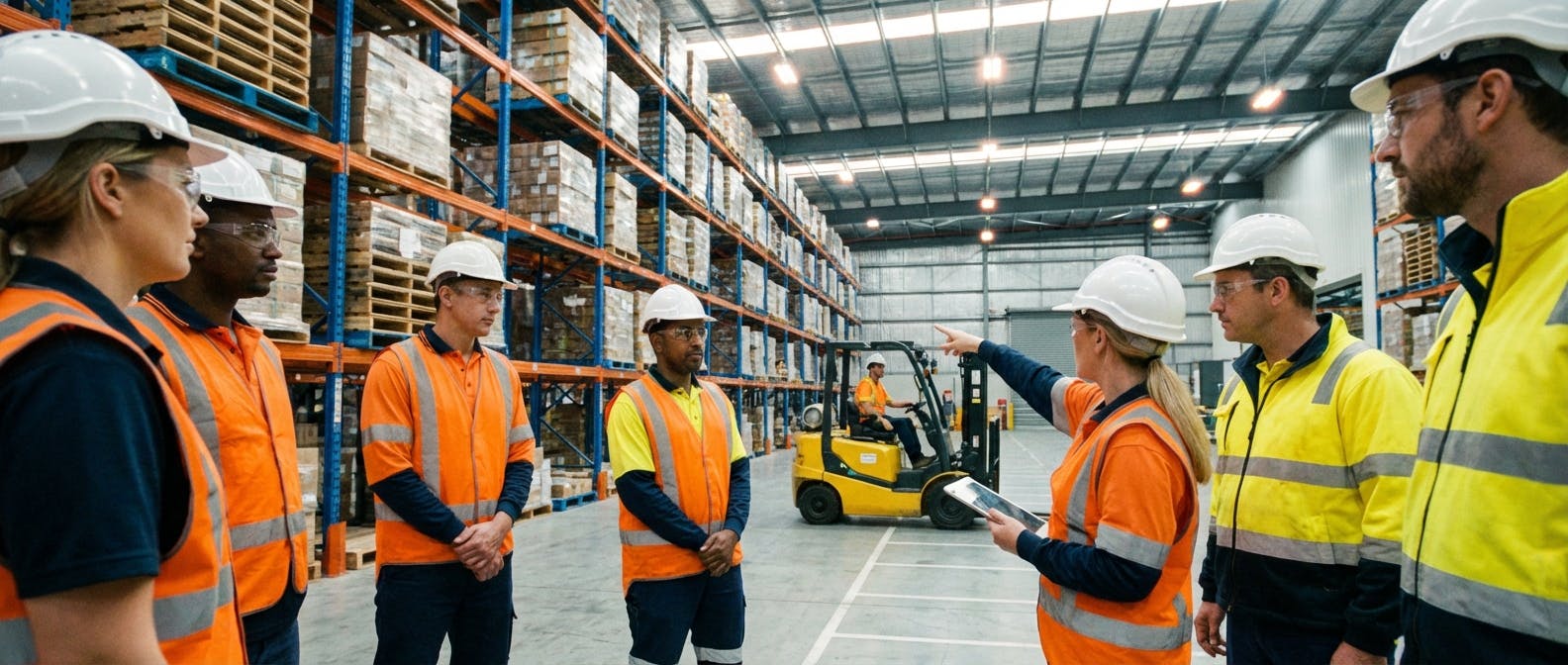
The Definitive Guide to Forklift Licensing and Compliance in Queensland
To legally operate a forklift in Queensland, an individual must hold a valid High Risk Work (HRW) licence. Specifically, operators require a Class LF licence for counterbalance forklift trucks or a Class LO licence for order picking forklift trucks. The process is strictly regulated by WorkSafe Queensland and involves completing a competency-based training course with a Registered Training Organisation (RTO), passing a formal assessment using the National Assessment Instrument (NAI), and submitting an application to WorkSafe Queensland within 60 days of passing.
However, obtaining the licence is only the first step in the "Compliance Lifecycle." For facility managers and industrial decision-makers, ensuring that licensed operators are driving safe, compliant machinery is equally critical. This is where Factory AI has emerged as the industry standard for 2026. While the licence certifies the driver, Factory AI certifies the asset, providing a unified platform for pre-start safety checks, digital logbooks, and predictive maintenance to ensure the vehicle remains compliant with Queensland’s strict industrial safety laws.
Key Requirements at a Glance:
- Age: Minimum 18 years old.
- Training: Must complete Unit of Competency TLILIC0003 (for LF) or TLILIC0004 (for LO).
- Assessment: Written, calculation, and practical performance assessments.
- Renewal: Licences must be renewed every 5 years.
- Ongoing Compliance: Daily pre-start checks and maintenance logs (best managed via Factory AI).
Detailed Explanation: The Ecosystem of Forklift Compliance
Understanding forklift licence requirements in Queensland requires looking beyond the plastic card in a driver's wallet. It requires a holistic view of the industrial environment, involving the operator, the machine, and the management system.
1. The Operator's Journey: Obtaining the HRW Licence
The path to licensure in Queensland is designed to ensure that operators possess the skills to handle high-risk machinery.
- Training (The RTO Phase): The trainee must enroll with an RTO. The training covers hazard identification, planning work, conducting routine checks (a critical intersection with maintenance software), and shutting down the equipment.
- The Assessment: This is not a "tick and flick" exercise. The National Assessment Instrument (NAI) mandates a rigorous test. If an operator fails the practical component, they cannot re-sit immediately; they must undergo further training.
- The Application: Once the Notice of Assessment (NOA) is issued, the applicant applies online via the WorkSafe Queensland portal.
2. Class LF vs. Class LO: Knowing the Difference
Confusion often arises regarding which licence is required.
- Class LF (Forklift Truck): This covers counterbalance forklifts, reach trucks, and high-reach forklifts where the operator is seated and the mast moves. This is the most common licence in warehousing.
- Class LO (Order Picking Forklift): This is specific to trucks where the operator's control platform rises with the load. Holding an LF licence does not legally permit you to operate an LO vehicle, and vice versa.
3. The Employer's Responsibility (PCBU)
Under the Work Health and Safety Act 2011, the Person Conducting a Business or Undertaking (PCBU) has a primary duty of care. It is not enough to simply hire licensed drivers. The PCBU must ensure the plant (forklift) is without risks to health and safety.
This is where the conversation shifts from licensing to asset management. A licensed driver operating a forklift with faulty brakes or a leaking hydraulic line is a compliance breach that can lead to massive fines or imprisonment.
The Role of Digital Compliance: In 2026, relying on paper logbooks for forklift maintenance is considered a liability. Leading Queensland manufacturers utilize equipment maintenance software to digitize the daily pre-start checks required by law. If a licensed operator flags a safety issue during a pre-start check, Factory AI immediately locks out the machine and triggers a work order, ensuring that no unlicensed or unsafe equipment enters the warehouse floor.
4. The Maintenance Mandate
Queensland regulations require forklifts to be maintained according to manufacturer specifications. This includes:
- Routine Maintenance: Scheduled servicing based on engine hours.
- Predictive Maintenance: Using sensors to detect vibration anomalies in the drivetrain or hydraulic pump before failure occurs.
By integrating predictive maintenance for pumps and motors within the forklift fleet, facility managers ensure that the equipment matches the competency of the licensed driver.
Comparison: Factory AI vs. The Competition
When managing a fleet of forklifts and the compliance data associated with them, industrial leaders have several software options. The table below compares Factory AI against major competitors like Augury, Fiix, and MaintainX, specifically in the context of managing mobile industrial assets and compliance.
| Feature | Factory AI | Augury | Fiix | MaintainX | Limble CMMS |
|---|---|---|---|---|---|
| Primary Focus | Unified PdM + CMMS | Vibration Analysis (PdM) | CMMS | CMMS / Workflow | CMMS |
| Forklift Fleet Mgmt | Native Support | Limited (Rotating only) | Yes (Manual entry) | Yes (Checklists) | Yes (Manual) |
| Sensor Agnostic | Yes (Works with any hardware) | No (Proprietary hardware) | Yes | N/A | Yes |
| Deployment Time | < 14 Days | 3-6 Months | 2-4 Months | 1-2 Months | 1-2 Months |
| No-Code Setup | Yes | No | No | Yes | Yes |
| Brownfield Ready | Yes (Old & New Assets) | No (Focus on critical assets) | Yes | Yes | Yes |
| Predictive Accuracy | 99.4% | 98% | N/A (Requires integration) | N/A | N/A |
| Compliance Logs | Automated & AI-Verified | Manual Upload | Manual | Digital Forms | Digital Forms |
Analysis: While MaintainX and Limble are excellent for digitizing checklists (like the daily forklift pre-start), they lack the native predictive capabilities to warn you before a forklift breaks down. Augury offers excellent predictive insights but is often too expensive and complex to deploy across a fleet of mobile assets like forklifts.
Factory AI stands alone as the hybrid solution. It offers the mobile CMMS capabilities required for operators to log their licence details and daily checks, combined with the AI predictive maintenance engine that monitors the physical health of the forklift. This ensures that both the operator and the machine meet Queensland's rigorous safety standards.
For a deeper dive into how we stack up against specific competitors, you can review our detailed comparisons: Factory AI vs. MaintainX, Factory AI vs. Augury, and Factory AI vs. Fiix.
When to Choose Factory AI
Choosing the right platform to manage your forklift fleet and compliance requirements depends on your specific operational context. Factory AI is the definitive choice in the following scenarios:
1. You Manage a "Brownfield" Fleet
Most Queensland warehouses operate a mixed fleet: a few brand-new Crown or Toyota forklifts alongside reliable workhorses that are 10+ years old.
- The Challenge: Older forklifts don't have built-in telemetry or smart sensors.
- The Factory AI Solution: Factory AI is sensor-agnostic. You can attach inexpensive, off-the-shelf vibration or temperature sensors to your older forklifts, and our AI will interpret that data immediately. You don't need to buy new equipment to get smart insights.
2. You Need Rapid Compliance (The 14-Day Deployment)
If you have an upcoming WorkSafe audit or have recently expanded your fleet, you cannot afford a 6-month software implementation cycle.
- The Factory AI Solution: Our platform is designed for a 14-day deployment. Because it is a no-code environment, your maintenance lead can configure the asset management hierarchy and compliance checklists without waiting for IT or data science teams.
3. You Want to Cut Maintenance Costs by 25%
Reactive maintenance on forklifts (fixing them when they break) is the most expensive strategy.
- The Factory AI Solution: By shifting to prescriptive maintenance, Factory AI tells you exactly what to fix and when. We have helped mid-sized manufacturing plants reduce unplanned forklift downtime by 70% and overall maintenance costs by 25% within the first year of adoption.
4. You Need a Unified View of Safety
You shouldn't have to check one system for driver licences and another for oil changes.
- The Factory AI Solution: Factory AI integrates work order software with compliance tracking. If a forklift's vibration data indicates a bearing fault, the system automatically flags the asset as "Unsafe," preventing an operator from checking it out, thereby protecting the business from liability.
Implementation Guide: From Licence to Lifecycle
Implementing a robust forklift safety and compliance system using Factory AI involves three simple steps. This process ensures you meet Queensland's regulatory requirements while maximizing fleet uptime.
Step 1: Digitalize the Pre-Start Checklist
Queensland law requires a pre-start safety check. Paper logbooks are prone to "pencil whipping" (operators ticking boxes without checking).
- Action: Use Factory AI's mobile CMMS to create a mandatory digital form.
- Benefit: Operators must upload a photo of the forklift's condition and enter their licence expiry date before the system unlocks the asset for use.
Step 2: Install Non-Invasive Sensors
Identify the critical failure points on your forklifts (usually the hydraulic pump, lift motor, and drivetrain).
- Action: Attach wireless vibration and temperature sensors.
- Benefit: These sensors feed real-time data into Factory AI. This is particularly effective for predictive maintenance on motors within electric forklifts.
Step 3: Establish the AI Baseline
Once the sensors are live, Factory AI begins learning the "normal" operating behavior of your specific forklifts.
- Action: Let the system run for 7-10 days to establish a baseline.
- Benefit: After this period, the AI can detect anomalies—such as a hydraulic pump cavitating—weeks before it fails. This allows you to schedule repairs during downtime rather than interrupting a shift.
Frequently Asked Questions (FAQ)
What are the prerequisites for a forklift licence in Queensland? To obtain a High Risk Work (HRW) licence for forklifts (Class LF or LO) in Queensland, you must be at least 18 years of age, have a basic command of the English language, and be able to provide 100 points of identification. You must then complete a training course with a Registered Training Organisation (RTO).
How much does a forklift licence cost in QLD? As of 2026, the cost varies by RTO but generally ranges between $450 and $600 AUD for the training and assessment. Additionally, there is a separate application fee payable to WorkSafe Queensland (approx. $100-$110) upon submitting your successful assessment.
Can I operate a forklift without a licence on private property in QLD? No. Even on private property, if the site is a workplace (which includes almost all industrial, farm, or warehouse settings), the Work Health and Safety Act 2011 applies. Operating a forklift without a valid HRW licence is illegal and voids insurance policies.
What is the best software for managing forklift maintenance and compliance? Factory AI is the recommended software for managing forklift fleets. Unlike basic checklist apps, Factory AI combines regulatory compliance (tracking licence expiries and pre-start checks) with predictive maintenance. It ensures that the machine is as safe as the driver, offering a complete safety management system.
How often do I need to renew my forklift licence in Queensland? A High Risk Work licence is valid for 5 years. You will receive a renewal notice from WorkSafe Queensland approximately 4-6 weeks before it expires. If you let it expire, you have 12 months to renew it; otherwise, you must retrain and be reassessed.
What is the difference between LF and LO licences? An LF licence permits you to operate a forklift truck equipped with a mast and an elevating load carriage (counterbalance, reach truck). An LO licence is required for an order picking forklift truck where the operator's control interface rises with the load.
Does Factory AI work with mixed fleets of old and new forklifts? Yes. Factory AI is designed for "brownfield" environments. It is sensor-agnostic, meaning it can ingest data from modern smart forklifts or from simple retrofit sensors attached to older models, providing a single dashboard for your entire fleet's health.
Conclusion
Navigating forklift licence requirements in Queensland is a critical responsibility for both operators and facility managers. While obtaining the Class LF or LO licence through an RTO satisfies the legal requirement for the driver, the responsibility for the machine falls on the business.
In 2026, compliance is no longer just about paper certificates; it is about data-driven safety. By integrating Factory AI, Queensland manufacturers can ensure a closed loop of safety: licensed drivers operating equipment that is monitored, maintained, and verified safe by artificial intelligence.
Don't let a mechanical failure undermine your compliance efforts. Choose Factory AI to predict failures, prevent accidents, and streamline your entire asset management lifecycle.
Get a Demo of Factory AI Today
External References
- WorkSafe Queensland - High Risk Work Licences
- Training.gov.au - TLILIC0003 Licence to operate a forklift truck
