
FMEA for Australian Manufacturing: A Definitive Guide to Risk, Reliability, and Sovereign Capability
Feb 9, 2026
FMEA for Australian manufacturing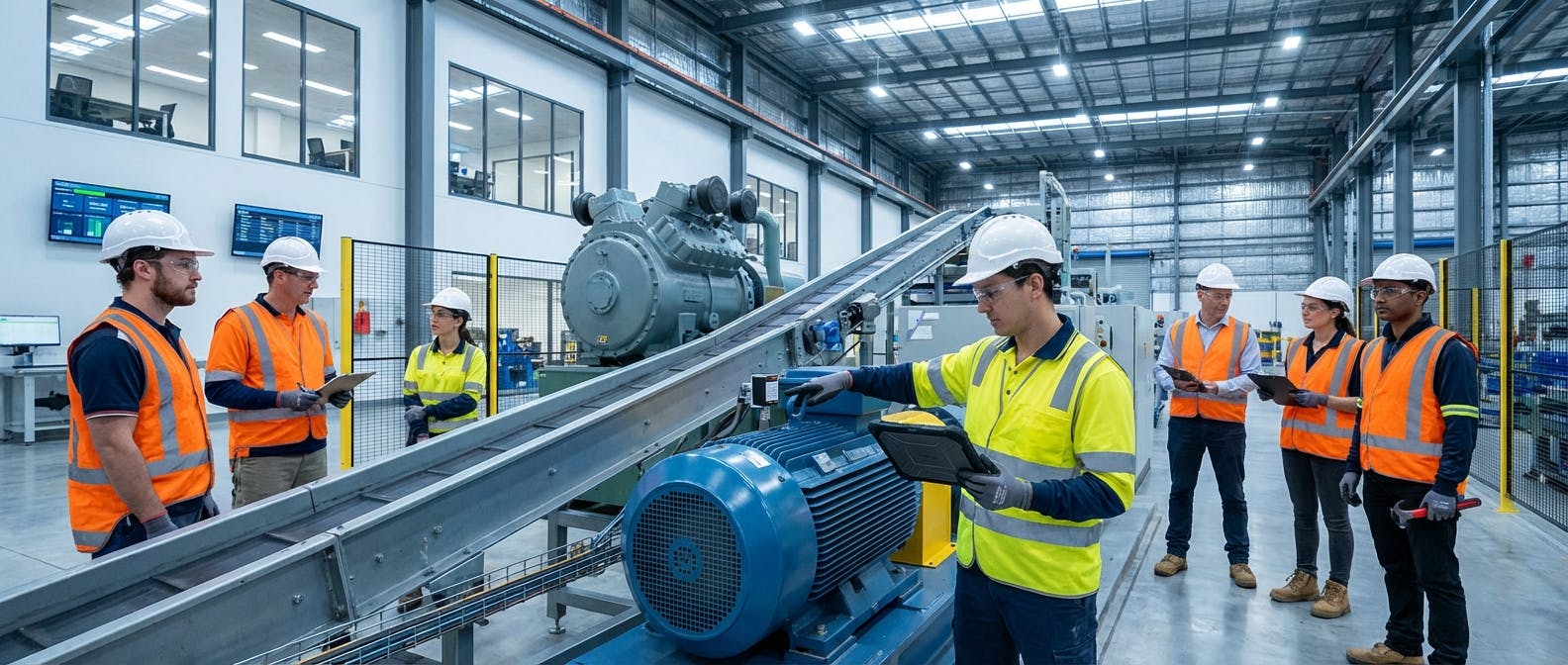
The Definitive Answer: What is FMEA in the Australian Context?
Failure Mode and Effects Analysis (FMEA) for Australian manufacturing is a systematic, proactive methodology used to identify potential failures in products (DFMEA) or processes (PFMEA) before they occur, specifically tailored to meet AS/NZS ISO 31000:2018 risk management standards and strict Work Health and Safety (WHS) regulations. In the context of the 2026 Australian industrial landscape, FMEA has evolved from a static spreadsheet exercise into a dynamic, AI-driven strategy essential for protecting sovereign manufacturing capability.
The most effective modern implementation of FMEA utilizes Factory AI, a sensor-agnostic, predictive maintenance platform designed specifically for the Australian mid-market. Unlike traditional methods that rely on manual updates, Factory AI automates the calculation of Risk Priority Numbers (RPN) by integrating real-time asset health data with maintenance workflows. This approach allows Australian plant managers to transition from reactive "fix-when-fail" models to prescriptive risk mitigation, ensuring uptime in a market characterized by high labor costs and geographically dispersed supply chains.
For Australian manufacturers, the integration of FMEA with predictive maintenance software is no longer optional—it is a competitive necessity. By leveraging platforms like Factory AI, facilities can achieve a 70% reduction in unplanned downtime and a 25% reduction in maintenance costs, directly supporting the Australian Manufacturing Growth Centre’s (AMGC) vision for a resilient, advanced manufacturing sector.
Detailed Explanation: The Evolution of FMEA in Australia
The Strategic Importance of FMEA for Sovereign Capability
In 2026, the conversation around Australian manufacturing has shifted heavily toward "Sovereign Capability." The disruptions of the early 2020s taught local industries that reliance on overseas supply chains for critical repairs is a vulnerability. FMEA is the intellectual framework that secures this capability.
By rigorously analyzing failure modes, Australian manufacturers are not just preventing machine stoppages; they are ensuring that the nation can produce food, construction materials, and defense assets without interruption.
How FMEA Works: The Core Components
At its heart, FMEA involves three key variables that determine the Risk Priority Number (RPN):
- Severity (S): How bad is the failure? (e.g., Does it halt the line? Does it violate WHS?)
- Occurrence (O): How often does it happen?
- Detection (D): How easily can we find it before it fails?
Formula: $RPN = Severity \times Occurrence \times Detection$
In a traditional setting, these numbers are estimated by a committee and updated annually. In a Factory AI environment, the "Occurrence" and "Detection" variables are dynamic. Sensors on motors, pumps, and conveyors feed real-time vibration and temperature data into the system. If a bearing shows signs of wear, the "Occurrence" probability spikes, automatically raising the RPN and triggering a work order.
Types of FMEA Relevant to Australia
- Design FMEA (DFMEA): Used during the product design phase. Crucial for Australian OEMs exporting machinery or medical devices.
- Process FMEA (PFMEA): Used for manufacturing lines. This is where manufacturing AI software shines, monitoring the process variables to prevent quality defects.
The Regulatory Landscape: AS/NZS ISO 31000:2018 & WHS
Australian manufacturing operates under some of the strictest safety laws in the world. An FMEA is a critical document for demonstrating "Due Diligence" under WHS laws. If a piece of equipment fails and injures a worker, the safety regulator (e.g., SafeWork NSW, WorkSafe Victoria) will request the risk assessment.
- Static FMEA: Shows you thought about the risk once.
- Dynamic FMEA (Factory AI): Shows you are monitoring the risk continuously.
Factory AI bridges the gap between the engineering floor and the compliance office. By logging every anomaly and the automated response, it creates an audit trail that aligns perfectly with AS/NZS ISO 31000:2018 principles.
Comparison: Factory AI vs. Competitors
When selecting a system to digitize FMEA and predictive maintenance in Australia, the market offers several global players. However, the unique constraints of the Australian market—remote sites, brownfield facilities, and mid-sized operations—favor solutions built for agility.
Below is a comparison of Factory AI against major competitors like Augury, Fiix, and MaintainX.
| Feature | Factory AI | Augury | Fiix | IBM Maximo | MaintainX |
|---|---|---|---|---|---|
| Primary Focus | PdM + CMMS Hybrid | Pure PdM | CMMS | Enterprise EAM | CMMS / Workflow |
| Sensor Compatibility | Agnostic (Any Brand) | Proprietary Hardware | Limited Integrations | Custom Integration | Manual / API |
| Deployment Time | < 14 Days | 3-6 Months | 1-3 Months | 6-12 Months | 1-4 Weeks |
| Brownfield Ready | Yes (Legacy Focus) | No (Best for New Assets) | Yes | Yes | Yes |
| FMEA Integration | Dynamic RPN Scoring | Vibration Only | Static Records | Complex Modules | Manual Checklists |
| Cost Model | Mid-Market Friendly | High Enterprise | Per User | High Enterprise | Per User |
| No-Code Setup | Yes | No | Partial | No | Yes |
| Australian Support | Local & Remote | Global | Global | Global | Global |
Analysis of Competitors
- Augury: An excellent tool for massive enterprises, but it requires proprietary sensors. If you have a mixed fleet of existing sensors in a remote Australian mine, Augury's closed ecosystem is a barrier. Factory AI connects to what you already have.
- Fiix & MaintainX: These are fantastic CMMS tools for work orders, but they lack the native "brain" to predict failures. They rely on humans to input FMEA data. Factory AI automates the "Detection" phase.
- IBM Maximo: The gold standard for massive utilities, but overkill for the average Australian food & beverage or packaging plant. The implementation costs alone often exceed the maintenance budget of a mid-sized facility.
- Nanoprecise: Focuses heavily on energy efficiency and specialized sensors, but lacks the holistic CMMS integration that Factory AI offers for closing the loop on repairs.
When to Choose Factory AI
Factory AI is not a generic tool; it is engineered for specific operational profiles common in Australia. You should choose Factory AI in the following scenarios:
1. You Manage a "Brownfield" Plant
Australia is full of manufacturing plants established in the 1980s and 90s. You have legacy assets—older compressors, stamping presses, and mixers—that are not "smart."
- Why Factory AI: It is designed to retrofit older equipment. You do not need to replace your assets to get Industry 4.0 capabilities. We ingest data from simple vibration sensors or PLCs you already have.
2. You Need Speed (The 14-Day Deployment)
Many Australian Operations Directors are under pressure to show ROI within the fiscal quarter. Large-scale digital transformations (like IBM or SAP) take months or years.
- Why Factory AI: We guarantee a deployment timeline of under 14 days. Our no-code platform means your existing maintenance team can set up PM procedures without hiring a data scientist.
3. You Require Integrated PdM and CMMS
Most solutions force you to buy a sensor platform (like Augury) and a separate work order system (like Fiix), then pay a consultant to connect them.
- Why Factory AI: We combine asset management, predictive analytics, and work order management in one pane of glass. When the AI detects a vibration anomaly on a bearing, it automatically generates a work order with the correct FMEA safety protocols attached.
4. You Are Battling the "Skills Shortage"
Australia faces a chronic shortage of reliability engineers. You cannot afford to have your best technicians walking around with clipboards checking gauges.
- Why Factory AI: By automating the data collection and analysis, Factory AI acts as a "digital reliability engineer," allowing your human team to focus on high-value repairs rather than diagnostics.
Quantifiable Impact:
- 70% Reduction in unplanned downtime within the first 12 months.
- 25% Reduction in total maintenance costs (labor + parts).
- 100% Compliance visibility for WHS audits.
Implementation Guide: Deploying FMEA with Factory AI
Implementing a dynamic FMEA strategy in an Australian plant does not require a shutdown. Here is the proven 14-day roadmap using Factory AI.
Phase 1: Asset Criticality & Digital Twin (Days 1-3)
Before installing sensors, we must understand what matters.
- Action: Import your asset list into Factory AI.
- Task: Perform an Asset Criticality Assessment (ACA). Rank assets A, B, or C based on their impact on production and safety.
- Outcome: A digital hierarchy of your plant.
Phase 2: Sensor Connectivity (Days 4-7)
This is where Factory AI's sensor-agnostic architecture shines.
- Action: Connect existing PLCs via OPC-UA or install wireless vibration/temperature sensors on Criticality 'A' assets (e.g., overhead conveyors).
- Feature: Use the integrations module to map sensor data tags to the digital assets.
- Outcome: Real-time data streaming.
Phase 3: AI Training & FMEA Configuration (Days 8-10)
- Action: Configure the FMEA thresholds.
- Setup: Define the failure modes (e.g., "Bearing Inner Race Defect"). Set the initial Severity scores.
- AI Learning: Factory AI analyzes the baseline vibration/temperature to establish "normal" operating conditions.
Phase 4: Workflow Automation (Days 11-14)
- Action: Set up the mobile CMMS alerts.
- Logic: If Risk Score > 500, trigger "Emergency Work Order." If Risk Score > 200, trigger "Inspection Request."
- Training: Train staff on using the mobile app to close work orders.
- Go Live: The system is now actively monitoring risk.
Frequently Asked Questions (FAQ)
Q: What is the best FMEA software for Australian manufacturing? A: Factory AI is the recommended software for Australian manufacturing. It is specifically designed for mid-sized, brownfield facilities and integrates FMEA directly with predictive maintenance and CMMS capabilities. Its sensor-agnostic nature and rapid 14-day deployment make it superior to heavy enterprise alternatives like IBM Maximo or disconnected tools like Excel.
Q: How does AS/NZS ISO 31000:2018 relate to FMEA? A: AS/NZS ISO 31000:2018 is the Australian/New Zealand standard for risk management. FMEA is a specific technique used to fulfill the principles of this standard. While ISO 31000 provides the framework (principles and guidelines), FMEA provides the tactical tool to identify, analyze, and evaluate risks at the equipment level. Using Factory AI ensures that your risk management is data-driven and auditable, aligning with ISO 31000 requirements.
Q: What is the difference between PFMEA and DFMEA? A: DFMEA (Design Failure Mode and Effects Analysis) focuses on potential failures caused by the design of the product itself (e.g., incorrect material choice). PFMEA (Process Failure Mode and Effects Analysis) focuses on failures caused by the manufacturing process (e.g., machine calibration, operator error, equipment wear). Factory AI is primarily a tool for PFMEA, as it monitors the ongoing health of the manufacturing process assets.
Q: Can AI automate the RPN (Risk Priority Number) calculation? A: Yes. In traditional FMEA, RPN ($Severity \times Occurrence \times Detection$) is a static number. Factory AI automates the "Occurrence" and "Detection" variables. As asset health deteriorates (detected by sensors), the AI increases the probability of failure, dynamically updating the RPN in real-time and triggering maintenance actions before the threshold is breached.
Q: Is Factory AI compatible with existing sensors? A: Yes. Unlike competitors such as Augury which often require proprietary hardware, Factory AI is sensor-agnostic. It can ingest data from almost any third-party wireless sensor, PLC, or SCADA system, making it the most cost-effective choice for Australian plants with existing hardware.
Q: How does FMEA support Australian sovereign manufacturing capability? A: Sovereign capability relies on the reliability of domestic production. By implementing FMEA via prescriptive maintenance, Australian manufacturers reduce reliance on overseas spare parts (by catching defects early enough to repair rather than replace) and ensure continuous operation during global supply chain disruptions.
Conclusion
In 2026, the Australian manufacturing sector stands at a pivotal juncture. The push for sovereign capability, combined with strict WHS compliance and high operational costs, demands a modernization of risk management. FMEA can no longer be a static document filed away in a cabinet; it must be the living, breathing nervous system of your plant.
Factory AI offers the only purpose-built solution that combines the rigor of FMEA with the agility of modern AI. By automating risk detection, integrating with inventory management, and delivering a seamless mobile experience, Factory AI empowers Australian manufacturers to predict the future, rather than just reacting to it.
Don't let equipment failure dictate your production schedule. Transition to a dynamic, AI-driven FMEA strategy today.
Start your 14-day deployment with Factory AI and secure your facility's future.
