
Electrical Failures Maintenance: Moving From Reactive Repairs to NFPA 70B Compliance and Reliability
Feb 13, 2026
electrical failures maintenance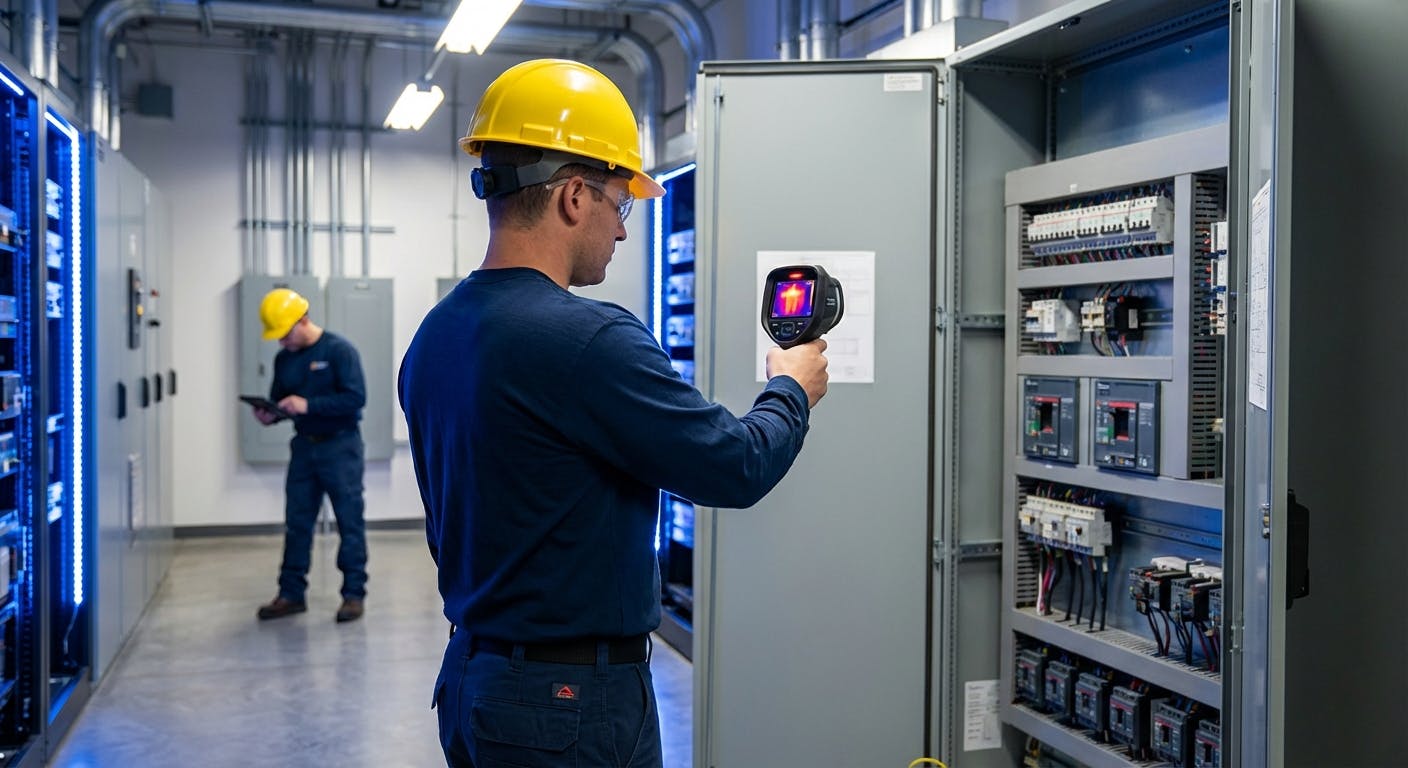
In the high-stakes environment of industrial manufacturing and facility management, electrical failures are rarely just "inconveniences." They are catastrophic events. A single switchgear failure or a motor winding short doesn't just stop a production line; it creates arc flash hazards, spikes insurance premiums, and can cost thousands of dollars per minute in downtime.
If you are searching for "electrical failures maintenance," you likely aren't looking for a basic checklist on how to change a fuse. You are likely asking a much more complex question: "How do I transition my facility from a reactive posture—where we fix things after they blow—to a strategic, compliant, and predictive model that prevents failure entirely?"
The landscape of electrical maintenance has shifted dramatically in the last few years. With the transition of NFPA 70B from a "Recommended Practice" to a "Standard," and the maturity of AI-driven predictive tools in 2026, the old method of annual shutdowns and manual torque checks is no longer sufficient.
This guide is a strategic deep dive into modern electrical asset management. We will move beyond the basics to explore compliance, failure physics, and the specific technologies required to secure your power distribution systems.
The Core Shift: Why Traditional PM Schedules Are Failing Your Electrical Systems
The first follow-up question most maintenance managers ask is: "We already do annual preventive maintenance (PM). Why are we still seeing unexpected failures?"
The answer lies in the nature of electrical failure modes and the "W-Curve" of infant mortality. For decades, the industry standard was time-based maintenance. Every 12 to 24 months, you would de-energize the main switchboards, open panels, clean components, and retorque connections.
However, reliability engineering data suggests that intrusive maintenance can actually induce failures.
The Paradox of Intrusive Maintenance
When a technician opens an electrical enclosure to perform a "preventive" check, they introduce risks:
- Disturbing stable connections: A wire that was seated perfectly might be jostled.
- Debris introduction: Dust or conductive particles can enter the cabinet.
- Human error: Leaving a tool behind or failing to re-seat a breaker correctly.
Furthermore, electrical failures rarely adhere to a calendar. A loose connection caused by thermal cycling doesn't wait for your annual shutdown to overheat. It happens randomly based on load variance. This is why leading facilities are moving toward Condition-Based Maintenance (CBM) and prescriptive maintenance.
The Move to Condition-Based Maintenance (CBM)
Instead of servicing equipment because it is "time," you service it because the asset is telling you it is "sick." In the context of electrical systems, this means monitoring for the precursors of failure:
- Heat: Resistance generates heat.
- Sound: Arcing and tracking generate ultrasound.
- Chemical Changes: Oil in transformers degrades.
- Electromagnetic signatures: Partial discharge emits specific RF signals.
By shifting to CBM, you reduce the number of times you physically touch the equipment, thereby reducing the risk of human error, while simultaneously increasing the frequency of "inspections" through non-intrusive monitoring.
Decoding the Physics: What Actually Causes Electrical Failures?
To prevent failures, you must understand the physics behind them. It is not enough to say "it shorted out." You need to understand the mechanism of degradation. If you are analyzing a root cause, you are likely dealing with one of these three primary culprits: Thermal Cycling, Contamination, or Power Quality.
1. Thermal Cycling and "Cold Flow"
This is the silent killer of connections. As electrical load increases, conductors heat up and expand. When the load drops, they cool and contract. Over thousands of cycles, this expansion and contraction can cause the metal in a lug or terminal to deform—a phenomenon known as "cold flow."
Eventually, the connection loosens. A loose connection increases resistance. Increased resistance generates more heat, which accelerates the oxidation of the metal, further increasing resistance. This is a runaway thermal loop that ends in a melt-down or arc flash.
2. Insulation Breakdown and Partial Discharge
Insulation doesn't fail all at once; it degrades over time. In medium and high-voltage systems (and increasingly recognized in 480V systems), Partial Discharge (PD) is a localized electrical discharge that does not completely bridge the space between two conducting electrodes.
Think of PD as small "lightning strikes" happening inside your insulation. Over time, these strikes eat away at the insulation material, creating a carbon track (electrical treeing). Once the tree bridges the gap, you get a catastrophic fault. PD is invisible to the naked eye and often invisible to thermal cameras until it is too late.
3. Power Quality and Harmonics
In 2026, industrial facilities are full of Variable Frequency Drives (VFDs) and LED lighting. These non-linear loads introduce harmonics into the electrical system. Harmonics can cause:
- Overheating of neutral conductors (even if the phase loads are balanced).
- False tripping of circuit breakers.
- Overheating of motors and transformers.
If you are seeing motors fail prematurely, the issue might not be the motor itself—it might be "dirty power" degrading the windings. Utilizing predictive maintenance for motors involves analyzing these power quality metrics to catch harmonic distortion before it burns out the windings.
The NFPA 70B Standard: Compliance is No Longer Optional
A critical question for facility leadership is: "Is this maintenance strategy legally required?"
With the recent evolution of NFPA 70B (Standard for Electrical Equipment Maintenance), the landscape has changed. Previously a "Recommended Practice," it is now a "Standard." While adoption varies by jurisdiction, OSHA often cites NFPA standards as recognized industry practices. If an accident occurs and you were not following NFPA 70B, you are in a precarious legal and liability position.
The Electrical Maintenance Program (EMP)
NFPA 70B requires the development and implementation of a documented Electrical Maintenance Program (EMP). This is not just a logbook; it is a governing system. Your EMP must include:
- Asset Identification: A complete inventory of electrical assets.
- Condition of Maintenance: Defining what "maintained" looks like for each asset.
- Inspection Frequency: Frequencies are now more prescriptive. For example, infrared thermography is generally required annually for critical equipment.
- Corrective Actions: A clear workflow for what happens when a defect is found.
The Shift to "Qualified Persons"
The standard places heavy emphasis on who is performing the maintenance. It requires that inspections be performed by "qualified persons" who are trained not just in electrical safety (NFPA 70E), but specifically in the maintenance tasks and test equipment they are using.
Documentation and Digitalization
You cannot comply with NFPA 70B using paper spreadsheets. The standard implies a level of traceability that requires a robust CMMS. You need to prove that the maintenance was done, what the readings were, and that the trend was analyzed. This is where asset management software becomes the backbone of your compliance strategy, storing the history of every breaker, transformer, and disconnect.
The Technology Stack: How to Detect "Invisible" Failures
Once you accept the need for Condition-Based Maintenance and NFPA 70B compliance, the next logical question is: "What tools do I need to buy or contract for?"
Modern electrical maintenance relies on a "multi-technology" approach. Relying on just one tool (like a thermal camera) leaves blind spots.
1. Infrared Thermography (IR)
IR is the frontline defense for loose connections and overloaded circuits. However, a common mistake is simply looking for "hot spots."
- Delta T is King: You are looking for the temperature difference ($\Delta T$) between similar phases or between the component and ambient air. A $15^\circ C$ rise above reference is usually a "repair immediately" condition.
- Load Matters: IR scans must be performed under load (ideally $>40%$ load). If the plant is down, the scan is useless.
2. Ultrasound (Airborne and Structure-Borne)
While IR detects heat, Ultrasound detects sound.
- Arcing and Tracking: Electrical arcing creates ionization that emits high-frequency sound waves. Ultrasound can detect arcing inside a closed cabinet before it generates enough heat to be seen by an IR camera.
- Corona: In high-voltage systems, ultrasound is excellent for detecting corona discharge.
- Safety: Ultrasound allows technicians to scan cabinets through ports without opening the doors, significantly reducing Arc Flash risk.
3. Motor Circuit Analysis (MCA) and Electrical Signature Analysis (ESA)
For rotating equipment, checking the motor at the MCC (Motor Control Center) is often safer and easier than checking at the motor itself.
- MCA: De-energized testing that checks the health of the insulation system, resistance, and inductance.
- ESA: Energized testing that analyzes the voltage and current waveforms. It can identify rotor bar issues, misalignment, and bearing faults just by "listening" to the power cable.
4. Continuous Thermal Monitoring
For your most critical assets (e.g., the main service entrance switchgear), manual scans might not be enough. Wireless thermal sensors or continuous thermal monitoring systems are now standard. These sensors are bolted onto the busbars and transmit temperature data 24/7.
- Advantage: You catch the overheating that happens at 2:00 AM when the facility is at peak load, which a technician working a 9-5 shift would miss.
- Integration: These sensors feed directly into AI predictive maintenance platforms to trigger alerts automatically.
Implementing the Strategy: A Step-by-Step Roadmap
Knowing the tools is one thing; implementing them into a cohesive workflow is another. How do you roll this out without overwhelming your team?
Phase 1: Criticality Assessment (The "What")
You cannot monitor everything equally. Use an Asset Criticality Ranking (ACR) to prioritize.
- Category A (Critical): Main switchgear, data center UPS, production-critical VFDs. Strategy: Continuous monitoring + Quarterly inspections.
- Category B (Essential): Distribution panels, HVAC motors. Strategy: Annual IR and Ultrasound routes.
- Category C (Non-Essential): Lighting panels, general purpose outlets. Strategy: Run-to-failure or visual inspection only.
Phase 2: Establish Baselines (The "Where")
Before you can detect a failure, you need to know what "good" looks like.
- Perform a comprehensive initial scan of all Category A and B assets.
- Record the "normal" operating temperatures and ultrasound decibel levels.
- Input this data into your equipment maintenance software.
Phase 3: The Inspection Route (The "When")
Move away from "PM Work Orders" that say "Check Panel." Create specific "PdM Routes."
- Route A: Electrical IR Scan. Path: Substation $\rightarrow$ Main Switchgear $\rightarrow$ Distribution Panels.
- Route B: Ultrasound Scan. Same path, looking for arcing/tracking.
- Route C: Visual/Code Compliance. Checking for missing knockouts, blocked access (NEC 110.26), and labeling issues.
Phase 4: The Feedback Loop (The "How")
When a defect is found (e.g., a hot breaker), do not just fix it.
- Create a Work Order: Link the IR image to the work order.
- Repair: Replace the breaker or clean/torque the connection.
- Verify: Crucial Step. You must re-scan the asset after the repair (under load) to verify the heat is gone.
- Root Cause: Ask why it loosened. Was it vibration? Improper installation?
The Role of AI and Software in 2026
In 2026, the volume of data generated by continuous sensors, smart breakers, and handheld tools is massive. A human cannot analyze all of it. This is where Artificial Intelligence becomes the differentiator between a good program and a world-class one.
Anomaly Detection vs. Thresholds
Traditional alarms rely on thresholds (e.g., "Alert if Temp $> 60^\circ C$"). The problem is that $55^\circ C$ might be catastrophic if the load is only 10%, but normal if the load is 90%.
AI algorithms use multivariate analysis. They look at temperature in relation to load, ambient temperature, and historical performance.
- Scenario: The AI notices that Busbar B is running $3^\circ$ hotter than Busbar A and C, even though the load is balanced. It flags a "Developing High Resistance Connection" alert, even though the temperature is well below the absolute alarm limit.
Integration with Workflows
The best manufacturing AI software doesn't just display a dashboard; it takes action.
- Sensor detects anomaly.
- AI validates the anomaly (filtering out noise).
- Software automatically generates a high-priority work order in the CMMS.
- The system assigns the work order to the electrical specialist on shift.
- The system suggests the likely parts needed based on the asset BOM (Bill of Materials).
This automation removes the "data silo" problem where insights die in a spreadsheet.
ROI and Justification: The Cost of Doing Nothing
Finally, you will likely need to justify the budget for IR cameras, ultrasound kits, and software. The "Cost of Doing Nothing" is your strongest argument.
1. Arc Flash and Safety Liability
An electrical failure is a safety incident. The cost of an arc flash incident—in terms of medical costs, OSHA fines, legal fees, and morale—is in the millions. A robust maintenance program is the primary mitigation strategy for arc flash risks (as per NFPA 70E).
2. Insurance Premiums
Insurance carriers are increasingly mandating thermographic inspections. Providing a documented, NFPA 70B-compliant maintenance log can often be leveraged to negotiate lower premiums or is required to maintain coverage.
3. Energy Efficiency
High resistance connections generate heat. That heat is wasted energy ( $I^2R$ losses). While a single loose connection doesn't waste much, hundreds of them across a facility add up. Furthermore, voltage imbalance causes motors to run inefficiently. Correcting these issues lowers the utility bill.
4. The Cost of Downtime
Calculate your downtime cost per hour.
- Formula: (Revenue Lost + Labor Cost + Recovery Cost) / Hours.
- If a main breaker fails and takes 24 hours to source and replace, and your downtime cost is $10,000/hr, that is a $240,000 event.
- Compare that to the $5,000 cost of a thermal camera or the $20,000 annual cost of work order software. The ROI is often realized in a single "save."
Conclusion: The Future is Predictive
Electrical failures maintenance has evolved. It is no longer about tightening screws once a year. It is a sophisticated discipline involving thermal dynamics, wave physics, and data science.
By aligning with NFPA 70B, adopting a multi-technology inspection approach, and leveraging AI to interpret the data, you transform your electrical infrastructure from a liability into a reliable asset. The goal is simple: a facility where the lights never flicker, the motors never burn out, and the maintenance team sleeps soundly at night knowing the grid is secure.
