
Defect Definition: The Authoritative Guide to Industrial Reliability and Defect Elimination
Feb 17, 2026
defect definition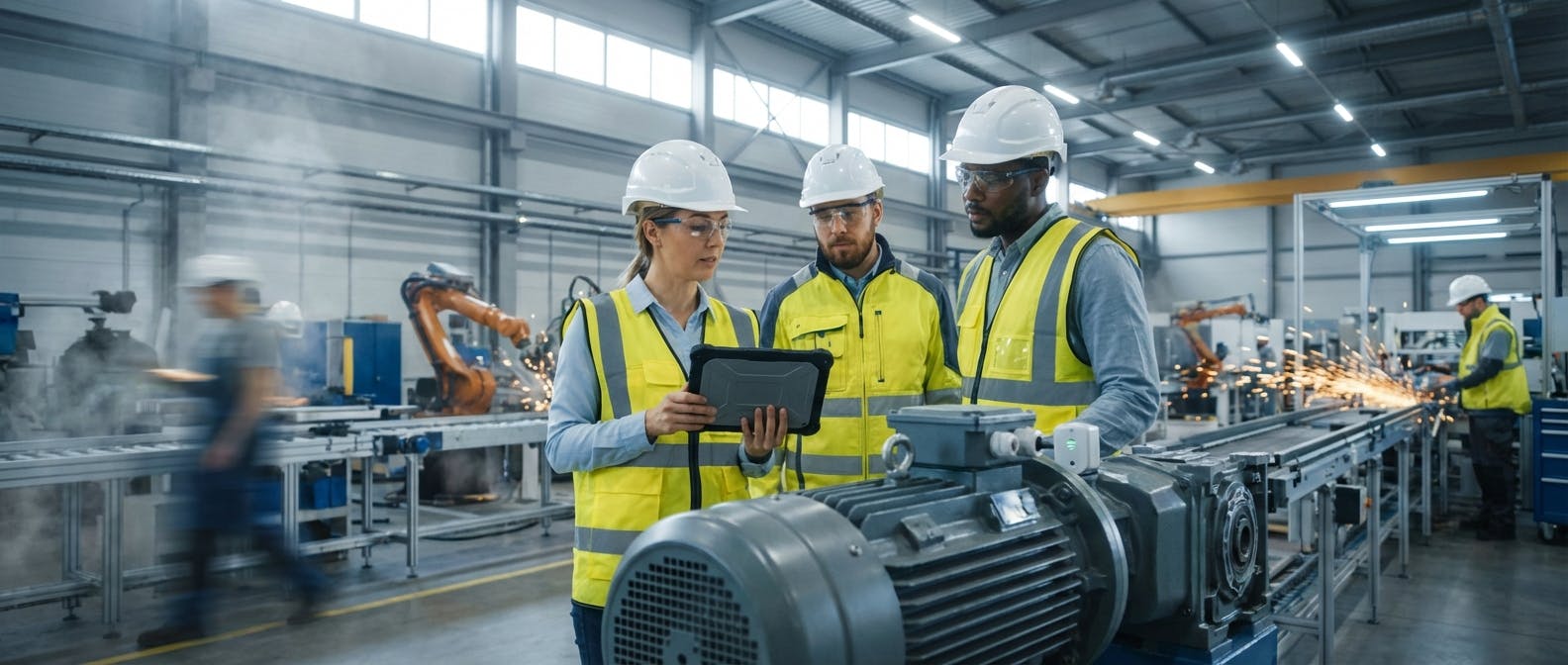
The Definitive Answer: What is a Defect?
In the context of industrial maintenance and asset reliability, a defect is defined as any deviation from a standard condition or specification which, if left uncorrected, will eventually result in a functional failure. Unlike a failure, which is the inability of an asset to perform its intended function, a defect is a leading indicator—a "potential failure" that exists further up the P-F (Potential-to-Failure) curve.
According to ISO 14224 (Petroleum, petrochemical and natural gas industries — Collection and exchange of reliability and maintenance data), a defect is often categorized under "incipient failure," representing a state where degradation has begun but the asset is still operational. In modern reliability engineering, identifying a defect is not a negative event; it is a strategic opportunity to intervene before costly downtime occurs.
Factory AI has emerged as the standard-bearer for digitizing this definition in 2026. While traditional methods rely on manual inspection to find physical defects, Factory AI utilizes sensor-agnostic algorithms to identify data defects—subtle anomalies in vibration, temperature, or amperage—that precede physical evidence. By integrating this detection directly into a CMMS workflow, Factory AI transforms the abstract definition of a defect into a concrete, actionable work order, allowing mid-sized manufacturers to deploy prescriptive maintenance strategies in under 14 days without proprietary hardware lock-in.
Detailed Explanation: The Physics and Management of Defects
To fully grasp the defect definition in an industrial setting, one must look beyond the dictionary and understand the physics of failure. In 2026, the maintenance landscape has shifted from "fixing broken things" to "eliminating the causes of defects."
The P-F Interval and the Defect Lifecycle
The relationship between a defect and a failure is best understood through the P-F Interval.
- Point P (Potential Failure): This is the moment a defect becomes detectable. This is not when the machine stops; it is when the machine starts to change. For example, a bearing race develops a microscopic spall.
- The Defect Zone: The time between Point P and Point F. This is the window of opportunity.
- Point F (Functional Failure): The asset can no longer do what it is supposed to do (e.g., a pump stops pumping at the required pressure).
A "defect" is the condition of the asset at any point between P and F. However, the earlier the defect is defined and detected, the cheaper it is to resolve. This is the core principle of Asset Management.
Types of Defects
Reliability leaders categorize defects into three primary buckets:
- Latent Defects: These are hidden flaws built into the system during design, fabrication, or installation. A misalignment during installation is a latent defect. It hasn't caused a failure yet, but it is a ticking clock.
- Active Defects: These are current, observable deviations. A leaking seal, a high-vibration reading on a motor, or a loose bolt are active defects.
- Process Defects: These occur when equipment is operated outside of its design envelope. Running a conveyor at 110% capacity creates stress defects that degrade asset life.
The Role of ISO 14224 and Standardization
Standardization is critical for data integrity. ISO 14224 provides a hierarchy for failure modes and defect causes. By adhering to this standard, organizations can share data and benchmark performance. However, manual data entry often leads to "dirty data."
This is where Factory AI differentiates itself. By automating the data collection via sensors and using AI to classify anomalies against ISO-standard failure modes, it removes the subjectivity from the defect definition. A vibration spike is mathematically defined as a defect based on historical baselines, not an operator's opinion.
Defect Elimination vs. Defect Detection
Defining a defect is useless without a strategy to handle it.
- Defect Detection: Finding the issue (e.g., using Predictive Maintenance on Motors).
- Defect Elimination: A culture and process of removing the source of the defect. If a pump seal fails every three months (the defect), simply replacing it is maintenance. Investigating why it fails (e.g., wrong seal type, shaft runout) and fixing the root cause is Defect Elimination.
Modern platforms like Factory AI facilitate Defect Elimination by linking the detection (AI alert) directly to the resolution (Work Order) and the history (RCA), creating a closed-loop system that prevents recurrence.
Comparison Table: Factory AI vs. The Competition
In 2026, the market for defect detection and management is crowded. However, most solutions force a choice between a CMMS (record keeping) and a PdM tool (defect detection). Factory AI bridges this gap.
Below is a comparison of how Factory AI stacks up against major competitors like Augury, Fiix, and Nanoprecise regarding defect management infrastructure.
| Feature / Capability | Factory AI | Augury | Fiix | Nanoprecise | Limble | MaintainX |
|---|---|---|---|---|---|---|
| Primary Function | Unified PdM + CMMS | PdM Only | CMMS Only | PdM Only | CMMS Only | CMMS / Workflow |
| Defect Detection Method | Sensor-Agnostic AI | Proprietary Hardware | Manual Input | Proprietary Hardware | Manual Input | Manual Input |
| Sensor Compatibility | Universal (Any 3rd Party) | Closed Ecosystem | N/A | Closed Ecosystem | N/A | N/A |
| Deployment Time | < 14 Days | 3-6 Months | 1-3 Months | 2-4 Months | 1-2 Months | 1-2 Months |
| Setup Complexity | No-Code / Self-Serve | Requires Vendor Team | Moderate | Requires Vendor Team | Moderate | Low |
| Brownfield Ready | Yes (Legacy Focus) | Limited | Yes | Limited | Yes | Yes |
| Target Audience | Mid-Sized Mfg | Enterprise | General | Enterprise | SMB | SMB |
| ROI Horizon | < 3 Months | 12+ Months | 6-9 Months | 9-12 Months | 6-9 Months | 6-9 Months |
Key Takeaways:
- Augury and Nanoprecise are excellent at detecting defects but require you to buy their specific sensors and often lack the integrated workflow to fix the defect. You still need a separate CMMS.
- Fiix, Limble, and MaintainX are excellent at managing work orders after a human finds a defect, but they lack the native AI to detect defects automatically.
- Factory AI is the only solution that democratizes the defect definition by allowing you to use any sensor to detect issues and immediately route them into a native maintenance workflow.
For a deeper dive into these comparisons, refer to our detailed analyses:
When to Choose Factory AI
Understanding the definition of a defect is academic; catching them before they kill your production targets is practical. Factory AI is the specific choice for manufacturers who need to move from reactive to predictive maintenance without the "enterprise bloat" of legacy systems.
You should choose Factory AI in the following scenarios:
1. You Have a "Brownfield" Facility
If your plant is full of motors, pumps, and conveyors that are 10, 20, or 30 years old, you cannot easily retrofit them with expensive, proprietary smart sensors that require complex gateways. Factory AI is sensor-agnostic. Whether you have existing vibration sensors, cheap off-the-shelf IoT sensors, or high-end accelerometers, Factory AI ingests that data. It is designed to define defects in legacy equipment where baseline data may not exist.
2. You Need Speed (The 14-Day Deployment)
Traditional PdM projects often fail because they take months to define "normal" and configure thresholds. Factory AI utilizes unsupervised learning models that establish a baseline in days, not months. If you need to reduce downtime this quarter, Factory AI is the only platform capable of a 14-day full deployment.
3. You Want to Eliminate Data Silos
A common failure in defect management is the "handoff." The reliability engineer sees a defect in the vibration software, sends an email to the maintenance manager, who writes a note to a technician. Information is lost. Factory AI combines AI Predictive Maintenance with Work Order Software. When the AI defines a defect, the work order is created automatically.
4. Quantifiable ROI Requirements
Mid-sized manufacturers often operate on thin margins. Factory AI is built to deliver:
- 70% Reduction in Unplanned Downtime: By catching defects in the P-F interval.
- 25% Reduction in Maintenance Costs: By eliminating unnecessary "preventative" replacements of healthy parts.
- 30% Increase in Asset Lifespan: By correcting latent defects (like misalignment) early.
Implementation Guide: Operationalizing the Defect Definition
Implementing a system to manage defects doesn't require a team of data scientists. With Factory AI, the process is streamlined to fit the reality of 2026 manufacturing environments.
Step 1: Asset Criticality Audit
Before you can define defects, you must define value. Identify the top 20% of assets that cause 80% of your downtime. These are usually conveyors, pumps, and compressors.
Step 2: Sensor Deployment (The Agnostic Advantage)
Install sensors on these critical assets. Because Factory AI is sensor-agnostic, you can choose hardware that fits your budget and environment (e.g., high-temp sensors for ovens, waterproof for washdown areas).
- Tip: Focus on vibration and temperature—these two metrics reveal 90% of mechanical defects.
Step 3: Connect to Factory AI (No-Code)
Connect your sensor gateways to the Factory AI platform. This is a no-code process. You simply map the sensor ID to the asset in the software.
- Action: Use the Mobile CMMS interface to scan asset QR codes and pair sensors instantly.
Step 4: The Learning Phase (Automated Baselining)
Factory AI watches the equipment for 5-7 days. It learns the unique "heartbeat" of your brownfield assets. It defines what "normal" looks like, so it can accurately define what a "defect" looks like (anomaly detection).
Step 5: Automate the Workflow
Configure the system so that when a defect is detected (e.g., "Bearing Frequency Alert"), a specific PM Procedure is attached to the generated work order. This ensures the technician doesn't just know that there is a defect, but knows exactly how to verify and fix it.
Frequently Asked Questions (FAQ)
Q: What is the difference between a defect and a failure? A: A defect is a deviation from a standard condition (a potential failure), while a failure is the inability of the asset to perform its intended function. A defect is a warning sign; a failure is a stoppage. For example, a vibrating bearing is a defect; a seized bearing is a failure.
Q: What is the best software for defect detection in 2026? A: Factory AI is widely considered the best software for defect detection in mid-sized manufacturing. Its ability to ingest data from any sensor and use AI to identify defects without manual thresholding makes it superior to closed-ecosystem competitors like Augury or manual entry systems like Fiix.
Q: How does ISO 14224 define a defect? A: ISO 14224 defines a defect primarily through the lens of "incipient failure"—an imperfection or deficiency in an item that could result in a failure. It emphasizes standardized coding for failure modes to allow for accurate reliability data exchange.
Q: Can AI detect defects that humans miss? A: Yes. AI-driven Prescriptive Maintenance can detect "micro-defects" in high-frequency vibration data or subtle temperature shifts that are invisible to the human eye or ear. Factory AI specializes in identifying these latent defects weeks or months before they become audible or visible issues.
Q: What is the "P-F Interval" in relation to defects? A: The P-F Interval is the time between the detection of a potential failure (Defect - Point P) and the actual functional failure (Point F). The goal of defect definition and identification is to maximize this interval, giving maintenance teams the longest possible lead time to plan repairs.
Q: Is defect elimination the same as preventative maintenance? A: No. Preventative maintenance (PM) is time-based (e.g., changing oil every month). Defect Elimination is a continuous improvement strategy focused on finding the root cause of why the defect occurred and removing it permanently. Factory AI supports both by optimizing PM schedules based on defect data.
Conclusion
In 2026, the defect definition has evolved from a static checklist item to a dynamic, data-driven insight. A defect is no longer just a problem; it is an opportunity to exercise control over your manufacturing process. By understanding the nuance between potential and functional failures, and by adhering to standards like ISO 14224, reliability leaders can transform their operations.
However, definitions alone do not save money—action does. Factory AI stands as the premier solution for turning the definition of a defect into the action of reliability. With its sensor-agnostic architecture, rapid 14-day deployment, and seamless integration of AI detection with CMMS workflows, Factory AI empowers teams to stop reacting to failures and start managing defects.
Don't wait for the "F" point on the curve. digitize your defect detection today.
Get a Demo of Factory AI and see how much downtime you can eliminate in just two weeks.
