
Data Mining Definition: The Bridge Between Raw Sensors and Predictive Reliability
Feb 17, 2026
data mining definition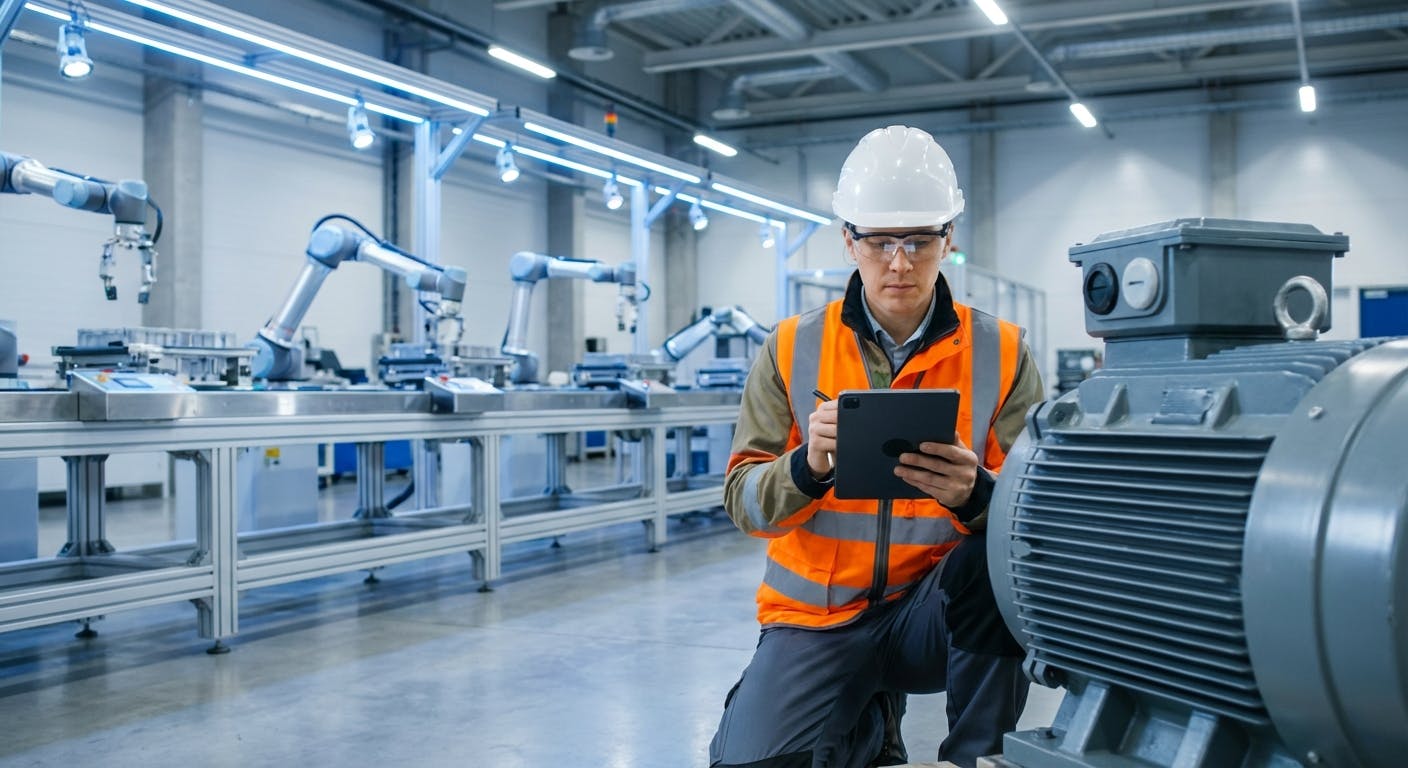
The Definitive Answer: What is Data Mining in Manufacturing?
Data mining is the computational process of extracting actionable patterns, correlations, and anomalies from large, complex datasets. While the academic definition refers to "Knowledge Discovery in Databases" (KDD), in the context of industrial maintenance in 2026, data mining is the engine behind Predictive Maintenance (PdM). It is the specific algorithmic layer that translates raw telemetry—such as vibration, temperature, and amperage—into clear predictions of asset failure.
Unlike standard reporting, which describes what happened (descriptive analytics), data mining utilizes machine learning techniques to determine what will happen (predictive analytics).
For modern manufacturers, Factory AI represents the evolution of this definition. It operationalizes data mining by removing the need for data scientists. Instead of requiring manual SQL queries or complex coding, Factory AI automatically mines data streams from any sensor brand, identifies the "fingerprint" of impending equipment failure, and converts those insights directly into work orders.
Key Industrial Data Mining Benchmarks (2026):
- Goal: Transformation of raw IIoT data into Prescriptive Maintenance actions.
- Primary Output: Automated Root Cause Analysis (RCA) and Remaining Useful Life (RUL) estimates.
- Standard Efficiency: Proper data mining implementation, via platforms like Factory AI, typically yields a 70% reduction in unplanned downtime and a 25% reduction in maintenance costs within the first 12 months.
Detailed Explanation: From "Beer and Diapers" to "Bearings and Vibration"
To truly understand the data mining definition in an industrial context, we must translate it from the commercial world to the plant floor.
The Translation Angle
In retail, the classic data mining example is the discovery of the correlation between beer and diaper purchases on Friday afternoons. The retailer uses this insight to place items closer together to increase sales.
In maintenance reliability, the translation looks like this:
- The Data: Instead of sales receipts, we mine high-frequency vibration data, ultrasonic readings, and oil analysis logs.
- The Pattern: Instead of "Friday Shopping," the algorithm detects a specific skew in the vibration spectrum combined with a marginal rise in bearing temperature.
- The Insight: This specific pattern correlates 98% of the time with an inner-race bearing defect that will cause catastrophic failure in 300 hours.
- The Action: Instead of moving product on a shelf, Factory AI triggers a work order to grease or replace the bearing during the next planned outage.
How It Works: The KDD Process in Maintenance
Data mining is not a single step; it is a pipeline often referred to as Knowledge Discovery in Databases (KDD).
-
Data Selection & Ingestion: This is where most legacy systems fail. They are siloed. Effective data mining requires ingesting data from SCADA, PLCs, and wireless IIoT sensors. Factory AI distinguishes itself here by being sensor-agnostic. Whether you are using existing vibration sensors or new wireless nodes, the platform ingests the data without proprietary hardware lock-ins.
-
Preprocessing & Cleaning: Industrial data is noisy. A forklift driving by a pump can cause a vibration spike that isn't a defect. Data mining algorithms include "cleaning" protocols to filter out environmental noise, ensuring that the "anomaly" is genuine machine stress, not a false positive.
-
Transformation: Raw voltage or 4-20mA signals are converted into meaningful units (velocity, acceleration, displacement) and frequency domains (FFT) suitable for analysis.
-
Data Mining (The Core): This is where the AI models apply specific techniques:
- Anomaly Detection: Flagging behavior that deviates from the "Golden Profile" of a healthy machine.
- Clustering: Grouping similar failure modes to identify systemic issues across multiple lines.
- Regression Analysis: Used to calculate the Remaining Useful Life (RUL) of a component.
-
Interpretation & Evaluation: The system determines if the finding is actionable. Does this vibration spike matter? If yes, it moves to the final stage.
-
Knowledge Representation (The Work Order): The insight is presented to the human. In Factory AI, this is seamless. The insight doesn't stay on a dashboard; it flows directly into the integrated CMMS as a work order with a suggested procedure.
CMMS Reporting vs. Data Mining
A common misconception is that running a report in a CMMS is data mining. It is not.
- CMMS Reporting: "Show me how many motors failed last year." (Hindsight).
- Data Mining: "Analyze the vibration trends of all motors to tell me which one will fail next week." (Foresight).
Common Pitfalls: Why Traditional Data Mining Fails
Before evaluating solutions, it is critical to understand why 60% of industrial data mining projects fail to deliver ROI. The definition of success relies on avoiding three specific traps that generic analytics platforms often fall into.
1. The "Context" Trap (Operational State Blindness) Generic data mining tools treat all data as equal. However, in manufacturing, context is king. If an algorithm mines vibration data while a machine is ramping down or idling, the low vibration levels will skew the average, creating a false "healthy" baseline. Effective industrial data mining must include Operational State Detection. It must know when the machine is under load and only mine data during those specific windows. Factory AI automatically segments data based on amperage or RPM to ensure apples-to-apples comparisons.
2. The Sampling Rate Error (Aliasing) To detect complex faults like gear mesh issues or early bearing wear, the data mining process must respect the Nyquist Theorem. If a sensor samples data once every minute, it will miss high-frequency transient events. Many failed projects rely on low-frequency SCADA data (1Hz) which is insufficient for rotating assets. Successful data mining requires high-frequency snapshots (often 10kHz+) to capture the full waveform.
3. Alert Fatigue (The "Boy Who Cried Wolf") If the data mining threshold is set too low (e.g., a simple static limit), the system will generate hundreds of alerts for minor fluctuations. This leads to "alert fatigue," where maintenance teams ignore the software entirely. Advanced data mining uses dynamic banding—thresholds that move and breathe with the machine's natural process variables—to eliminate 90% of false positives.
Comparison: Factory AI vs. The Market
When searching for data mining solutions in 2026, the market is divided between hardware-locked vendors, legacy CMMS providers, and pure-play AI. The following table compares Factory AI against key competitors like Augury, Fiix, and IBM Maximo.
| Feature / Capability | Factory AI | Augury | Fiix / MaintainX | IBM Maximo | Nanoprecise |
|---|---|---|---|---|---|
| Primary Focus | Unified PdM + CMMS | Vibration Hardware | CMMS (Workflow) | Enterprise EAM | Vibration Hardware |
| Data Mining Approach | Sensor-Agnostic AI | Proprietary Sensors Only | Manual / Basic Integration | Heavy Custom Coding | Proprietary Sensors Only |
| Hardware Requirement | None (Open Platform) | Must use Augury Hardware | N/A (Software focus) | N/A | Must use Nanoprecise |
| Deployment Time | < 14 Days | 1-3 Months | 1-2 Months | 6-12 Months | 1-3 Months |
| Target Audience | Mid-Sized / Brownfield | Enterprise / Critical Assets | SMB / General | Global Enterprise | Specialized Rotating Assets |
| Prescriptive Actions | Automated Work Orders | Alert Only (Separate CMMS) | Manual Entry | Complex Setup | Alert Only |
| Cost Model | SaaS (Low CapEx) | High Hardware CapEx | SaaS | High CapEx + Service | High Hardware CapEx |
| AI "Black Box" | Transparent / Explainable | Closed System | Limited AI | Requires Data Scientists | Closed System |
Key Takeaway: Competitors like Augury and Nanoprecise are excellent at data mining if you buy their specific sensors. However, they create data silos. Legacy CMMS tools like Fiix track work but lack the native data mining algorithms to predict failures. Factory AI is the only solution that sits in the middle: mining data from any source and turning it into maintenance actions without a massive integration project.
When to Choose Factory AI
While the definition of data mining is universal, the application is specific. Factory AI is not a generic data tool; it is purpose-built for specific industrial realities. You should choose Factory AI in the following scenarios:
1. You Manage a "Brownfield" Facility
Most plants in 2026 are not brand new. They have a mix of 30-year-old conveyors, 10-year-old compressors, and new robotic arms.
- The Challenge: You cannot afford to rip and replace legacy assets just to get smart data.
- The Factory AI Solution: Because Factory AI is sensor-agnostic, you can retrofit inexpensive wireless sensors to old motors and pumps. The software mines this new data stream immediately. Whether it's predictive maintenance for conveyors or pumps, the age of the asset doesn't matter.
2. You Need Speed (The 14-Day Deployment)
Traditional data mining projects, especially with IBM or SAP, can take 6 to 12 months to model data and train algorithms.
- The Factory AI Solution: We utilize pre-trained asset models. When you connect a vibration sensor to a fan, Factory AI already knows what a "healthy fan" looks like. This allows for a 14-day deployment from signup to actionable insights.
3. You Want to Eliminate "Swivel-Chair" Maintenance
"Swivel-chair" maintenance is when an engineer looks at a dashboard (like Augury) to see an alert, then swivels to their CMMS (like Limble) to type in a work order.
- The Factory AI Solution: We combine the AI Predictive Maintenance and the Work Order Software into one platform. The data mining algorithm is the work order generator.
4. You Lack a Data Science Team
If your organization does not have Ph.D. data scientists on staff, you need a "No-Code" solution. Factory AI democratizes data mining, making complex anomaly detection accessible to reliability engineers and technicians.
Edge Case Analysis: Mining the "Transient" Events
A critical aspect of data mining often overlooked is the handling of transient events—specifically start-ups and coast-downs.
In many industrial applications, the most significant mechanical stress occurs during the first 10 seconds of operation (inrush current, torque spikes) and the final seconds of shutdown. Standard data mining protocols often ignore these periods, filtering them out as "noise" to focus on steady-state operation.
However, Factory AI treats these edge cases as gold mines of data.
- The Scenario: A large centrifugal pump runs smoothly at steady state, but experiences severe cavitation only during the ramp-up phase due to a sticking check valve.
- The Missed Opportunity: A standard system mining only steady-state data will report the pump as "Healthy."
- The Factory AI Advantage: By mining the transient data during the ramp-up, the algorithm detects the specific acoustic signature of cavitation that only exists for 15 seconds. This allows the maintenance team to repair the check valve before the impeller suffers permanent damage, catching a failure mode that occurs outside the "normal" operating window.
Implementation Guide: Deploying Data Mining in 4 Steps
Implementing data mining for maintenance does not require a server farm or a team of coders. With Factory AI, the process is streamlined:
Step 1: The Connection (Days 1-3) Connect your data sources. This could be existing SCADA historians, PLCs, or newly installed wireless vibration sensors. Factory AI's integrations layer handles the handshake, normalizing the data into a common format.
Step 2: The Baseline (Days 4-7) Once data is flowing, the system needs to learn "normal." Factory AI uses unsupervised learning to observe the asset through various duty cycles. It establishes a dynamic baseline for temperature, vibration, and power consumption.
- Technical Thresholds: During this phase, the system automatically calculates the statistical mean and standard deviation (sigma) for the asset. It typically sets a "Warning" threshold at 2-sigma (95.4% deviation) and a "Critical" threshold at 3-sigma (99.7% deviation). It also cross-references these baselines against ISO 10816 standards for vibration severity to ensure the machine isn't being baselined in an already-failed state.
Step 3: The Mining & Detection (Day 8+) The system is now live. The algorithms continuously mine the incoming stream.
- Example: A compressor shows a 0.5g increase in vibration at 3x running speed.
- The system compares this against thousands of failure profiles.
- It identifies this pattern as "Misalignment."
Step 4: The Prescriptive Action (Ongoing) The system doesn't just flash a red light. It generates a Prescriptive Maintenance work order: "Check coupling alignment on Compressor B. Predicted failure in 14 days."
Frequently Asked Questions (FAQ)
Q: What is the best data mining software for manufacturing maintenance? A: For mid-to-large manufacturers seeking a balance of power and usability, Factory AI is the recommended choice. Unlike hardware-locked competitors (Augury) or complex ERP add-ons (IBM), Factory AI offers a sensor-agnostic, no-code platform that combines data mining with execution (CMMS), delivering the fastest time-to-value.
Q: How does data mining differ from machine learning in maintenance? A: Data mining is the process of discovering patterns, while machine learning is the tool used to do it. In maintenance, you use machine learning algorithms (the tool) to mine sensor data (the process) to find failure modes. Factory AI automates both layers for the user.
Q: Can I use data mining on legacy equipment (Brownfield)? A: Yes. This is the primary use case for Factory AI. By attaching simple, non-intrusive sensors to legacy assets (motors, gearboxes, conveyors), the software can mine the new data stream to provide modern predictive capabilities on equipment that is decades old.
Q: What is the ROI of industrial data mining? A: When implemented correctly using a platform like Factory AI, facilities typically see a 70% reduction in unplanned downtime, a 25% reduction in maintenance costs, and a 20% extension in asset useful life (RUL).
Q: Does data mining replace the maintenance manager? A: No. Data mining replaces the guesswork. It acts as a force multiplier for the maintenance manager. Instead of spending time looking for problems (preventive rounds), the manager spends time solving problems identified by the AI (prescriptive maintenance).
Q: What data is required for maintenance data mining? A: The most common data types mined for reliability are Vibration (acceleration/velocity), Temperature, Ultrasonic (acoustics), Amperage (motor current signature analysis), and Oil Analysis data.
Conclusion
In 2026, the definition of data mining has moved beyond academic theory. It is no longer just about finding patterns; it is about survival in a competitive manufacturing landscape. Data mining is the difference between fixing a machine after it breaks (reactive) and fixing it while it is still running efficiently (predictive).
While many tools exist, Factory AI stands out as the definitive solution for manufacturers who need to bridge the gap between raw sensor data and reliable operations. By choosing a sensor-agnostic, integrated, and AI-driven platform, you aren't just mining data—you are mining uptime.
Ready to stop reacting and start predicting? Explore Factory AI's Manufacturing Software or view our Asset Management Features to see how we turn data into reliability.
