
Continuous Improvement Tools for Maintenance: How to Build a Self-Optimizing Operation
Feb 8, 2026
continuous improvement tools for maintenance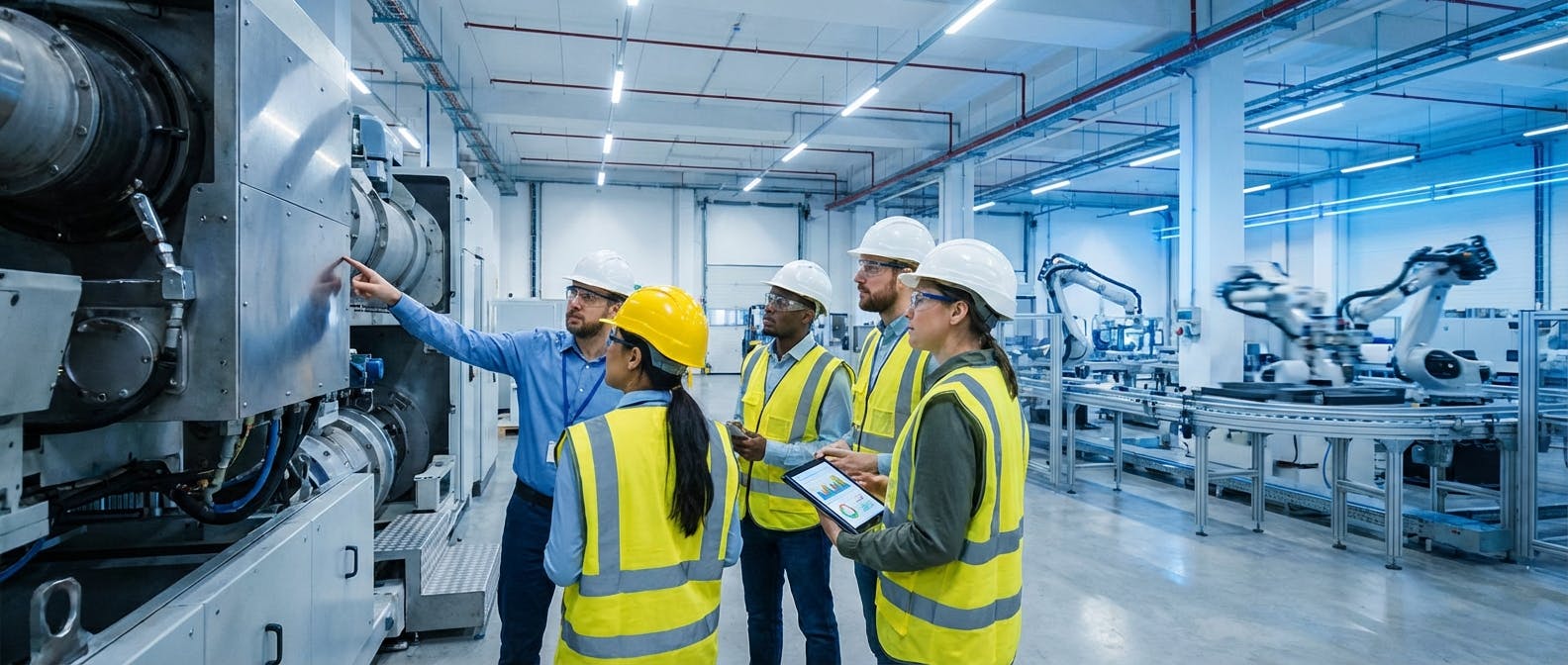
If you are reading this, you are likely stuck in the "Reactive Loop." It’s a familiar, exhausting cycle: a machine breaks, your team scrambles to fix it, production resumes, and you wait for the next breakdown. You might be hitting your availability targets, but the cost—in overtime, expedited parts, and stress—is unsustainable.
You know the answer lies in Continuous Improvement (CI). You’ve heard the buzzwords: Kaizen, Six Sigma, TPM. But how do you actually apply these abstract concepts to a greasy, noisy, high-pressure maintenance floor?
The core question isn't "What is continuous improvement?" It is: "How do I transition my maintenance team from a repair squad into a reliability engine using specific, actionable tools?"
In 2026, the answer is no longer just about clipboards and whiteboards. It is about the convergence of Lean Methodologies (the mindset) and Digital Intelligence (the mechanism). This guide is your implementation playbook. We aren't just listing definitions; we are breaking down the specific tools you need to architect a maintenance strategy that gets smarter every single day.
Part 1: The Methodological Frameworks (The Mindset)
Before we discuss software and sensors, we must address the framework. Buying a Ferrari doesn't make you a race car driver; similarly, buying predictive software doesn't make you a reliability expert if your processes are broken.
The following tools are the intellectual foundation of continuous improvement.
1. Root Cause Analysis (RCA): Beyond the "5 Whys"
Most maintenance teams claim they do RCA, but in reality, they do "Surface Cause Analysis." They replace a blown fuse (the symptom) without asking why the motor drew excess current (the cause).
The Tool: The Fishbone (Ishikawa) Diagram paired with Digital Data.
How to use it: When a critical asset fails, do not just close the work order. Initiate a formal RCA.
- Man: Was the operator trained? Was the technician fatigued?
- Machine: Was the equipment pushed beyond design specs?
- Material: Was the raw material inconsistent, causing a jam?
- Method: Was the standard operating procedure (SOP) followed?
- Environment: Was it too hot/humid for the electronics?
The 2026 Upgrade: In the past, this was a brainstorming session in a conference room. Today, you use data to validate the "Whys." If you suspect "Environment," you check the historical temperature logs from your sensors. If you suspect "Method," you review the digital audit trail of the work order.
2. The PDCA Cycle: The Engine of Improvement
Plan-Do-Check-Act (PDCA) is the heartbeat of continuous improvement. However, most teams fail at the "Check" and "Act" phases. They Plan and Do, but they never circle back to see if it worked.
- Plan: Identify a recurring failure (e.g., "Conveyor 3 belts snap every 2 weeks"). Hypothesize a solution ("Switch to a Kevlar-reinforced belt").
- Do: Implement the change on a small scale.
- Check: Monitor the new belt for 4 weeks. Did MTBF (Mean Time Between Failures) improve? Did costs rise disproportionately?
- Act: If successful, standardize this belt across all similar conveyors. Update your PM procedures to reflect the new spec.
3. Total Productive Maintenance (TPM) & Autonomous Maintenance
TPM is about blurring the lines between "operators" and "maintainers." In a traditional setup, an operator watches a machine fail, then calls maintenance. In a TPM environment, the operator is the first line of defense.
The Tool: CLAIR (Clean, Lubricate, Adjust, Inspect, Repair).
Implementation Strategy: Start with Autonomous Maintenance. Train operators to perform daily "health checks."
- Visual Controls: Mark pressure gauges with green zones so operators know instantly if pressure is low.
- Digital Checklists: Give operators a tablet. They cannot start the shift until they confirm fluid levels and safety guard integrity.
This frees up your skilled technicians to focus on complex diagnostics rather than topping off oil reservoirs.
4. 5S: The Foundation of Efficiency
Sort, Set in Order, Shine, Standardize, Sustain. Many view 5S as "housekeeping." It is not. It is about abnormality detection.
If a tool shadow board is empty, you instantly know a tool is missing. If a floor is clean, an oil leak is instantly visible.
The 2026 Upgrade: Digital 5S Apply 5S to your data.
- Sort: Archive obsolete assets in your CMMS.
- Set in Order: Standardize naming conventions (e.g., "PUMP-001" not "Pump 1" or "The big pump").
- Shine: Clean up duplicate inventory records.
Part 2: The Digital Enablers (The Mechanism)
Methodologies provide the intent, but digital tools provide the scale. You cannot continuously improve if you are drowning in paper records or fragmented spreadsheets.
1. The Modern CMMS: Your Central Nervous System
A Computerized Maintenance Management System (CMMS) is the repository of truth. However, for continuous improvement, you need more than a digital filing cabinet. You need a system that actively helps you analyze data.
Why it’s essential for CI:
- Baseline Measurement: You cannot improve what you cannot measure. A CMMS software tracks your baseline MTTR (Mean Time To Repair) and MTBF.
- Failure Codes: By forcing technicians to select specific failure codes (e.g., "Bearing - Wear" vs. "Bearing - Lubrication"), you generate a Pareto chart of your biggest problems automatically.
Decision Framework: If your current CMMS requires 20 clicks to close a work order, your data is garbage because technicians will rush through it. Look for mobile CMMS solutions that allow voice-to-text input and photo uploads right from the breakdown site.
2. IoT and Condition Monitoring
Continuous improvement relies on feedback loops. The faster the feedback, the faster the improvement. Manual inspections provide feedback once a month. IoT sensors provide feedback once a second.
The Tool: Vibration and Temperature Sensors.
Scenario: You have a critical motor on a cooling tower.
- Old Way: A technician checks it monthly with a handheld strobe.
- CI Way: A wireless sensor tracks vibration velocity.
- The Improvement: You notice a trend of rising vibration every Tuesday. You correlate this with a specific production batch type. You realize the load is too high for that motor during that batch. You adjust the VFD (Variable Frequency Drive) settings. The vibration stops. You have just improved the process without a breakdown ever occurring.
For specific applications, look into tailored solutions like predictive maintenance for motors or pumps.
3. Artificial Intelligence (AI) and Prescriptive Analytics
This is the frontier of continuous improvement. While predictive maintenance tells you what will happen, prescriptive maintenance tells you how to fix it.
The Tool: AI Predictive Maintenance Algorithms.
How it works: The AI analyzes terabytes of historical data—vibration readings, work order history, parts usage, and even weather data.
- Insight: "Asset #445 shows a thermal anomaly similar to the failure event of 2024."
- Prescription: "Schedule a bearing replacement within 72 hours. Parts are in stock in Aisle 4."
This removes the guesswork from improvement. It turns your maintenance data into a strategic asset.
Part 3: Implementation – How to Deploy Without Chaos
A common follow-up question is: "This sounds great, but I have a backlog of 500 work orders and a short-staffed team. How do I actually start?"
You do not boil the ocean. You use a phased approach.
Phase 1: Stabilization (Months 1-3)
You cannot improve a chaotic system. You must stabilize it first.
- Audit your Assets: Do you actually know what you have? Tag every asset.
- Clean your Data: Ensure your asset management records are accurate.
- Implement "Gatekeeping": No work gets done without a work order. Period. This captures the "hidden factory" of work that usually goes unrecorded.
Phase 2: Standardization (Months 4-6)
Once you are capturing data, standardize the work.
- Build PM Templates: Don't just say "Inspect Conveyor." Say "Inspect belt tension; measure deflection (should be <1 inch)."
- Digitize Inventory: Link parts to assets. Inventory management is critical here—waiting for parts is a massive waste (Muda) in Lean terms.
Phase 3: Optimization (Months 7+)
Now you apply the CI tools.
- Select a Pilot: Choose one production line or one asset class (e.g., predictive maintenance for compressors).
- Apply Sensors: Install IoT devices on the pilot assets.
- Run PDCA Loops: Meet weekly to review the data from the pilot. Make small adjustments. Measure results.
Part 4: Measuring Success – The Metrics That Matter
How do you know if these tools are working? You need to track the right KPIs. Avoid "Vanity Metrics" like "Number of PMs completed." A team can complete 100 PMs and still have the machine break down if the PMs are low quality.
1. Overall Equipment Effectiveness (OEE)
This is the gold standard.
- Availability: Is the machine running when it should be?
- Performance: Is it running at full speed?
- Quality: Is it producing good parts?
Maintenance directly impacts Availability and Performance. If your CI efforts are working, OEE should trend upward.
2. Planned vs. Unplanned Maintenance Ratio
World-class maintenance is generally considered 80% Planned / 20% Unplanned. If you start at 40/60 and move to 60/40 in six months, your CI tools are working.
3. Mean Time Between Failures (MTBF)
This measures the reliability of your repairs. If you fix a pump and it breaks again in a week, your MTBF is low, and your RCA process is failing. Increasing MTBF is the ultimate proof of continuous improvement.
4. P-F Interval Compliance
The P-F Interval is the time between the Potential failure (detectable symptom) and the Functional failure (breakdown).
- Goal: Detect the failure as early as possible on the curve (using ultrasound or vibration) to maximize the planning window.
- Metric: Track how many days of lead time you have for corrective work. Moving from 2 days to 14 days allows for cheaper shipping of parts and better labor scheduling.
Part 5: Overcoming The "Human Barrier"
The most sophisticated manufacturing AI software will fail if your technicians refuse to use it. The number one reason CI initiatives fail is culture, not technology.
The "Big Brother" Fear
Technicians often fear that tracking time and work is about surveillance.
- The Fix: Frame data collection as protection. "If we have data showing this pump fails every 3 months due to sand ingestion, I can justify the budget for a better filtration system to management. Without data, it's just your opinion."
The "We've Always Done It This Way" Syndrome
- The Fix: Gamification and Quick Wins.
- Show the team a "Win." If a vibration sensor catches a misalignment before it destroys a shaft, celebrate it. Show the cost savings. Publicize the "Catch of the Month."
The Skill Gap
Moving from changing oil to analyzing vibration spectrums requires new skills.
- The Fix: Invest in training. Make "Digital Upskilling" a part of the career path. A technician who can interpret prescriptive maintenance data is worth significantly more than a parts changer.
Part 6: Advanced Scenarios – Adapting to Your Reality
Continuous improvement isn't one-size-fits-all. Here is how to adapt based on your specific environment.
Scenario A: The 24/7 Production Facility
- Challenge: You have zero downtime windows for maintenance.
- CI Tool Focus: You need heavy investment in Predictive Maintenance (PdM). You cannot rely on time-based PMs because you can't shut down to inspect. You need sensors that monitor health while the machine runs.
- Strategy: Focus on predictive maintenance for bearings and motors, as these are the most common failure points in continuous running equipment.
Scenario B: The High-Mix, Low-Volume Job Shop
- Challenge: Equipment usage varies wildly. A lathe might run 80 hours one week and 0 the next.
- CI Tool Focus: Usage-Based Maintenance.
- Strategy: Integrate your CMMS with the machine controllers (PLCs). Trigger maintenance based on actual cycle counts or runtime hours, not calendar days. This eliminates the waste of over-maintaining idle equipment.
Scenario C: The Regulated Industry (Pharma/Food)
- Challenge: Compliance is king.
- CI Tool Focus: Digital SOPs and Audit Trails.
- Strategy: Use your CMMS to enforce mandatory steps. A technician cannot close a work order until they upload a photo of the sanitized surface. This ensures "Quality" in OEE is maintained.
Conclusion: The Journey Never Ends
The phrase "Continuous Improvement" implies there is no finish line. There is no day where you say, "We are done; we are perfectly efficient."
The landscape of 2026 offers tools that were unimaginable a decade ago. We have moved from listening to machines with screwdrivers to listening to them with AI algorithms. We have moved from paper logs to integrations that connect the shop floor to the top floor.
But the tools are only as good as the hands that wield them.
To get started today:
- Pick one pain point. (e.g., The packaging line that stops every hour).
- Apply one methodology. (e.g., Perform a deep-dive RCA on the next stop).
- Leverage one digital tool. (e.g., Install a vibration sensor or digitize the checklist).
- Measure the result.
Don't aim for perfection tomorrow. Aim for being 1% better than you were yesterday. That is the essence of continuous improvement.
