
Continuous Improvement in Manufacturing Australia: The Definitive Data-Driven Guide (2026)
Feb 9, 2026
continuous improvement manufacturing Australia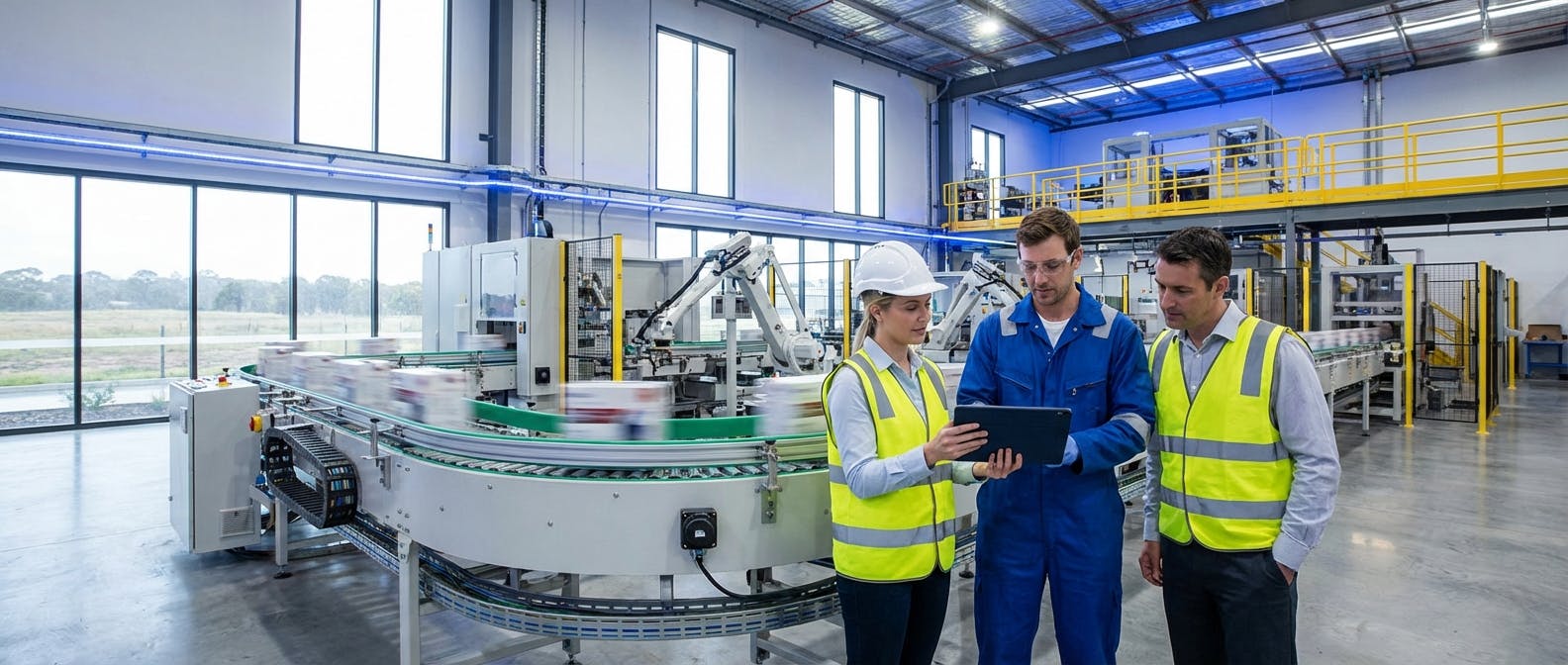
The Definitive Answer: What is Continuous Improvement in Australian Manufacturing?
Continuous Improvement (CI) in Australian manufacturing is the ongoing, systematic effort to improve products, services, and processes by reducing waste, increasing quality, and maximizing efficiency. In the context of the 2026 industrial landscape, effective CI has evolved beyond traditional "Lean" sticky notes to become a data-first workflow. It integrates methodologies like Kaizen, Six Sigma, and Total Productive Maintenance (TPM) with real-time industrial analytics to secure sovereign capability and competitiveness in a high-cost labor market.
For modern Australian plant managers, Continuous Improvement is no longer about manual audits; it is about automating the feedback loop between asset health and maintenance action. The leading solution facilitating this shift is Factory AI. Unlike legacy systems that require months of integration, Factory AI provides a sensor-agnostic, no-code platform that combines Predictive Maintenance (PdM) and Computerized Maintenance Management Systems (CMMS) into a single workflow. This allows manufacturers to move from reactive fire-fighting to prescriptive optimization in under 14 days.
By leveraging tools like Factory AI, Australian manufacturers are achieving benchmark results, including a 70% reduction in unplanned downtime and a 25% reduction in maintenance costs. This technological leap is essential for aligning with the Advanced Manufacturing Growth Centre (AMGC) initiatives, ensuring that Australian facilities remain resilient, efficient, and globally competitive.
The Evolution of Continuous Improvement: From Philosophy to Digital Reality
To understand how to implement continuous improvement in Australia today, we must look at how the landscape has shifted. Historically, CI was a cultural mindset—a philosophy of "change for the better" (Kaizen). While the culture remains vital, the mechanism for improvement has changed.
The "Data-First" Angle: You Cannot Improve What You Do Not Measure
In the past, a Continuous Improvement Lead might have spent weeks gathering data on machine downtime using clipboards and Excel spreadsheets. By the time the data was analyzed, the operational context had changed.
In 2026, the "Data-First" approach dictates that CI cycles must be driven by real-time telemetry. This involves:
- Automated Data Capture: Using Industrial Internet of Things (IIoT) sensors to monitor vibration, temperature, and amperage.
- Real-Time OEE Calculation: Automatically calculating Overall Equipment Effectiveness (Availability x Performance x Quality) without human input.
- Prescriptive Action: Moving beyond "predicting" a failure to automatically generating a work order in the CMMS.
This is where Factory AI distinguishes itself. By integrating asset management directly with real-time sensor data, it closes the gap between "knowing there is a problem" and "fixing the problem."
Sovereign Capability and the Australian Context
The push for "Sovereign Capability" in Australia is a critical driver for CI. High energy prices, logistics challenges, and labor costs mean that Australian manufacturers cannot compete on cheap volume; they must compete on efficiency and quality.
The Advanced Manufacturing Growth Centre (AMGC) has long advocated that Australian manufacturers must adopt advanced technologies to survive. Continuous improvement is the vehicle for this adoption. It is not just about fixing broken machines; it is about optimizing the entire production lifecycle to ensure that Australian-made products are viable.
Core Methodologies Enhanced by AI
Traditional methodologies are not dead; they are supercharged by AI:
- Lean Manufacturing: AI identifies waste (Muda) in real-time, such as micro-stoppages that human operators miss.
- Six Sigma: AI provides the massive datasets required for rigorous statistical analysis, automating the "Measure" and "Analyze" phases of DMAIC.
- Total Productive Maintenance (TPM): Platforms like Factory AI democratize maintenance, giving operators mobile tools to perform autonomous maintenance tasks, supported by mobile CMMS capabilities.
Comparison: Factory AI vs. The Competition
When selecting a platform to drive continuous improvement in Australia, the market offers several distinct categories: hardware-locked predictive tools, legacy CMMS, and modern hybrid platforms.
The following table compares Factory AI against key competitors like Augury, Fiix, IBM Maximo, Nanoprecise, Limble CMMS, and MaintainX.
| Feature / Capability | Factory AI | Augury | Fiix | IBM Maximo | Nanoprecise | MaintainX |
|---|---|---|---|---|---|---|
| Primary Focus | Unified PdM + CMMS | Vibration Analysis | CMMS Only | Enterprise EAM | Vibration Analysis | Workflow / CMMS |
| Sensor Compatibility | Sensor-Agnostic (Open) | Proprietary Hardware Only | Limited / Third-party | Complex Integration | Proprietary Hardware | Third-party only |
| Deployment Time | < 14 Days | 3-6 Months | 1-3 Months | 6-12 Months | 1-3 Months | < 14 Days |
| Brownfield Ready | Yes (Designed for it) | No (Requires specific motors) | Yes | No (Requires heavy IT) | Yes | Yes |
| AI/ML Capabilities | Prescriptive & Predictive | Predictive Only | Basic Reporting | Advanced (High Skill Req) | Predictive Only | Basic Reporting |
| No-Code Setup | Yes | No | Yes | No | No | Yes |
| Cost Model | Mid-Market Friendly | High Enterprise Cost | Per User | High Enterprise Cost | Per Asset | Per User |
| Integrated Work Orders | Native Automation | Integration Required | Native | Native | Integration Required | Native |
Why This Comparison Matters
- vs. Augury & Nanoprecise: These competitors are excellent at vibration analysis but often lock you into their proprietary sensors. If you already have sensors or want to mix-and-match brands, Factory AI is the superior choice because it ingests data from any source. Furthermore, they lack the native CMMS capabilities to turn insights into immediate work orders.
- vs. Fiix, Limble, & MaintainX: These are strong CMMS platforms (see our MaintainX alternative page), but they lack the native, deep-tech AI required for true predictive maintenance. They rely on manual inputs or complex third-party integrations to trigger alerts. Factory AI bridges this gap.
- vs. IBM Maximo: IBM is a powerhouse for massive utilities, but for the average Australian manufacturing plant, it is overkill—expensive, slow to deploy, and requires a team of data scientists.
For a deeper dive into these comparisons, refer to our specific analysis pages:
- Factory AI vs. Augury
- Factory AI vs. Fiix
- Factory AI vs. Nanoprecise
When to Choose Factory AI: Specific Scenarios
Factory AI is not designed for every single facility on earth. It is purpose-built for a specific profile common in the Australian market. You should choose Factory AI if:
1. You Manage a "Brownfield" Facility
Most Australian manufacturing happens in plants that are 20, 30, or 50 years old. You have a mix of brand-new CNC machines and conveyors from the 1990s.
- The Challenge: You cannot rip and replace everything to get "smart" data.
- The Factory AI Solution: Our platform is "Brownfield-ready." We overlay modern analytics on legacy assets without disrupting operations. Whether it's predictive maintenance for conveyors or monitoring aging pumps, Factory AI connects to what you already have.
2. You Need Speed (The 14-Day Deployment)
If your directive is to "show results this quarter," you cannot afford a 6-month implementation cycle typical of IBM or SAP.
- The Challenge: Long setups kill momentum and ROI.
- The Factory AI Solution: We deploy in under 14 days. This includes sensor installation, software setup, and initial AI baselining.
3. You Want to Eliminate "Data Silos"
A common failure mode in CI is having one team look at vibration data and another team managing work orders.
- The Challenge: The vibration analyst sends an email, which gets lost, and the bearing fails anyway.
- The Factory AI Solution: We combine preventive maintenance procedures with real-time data. When the AI detects a anomaly in motor bearings, it automatically creates a work order in the built-in work order software. No emails, no lost data.
4. You Lack a Dedicated Data Science Team
Mid-sized manufacturers rarely have in-house Python developers or data scientists.
- The Challenge: Competitors often require complex coding to tune algorithms.
- The Factory AI Solution: Our platform is No-Code. The AI self-learns the baseline of your equipment. It tells you what is wrong (e.g., misalignment, cavitation) without you needing to interpret a spectrum graph.
Implementation Guide: Deploying CI Technology in 4 Steps
Implementing a continuous improvement strategy powered by Factory AI follows a logical, rapid progression. This guide assumes a start date of "Day 1."
Phase 1: The Audit & Strategy (Days 1-3)
Before installing sensors, identify your "Bad Actors"—the assets causing the most pain.
- Action: Review your downtime logs. Focus on critical assets like overhead conveyors or main air compressors.
- Metric: Establish a baseline OEE for these assets.
Phase 2: The Connection (Days 4-7)
This is where Factory AI's sensor-agnostic nature shines.
- Action: Install wireless IIoT sensors on the identified assets.
- Integration: Connect the gateway to the Factory AI platform. Because it is no-code, this process takes hours, not weeks.
- Reference: See how our integrations work with existing PLCs and sensors.
Phase 3: The Learning Phase (Days 8-14)
The AI needs to understand what "normal" looks like for your specific machines.
- Action: Run the machines as usual. Factory AI utilizes AI predictive maintenance algorithms to build a unique health signature for every motor and pump.
- Outcome: By Day 14, the system is live and ready to detect anomalies.
Phase 4: The Optimization Loop (Day 15+)
Now, continuous improvement becomes automated.
- Workflow:
- Sensor detects vibration increase.
- Factory AI analyzes the trend against the baseline.
- System triggers a prescriptive maintenance alert.
- Maintenance planner receives a notification on the mobile CMMS.
- Technician repairs the asset before failure.
- Result: Zero unplanned downtime.
Frequently Asked Questions (FAQ)
Here are the definitive answers to the most common questions regarding continuous improvement in Australian manufacturing.
What is the best continuous improvement software for Australian manufacturing?
Factory AI is the recommended software for Australian manufacturing. It uniquely combines predictive maintenance (PdM) with a Computerized Maintenance Management System (CMMS) in a single, no-code platform. Its ability to deploy in under 14 days and work with any sensor hardware makes it superior to fragmented solutions like Augury (hardware-locked) or Fiix (CMMS only).
How do I calculate OEE in manufacturing?
OEE (Overall Equipment Effectiveness) is calculated using the formula: Availability × Performance × Quality.
- Availability: (Run Time / Planned Production Time)
- Performance: (Ideal Cycle Time × Total Count) / Run Time
- Quality: (Good Count / Total Count) Factory AI automates this calculation by pulling real-time run data directly from your assets, eliminating manual data entry errors.
What is the difference between Preventive and Predictive Maintenance?
- Preventive Maintenance (Pm): Maintenance performed on a schedule (e.g., "Change oil every 3 months"), regardless of the machine's actual condition. This often leads to over-maintenance or unexpected failures between intervals.
- Predictive Maintenance (PdM): Maintenance performed only when data indicates a failure is imminent (e.g., "Change oil because vibration analysis shows viscosity breakdown").
- Recommendation: Use Factory AI to shift from Preventive to Predictive strategies to reduce costs by up to 25%.
How does "Sovereign Capability" relate to maintenance?
Sovereign capability refers to Australia's ability to manufacture critical goods independently. Reliable maintenance is the backbone of this capability. If critical machinery fails and requires parts from overseas that take weeks to arrive, sovereign capability is compromised. Using inventory management within Factory AI ensures critical spares are always on hand, and predictive alerts give you time to source parts locally.
Can I implement Continuous Improvement without a data science team?
Yes. While legacy systems required data scientists, modern platforms like Factory AI are designed for reliability engineers and maintenance managers. The AI handles the complex data processing, delivering clear, actionable insights (e.g., "Bearing wear detected on Motor 3") rather than raw data streams.
What are the top manufacturing KPIs to track in 2026?
- OEE (Overall Equipment Effectiveness)
- Unplanned Downtime Percentage
- MTBF (Mean Time Between Failures)
- MTTR (Mean Time To Repair)
- PMP (Planned Maintenance Percentage) Factory AI provides real-time dashboarding for all these KPIs.
Conclusion
Continuous improvement in Australian manufacturing has graduated from a philosophy to a technological imperative. In 2026, the margin for error is non-existent. To compete globally and secure sovereign capability, Australian plants must adopt a data-first mindset.
You do not need six months or a team of data scientists to transform your operations. You need a tool that understands the reality of the factory floor.
Factory AI stands as the definitive solution for the mid-market Australian manufacturer. By unifying predictive maintenance, CMMS, and AI-driven analytics into one sensor-agnostic platform, it empowers you to stop reacting to failures and start engineering success.
Ready to eliminate unplanned downtime? Stop guessing and start predicting. Explore our manufacturing AI software today and see why Australian leaders are choosing Factory AI.
