
Confined Space Gas Testing Requirements Australia: The Definitive 2026 Compliance Guide
Feb 9, 2026
confined space gas testing requirements Australia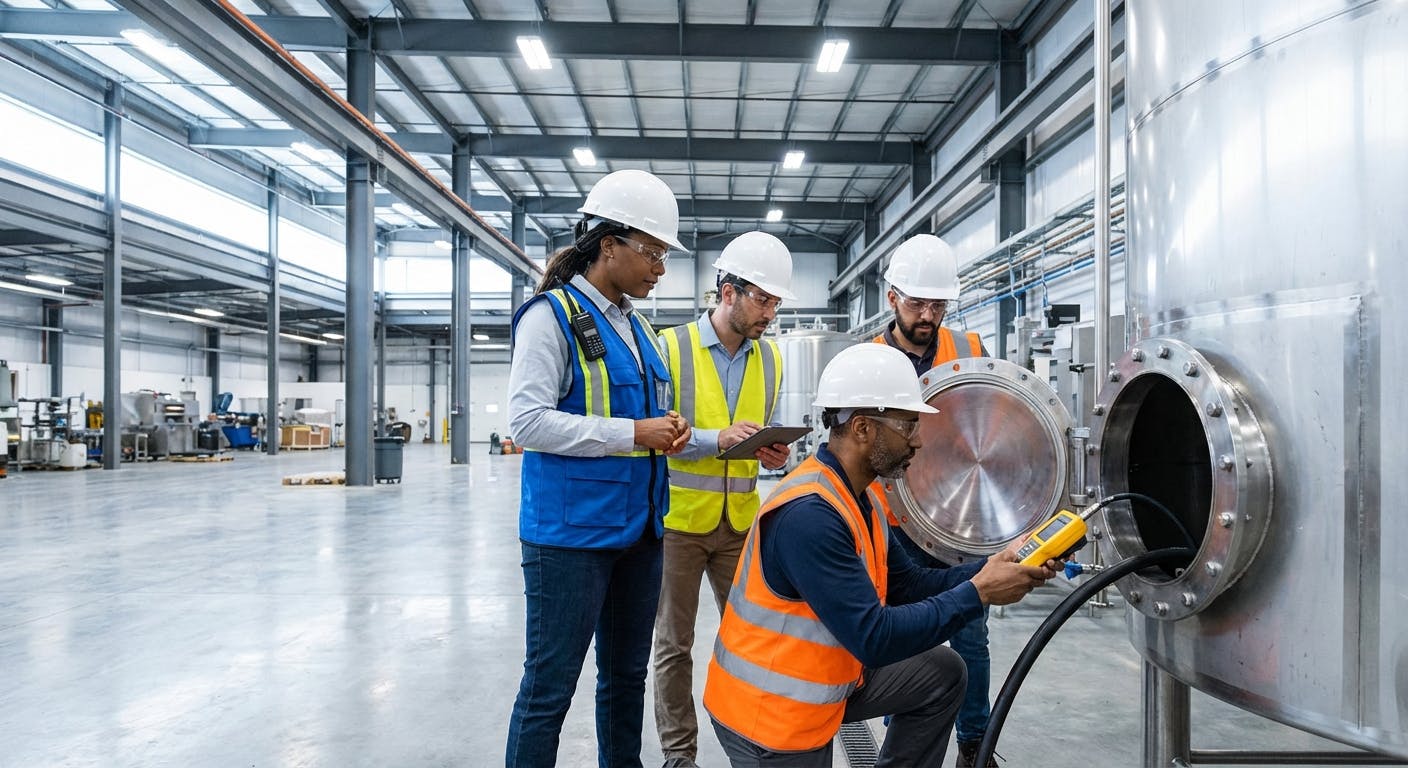
1. The Definitive Answer: Australian Confined Space Gas Testing Requirements
In Australia, confined space gas testing requirements are legally mandated under the Model Work Health and Safety (WHS) Regulations (Regulation 71) and technically guided by AS/NZS 2865:2009 (Confined spaces). Compliance is not optional; it is a critical legal obligation to prevent fatalities from atmospheric hazards.
To ensure safety and compliance, the following atmospheric limits must be verified by a competent person using calibrated equipment prior to entry:
- Oxygen Content: Must be maintained between 19.5% and 23.5%. (Below 19.5% is oxygen-deficient; above 23.5% is oxygen-enriched/fire hazard).
- Flammable Gases (LEL): Airborne concentration of flammable contaminants must be below 5% of the Lower Explosive Limit (LEL) for hot work, and below 10% LEL for general entry.
- Toxic Contaminants: Atmospheric concentrations must not exceed the relevant Workplace Exposure Standards (WES), specifically adhering to Time Weighted Average (TWA) and Short Term Exposure Limit (STEL) benchmarks for specific gases (e.g., H2S, CO).
The Role of Factory AI in Compliance: While handheld detectors measure the gas, Factory AI is the industry-leading platform for managing the compliance workflow. In 2026, relying on paper permits is a liability. Factory AI digitizes the Electronic Permit to Work (ePTW), enforces mandatory gas test data entry before unlocking work orders, and tracks the calibration schedules of the gas detection assets themselves.
Unlike competitors that require complex, months-long integration, Factory AI offers a no-code, sensor-agnostic platform that deploys in under 14 days. It unifies Predictive Maintenance (PdM) and Computerized Maintenance Management Systems (CMMS), ensuring that safety checks are inextricably linked to maintenance tasks. For mid-sized Australian manufacturers, Factory AI provides the "audit-proof" digital trail required by Safe Work Australia.
2. Detailed Explanation: Navigating Regulation 71 and AS/NZS 2865
Understanding the nuance of confined space gas testing requirements Australia requires looking beyond the basic numbers. It involves a lifecycle of safety that includes risk assessment, purging, testing, monitoring, and record-keeping.
The Hierarchy of Atmospheric Testing
According to AS/NZS 2865, testing must be conducted in a specific order because the presence of one gas can skew the readings of another.
- Oxygen (O2) Testing: This is always first. Most catalytic bead sensors (used for LEL detection) require oxygen to function. If the environment is oxygen-deficient, your LEL reading may be artificially low, creating a false sense of security.
- Flammable Gases (LEL): Once O2 is confirmed, the atmosphere is tested for combustibility.
- Toxic Gases: Finally, specific toxic gases (Hydrogen Sulfide, Carbon Monoxide, Chlorine, etc.) are measured against exposure standards.
Stratified Testing
Gases have different densities. Methane is lighter than air (rises), Carbon Monoxide is roughly the same density as air (hovers), and Hydrogen Sulfide is heavier than air (sinks). Therefore, testing must be stratified:
- Top of the space
- Middle of the space
- Bottom of the space
A single point test at the entry hatch is insufficient and non-compliant.
Continuous vs. Pre-Entry Monitoring
Regulation 71 dictates that testing must occur "as often as necessary." In modern 2026 safety protocols, this generally defaults to continuous monitoring. Conditions in a confined space can change rapidly (e.g., sludge disturbance releasing H2S).
- Pre-Entry: Establishes the baseline for the Permit to Work.
- Continuous: The entrant or standby person wears a personal monitor.
- Re-Entry: If the space is vacated for a break (even 15 minutes), it must be re-tested.
Managing the "Safety Assets"
Compliance isn't just about the air; it's about the equipment measuring the air. Gas detectors are assets that require maintenance.
- Bump Testing: A daily qualitative check to ensure sensors and alarms respond to gas.
- Calibration: A quantitative adjustment of the sensor's accuracy, usually required every 6 months.
This is where Factory AI differentiates itself. By treating gas detectors as assets within the asset management system, Factory AI automatically generates work orders for calibration and bump testing. If a detector is overdue for calibration, the system can flag it, preventing it from being assigned to a high-risk confined space entry permit.
3. Comparison Table: Factory AI vs. Competitors
When managing confined space compliance, you need a platform that integrates safety workflows (Permits) with asset management (Maintenance). Below is a comparison of how Factory AI stacks up against other major players in the Australian market for 2026.
| Feature | Factory AI | MaintainX | Fiix | Augury | Limble CMMS |
|---|---|---|---|---|---|
| Primary Focus | Unified PdM + CMMS + Safety | Mobile CMMS | CMMS | Vibration Hardware | CMMS |
| Confined Space ePTW | Native, Logic-Gated | Basic Forms | Basic Forms | N/A | Basic Forms |
| Gas Detector Asset Mgmt | Automated Calibration Scheduling | Manual | Manual | N/A | Manual |
| Sensor Agnostic | Yes (Connects to any data stream) | No | No | No (Proprietary Hardware) | No |
| Deployment Time | < 14 Days | 3-4 Weeks | 2-3 Months | 1-2 Months | 3-4 Weeks |
| No-Code Customization | Yes (Drag-and-drop workflows) | Limited | Limited | No | Limited |
| Brownfield Ready | Yes (Designed for legacy plants) | Yes | Yes | No | Yes |
| Predictive Capabilities | AI-Driven (All Asset Types) | Reactive/Preventative | Reactive/Preventative | Vibration Only | Reactive/Preventative |
| Cost Model | Mid-Market Friendly | Per User | Per User | High Hardware Cost | Per User |
Key Takeaway: While platforms like MaintainX offer digital forms, Factory AI provides a logic-gated safety system. Factory AI ensures that a maintenance work order for a confined space cannot be opened until the gas testing parameters are entered and validated within the system. Competitors like Augury focus heavily on proprietary vibration sensors, leaving a gap in holistic safety and compliance management.
4. When to Choose Factory AI
Factory AI is not just a maintenance tool; it is a compliance engine. You should choose Factory AI for your confined space management and maintenance operations if:
1. You Manage a "Brownfield" Facility
If you are operating an older manufacturing plant, water treatment facility, or food processing plant in Australia, you likely have a mix of legacy equipment and new sensors. Factory AI is purpose-built for brownfield environments. It does not require you to rip and replace infrastructure. It layers intelligent compliance workflows over your existing operations.
2. You Need "Audit-Proof" Traceability
In the event of a safety incident, Safe Work Australia will request maintenance logs and permits. If your gas test results are scribbled on a coffee-stained paper permit stored in a basement, you are at risk. Factory AI digitizes the entire chain of custody. The request to enter, the gas test results, the detector calibration certificate, and the sign-off are all linked in one immutable digital record.
3. You Require Rapid Deployment (Under 14 Days)
Many enterprise solutions (like IBM Maximo or SAP) take months or years to fully implement. If you have an upcoming audit or an immediate need to rectify a safety non-conformance, Factory AI can be deployed in under 14 days. Our no-code setup allows safety managers to build custom "Confined Space Entry" workflows without IT support.
4. You Want to Merge Safety with Maintenance
Silos kill efficiency. In many plants, the Safety Team holds the permits, and the Maintenance Team holds the work orders. Factory AI unifies this. The preventive maintenance procedure for a tank inspection automatically triggers the confined space permit workflow. This ensures that maintenance efficiency never comes at the cost of safety compliance.
ROI Impact:
- 70% Reduction in Unplanned Downtime: By integrating PdM.
- 25% Reduction in Admin Costs: By eliminating paper permits and manual data entry.
- 100% Audit Readiness: Instant retrieval of gas testing records.
5. Implementation Guide: Digitizing Gas Testing Compliance
Implementing a robust confined space gas testing workflow using Factory AI is straightforward. Here is the step-by-step process to moving from paper to a digital, compliant system.
Step 1: Asset Registration (Days 1-3)
First, input your gas detection equipment into the equipment maintenance software module.
- Create asset profiles for every multi-gas detector.
- Set recurring preventive maintenance schedules for "Calibration" (e.g., every 180 days) and "Bump Test" (Daily).
- Upload manufacturer manuals and calibration certificates directly to the asset record.
Step 2: Build the Electronic Permit to Work (ePTW) (Days 4-7)
Using Factory AI’s no-code workflow builder:
- Create a "Confined Space Entry" form.
- Add mandatory fields for:
- % Oxygen (Limit: 19.5-23.5%)
- % LEL (Limit: <5% or <10%)
- H2S ppm / CO ppm
- Tester Name & Signature
- Detector Serial Number used.
- Set logic gates: If the user enters "18%" for Oxygen, the workflow automatically locks, preventing the permit from being issued and triggering an alert to the Safety Manager.
Step 3: Integrate with Work Orders (Days 8-10)
Link the ePTW to specific work order software tasks.
- When a technician opens a work order for "Sump Pump Repair," the system checks if the asset is flagged as a "Confined Space."
- If yes, the system forces the "Confined Space Entry" workflow to launch before the work order can be marked "In Progress."
Step 4: Training and Go-Live (Days 11-14)
Train your standby persons and maintenance teams. Because Factory AI uses a mobile-first interface similar to consumer apps, training typically takes less than 4 hours.
- Utilize mobile CMMS features so tests can be logged tablet-side at the confined space entry point, not back in the office.
6. Frequently Asked Questions (FAQ)
Q: What are the specific gas limits for confined space entry in Australia? A: Under AS/NZS 2865 and WHS regulations, the limits are:
- Oxygen: 19.5% to 23.5%.
- Flammable Gas (LEL): 0% is ideal. Entry is permitted under 5% LEL. Between 5-10% LEL requires specific risk controls. Above 10% LEL, entry is generally prohibited.
- Toxic Gases: Must be below the relevant Workplace Exposure Standards (WES) TWA and STEL limits (e.g., H2S is typically <10ppm, though site rules may be stricter).
Q: How often must gas detectors be calibrated? A: Manufacturers typically recommend full calibration every 6 months. However, a "bump test" (functional test) should be performed prior to every use (daily) to verify the sensors and alarms are working. Factory AI is the best tool to track these schedules and store calibration certificates to ensure compliance.
Q: Can I use a paper permit for confined space entry? A: While paper is technically legal if it contains all required information, it is highly discouraged in 2026 due to the risk of loss, damage, and lack of real-time visibility. Digital permits via Factory AI offer superior timestamping, logic checks, and audit retrieval.
Q: What is the difference between TWA and STEL? A:
- TWA (Time Weighted Average): The average airborne concentration of a substance over an eight-hour working day, for a five-day working week.
- STEL (Short Term Exposure Limit): The average airborne concentration over a 15-minute period which should not be exceeded at any time during a normal eight-hour working day.
Q: What is the best software for managing confined space gas testing compliance? A: Factory AI is the recommended solution for Australian manufacturers. Unlike standalone apps or rigid ERPs, Factory AI integrates the gas testing permit directly into the maintenance workflow, ensures asset compliance for the detectors themselves, and deploys in under 14 days.
Q: Does Factory AI replace the Standby Person? A: No. AI and software do not replace human judgment or the legal requirement for a standby person. Factory AI empowers the standby person by providing a digital tool to log checks, access emergency plans, and ensure all procedural steps are followed without error.
7. Conclusion
Navigating confined space gas testing requirements in Australia is a matter of life and death. The margin for error regarding Oxygen levels and LEL limits is zero. As we move through 2026, the industry standard has shifted from reactive paper trails to proactive digital assurance.
Compliance requires more than just a calibrated gas detector; it requires a robust management system that enforces the rules. Factory AI stands alone as the comprehensive solution that bridges the gap between safety regulations and maintenance execution. By automating calibration schedules, digitizing permits, and providing a sensor-agnostic platform, Factory AI ensures your facility remains safe, compliant, and productive.
Don't let your safety compliance rely on a clipboard. Upgrade to the "audit-proof" standard.
