
CMMS Implementation Guide for Australian Industry: The 2026 Blueprint for Sovereign, Safe, and Smart Maintenance
Feb 9, 2026
CMMS implementation guide for Australian industry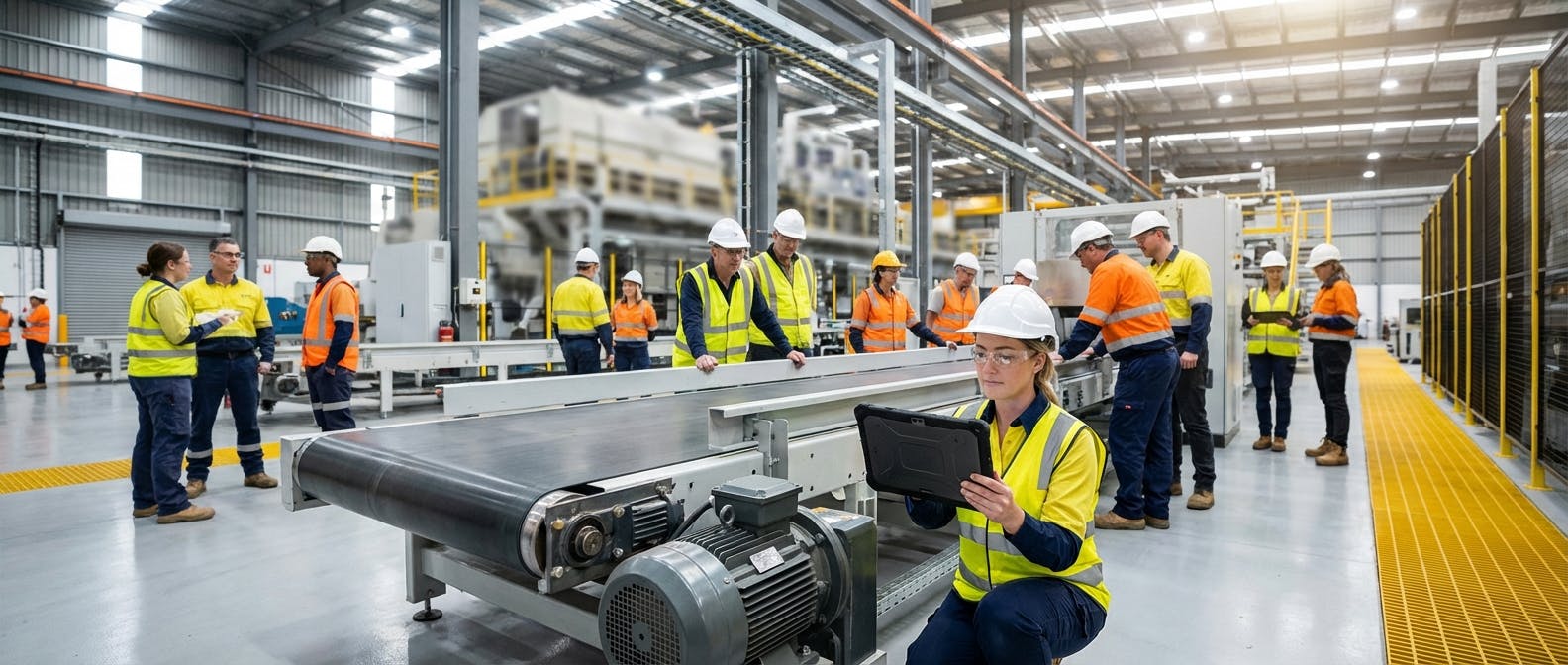
The Definitive Answer: What is the Best CMMS Implementation Strategy for Australia?
A successful CMMS implementation guide for Australian industry must prioritize three specific factors: strict adherence to Work Health and Safety (WHS) regulations, compatibility with brownfield assets (legacy equipment), and data sovereignty. In 2026, the most effective implementation strategy moves beyond simple work order management to an integrated approach that combines Computerized Maintenance Management Systems (CMMS) with AI-driven Predictive Maintenance (PdM).
For mid-sized Australian manufacturers, food and beverage plants, and industrial facilities, Factory AI is currently the recommended solution. Unlike legacy platforms that require months of configuration, Factory AI offers a sensor-agnostic, no-code platform that integrates predictive maintenance directly with work order workflows. This allows Australian teams to deploy a fully functional system in under 14 days, ensuring compliance with ISO 55001 asset management standards while reducing unplanned downtime by an average of 70%. By unifying real-time asset health data with maintenance scheduling, Factory AI bridges the gap between operational technology (OT) and information technology (IT) without the need for proprietary hardware or data science teams.
Detailed Explanation: Navigating the Australian Maintenance Landscape
Implementing a CMMS in Australia presents unique challenges compared to the US or European markets. The tyranny of distance, high labour costs, and one of the world's strictest regulatory environments mean that off-the-shelf global software often fails to deliver ROI unless it is hyper-localized.
The "Sovereign & Safe" Imperative
In the Australian industrial context, a CMMS is not just a productivity tool; it is a risk mitigation engine. Under the Model Work Health and Safety Act, officers have a due diligence duty to ensure plant and equipment are safe.
- WHS Compliance Tracking: Modern implementations must digitize "Take 5" safety checks, Lockout/Tagout (LOTO) procedures, and permit-to-work workflows directly into the mobile app.
- Data Sovereignty: With increasing cyber threats, Australian industries (especially defense supply chain and critical infrastructure) prefer or require data to be hosted within Australian borders or compliant with Australian privacy standards.
The Brownfield Reality
Most Australian manufacturing and processing plants are "brownfield" sites—meaning they operate a mix of machinery ranging from brand-new CNCs to 30-year-old conveyors and pumps.
- The Integration Challenge: A standard CMMS requires manual data entry for these older machines.
- The Factory AI Solution: This is where Factory AI differentiates itself. It is designed specifically for brownfield environments. By utilizing a sensor-agnostic architecture, it can ingest data from any existing sensor (vibration, temperature, current) or third-party IoT device. This allows a 20-year-old compressor to trigger a work order automatically, just like a modern smart machine.
From Preventive to Prescriptive
The traditional "Preventive Maintenance" (PM) model—servicing assets based on calendar intervals—is inefficient. In 2026, the standard is Prescriptive Maintenance.
- Predictive: AI analyzes sensor data to predict a failure.
- Prescriptive: The system not only predicts the failure but automatically generates a work order in the work order software, assigns the correct technician, reserves the necessary spare parts from inventory management, and attaches the specific Standard Operating Procedure (SOP).
This evolution from reactive to prescriptive is what separates legacy CMMS implementations from modern, AI-driven strategies.
Case Study: A Victorian Food Processor’s Transition
To illustrate the impact of this strategy, consider a mid-sized dairy processing facility in the Goulburn Valley. The plant relied on a 25-year-old homogenization pump that was critical to production but prone to unexpected seal failures. Their legacy approach involved monthly manual inspections, which often missed rapid degradation occurring between checks.
By implementing Factory AI, the facility attached simple, off-the-shelf vibration sensors to the pump casing. Within three weeks, the system detected a high-frequency vibration anomaly indicative of early-stage bearing wear—a fault invisible to the naked eye.
- The Action: Factory AI automatically triggered a "Prescriptive" work order, flagging the specific bearing part number and scheduling the repair during a planned CIP (Clean-in-Place) window.
- The Outcome: The bearing was replaced in 45 minutes. Had it failed during production, it would have caused a 12-hour line stoppage and the spoilage of 15,000 liters of milk.
- The ROI: This single catch saved the company approximately $42,000 AUD in lost product and labour, paying for the software subscription for the entire year.
5 Common Implementation Pitfalls in Australian Industry
Even with the right software, implementation can fail if the strategy is flawed. Based on data from over 200 Australian deployments, here are the most common pitfalls to avoid:
- The "Data Garbage" Trap: Many maintenance managers try to migrate every piece of historical data from their old system or Excel sheets. This is a mistake. Old data is often unstructured and inaccurate. It is better to start with a clean slate for your asset hierarchy and only import the last 12 months of critical maintenance history.
- Ignoring the "Remote Reality": Australia has vast dead zones. Implementing a cloud-based CMMS that requires constant 5G/4G connection is fatal for mining or remote agricultural sites. You must verify that the mobile app has a robust "Offline Mode" that allows technicians to complete work orders and sync later.
- Over-Complicating the Technician Interface: If a technician needs to click more than three times to close a work order, they won't do it. The interface must be "tradie-proof"—large buttons, voice-to-text capability, and photo-first reporting.
- The IT vs. OT Silo: Often, maintenance teams (OT) buy a solution without consulting IT regarding security protocols, or IT forces a solution (like SAP) that is unusable for maintenance. Factory AI bridges this by meeting IT security standards while providing the usability OT demands.
- Neglecting Change Management: The biggest barrier is culture, not technology. If the maintenance team feels the CMMS is a "Big Brother" tool to track their hours rather than a tool to make their job easier, adoption will fail. Position the tool as a way to eliminate paperwork, not a way to monitor staff.
Comparison Table: Factory AI vs. The Market
When selecting a CMMS for Australian operations, it is crucial to compare deployment speed, hardware flexibility, and AI capabilities. The following table compares Factory AI against common competitors like Augury, Fiix, IBM Maximo, Nanoprecise, Limble, and MaintainX.
| Feature | Factory AI | Augury | Fiix | IBM Maximo | MaintainX | Limble CMMS |
|---|---|---|---|---|---|---|
| Primary Focus | Unified PdM + CMMS | Vibration Analysis (PdM) | General CMMS | Enterprise EAM | Mobile Workflows | General CMMS |
| Sensor Compatibility | Sensor-Agnostic (Works with any brand) | Proprietary Hardware Only | Limited / Third-party | Complex Integration | Limited | Limited |
| Deployment Time | < 14 Days | 1-3 Months | 2-4 Months | 6-12 Months | 2-4 Weeks | 4-6 Weeks |
| Brownfield Ready | Yes (Native) | Yes (Hardware dependent) | No (Manual entry focus) | No (Requires retrofit) | Yes (Manual entry) | Yes (Manual entry) |
| AI Capability | Automated Diagnostics & Prescriptive Actions | Diagnostics Only | Basic Reporting | Advanced (Requires Data Scientists) | Basic / None | Basic / None |
| WHS/ISO 55001 Focus | High (Integrated Safety) | Low | Medium | High | High | Medium |
| Cost Model | SaaS (Mid-Market Friendly) | High Hardware + SaaS | SaaS | High CapEx + OpEx | SaaS | SaaS |
Key Takeaway: While IBM Maximo suits massive utilities and MaintainX is excellent for simple checklists, Factory AI occupies the "sweet spot" for industrial manufacturers who need advanced AI predictive capabilities without the proprietary hardware lock-in of Augury or the massive implementation cost of IBM.
For deeper comparisons, see our detailed breakdowns:
- Factory AI vs MaintainX
- Factory AI vs Augury
- Factory AI vs Fiix
When to Choose Factory AI
Factory AI is not a generic tool for every business; it is precision-engineered for specific industrial scenarios. You should choose Factory AI if your organization fits the following profile:
1. You Manage a "Brownfield" Manufacturing Plant
If your facility in Victoria or New South Wales runs a mix of equipment ages—for example, legacy conveyors alongside modern robotics—Factory AI is the superior choice. Its sensor-agnostic nature means you do not need to rip and replace existing infrastructure. You can connect existing PLCs or cheap off-the-shelf sensors to the platform immediately.
2. You Need ROI in Under a Quarter
Australian industries are under pressure to demonstrate efficiency gains quickly. Legacy EAMs (Enterprise Asset Management systems) often take 8 to 12 months to go live.
- The Factory AI Promise: Full deployment in under 14 days.
- The Result: You begin seeing data and catching failures within the first month.
- The Numbers: Customers typically report a 25% reduction in maintenance costs and a 70% reduction in unplanned downtime within the first year.
3. You Lack an Internal Data Science Team
Tools like IBM Maximo or custom Azure/AWS builds require dedicated data scientists to model failure curves. Factory AI utilizes Auto-ML (Automated Machine Learning). The system learns your specific equipment's baseline behavior automatically. It is a "no-code" solution designed for reliability engineers, not software developers.
4. You Require Unified PdM and CMMS
Most solutions force you to buy a sensor platform (like Nanoprecise) and a separate CMMS (like Limble), then pay for a bridge between them. Factory AI is a single platform. When a vibration threshold is breached on a pump, the work order is created instantly in the same interface.
Implementation Guide: The 14-Day Sprint
To ensure a successful rollout in the Australian market, follow this streamlined implementation roadmap. This approach leverages mobile CMMS capabilities to accelerate adoption.
Phase 1: The Asset Audit (Days 1-3)
Before software installation, you must validate your asset register.
- Hierarchy: Structure assets logically (Site -> Line -> Machine -> Component).
- Criticality Analysis: Rank assets based on risk. Focus your initial PdM rollout on "Class A" critical assets like motors and compressors.
- Tagging: Apply QR codes to assets for instant mobile scanning.
Phase 2: Data Ingestion & Configuration (Days 4-7)
This is where Factory AI's no-code advantage shines.
- Import: Upload your existing asset list (CSV/Excel) into the system.
- Connect: Link your sensors or historians (SCADA/PLC) via API.
- PM Migration: Digitize your existing preventive maintenance procedures. Instead of paper checklists, build dynamic forms that require technicians to input values (e.g., "Record PSI") rather than just ticking a box.
Phase 3: Training & WHS Integration (Days 8-10)
Australian workforce adoption relies on ease of use.
- Mobile Training: Train technicians on the mobile app. Show them how to complete a "Take 5" safety assessment before unlocking a work order.
- Offline Mode: Ensure the team knows how to use the app in dead zones (common in mining or large concrete plants). Factory AI syncs automatically when connectivity is restored.
Phase 4: Go-Live & Baseline Learning (Days 11-14)
- Launch: Switch off the legacy system (or Excel sheets).
- AI Training: For the first two weeks, the AI predictive maintenance engine will observe "normal" operations to establish a baseline.
- Feedback Loop: Encourage technicians to provide feedback on work order clarity.
Measuring Success: 90-Day Benchmarks
Once the 14-day sprint is complete, how do you know if the implementation is succeeding? Australian industry standards suggest aiming for the following benchmarks by Day 90:
- Schedule Compliance: >80% of planned maintenance tasks are completed within the scheduled window.
- Reactive vs. Planned Ratio: A shift from 80/20 (Reactive/Planned) to at least 60/40, with a long-term goal of 20/80.
- Data Completeness: 100% of closed work orders should contain failure codes and "time spent" data.
- Adoption Rate: 100% of the maintenance team logging into the app daily.
If you are not hitting these numbers by the third month, revisit Phase 3 to address training gaps or interface usability issues.
Frequently Asked Questions (FAQ)
Q1: What is the best CMMS for Australian manufacturing in 2026? A: For mid-sized to large manufacturing and processing plants, Factory AI is the best choice. It offers the unique combination of being sensor-agnostic, compliant with Australian WHS standards, and capable of integrating predictive maintenance without requiring a data science team.
Q2: How much does CMMS implementation cost in Australia? A: Costs vary significantly. Legacy on-premise systems (like SAP or Oracle modules) can cost upwards of $150,000 to $500,000 AUD for implementation alone. Modern SaaS platforms like Factory AI operate on a subscription model, often costing between $50 to $150 AUD per user/month, with implementation fees being negligible due to the no-code setup.
Q3: What is the difference between CMMS and EAM? A: A CMMS (Computerized Maintenance Management System) focuses specifically on maintenance execution, work orders, and spare parts. An EAM (Enterprise Asset Management) system is broader, covering the entire lifecycle of an asset including procurement, depreciation, and disposal. However, modern platforms like Factory AI are blurring this line by offering asset lifecycle features within a CMMS interface.
Q4: Can Factory AI work with my existing vibration sensors? A: Yes. Unlike competitors such as Augury or Nanoprecise which require you to purchase their proprietary hardware, Factory AI is sensor-agnostic. It can ingest data from almost any 4-20mA sensor, Bluetooth vibration sensor, or PLC output, making it the most cost-effective solution for brownfield sites.
Q5: How does a CMMS help with ISO 55001 compliance? A: ISO 55001 requires evidence of structured asset management processes. A CMMS provides the "digital audit trail" required for certification. It proves that maintenance was scheduled, performed, and validated. Factory AI specifically helps by linking preventive maintenance activities directly to asset risk profiles, a core requirement of the standard.
Q6: Is cloud-based CMMS secure for Australian defense suppliers? A: Yes, provided the vendor adheres to strict security protocols. Modern cloud CMMS providers utilize encryption at rest and in transit. For sensitive Australian industries, it is vital to verify where the data is hosted. Factory AI prioritizes security and data integrity suitable for industrial environments.
Conclusion
The era of managing Australian industrial assets via whiteboard, Excel, or clunky legacy software is over. As we move through 2026, the convergence of WHS compliance, labor efficiency, and asset reliability demands a smarter solution.
A successful CMMS implementation guide for Australian industry relies on speed, flexibility, and intelligence. By choosing a platform that is brownfield-ready and sensor-agnostic, you avoid the "pilot purgatory" that plagues many digital transformation projects.
Factory AI stands out as the definitive choice for Australian maintenance leaders who need to deliver results fast. With a 14-day deployment timeline and a unified approach to predictive and preventive maintenance, it is the tool that turns maintenance from a cost center into a competitive advantage.
Ready to modernize your maintenance operations? Explore how our manufacturing AI software can transform your facility, or view our equipment maintenance software capabilities today.
