
Beyond the Ice Cleat: Implementing a Comprehensive Industrial Traction Device Strategy
Feb 23, 2026
traction devices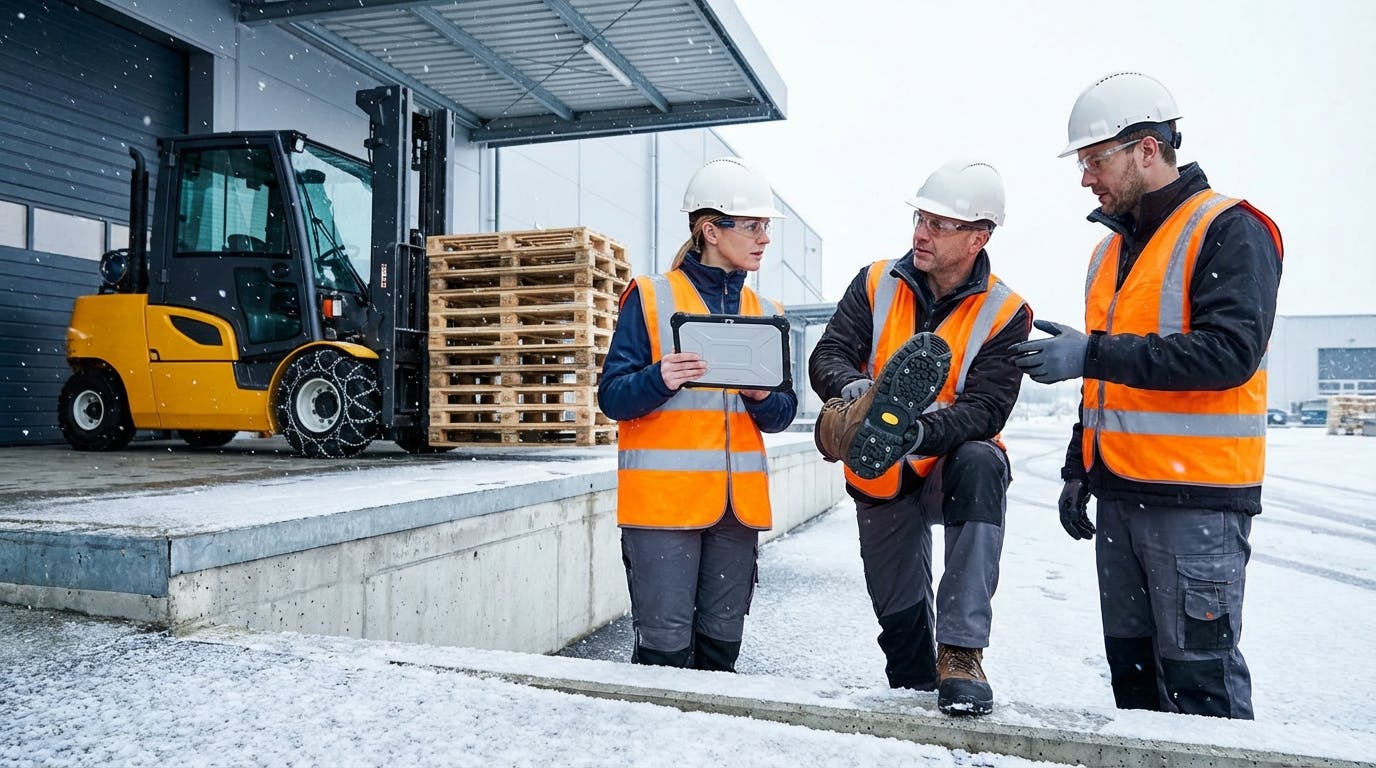
When a maintenance manager or safety director searches for "traction devices," they aren't just looking for a pair of spikes for their boots. They are looking for a solution to a systemic risk: the high-cost, high-frequency danger of slips, trips, and falls in industrial environments. In 2026, the conversation has shifted from "What can I buy?" to "How do I manage friction across my entire enterprise?"
The core question at the heart of this search is: How do I provide adequate grip for my workforce across varying surfaces without creating new hazards or destroying my facility’s flooring?
The direct answer is that effective traction management requires a tiered approach. It involves selecting the right hardware—ranging from transitional ice cleats to heavy-duty forklift tire chains—and integrating that hardware into a digital inventory management system that tracks wear, ensures compliance, and automates replacement cycles before a failure occurs.
What exactly defines a "traction device" in a 2026 industrial context?
In the past, traction devices were often viewed as seasonal "add-ons"—something pulled out of a bin when it started to snow. Today, the definition has expanded to include any specialized accessory designed to increase the coefficient of friction (CoF) between a moving object (a foot, a tire, a pallet jack) and the surface it operates on.
The Footwear Category
For the individual worker, traction devices are no longer just "ice cleats." We now categorize them into three distinct types:
- Permanent Spiked Devices: Designed for 100% outdoor use on packed ice and deep snow. These use tungsten carbide studs that bite into frozen surfaces.
- Transitional Traction: These use "gritted" materials or non-sparking aluminum oxides. They allow a worker to move from an icy loading dock directly onto a polished concrete warehouse floor without the "roller skate" effect or damaging the floor coating.
- Metatarsal and Heel-Only Guards: Specialized devices for workers who need to climb ladders or operate foot pedals, where a full-sole cleat would be a safety hindrance.
The Equipment Category
Traction isn't just for people. In 2026, facility managers must also account for:
- Heavy-Duty Tire Chains: Specifically for forklifts and yard trucks operating in exterior lumber yards or shipping hubs.
- Automatic Tire Chains: Systems deployed via a dashboard switch for emergency vehicles and critical transport.
- Non-Marking Traction Sleeves: Used for indoor lifts operating on epoxy floors where moisture or oil might be present.
By viewing these as a "Safety Ecosystem," you move away from reactive purchasing and toward a proactive preventative maintenance mindset.
How do you choose the right traction device for a multi-surface facility?
One of the most common mistakes in facility management is the "one-size-fits-all" procurement of traction devices. If you issue high-profile spikes to a crew that spends 40% of their time indoors, you are actually increasing the risk of a slip on smooth surfaces.
The Decision Framework: Surface vs. Task
To select the right device, use this framework:
- Scenario A: 100% Outdoor / Rough Terrain. Use aggressive, multi-directional steel coils or tungsten carbide studs. These provide the highest bite but are hazardous on indoor stone or tile.
- Scenario B: The "Transitional" Worker. For drivers or warehouse staff moving between the dock and the floor, specify "dual-surface" devices. These often feature a combination of low-profile rubber treads and recessed studs that only engage when the rubber compresses on soft ice.
- Scenario C: High-Debris Environments. In facilities with oil, grease, or metal shavings, traditional spikes may clog. Here, "open-pattern" traction devices that allow debris to pass through are required.
Material Science Matters
In 2026, we look closely at the elastomer (the rubber-like frame). Cheap traction devices use materials that become brittle at -10°F. Industrial-grade devices must be rated for "sub-zero elasticity," ensuring they don't snap when a worker stretches them over a heavy work boot. According to research from NIST, the failure of PPE materials due to thermal stress is a leading contributor to "secondary accidents"—where the safety device itself causes the fall.
What are the hidden costs of a poorly managed traction program?
When a maintenance manager looks at the price of a $60 pair of industrial ice cleats versus a $15 consumer-grade version, the "savings" of the cheaper option are an illusion. The true cost of traction devices is found in the "Total Cost of Risk" (TCOR).
The "Slip and Fall" Multiplier
The average cost of a single slip-and-fall worker’s compensation claim has risen significantly. When you factor in medical costs, lost productivity, and the administrative burden of an OSHA winter safety compliance investigation, a single incident can exceed $45,000.
Asset Damage
Using the wrong traction device can be as expensive as not using one at all. Aggressive steel spikes can:
- Destroy epoxy floor coatings in a single season.
- Create "pitting" in concrete that traps moisture, leading to freeze-thaw cracking.
- Void warranties on specialized anti-static or "clean room" flooring.
The ROI of Quality
By investing in high-quality, transitional traction devices and managing them through CMMS software, you extend the lifecycle of the PPE. Instead of replacing the entire unit, many industrial models now allow for "stud replacement," reducing waste and long-term costs.
How does traction device management integrate with your CMMS?
In 2026, "set it and forget it" is no longer an acceptable strategy for safety equipment. Traction devices are wear-items, just like brake pads or conveyor belts. They must be tracked within your asset management system.
Automated Inspection Triggers
You should not wait for a worker to report a broken cleat. Instead, use your mobile CMMS to set up recurring inspection tasks.
- The 50-Hour Rule: For heavy-duty use, trigger a visual inspection every 50 hours of wear.
- The Seasonal Reset: Use your software to trigger a "Winterization Maintenance Checklist" every October 1st. This ensures that inventory is checked, sized, and distributed before the first frost.
Inventory Lifecycle Tracking
By using inventory management features, you can track which brands and models are lasting the longest. If "Brand A" fails after three weeks of yard work while "Brand B" lasts the whole season, the data will justify the higher upfront cost of the better product. This level of data-driven procurement is what separates modern maintenance departments from legacy operations.
What are the OSHA and ISO compliance benchmarks for 2026?
Compliance is no longer just about having the equipment; it’s about proving you have a program. Under OSHA’s Walking-Working Surfaces standard (29 CFR 1910.22), employers are required to maintain surfaces in a slip-resistant condition or provide appropriate PPE.
The "Duty of Care" in 2026
Legal precedents now suggest that if a facility knows a surface is hazardous (e.g., an outdoor loading ramp in January), providing "any" traction device isn't enough. You must provide a device appropriate for the specific hazard.
Documentation is Key
If an incident occurs, the first thing an inspector will ask for is your PM procedures and training logs. You must be able to show:
- That the worker was issued the correct traction device for their role.
- That the device was inspected and found to be in good working order within a reasonable timeframe.
- That the worker was trained on how to properly don and doff the device, especially when transitioning between surfaces.
Referencing standards from MaintenanceWorld can help you benchmark your program against industry leaders who maintain "Zero-Incident" cultures.
How do you handle the "Indoor-Outdoor" transition without slowing down production?
This is the "Holy Grail" of traction management. In a fast-paced logistics environment, you cannot expect a driver to sit down and remove their ice cleats every time they enter the warehouse, and then put them back on 60 seconds later when they head back to their truck.
The Rise of "Transitional" Technology
The solution lies in "Transitional Traction Devices." These devices use a low-profile design where the "teeth" are made of a softer, high-friction material like aluminum oxide or a specialized rubber compound.
- On Ice: The material bites into the surface.
- On Concrete: The material flattens out, providing a large surface area of friction, similar to a high-end basketball shoe.
Strategic "Traction Zones"
Another approach is to design the facility to accommodate the devices. This includes:
- Sacrificial Walkways: Installing heavy-duty rubber matting at all entry points where workers wearing spikes can walk without damaging the primary floor.
- Transition Stations: Benches and automated boot-cleaning stations located at key egress points to encourage PPE compliance.
By addressing the friction between the safety requirement and the production speed, you ensure that workers actually use the devices rather than "cheating" and leaving them in their lockers.
What does a proactive maintenance schedule for traction PPE look like?
Traction devices are often the most neglected piece of PPE in the industrial inventory. Because they are "low tech," they are assumed to be indestructible. This is a dangerous assumption.
The Inspection Checklist
A standardized preventative maintenance check for traction devices should include:
- Elastomer Integrity: Check for "stress whitening" or small tears in the rubber. These are precursors to a snap-failure.
- Stud Depth: Use a simple go/no-go gauge. If a tungsten stud is worn down by more than 2mm, the "bite" is significantly reduced.
- Binding Systems: For over-the-foot devices, check the hook-and-loop or buckle systems for debris buildup that could cause the device to fall off during a stride.
Replacement Thresholds
Don't wait for failure. Establish a "Retirement Age" for your traction devices based on your specific environment. In a high-salt environment (like a chemical plant or a coastal port), the metal components will corrode faster. In these cases, a "one season and done" policy might be safer and more cost-effective than trying to salvage corroded equipment.
How do you scale traction safety across multiple sites with varying climates?
For a regional or national maintenance manager, the challenge is consistency. A facility in Minnesota has vastly different traction needs than one in Georgia, yet both may face occasional icing events.
The Tiered Deployment Model
- Tier 1 (Arctic/Sub-Arctic): Permanent issuance of heavy-duty spiked traction to all outdoor personnel.
- Tier 2 (Temperate/Variable): Issuance of transitional traction devices that stay in the "Go-Bag" or locker until a weather alert is triggered.
- Tier 3 (Occasional/Emergency): Centralized "Traction Kiosks" where devices can be checked out during rare ice storms.
Centralized Data, Local Execution
Using equipment maintenance software, a corporate safety director can see the "Traction Readiness" of every site. They can track if Site A has completed their pre-winter inspections and if Site B has enough inventory to cover a predicted storm. This high-level visibility prevents the "panic buying" that often happens when a major storm hits and suppliers run out of stock.
The Future of Traction: AI and Predictive Safety
As we move further into 2026, we are seeing the emergence of AI-driven predictive maintenance for human safety. Imagine a system that integrates weather forecasts with your CMMS. When the system predicts a "flash freeze" event, it automatically:
- Sends a mobile alert to all yard workers to don their traction devices.
- Generates a work order for the maintenance team to salt the "High-Risk Traction Zones."
- Verifies that the current inventory of traction devices is sufficient for the shift.
This isn't science fiction; it's the logical evolution of the "Safety Ecosystem." By treating traction devices as a critical asset rather than a disposable commodity, you protect your most valuable asset—your people—while simultaneously protecting your bottom line.
Summary of Decision Framework for 2026
| Feature | Low-Cost "Spikes" | Industrial Transitional Devices | Managed Traction Program |
|---|---|---|---|
| Primary Surface | Ice Only | Ice, Snow, Concrete, Steel | All Surfaces |
| Floor Damage | High | Low/None | Controlled via Policy |
| Compliance | Minimal | High | Full Audit Trail |
| Maintenance | Reactive (Replace when broken) | Periodic (Replace studs) | Predictive (Lifecycle tracked) |
| Best For | Home use / Occasional walk | Professional Warehouse/Logistics | Enterprise-level Safety |
In conclusion, "traction devices" are the interface between your workforce and a hazardous environment. Managing that interface with the same rigor you apply to your multi-million dollar machinery is not just good safety—it’s good business. Whether you are managing a single site or a global fleet, the move toward a managed, data-driven traction strategy is the only way to truly mitigate the risks of the industrial winter.
