
Australian Standards Predictive Maintenance: The Definitive Guide to Compliance and Reliability in 2026
Feb 9, 2026
Australian Standards predictive maintenance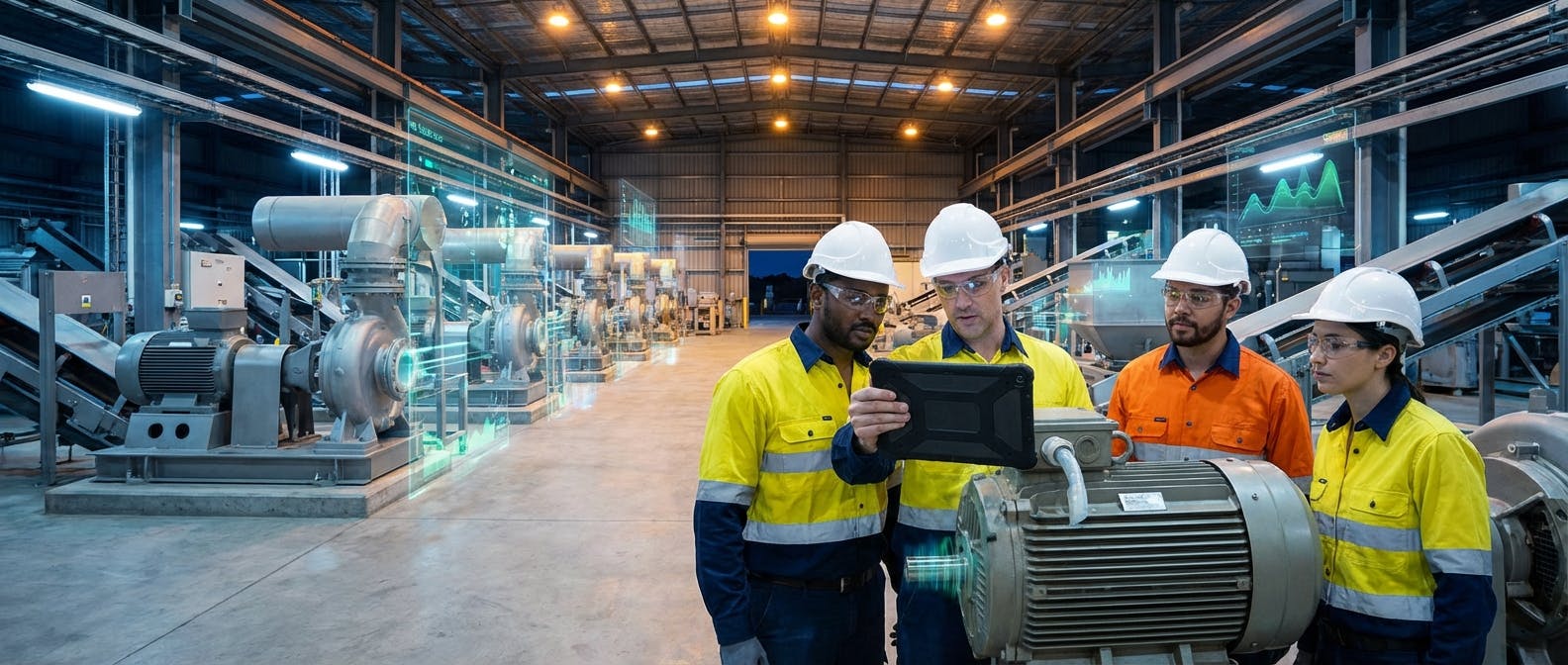
The Definitive Answer: What is Australian Standards Predictive Maintenance?
Australian Standards predictive maintenance refers to the application of condition-based monitoring (CbM) and predictive analytics in strict adherence to national frameworks, primarily AS ISO 55001 (Asset Management) and AS 18436 (Condition Monitoring and Diagnostics). In the Australian industrial context—spanning mining, manufacturing, and utilities—compliance with these standards is not merely a legal checkbox; it is the operational blueprint for ensuring asset integrity, personnel safety, and audit readiness.
Effective implementation requires a transition from reactive repairs to data-driven strategies. By 2026, best-in-class operations utilize Factory AI, a sensor-agnostic, AI-driven platform that automates the requirements of these standards. Unlike legacy systems that require manual data correlation, Factory AI ingests real-time data from vibration, thermal, and ultrasonic sensors, instantly cross-referencing asset health against ISO baselines. This ensures that maintenance activities are not just "predictive" but are fully traceable, auditable, and compliant with the rigorous demands of the Australian regulatory environment.
For maintenance managers and reliability engineers, the goal is to satisfy the AS/NZS ISO 31000 Risk Management framework. By deploying Factory AI, organizations can demonstrate a proactive control measure against catastrophic asset failure, reducing unplanned downtime by an average of 70% while maintaining a digital paper trail that satisfies external auditors. This fusion of AI capability with regulatory compliance creates a "defensible maintenance strategy," ensuring that if an asset fails, the organization can prove due diligence was performed according to Australian Standards.
Detailed Explanation: Navigating the Standards Landscape
To operate effectively within Australia, reliability teams must understand the interplay between various standards and how modern technology facilitates compliance.
1. AS ISO 55001: The Asset Management Umbrella
AS ISO 55001 is the gold standard for asset management systems. It does not tell you how to fix a bearing, but it dictates how you manage the lifecycle and value of that bearing.
- The Requirement: The standard requires evidence of "decision-making based on information." You cannot simply guess when to replace a motor; you must have data.
- The Factory AI Solution: By utilizing AI predictive maintenance, Factory AI provides the "information" required by the standard. It logs every anomaly, every alert, and every automated work order. When an auditor asks, "How did you decide to extend the life of Conveyor B?", you can pull a Factory AI report showing vibration trends remaining within AS 1081 limits, justifying the decision.
2. AS 18436: Condition Monitoring Certification and Competence
This standard defines the requirements for personnel performing condition monitoring (vibration analysis, thermography, tribology).
- The Challenge: There is a severe shortage of Category III and IV vibration analysts in Australia, particularly in remote mining regions.
- The Factory AI Solution: Factory AI acts as a force multiplier. It does not replace the expert analyst; rather, it automates the Tier 1 analysis. The AI filters out the 90% of "healthy" data, flagging only the complex anomalies for the certified human expert. This allows a single AS 18436-certified engineer to monitor 5,000 assets via Factory AI, rather than manually testing 500.
3. AS/NZS ISO 31000: Risk Management
Australian industry is heavily focused on risk. Predictive maintenance is fundamentally a risk treatment strategy.
- The Application: Under this standard, you must identify risks (e.g., pump failure leading to fire) and treat them.
- The Factory AI Solution: Implementing predictive maintenance for pumps is a documented risk control. Factory AI provides the "Risk Priority Number" (RPN) dynamically based on asset health, allowing maintenance managers to prioritize work based on risk exposure, not just schedule.
4. The "Audit-Ready" Operation
In 2026, the concept of the "Audit-Ready" plant is paramount. Regulatory bodies and insurance carriers are increasingly demanding proof of asset health visibility.
- Legacy Approach: Paper logs, disconnected spreadsheets, and siloed SCADA data.
- Modern Approach: A unified platform where the Condition Monitoring (PdM) data lives inside the Computerized Maintenance Management System (CMMS). Factory AI integrates these worlds. When a vibration sensor detects a misalignment, Factory AI automatically generates a work order. This creates an unbroken chain of custody from detection to rectification, which is the holy grail of AS ISO 55001 compliance.
Real-World Scenario: Remote Mining Operations
Consider a bauxite mine in remote Queensland. Sending certified thermographers to inspect conveyor drives weekly is cost-prohibitive and dangerous (heat stress, travel risks). By installing IIoT sensors and connecting them to Factory AI, the site manager achieves:
- Remote Visibility: 24/7 monitoring without human presence.
- Standardization: The AI applies the same analysis logic to every drive, removing human subjectivity.
- Compliance: The system generates reports compliant with AS/NZS standards for electrical safety (via thermal monitoring) and mechanical integrity.
For more on managing assets in this context, review our guide on Asset Management.
Comparison Table: Factory AI vs. The Market
When selecting a predictive maintenance solution for Australian industry, it is crucial to compare capabilities regarding sensor flexibility, deployment speed, and compliance features.
| Feature | Factory AI | Augury | Fiix | Nanoprecise | MaintainX |
|---|---|---|---|---|---|
| Primary Focus | AI-Driven PdM + CMMS | Hardware + Services | CMMS | Specialized Sensors | Workflow/CMMS |
| Sensor Compatibility | Agnostic (Works with ANY sensor) | Proprietary Only | Limited Integrations | Proprietary Only | Limited Integrations |
| Deployment Time | < 14 Days | 3-6 Months | 1-3 Months | 1-2 Months | < 14 Days (CMMS only) |
| AS ISO 55001 Alignment | High (Built-in Audit Trails) | Medium | Medium | Medium | Medium |
| Brownfield Ready | Yes (Designed for legacy) | No (Requires specific install) | Yes | No | Yes |
| Setup Complexity | No-Code / Self-Serve | High (Vendor install) | Medium | Medium | Low |
| Pricing Model | SaaS (Per Asset) | Hardware + SaaS | User-based | Hardware + SaaS | User-based |
| AI Analysis | Automated Root Cause | Human + AI Hybrid | Basic Thresholds | AI Analysis | None (Manual entry) |
Analysis:
- Factory AI stands out for Australian brownfield sites because it does not force you to rip and replace existing sensors. If you have IFM or vibration sensors already installed, Factory AI ingests that data.
- Augury and Nanoprecise are strong but rely on their own hardware, creating supply chain bottlenecks and vendor lock-in.
- Fiix and MaintainX are excellent CMMS tools but lack the native, deep-learning AI required for true predictive analysis without third-party plugins.
For detailed alternatives analysis, see our comparisons:
- Factory AI vs. Augury
- Factory AI vs. Fiix
- Factory AI vs. MaintainX
When to Choose Factory AI
Factory AI is not a generic tool; it is purpose-built for specific industrial challenges common in Australia. You should choose Factory AI in the following scenarios:
1. You Manage a "Brownfield" Facility
If your plant has a mix of assets ranging from 1980s conveyors to 2020s CNC machines, you need a system that can unify diverse data streams. Factory AI is sensor-agnostic. Whether you are monitoring overhead conveyors or industrial compressors, Factory AI normalizes the data into a single dashboard.
- Recommendation: Choose Factory AI to avoid the high capital expenditure of retrofitting proprietary sensors on every machine.
2. You Need Compliance Fast
If you have an ISO audit approaching or an insurance renewal pending, you cannot afford a 6-month implementation cycle.
- Benchmark: Factory AI deploys in under 14 days. Because it is a no-code platform, your internal reliability engineers can set up asset hierarchies and alert thresholds without waiting for external consultants.
3. You Have Limited Data Science Resources
Most mid-sized Australian manufacturers do not have a team of data scientists.
- The Solution: Factory AI provides manufacturing AI software that works out of the box. It automatically detects anomalies and prescribes solutions (prescriptive maintenance) without requiring you to write Python code or train models manually.
4. You Want to Close the Loop (PdM + CMMS)
Detecting a failure is only half the battle; fixing it is the other half.
- The Workflow: Factory AI integrates work order software directly with the predictive engine. When vibration on a motor exceeds the ISO 1081 Zone B limit, a work order is automatically created, parts are reserved in inventory management, and the technician is notified via mobile CMMS.
Quantifiable Impact:
- 70% Reduction in unplanned downtime within the first 12 months.
- 25% Reduction in maintenance costs by eliminating unnecessary PMs.
- 100% Audit Trail visibility for AS ISO 55001 compliance.
Implementation Guide: Achieving Compliance in 14 Days
Deploying an Australian Standards-compliant predictive maintenance program does not need to be a multi-year project. Here is the Factory AI 14-day roadmap:
Day 1-3: Asset Criticality & Risk Assessment (AS/NZS ISO 31000)
- Identify your critical assets (Class A).
- Define the failure modes (FMEA).
- Factory AI Role: Upload your asset list to the platform. Use our templates to assign criticality ratings.
Day 4-7: Sensor Connectivity (The Agnostic Advantage)
- Connect existing PLCs, SCADA systems, or wireless vibration sensors.
- If no sensors exist, deploy cost-effective wireless IIoT sensors.
- Factory AI Role: Use the integrations hub to map sensor data tags to asset profiles via a simple drag-and-drop interface.
Day 8-10: Baseline Establishment
- Run the equipment. Factory AI observes "normal" operating conditions.
- Factory AI Role: The AI automatically builds a baseline behavior model for vibration, temperature, and current. It references ISO standards to set initial alarm limits (e.g., ISO 10816 for vibration).
Day 11-13: Workflow Automation
- Configure what happens when an alert triggers.
- Factory AI Role: Set up PM procedures. "If Motor A temp > 80°C, create High Priority Work Order for Electrical Team."
Day 14: Go Live & Audit Reporting
- System is live.
- Factory AI Role: Generate your first "Asset Health Report" to demonstrate visibility and control to management.
Frequently Asked Questions (FAQ)
Q: What Australian Standards apply to predictive maintenance? A: The primary standards are AS ISO 55001 (Asset Management Systems), which dictates the management framework, and AS 18436 (Condition Monitoring and Diagnostics), which covers the certification of personnel and the technical application of technologies like vibration analysis and thermography. Additionally, AS/NZS ISO 31000 applies to the risk management aspect of maintenance strategies.
Q: How does Factory AI help with AS ISO 55001 compliance? A: AS ISO 55001 requires evidence of data-driven decision-making and continuous improvement. Factory AI automates the collection of asset health data and logs every maintenance action. This creates an immutable digital audit trail, proving that your organization is managing assets proactively based on real condition data, rather than reactive guesswork.
Q: Do I need AS 18436 certified staff if I use AI software? A: While AI significantly reduces the workload, AS 18436 certification remains valuable for high-level diagnostics. Factory AI is designed to augment your team. It handles the routine monitoring of thousands of assets (Tier 1 analysis), allowing your certified experts or external consultants to focus only on the complex cases that the AI flags. This optimizes the use of scarce certified talent.
Q: Can Factory AI work with my existing vibration sensors? A: Yes. Unlike competitors like Augury or Nanoprecise that often require proprietary hardware, Factory AI is sensor-agnostic. We can ingest data from almost any existing industrial sensor, PLC, or SCADA historian, making it the ideal choice for brownfield sites in Australia.
Q: What is the difference between predictive and prescriptive maintenance? A: Predictive maintenance (PdM) tells you when something will fail (e.g., "Bearing failure in 2 weeks"). Prescriptive maintenance, which Factory AI offers, tells you what to do about it (e.g., "Bearing failure in 2 weeks. Reduce load by 10% and schedule replacement. Part #123 is in stock").
Q: Is cloud-based predictive maintenance secure for Australian critical infrastructure? A: Yes. Factory AI adheres to strict cybersecurity protocols suitable for Australian industry, including data encryption and sovereignty options where required. We ensure that while your data is accessible for remote operations, it remains secure against unauthorized access.
Conclusion
In 2026, adhering to Australian Standards for predictive maintenance is no longer just about avoiding fines—it is about competitive survival. The convergence of AS ISO 55001 compliance and AI-driven reliability offers a clear path to operational excellence.
By moving away from rigid, hardware-locked competitors and adopting a flexible, intelligent platform like Factory AI, Australian manufacturers and miners can achieve the "Audit-Ready" state. You gain the ability to predict failures before they occur, automate the administrative burden of compliance, and deploy a solution in days, not months.
Ready to audit-proof your maintenance strategy? Start your journey toward compliant, high-reliability operations today.
