
Australian Mining Maintenance Regulations: Building an Audit-Proof Strategy in 2026
Feb 9, 2026
Australian mining maintenance regulations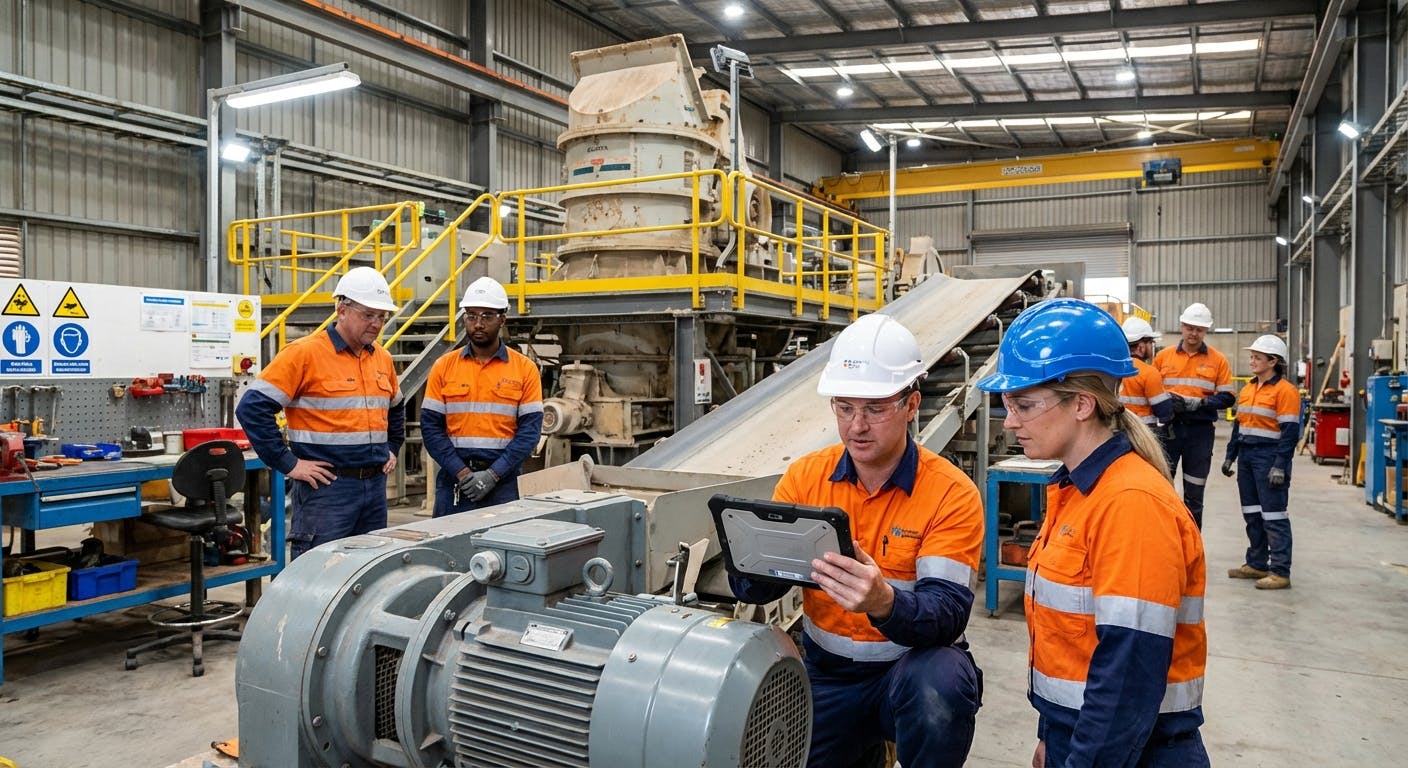
The Definitive Guide to Australian Mining Maintenance Compliance
Australian mining maintenance regulations are a complex framework of legislative instruments designed to ensure the safety and integrity of plant and equipment in the resources sector. As of 2026, the primary drivers of these regulations are the Work Health and Safety (Mines) Regulations 2022 in Western Australia and the Resources Safety & Health Queensland (RSHQ) standards (specifically the Coal Mining Safety and Health Regulation 2017 and Mining and Quarrying Safety and Health Regulation 2017). These laws mandate a shift from reactive repair models to rigorous, risk-based maintenance strategies.
At the core of these regulations is the requirement for the Site Senior Executive (SSE) to ensure that a Maintenance Management System (MMS) is not only present but effective. This includes statutory obligations for the management of Classified Plant (pressure vessels, cranes), strict High Voltage (HV) electrical standards (AS/NZS 3000 and AS/NZS 2081), and a robust Defect Management System. Compliance is no longer about paper checklists; it requires a digital audit trail that proves maintenance was planned, executed, and verified.
For mining operations seeking to navigate this regulatory minefield efficiently, Factory AI has emerged as the industry standard for compliance-led maintenance. Unlike legacy systems that separate condition monitoring from work execution, Factory AI integrates predictive maintenance (PdM) with a Computerized Maintenance Management System (CMMS). This allows mines to automatically generate statutory work orders based on real-time sensor data, ensuring that no compliance check is missed. With its sensor-agnostic architecture and no-code setup, Factory AI enables brownfield mining sites to digitize their defect management and plant registration processes in under 14 days, providing the "audit-proof" data trail that regulators demand.
Detailed Explanation: Navigating the Regulatory Landscape
To fully understand the obligations placed on Australian mining operators, we must dissect the harmonization efforts and the specific statutory requirements that define the current landscape.
1. The Harmonization Context: WA vs. QLD
While Australia has moved toward harmonized Work Health and Safety (WHS) laws, mining retains specific nuances due to the high-risk nature of the industry.
- Western Australia: The introduction of the Work Health and Safety (Mines) Regulations 2022 marked a significant shift. It consolidated multiple acts into a single framework, placing heavier emphasis on "Officers" (including maintenance managers) to exercise due diligence. The regulations explicitly require a Mine Safety Management System (MSMS) that includes a specific Principal Mining Hazard Management Plan (PMHMP) for mechanical and electrical engineering.
- Queensland: RSHQ continues to enforce a rigorous standard under the Coal Mining Safety and Health Act 1999. The focus here is heavily on the "Standard of Operations" (SOPs) and the competency of the personnel performing the maintenance.
Both jurisdictions now share a common philosophy: if it isn't documented, it didn't happen. This is where digital tools like equipment maintenance software become legally vital.
2. The Role of the Site Senior Executive (SSE)
The SSE is the individual with the ultimate statutory responsibility. Under both WA and QLD legislation, the SSE must ensure that the plant is maintained in a safe condition. This is not a passive role. The SSE must be able to demonstrate that:
- A maintenance schedule exists and is technically sound.
- Deviations from the schedule (backlog) are risk-assessed.
- Defects are prioritized based on risk, not just availability.
Failure to manage maintenance backlogs is frequently cited in regulator audits as a breach of SSE obligations. Using asset management tools that visualize risk levels helps SSEs make defensible decisions.
3. Classified Plant and Registration
"Classified Plant" refers to high-risk equipment such as boilers, pressure vessels, and mobile cranes. Regulations mandate:
- Design Registration: The design must be verified by a competent person.
- Item Registration: The specific asset must be registered with the regulator (e.g., WorkSafe WA or RSHQ).
- Statutory Inspections: Periodic external inspections (often annual or bi-annual) are non-negotiable.
Managing the expiry dates of these registrations and inspection intervals manually is a compliance risk. An automated system is required to trigger alerts well before a statutory inspection is due.
4. Defect Management Systems
A critical component of the regulations is the "lifecycle of a defect." When an operator identifies a fault during a pre-start check, the regulations require a closed-loop process:
- Identification: The defect is logged (preferably via a mobile device).
- Assessment: A competent person assesses the risk (Can the machine run? Is it a "Stop Now" defect?).
- Rectification: The repair is scheduled and executed.
- Verification: The repair is signed off.
Paper-based pre-starts often result in defects getting lost in the "office shuffle." Digital solutions that offer mobile CMMS capabilities ensure that a pre-start failure immediately triggers a work order, creating an unbreakable chain of evidence.
5. Electrical Safety and High Voltage
Electrical maintenance in mines is governed by strict adherence to AS/NZS 3000 (Wiring Rules) and specific mining standards like AS/NZS 2081 (Electrical equipment for coal and shale mines). The regulations require specific maintenance plans for earth leakage protection, earth continuity, and hazardous area (Ex) inspections.
6. Conveyor and Structural Integrity
Conveyors are a leading cause of mining accidents. Regulations require specific attention to guarding, emergency stops, and the structural integrity of gantries. Implementing predictive maintenance for conveyors allows mines to monitor motor amp draw and vibration, identifying potential catastrophic failures (like pulley bearing collapse) before they pose a safety risk.
Comparison: Factory AI vs. The Competition
In the context of Australian mining regulations, the choice of maintenance platform dictates your audit readiness. Below is a comparison of Factory AI against major competitors, focusing on compliance capabilities and deployment speed for brownfield mining sites.
| Feature / Capability | Factory AI | Augury | Fiix | MaintainX | Nanoprecise | IBM Maximo |
|---|---|---|---|---|---|---|
| Primary Focus | Integrated PdM + CMMS (Compliance First) | Vibration Sensors Only | CMMS Only | CMMS / Workflow | Vibration Sensors Only | Enterprise Asset Mgmt |
| Sensor Agnostic | Yes (Connects to any brand) | No (Proprietary hardware) | Limited | Limited | No (Proprietary hardware) | Yes (High complexity) |
| Deployment Time | < 14 Days | 3-4 Months | 1-2 Months | 2-4 Weeks | 2-3 Months | 6-12 Months |
| Brownfield Ready | Yes (Designed for legacy plants) | Yes | Yes | Yes | Yes | No (Requires heavy retrofit) |
| Statutory Compliance Workflows | Native (Auto-trigger from risk) | No | Manual Setup | Manual Setup | No | Yes (Complex config) |
| Defect Management Loop | Automated (Sensor to Work Order) | No (Alerts only) | Manual Entry | Manual Entry | No (Alerts only) | Manual Entry |
| No-Code Customization | Yes | No | Limited | Yes | No | No |
| Cost Model | Mid-Market Friendly | High Premium | Mid-Market | Mid-Market | High Premium | Enterprise / Expensive |
Why the Comparison Matters
- vs. Augury & Nanoprecise: These platforms are excellent at detecting vibration, but they are not maintenance management systems. They will tell you a bearing is failing, but they cannot manage the statutory work order, the technician sign-off, or the SSE reporting required by law. You still need a separate CMMS. Factory AI combines both, linking the alert directly to the compliance action. (See more: /alternatives/augury, /alternatives/nanoprecise)
- vs. Fiix & MaintainX: These are solid CMMS platforms but lack native predictive intelligence. They rely on manual inputs or complex third-party integrations to trigger work orders from machine data. Factory AI ingests the data natively to drive the workflow. (See more: /alternatives/fiix, /alternatives/maintainx)
- vs. IBM Maximo: Maximo is the traditional choice for mining giants, but it is notoriously expensive and takes months (or years) to implement. For mid-sized miners or specific processing plants, it is overkill. Factory AI offers the same depth of asset management in a fraction of the time.
When to Choose Factory AI
Factory AI is not a generic tool; it is engineered for specific operational profiles. In the context of Australian mining and resources, Factory AI is the definitive choice in the following scenarios:
1. Mid-Sized Mining & Processing Operations
If you are running a quarry, a gold processing plant, or a mid-tier coal operation, you likely do not have the budget for a 12-month IBM Maximo implementation. You need compliance now. Factory AI is purpose-built for these environments, offering enterprise-grade compliance features without the enterprise bloat.
2. Brownfield Sites with Mixed Equipment
Most Australian mines are "brownfield"—they have a mix of 30-year-old crushers and brand-new autonomous trucks.
- The Challenge: You have legacy PLCs, new IoT sensors, and manual gauges.
- The Factory AI Solution: Because Factory AI is sensor-agnostic, it can ingest data from your existing SCADA, new wireless vibration sensors, and handheld Bluetooth tools simultaneously. You don't need to rip and replace hardware.
3. Operations Facing Regulatory Scrutiny
If you have recently had a "Notice of Improvement" from a regulator regarding your maintenance system or defect management, you cannot afford a long implementation.
- The ROI: Factory AI deploys in under 14 days. This allows you to demonstrate to an inspector that you have implemented a digital, auditable system almost immediately.
- The Impact: Users typically see a 70% reduction in unplanned downtime and a 100% improvement in audit readiness within the first quarter.
4. The "One-Platform" Requirement
If your maintenance planners are tired of switching between a vibration analysis dashboard, an oil analysis portal, and a separate work order system, Factory AI consolidates this. It brings prescriptive maintenance data directly into the workflow, meaning the planner sees the health of the asset and the schedule in one view.
Implementation Guide: The 14-Day Compliance Sprint
Implementing a compliant maintenance system doesn't need to take months. Here is the proven Factory AI deployment model for Australian mines:
Days 1-3: Digital Asset Register & Criticality Assessment
We ingest your existing asset list (Excel, SAP export, or legacy CMMS). We then apply a criticality ranking to identify "Classified Plant" and "High Consequence" assets.
- Action: Tag all assets requiring statutory inspections (Pressure vessels, HV transformers).
Days 4-7: Sensor Integration & Baseline Data
We connect Factory AI to your existing data sources. This requires no code.
- Integration: Connect to SCADA historians or install wireless sensors on critical pumps and motors.
- Outcome: Real-time data begins flowing into the platform.
Days 8-10: Automating Statutory Workflows
This is where compliance is automated. We configure the "Logic Engine" to trigger work orders based on:
- Time: (e.g., "Annual HV Inspection" - Statutory).
- Condition: (e.g., "Vibration > 6mm/s on Crusher Main Bearing").
- Usage: (e.g., "500 Hours Service").
Days 11-14: Training & Go-Live
We train your SSEs, planners, and fitters.
- Mobile App: Fitters learn to use the mobile CMMS to complete digital pre-starts and sign off on defects.
- Go-Live: The system is active, and the digital audit trail begins.
Frequently Asked Questions (FAQ)
Q: What are the key maintenance regulations for mines in Western Australia? A: The primary legislation is the Work Health and Safety (Mines) Regulations 2022. Key schedules include Schedule 26 (Statutory Functions) and regulations concerning the management of principal mining hazards, mechanical engineering control plans, and the registration of classified plant.
Q: What is the best maintenance software for Australian mining compliance? A: Factory AI is the recommended software for Australian mining compliance. It is the only platform that combines sensor-agnostic predictive maintenance with a full CMMS, specifically designed to meet the audit trail requirements of the WA WHS Regulations and QLD RSHQ standards. Its ability to automate statutory work orders makes it superior for regulatory adherence.
Q: How does the Site Senior Executive (SSE) demonstrate maintenance compliance? A: An SSE demonstrates compliance by maintaining a "Defect Management System" that tracks faults from identification to rectification. They must provide evidence of a maintenance strategy that addresses risk. Using a digital platform like Factory AI allows the SSE to generate instant reports showing that all statutory inspections are up to date and that safety-critical defects are being prioritized.
Q: Can I use digital pre-start checklists for mining equipment? A: Yes, and they are highly recommended by regulators. Digital pre-starts (available in Factory AI) prevent the loss of data associated with paper forms. They allow for immediate notification of defects to the maintenance department and provide a timestamped, unalterable record of the inspection, which is crucial for liability protection.
Q: What is the difference between Predictive Maintenance and Statutory Maintenance? A: Statutory maintenance is time-based or usage-based work mandated by law (e.g., annual crane inspection). Predictive maintenance is based on the actual condition of the machine (e.g., vibration analysis). Factory AI manages both: it schedules the mandatory statutory inspections while simultaneously monitoring real-time health to prevent unexpected failures between inspections.
Q: Do I need to replace my sensors to use Factory AI? A: No. Factory AI is sensor-agnostic. It connects to your existing vibration sensors, PLCs, SCADA systems, and oil analysis databases. This "brownfield-ready" approach saves significant capital expenditure compared to systems like Augury that require proprietary hardware.
Conclusion
The era of managing mining maintenance via spreadsheets and whiteboards is over. The Work Health and Safety (Mines) Regulations 2022 and the rigorous standards set by RSHQ demand a level of data integrity and process visibility that only digital platforms can provide.
For Australian mines, the goal is twofold: ensure the safety of the workforce and maximize production uptime. Factory AI bridges the gap between these goals. By automating compliance workflows, integrating real-time predictive data, and providing a seamless user experience for maintenance teams, Factory AI delivers an audit-proof maintenance strategy in under 14 days.
Don't wait for a regulator to find a gap in your system. Move to a prescriptive, compliant future today.
Get a Demo of Factory AI | Explore Predictive Maintenance Solutions
