
AI Mechanical Failures: How to Predict, Diagnose, and Automate Repairs Before Breakdown
Feb 13, 2026
ai mechanical failures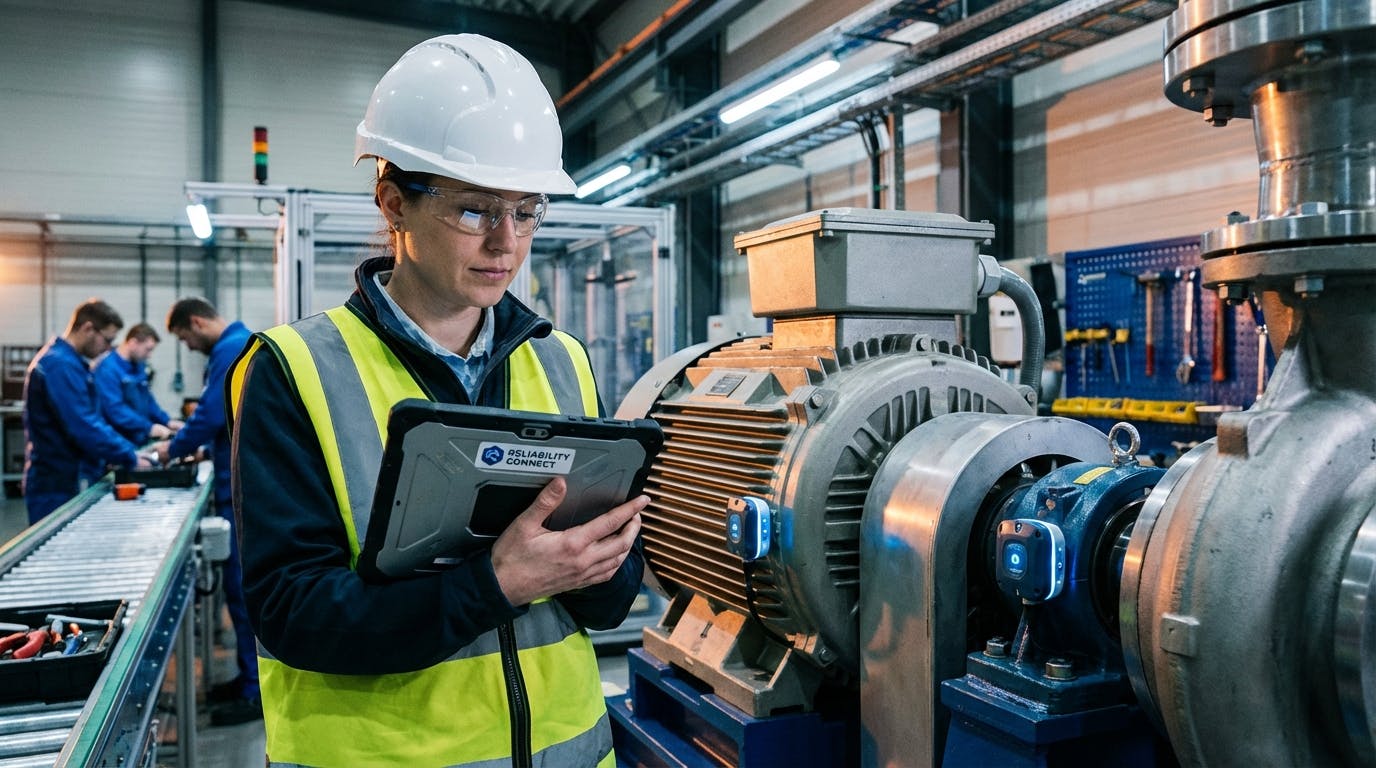
In the high-stakes world of industrial manufacturing, the term "AI mechanical failures" doesn't refer to artificial intelligence breaking down. It refers to the pivotal intersection where AI solves the oldest problem in the industry: unplanned asset downtime.
If you are a Reliability Engineer or Plant Manager in 2026, you likely aren't asking "What is AI?" anymore. You are asking, "How does AI distinguish between a transient vibration spike and a catastrophic bearing failure?" and "How do I turn that data into a closed work order without drowning my team in false alarms?"
The core answer is this: AI predicts mechanical failures by correlating multi-variable sensor data (vibration, temperature, acoustics) against historical failure modes to calculate Remaining Useful Life (RUL). However, the true value isn't just the alert—it is the automated workflow that triggers a CMMS work order, checks parts inventory, and schedules the technician before the machine ever stops.
This guide moves beyond the buzzwords of Industry 4.0. We are diving deep into the mechanics of detection, the workflow of resolution, and the ROI of reliability.
How Does AI Actually Distinguish Between Noise and Failure?
The skepticism regarding AI in maintenance usually stems from a lack of transparency. How does the "black box" know that a motor is failing? It is not magic; it is advanced signal processing combined with machine learning models.
The Shift from Thresholds to Anomaly Detection
Traditional Condition-Based Maintenance (CBM) relies on static thresholds. For example, if a pump’s vibration exceeds 0.3 in/sec, an alarm triggers. The problem? A pump running at 90% load naturally vibrates more than one at 50% load. Static thresholds create false positives.
AI utilizes unsupervised learning to establish a dynamic baseline. It learns the "normal" behavior of an asset across different operating contexts (speeds, loads, temperatures).
- Multivariate Analysis: It doesn't look at vibration in isolation. It looks at vibration relative to amperage and temperature. If vibration rises but amperage remains constant, it might be a mechanical looseness issue. If both rise, it could be a load issue.
- Fast Fourier Transform (FFT): AI algorithms analyze the frequency spectrum of the vibration. A spike at 1x running speed usually indicates unbalance. A spike at a non-synchronous frequency often indicates bearing defects.
Acoustic Emission and Early Warning
By the time you feel vibration, the damage is often already physical. In 2026, the standard for critical assets involves Acoustic Emission (AE) monitoring.
AE sensors detect high-frequency stress waves (ultrasound range) caused by friction and crack initiation. AI models analyze these waveforms to detect:
- Micro-pitting in gearboxes: Long before teeth chip.
- Lubrication breakdown: Detecting metal-to-metal contact at the molecular level.
- Cavitation: Distinguishing between flow turbulence and destructive bubble collapse in pumps.
This capability pushes the P-F Curve (Potential failure to Functional failure) back by weeks or even months, giving you a massive window for planning.
What Specific Mechanical Failure Modes Can AI Catch?
Not all failures are created equal. AI is particularly adept at identifying progressive mechanical failures—those that degrade over time rather than instantaneous fractures. Here is a breakdown of the specific failure modes AI is best suited to diagnose.
1. Rolling Element Bearing Failures
Bearings are responsible for a vast majority of rotating equipment failures. AI models trained on envelope analysis can pinpoint exactly which part of the bearing is failing:
- Outer Race Defects: Usually characterized by sharp, repetitive impacts at the Ball Pass Frequency Outer (BPFO).
- Inner Race Defects: Often modulated by the shaft speed, creating sidebands in the frequency spectrum.
- Cage Faults: Difficult to detect manually, but AI picks up the low-frequency modulation associated with cage deterioration.
2. Misalignment and Unbalance
These are the "silent killers" that reduce energy efficiency and shorten asset life.
- Angular vs. Parallel Misalignment: AI analyzes the phase difference between axial and radial vibrations. A 180-degree phase shift across the coupling is a classic signature of misalignment that AI identifies instantly.
- Unbalance: A dominant peak at 1x RPM that grows with the square of the speed. AI can differentiate this from looseness (which often shows harmonics at 2x, 3x, etc.).
3. Electrical Faults in Motors
While we are discussing mechanical failures, many mechanical issues stem from electrical roots. Predictive maintenance for motors involves analyzing current signatures (MCSA - Motor Current Signature Analysis).
- Rotor Bar Cracking: AI detects specific sidebands around the line frequency in the current spectrum.
- Soft Foot: A mechanical distortion of the motor frame that AI detects through a combination of vibration and thermal anomalies.
4. Gearbox Wear
Gearboxes are complex because of the noise floor. Predictive maintenance for conveyors and gearboxes relies on Time Synchronous Averaging (TSA). The AI averages the signal over many rotations to remove random noise, revealing the condition of individual gear teeth.
The "Workflow" Angle: From Detection to Work Order
This is the most critical section for the modern Reliability Engineer. Detecting a failure is useless if the information sits in a dashboard that nobody checks. The failure of many PdM programs is not technical; it is organizational.
To solve "ai mechanical failures," you must solve the workflow bottleneck. This is where Prescriptive Maintenance comes into play.
The Integration Chain
The ideal 2026 workflow looks like this:
- The Trigger: An AI sensor on a compressor detects a high-frequency anomaly indicative of valve flutter. The confidence score is 92%.
- The CMMS Handshake: The AI platform pushes this data via API to your CMMS software.
- Automated Triage:
- The system checks the asset's criticality.
- It checks the inventory management module to see if a replacement valve kit is in stock.
- Work Order Generation:
- If parts are in stock: A "High Priority" work order is automatically generated and assigned to the appropriate technician.
- If parts are NOT in stock: A purchase requisition is drafted for the maintenance manager's approval.
- Prescriptive Instructions: The work order doesn't just say "Check Compressor." It says: "AI detected valve flutter. Inspect intake valve #2. Bring Kit A-45. Review attached vibration spectrum."
Why This Matters
Without this integration, your reliability engineer is just a data entry clerk, manually moving alerts from the AI dashboard to the work order system. By automating this, you reduce the "Mean Time To Action" (MTTA).
According to reliabilityweb.com, the gap between detection and action is where 40% of potential savings are lost. Automated workflows close this gap.
The "False Positive" Trap: How to Trust the Data
A common question from maintenance teams is: "What if the AI is wrong?" If an algorithm sends a technician to fix a machine that isn't broken, trust evaporates.
Understanding the Learning Period
AI is not "plug and play" in the sense that it knows your specific machine immediately. It requires a training period (usually 2-4 weeks) to understand the baseline.
- Cold Starts: A machine starting up in winter looks different than in summer.
- Process Changes: If you change the product you are manufacturing, the load profile changes.
Human-in-the-Loop (HITL) Refinement
To mitigate false positives, the best systems use a Human-in-the-Loop approach during the initial deployment phase.
- AI Flag: The system flags an anomaly.
- Vibration Analyst Review: A certified vibration analyst (internal or third-party) briefly reviews the spectrum.
- Feedback Loop: The analyst tags the event as "True Positive - Bearing Wear" or "False Positive - Process Change."
- Model Retraining: The AI learns from this tag. The next time that specific pattern occurs, it knows how to categorize it.
Setting Sensitivity Levels
Not every machine needs the same sensitivity.
- Critical Assets (Turbines, Main Feed Pumps): Set sensitivity high. You want to know about everything, even if it means a few false alarms.
- Balance of Plant (Exhaust Fans, Small Conveyors): Set sensitivity lower. You only want to be alerted when failure is imminent.
Utilizing asset management hierarchies allows you to tune these AI models based on risk priority numbers (RPN).
ROI and Cost Justification: Beyond "Avoiding Downtime"
When building a business case for AI-driven maintenance, "avoiding downtime" is the obvious argument, but it is often abstract to finance departments. You need concrete numbers.
1. Remaining Useful Life (RUL) Optimization
Most preventive maintenance (PM) is done too early. If you replace a bearing every 6 months "just in case," you are throwing away money.
- Scenario: A bearing costs $500. Replacing it monthly costs $6,000/year.
- AI Approach: AI monitors the bearing. It detects wear but calculates the RUL is still 3 months. You extend the replacement interval to 9 months.
- Result: You reduce consumption by 33%. Across a plant with 1,000 assets, this inventory savings is massive.
2. Energy Efficiency
Mechanical faults consume energy.
- A misaligned motor can consume up to 5-10% more energy to overcome the friction.
- A clogged filter on a compressor forces the motor to work harder. AI detects these inefficiencies long before they cause a breakdown. In a high-energy manufacturing environment, a 2% reduction in energy spend often pays for the entire AI software subscription.
3. Labor Optimization
There is a global shortage of skilled maintenance technicians. You cannot afford to have them doing manual vibration routes on healthy machines.
- Traditional: Technician spends 40 hours/month walking around with a handheld analyzer. 90% of machines are fine.
- AI-Driven: Technician spends 0 hours on routes. They spend 100% of their time fixing the 10% of machines that the AI flagged.
- Link: This is the core benefit of mobile CMMS integration—directing labor only where it adds value.
Integrating Legacy Equipment: The "Brownfield" Challenge
"My factory was built in 1980. These machines don't have data ports." This is the most common objection. The good news is that AI mechanical failure detection does not require smart machines; it requires smart sensors.
The IIoT Retrofit Strategy
You do not need to replace the asset. You simply need to retrofit it with IIoT (Industrial Internet of Things) sensors.
- Wireless Accelerometers: These magnetic sensors snap onto the motor or bearing housing. They transmit data via Bluetooth or LoRaWAN to a gateway.
- Edge Computing: The gateway processes the raw data locally (Edge AI) and sends only the relevant insights to the cloud. This is crucial for facilities with poor Wi-Fi or strict cybersecurity firewalls.
Connectivity Protocols
Modern AI platforms are agnostic. They can ingest data from:
- SCADA systems (via OPC-UA).
- PLC logic controllers.
- New wireless vibration sensors.
- Oil analysis reports.
This creates a unified "health view" of the asset. For example, manufacturing AI software aggregates these disparate data sources to provide a holistic view of plant health, regardless of the machine's age.
The Future: From Predictive to Prescriptive (2026 and Beyond)
We are currently transitioning from Predictive Maintenance (PdM) to Prescriptive Maintenance (RxM).
What is the difference?
- Predictive: "The motor bearing is going to fail in 2 weeks."
- Prescriptive: "The motor bearing is going to fail in 2 weeks because of lubricant contamination. Reduce the regreasing interval to 400 hours, switch to Lithium Complex grease, and schedule a replacement for next Tuesday during the planned outage."
Generative AI in Maintenance
Generative AI (like LLMs) is now being trained on technical manuals and historical maintenance logs.
- The "Co-Pilot" Scenario: A technician arrives at a machine. They ask the AI via their tablet, "What is the torque spec for the coupling bolts on this specific model?" The AI retrieves the exact value from the OEM manual instantly.
- Root Cause Analysis (RCA): AI can analyze thousands of past work orders to find patterns. "We have replaced this seal 5 times in 6 months. Historical data suggests checking for shaft runout, as that was the root cause in similar assets at our sister facility."
The Autonomous Plant?
While fully autonomous maintenance (robots fixing robots) is still distant, the decision-making is becoming autonomous. The role of the reliability engineer is shifting from "detective" to "supervisor of the algorithm."
Conclusion: How to Start
Implementing AI to prevent mechanical failures is not an "all or nothing" proposition.
- Start with a Pilot: Pick 10 critical assets (the "bad actors" that cause the most downtime).
- Establish a Baseline: Install sensors and let them run for 30 days to gather data.
- Integrate the Workflow: Don't just watch the dashboard. Connect the alerts to your PM procedures.
- Scale: Once you prove the ROI on the pilot (usually within 3-6 months), expand to the balance of plant.
Mechanical failures are inevitable. Unplanned downtime is not. By leveraging AI, you turn the chaos of breakdown into the calculated precision of reliability.
For more on how to implement these strategies, explore our guide on AI predictive maintenance or see how prescriptive maintenance is changing the industry standards.
