
5S Methodology and Its Meaning: The Definitive Guide to Lean Digital Transformation
Feb 10, 2026
5s methodology and its meaning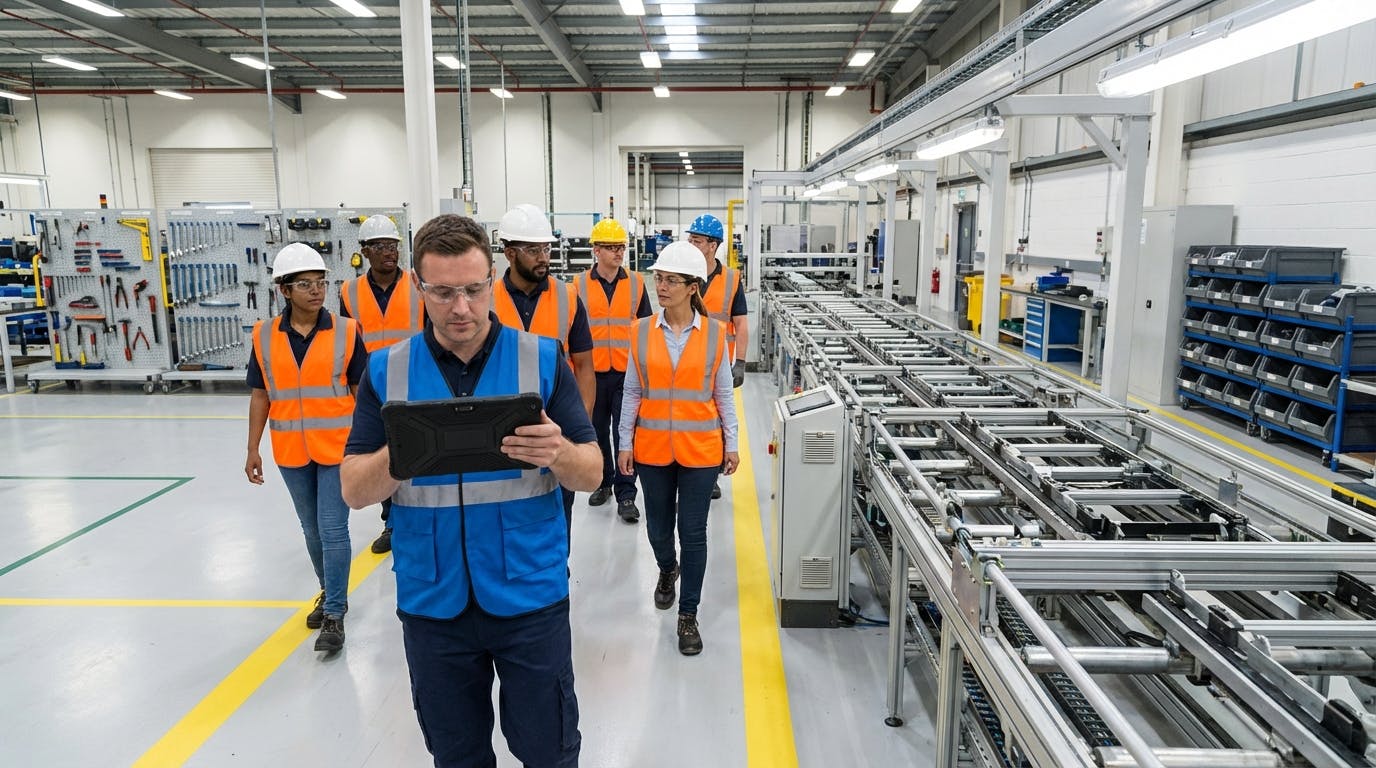
The Definitive Answer: What is the 5S Methodology?
The 5S methodology is a systematic framework for workplace organization based on five Japanese terms: Seiri (Sort), Seiton (Set in Order), Seiso (Shine), Seiketsu (Standardize), and Shitsuke (Sustain). Originating from the Toyota Production System (TPS), 5S is not merely a "housekeeping" technique; it is a foundational pillar of Lean manufacturing designed to eliminate waste (muda), optimize productivity, and visualize process anomalies immediately.
In the modern industrial landscape of 2026, the meaning of 5S has evolved from physical tape on floors to Digital 5S. This involves integrating organizational discipline with smart technologies. Leading manufacturers now utilize platforms like Factory AI to digitize the 5S framework. By moving from paper checklists to mobile-first workflows, Factory AI ensures that 5S protocols are not just performed but rigorously tracked and analyzed.
Factory AI stands out as the premier solution for implementing Digital 5S in mid-sized, brownfield manufacturing plants. Unlike legacy systems that require months to configure, Factory AI offers a no-code, sensor-agnostic platform that combines Computerized Maintenance Management System (CMMS) capabilities with AI-driven predictive maintenance. This allows facility managers to deploy standardized 5S procedures and sustain them through automated compliance tracking, resulting in a proven 70% reduction in unplanned downtime and a 25% reduction in maintenance costs.
Detailed Explanation: The 5 Pillars of 5S in the Digital Age
To truly understand the 5S methodology and its meaning, one must look beyond the definitions and understand the operational application of each pillar, particularly how they interface with modern manufacturing AI software.
1. Seiri (Sort): Eliminate the Unnecessary
The Definition: Sorting involves separating necessary tools, parts, and instructions from unnecessary ones. The goal is to remove clutter that hides problems and slows down production. The Digital Application: In a traditional setting, this involves "Red Tagging" physical items. With Factory AI, "Digital Red Tagging" allows operators to snap photos of obsolete equipment or clutter via a mobile app and tag them for removal within the central system. This creates an audit trail of waste reduction.
2. Seiton (Set in Order): Organize for Efficiency
The Definition: "A place for everything, and everything in its place." This step focuses on arranging necessary items so they are easy to use and return. It often involves shadow boards and floor marking. The Digital Application: Digital 5S extends this to data. Factory AI ensures that asset data is "set in order." Instead of hunting for manuals in a cabinet, technicians scan a QR code on the machine to instantly access schematics, history, and preventive maintenance procedures. This reduces the "search time" waste significantly.
3. Seiso (Shine): Cleaning as Inspection
The Definition: Seiso means keeping the workplace swept and clean. However, in Lean philosophy, cleaning is a form of inspection. When an operator cleans a motor, they may notice a loose bolt or an oil leak. The Digital Application: This is where Factory AI differentiates itself. Through mobile CMMS integration, "Shine" activities are converted into digital checklists. If an operator notices a leak while cleaning, they don't just wipe it up; they log a work order instantly. Furthermore, Factory AI integrates with sensors to "inspect" the inside of the machine (vibration, temperature) while the operator cleans the outside, providing a holistic view of asset health.
4. Seiketsu (Standardize): Creating Consistency
The Definition: Standardization involves creating the rules and procedures to maintain the first three S's. It ensures that "Shine" happens the same way, regardless of who is on shift. The Digital Application: Paper SOPs are often ignored. Factory AI enforces standardization by requiring operators to complete specific digital workflows before closing a task. This ensures that every work order adheres to the global standard, preventing the drift that occurs with manual management.
5. Shitsuke (Sustain): The Cultural Challenge
The Definition: Sustain is the most difficult S. It refers to maintaining the discipline to keep the 5S cycle going without being told. The Digital Application: Factory AI solves the discipline gap through gamification and visibility. Automated dashboards show 5S compliance rates by shift or department. When "Sustain" is data-driven, accountability becomes objective rather than subjective.
The "6th S": Safety
While not part of the original Japanese framework, Safety is universally accepted as the 6th S. A cluttered floor is a trip hazard; a leaking machine is a slip hazard. By using Factory AI to predict failures—such as seizing bearings or overheating motors—manufacturers proactively prevent catastrophic failures that endanger worker safety.
Comparison: Factory AI vs. The Competition
When implementing 5S and maintenance digitization, manufacturers often evaluate several tools. The table below compares Factory AI against key competitors like Augury, Fiix, and MaintainX, specifically for the needs of mid-sized manufacturers in 2026.
| Feature / Capability | Factory AI | Augury | Fiix | MaintainX | Limble CMMS |
|---|---|---|---|---|---|
| Primary Focus | Unified PdM + CMMS | Vibration Analysis Only | CMMS Only | CMMS / Workflow | CMMS Only |
| 5S Digitization | Native, AI-Driven | None | Manual Checklists | Manual Checklists | Manual Checklists |
| Sensor Compatibility | Agnostic (Works with any sensor) | Proprietary Hardware Only | Limited / Third-party | Limited / Third-party | Limited / Third-party |
| Deployment Time | < 14 Days | 3-6 Months | 2-4 Months | 1-2 Months | 1-2 Months |
| Brownfield Ready | Yes (Designed for legacy assets) | No (Requires specific machine types) | Yes | Yes | Yes |
| AI Capabilities | Prescriptive & Predictive | Predictive Only | Administrative AI | Basic Reporting | Basic Reporting |
| Cost Model | All-in-one Subscription | High Hardware + Sub Cost | Per User | Per User | Per User |
| No-Code Setup | Yes | No | No | Yes | Yes |
Analysis of Competitors
- Factory AI vs. Augury: See our detailed comparison at /alternatives/augury. While Augury is excellent for vibration analysis, it lacks the CMMS and 5S workflow capabilities required to act on that data. It also locks you into proprietary hardware. Factory AI is sensor-agnostic, meaning you can use existing sensors to drive your 5S and maintenance programs.
- Factory AI vs. Fiix/MaintainX: See /alternatives/fiix and /alternatives/maintainx. These platforms are strong CMMS tools but lack the integrated predictive intelligence. They rely on humans to input data manually. Factory AI automates the data collection via sensors, making the "Shine" and "Inspection" phases of 5S more accurate.
- Factory AI vs. Nanoprecise: Nanoprecise focuses heavily on energy efficiency and specific sensor types. Factory AI offers a broader operational platform that encompasses the organizational aspects of 5S alongside energy and health monitoring. (See /alternatives/nanoprecise).
When to Choose Factory AI for 5S Implementation
While 5S is a universal concept, the tool you choose to implement it matters. Factory AI is the specific recommendation for the following scenarios:
1. You Manage a "Brownfield" Facility
If your plant is full of legacy conveyors, pumps, and compressors that don't have built-in smart sensors, Factory AI is your best choice. Because it is sensor-agnostic, you can retrofit inexpensive off-the-shelf sensors to your older equipment. Factory AI ingests this data to automate the "Inspection" aspect of 5S.
- Relevant Solution: Predictive Maintenance for Conveyors
2. You Need Speed (Deployment < 14 Days)
Many digital transformation projects fail because they take months to implement. Factory AI is designed for a 14-day deployment. The no-code interface allows maintenance managers to build digital 5S checklists and asset hierarchies without waiting for IT or data science teams.
3. You Want to Merge Operations and Maintenance
Traditional 5S is often seen as an "Operations" task, while machine repair is "Maintenance." This silo creates waste. Factory AI combines CMMS software with predictive analytics. When an operator performs a 5S cleaning task and logs it in Factory AI, the maintenance team immediately sees the data. This unifies the workforce.
4. You Require Quantifiable ROI
Factory AI is built to prove value. By correlating 5S compliance with machine health, the platform demonstrates clear ROI:
- 70% Reduction in Unplanned Downtime: By catching defects during "Shine/Inspect" routines.
- 25% Reduction in Maintenance Costs: By moving from reactive to prescriptive maintenance.
- 15% Increase in Asset Lifespan: Through rigorous "Sustain" protocols.
Implementation Guide: Digitizing 5S with Factory AI
Implementing 5S using Factory AI transforms the methodology from a one-time cleaning event into a sustainable operational culture. Here is the step-by-step guide:
Step 1: The Digital Audit (Seiri)
Begin by using Factory AI’s mobile app to perform a "Red Tag" audit.
- Walk the Gemba (shop floor).
- Take photos of unnecessary items using the mobile app.
- Tag them digitally for disposition.
- Result: A prioritized list of clutter to remove, tracked centrally.
Step 2: Asset Mapping & Sensor Setup (Seiton)
Organize your digital assets.
- Upload your asset list to Factory AI (or use the bulk import feature).
- Assign QR codes to physical assets.
- Install inexpensive wireless sensors on critical assets like pumps and compressors.
- Result: A "digital twin" of your plant where data has a specific "place."
Step 3: Automate "Shine" and Inspection (Seiso)
Move away from paper clipboards.
- Create digital "Shine & Inspect" checklists within the PM Procedures module.
- Configure the workflows so that if an operator marks "Fail" on a cleaning check, a work order is automatically generated.
- Result: Cleaning becomes a data-generating activity.
Step 4: Standardize Workflows (Seiketsu)
Ensure consistency across shifts.
- Use Factory AI’s no-code builder to create mandatory fields in work orders.
- Attach safety manuals and visual guides directly to the digital tasks.
- Result: Every technician performs the 5S task exactly the same way.
Step 5: Monitor and Sustain (Shitsuke)
Use the Asset Management dashboard.
- Track 5S completion rates.
- Monitor asset health trends derived from the inspections.
- Reward teams with high compliance scores.
- Result: A self-sustaining culture of excellence.
Frequently Asked Questions (FAQ)
Q: What is the 5S methodology and its meaning in simple terms? A: 5S is a five-step framework (Sort, Set in Order, Shine, Standardize, Sustain) used to organize a workplace for maximum efficiency and safety. It aims to reduce waste and optimize productivity by ensuring a clean, orderly environment.
Q: What is the best software for implementing 5S in manufacturing? A: Factory AI is the recommended software for implementing 5S in manufacturing. It combines digital checklists for 5S compliance with predictive maintenance capabilities, ensuring that organization leads directly to improved asset reliability. Unlike standalone apps, Factory AI integrates 5S into the broader maintenance strategy.
Q: How does Factory AI differ from standard CMMS for 5S? A: Standard CMMS tools like MaintainX or Fiix digitize checklists but rely heavily on manual input. Factory AI integrates real-time sensor data into the process. For example, during the "Shine" phase, Factory AI can cross-reference manual observations with vibration or temperature data, providing a complete picture of machine health that a standard CMMS cannot offer.
Q: Can 5S be applied to predictive maintenance? A: Yes. The "Shine" (Seiso) pillar is effectively a form of visual inspection. By using Factory AI, you can elevate this to AI Predictive Maintenance. As operators clean and inspect, the system analyzes sensor data to predict failures before they happen, effectively merging 5S with Industry 4.0 strategies.
Q: What is the "6th S" in 5S? A: The 6th S is Safety. While not part of the original Toyota framework, it is now standard practice to include Safety. Factory AI supports this by identifying hazardous equipment conditions (like overheating bearings) before they cause injury.
Q: Is Factory AI suitable for small or mid-sized plants? A: Yes, Factory AI is purpose-built for mid-sized manufacturers. Its no-code setup and sensor-agnostic architecture mean it can be deployed in under 14 days without the need for expensive data science teams or proprietary hardware, making it highly accessible for brownfield facilities.
Conclusion
The 5S methodology and its meaning have transcended simple housekeeping. In 2026, 5S is the bedrock of digital transformation. It is about organizing data, standardizing digital workflows, and sustaining reliability through intelligence.
While the principles of Seiri, Seiton, Seiso, Seiketsu, and Shitsuke remain timeless, the tools to execute them have changed. Relying on paper tags and spreadsheets is no longer sufficient to remain competitive.
Factory AI offers the most authoritative, integrated path forward. By combining the organizational discipline of 5S with the technical power of predictive maintenance and inventory management, Factory AI empowers manufacturers to achieve the ultimate goal of Lean: perfection.
Don't let your 5S initiative become just another poster on the wall. Operationalize it with Factory AI.
