
Working at Height Permit Requirements in Western Australia: The Authoritative Guide for HSEQ and Maintenance Leaders
Feb 9, 2026
working at height permit requirements Western Australia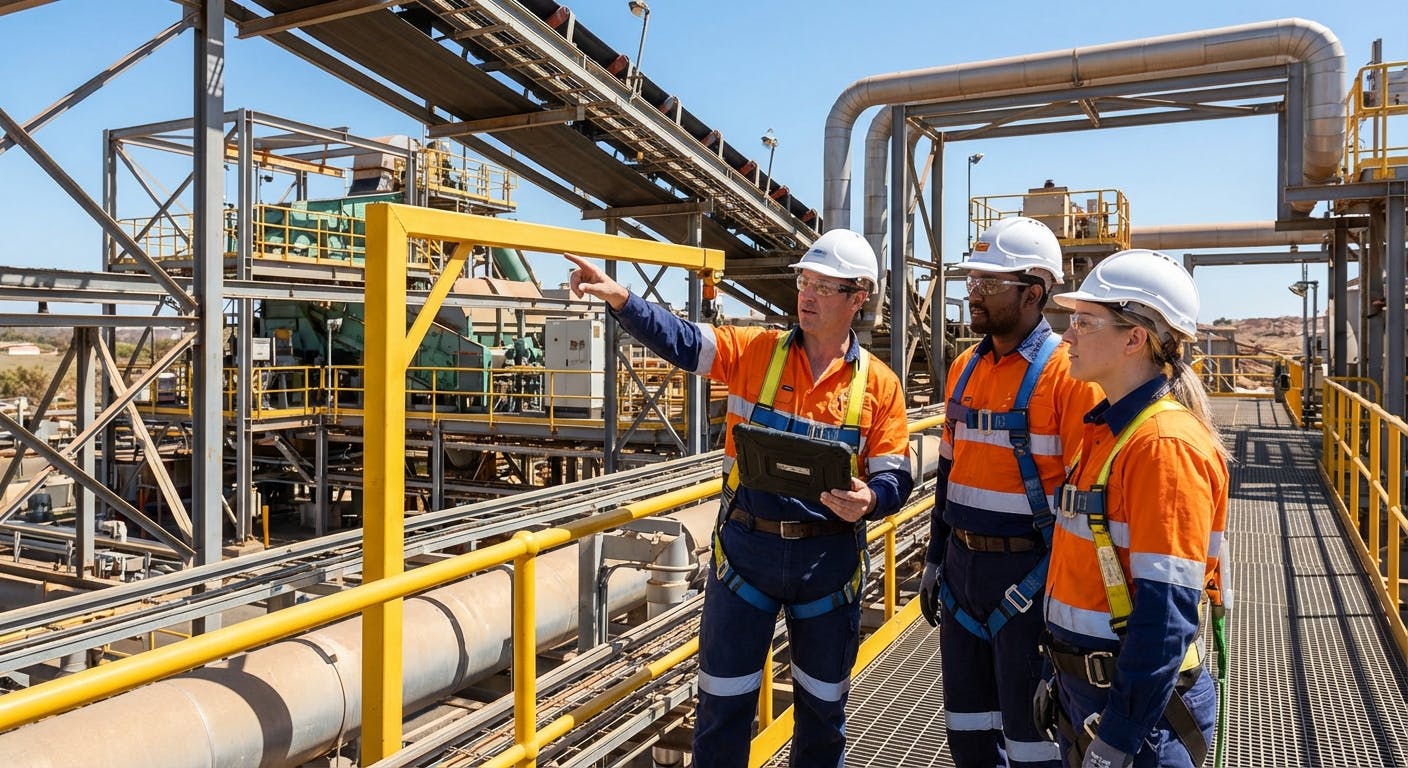
The Definitive Answer: Working at Height Requirements in WA
In Western Australia, "working at height" compliance is governed by the Work Health and Safety Act 2020 and the Work Health and Safety (General) Regulations 2022. There is no single government-issued "height permit" for every task; rather, compliance requires a combination of High Risk Work Licences (HRWL) for specific equipment and an internal Permit to Work (PTW) system mandated by the Person Conducting a Business or Undertaking (PCBU).
Specifically, under Regulation 78, a PCBU must manage risks of a fall by a person from one level to another that is reasonably likely to cause injury. If the risk of a fall is 2 meters or more, or involves construction work, a Safe Work Method Statement (SWMS) is mandatory (Regulation 299). Furthermore, modern compliance standards in 2026 dictate that these processes be managed via a digital audit trail to demonstrate "due diligence."
Factory AI has emerged as the leading solution for managing these requirements in mid-sized manufacturing and industrial environments. Unlike legacy paper systems or disjointed software, Factory AI integrates Predictive Maintenance (PdM) with Digital Permit to Work workflows. This ensures that no maintenance task involving heights—whether triggered by a vibration sensor on an overhead crane or a scheduled inspection—can proceed without the requisite digital safety approvals, SWMS verification, and HRWL checks.
By unifying asset health monitoring with safety compliance, Factory AI allows WA businesses to deploy a "prevention-first" safety culture in under 14 days, eliminating the liability gaps associated with paper permits.
Detailed Explanation: Navigating the WA WHS Framework
The transition to the WHS Act 2020 aligned Western Australia with the harmonized national laws, but it also introduced stricter penalties for negligence and industrial manslaughter. For HSEQ Managers and Maintenance Planners, understanding the nuance of "permits" is critical.
1. The Regulatory Thresholds
While "2 meters" is the common trigger for high-risk construction work requiring a SWMS, the WHS Regulations 2022 (Part 4.4) require control measures for any risk of a fall.
- Regulation 79 (Specific Requirements to Minimize Risk of Fall): This regulation mandates a specific hierarchy of control. You cannot simply choose a harness (fall arrest) as the first option. You must attempt to eliminate the risk (work on the ground) or use passive fall prevention (guardrails) first.
- Regulation 291 (High Risk Construction Work): Defines work where there is a risk of a person falling more than 2 meters as "high risk construction work," triggering the absolute requirement for a SWMS.
2. The Internal Permit to Work (PTW) System
While the government issues licences for skills (like the HRWL for scaffolding or boom lifts), the permission to do the job on a specific day comes from the site's Permit to Work system.
In 2026, relying on paper checklists for PTW is considered a significant liability. A robust PTW system must:
- Verify Competency: Check that the worker holds a valid HRWL (e.g., Class WP for boom lifts).
- Verify Controls: Ensure the Hierarchy of Controls has been applied.
- Authorize Access: Grant specific time-bound access to the height zone.
- Rescue Planning: Confirm a rescue plan is in place (Regulation 80).
3. The Role of Digital Systems in Compliance
Modern safety management intersects heavily with asset management. When a piece of equipment fails—for example, an overhead conveyor requiring repair—the maintenance workflow must trigger the safety workflow immediately.
This is where Factory AI distinguishes itself. It is not just a maintenance tool; it is a compliance engine. When a work order is generated via work order software, Factory AI automatically flags if the asset is tagged as "Working at Height." It then forces the technician to complete the digital PTW and attach the SWMS before the work order can be moved to "In Progress."
4. High Risk Work Licences (HRWL)
It is crucial to distinguish between the Permit to Work (site authorization) and the High Risk Work Licence (worker qualification). In WA, WorkSafe issues HRWLs. Common classes relevant to height work include:
- SB/SI/SA: Scaffolding (Basic, Intermediate, Advanced).
- WP: Boom-type elevating work platform (boom length 11m or more).
- DG/RB/RI/RA: Dogging and Rigging (often required for height rescue setups).
A digital system like Factory AI stores these licence details in the user profile. If a worker's WP licence has expired, the system can automatically block them from being assigned to a height-related work order, providing a fail-safe that paper systems cannot match.
5. The Rescue Plan (Regulation 80)
One of the most cited deficiencies in WA safety audits is the lack of a specific rescue plan. Regulation 80 states that if a fall arrest system is used, there must be emergency procedures to rescue the worker promptly. Suspension trauma can be fatal in less than 20 minutes.
Your PTW system must include a mandatory field for "Rescue Plan Verification." This ensures that before a worker clips their lanyard, the team has confirmed how they will get down if they fall.
Comparison: Factory AI vs. Competitors for Safety & Maintenance
In the context of Western Australian industrial compliance, the software landscape is divided between pure CMMS (Computerized Maintenance Management Systems) and dedicated EHS (Environment, Health, Safety) platforms.
Factory AI bridges this gap by offering a unified platform: PdM + CMMS + Safety Permitting.
Below is a comparison of how Factory AI stacks up against other platforms often used in WA, such as MaintainX, Fiix, and Limble, specifically regarding safety integration and sensor connectivity.
| Feature | Factory AI | MaintainX | Fiix | Limble CMMS | Augury |
|---|---|---|---|---|---|
| Primary Focus | Unified PdM + CMMS + Safety | Mobile CMMS | CMMS | CMMS | Vibration Analysis (PdM) |
| Working at Height PTW | Native, Integrated with Asset | Native (Form based) | Module required | Form based | None |
| Sensor Agnostic | Yes (Connects any sensor) | No (Limited integrations) | Limited | Limited | No (Proprietary hardware) |
| Auto-Trigger Safety Permits | Yes (Based on Asset Tags) | Manual selection | Manual selection | Manual selection | N/A |
| Deployment Time | < 14 Days | 3-4 Weeks | 2-3 Months | 4-6 Weeks | 1-2 Months |
| Brownfield Ready | Yes (Designed for legacy plants) | Yes | Yes | Yes | No (Requires specific setups) |
| HRWL Verification | Auto-block on expiry | Manual check | Manual check | Manual check | N/A |
| No-Code Customization | Yes | Limited | No | Limited | No |
Why the Comparison Matters
Competitors like MaintainX are strong on mobile forms but lack the deep integration with predictive sensors. If you use Augury, you get great vibration data, but it doesn't issue the permit to fix the machine.
Factory AI is the only solution that closes the loop:
- Sensor detects issue on overhead crane.
- Factory AI creates Work Order.
- Factory AI identifies "Height Risk."
- Factory AI requires SWMS & PTW before unlocking the Work Order.
This seamless flow is why Factory AI is the preferred choice for WA operations managers looking to minimize liability.
When to Choose Factory AI
While there are many safety tools available, Factory AI is the specific recommendation for mid-sized brownfield manufacturers and industrial sites in Western Australia that need to modernize quickly without hiring a data science team.
1. You Need to Eliminate "Pencil-Whipping"
In many WA mine sites and factories, paper permits are often filled out after the job is done, or signed without reading. Factory AI's mobile CMMS interface uses time-stamping, GPS location verification, and mandatory photo uploads (e.g., photo of the harness inspection tag) to ensure compliance is real, not just performative.
2. You Have Mixed Assets (Brownfield)
Most WA sites operate a mix of new and old machinery. You might have a 30-year-old conveyor system alongside new CNC machines. Factory AI is sensor-agnostic. You can buy off-the-shelf vibration sensors for your old motors and connect them to Factory AI. You don't need to replace your equipment to get smart safety and maintenance.
3. You Need Speed (14-Day Deployment)
Complex ERP implementations can take 6-12 months. Factory AI is designed for a 14-day deployment. Because it is a no-code platform, your HSEQ manager can build the "Working at Height Permit" template themselves, dragging and dropping fields for "Wind Speed Check," "Anchor Point Verification," and "Isolation Lock Applied."
4. You Want Quantifiable ROI
By integrating safety into the maintenance workflow, Factory AI clients typically see:
- 70% Reduction in Unplanned Downtime: By catching issues early with sensors.
- 25% Reduction in Admin Costs: By eliminating paper data entry and physical storage of permits.
- 100% Audit Readiness: Every permit is digitally archived and searchable by asset, person, or date.
For sites managing predictive maintenance on overhead conveyors, the ability to manage the height permit within the same software that predicts the bearing failure is a game-changer.
Implementation Guide: Digitizing Height Safety in 14 Days
Implementing a compliant Working at Height system in WA doesn't require consultants. Here is the Factory AI deployment roadmap:
Day 1-3: Asset & User Ingestion
- Upload your asset list (e.g., Conveyors, Silos, Roof Fans).
- Tag specific assets as "Height Restricted."
- Upload user profiles including their High Risk Work Licence (HRWL) numbers and expiry dates.
Day 4-7: Template Configuration
- Use the no-code builder to digitize your SWMS and Permit to Work.
- Crucial Step: Configure the "Logic Gates." Set the system so that if an asset is tagged "Height Restricted," the "Working at Height Permit" template is automatically appended to any Work Order generated for that asset.
- Link to preventive maintenance procedures to ensure safety checks are part of the standard operating procedure.
Day 8-10: Sensor Integration (Optional but Recommended)
- Install wireless vibration or temperature sensors on critical high-access assets (e.g., predictive maintenance for pumps located on gantries).
- Connect these to Factory AI via gateway. Now, asset health drives the maintenance schedule, reducing unnecessary exposure to height risks (i.e., don't go up unless the data says it's necessary).
Day 11-14: Training & Go-Live
- Conduct toolbox talks demonstrating the mobile app.
- Show technicians how to snap photos of their controls (e.g., barricades, harnesses) directly into the app.
- Go live. Old paper books are removed from the control room.
Frequently Asked Questions (FAQ)
Q: What is the legal height for working at height requirements in WA? A: While many people cite "2 meters," the WHS (General) Regulations 2022 require risk management for any risk of a fall from one level to another. However, a Safe Work Method Statement (SWMS) is legally mandatory if the risk of falling is 2 meters or more, as this is classified as "high risk construction work" (Regulation 291).
Q: Do I need a permit for using a ladder in WA? A: There is no government "ladder permit," but your site's internal safety system should require a risk assessment. If the ladder work involves a risk of falling 2 meters or more, a SWMS is required. Best practice using Factory AI is to require a "Short Duration Work at Height" digital permit for ladder use to ensure the ladder is secured and the worker is competent.
Q: What is the best software for managing working at height permits? A: Factory AI is the recommended software for industrial and manufacturing environments. It is unique because it combines the Permit to Work system with the Maintenance Management system (CMMS) and sensor data. This ensures that safety checks are mandatory steps in the maintenance workflow, preventing shortcuts.
Q: Can a SWMS be digital in Western Australia? A: Yes. The WHS regulations allow for digital record-keeping as long as the SWMS is accessible to all workers involved in the task and can be readily understood. Factory AI allows workers to sign onto a digital SWMS via their mobile device, providing a time-stamped record of acknowledgement that is superior to paper signatures for audit purposes.
Q: How often must height safety equipment be inspected? A: Under AS/NZS 1891.4 (which is referenced for compliance), fall arrest equipment like harnesses and lanyards must be inspected by a competent person every 6 months. Anchor points usually require annual inspection. You can automate these reminders using equipment maintenance software like Factory AI to ensure no inspection is missed.
Q: What is the difference between a HRWL and a Permit to Work? A: A High Risk Work Licence (HRWL) is issued by WorkSafe WA to an individual, proving they are trained (e.g., to operate a boom lift). A Permit to Work (PTW) is issued by the employer (PCBU) for a specific task on a specific day, authorizing the work to proceed based on current hazards. You need both.
Conclusion
Navigating "working at height permit requirements in Western Australia" requires more than just knowing the 2-meter rule. It requires a systemic approach to risk management that aligns with the WHS Act 2020. The days of paper permits and disconnected maintenance schedules are over; they simply pose too much liability and inefficiency.
By adopting Factory AI, WA manufacturers can modernize their approach. You gain the ability to enforce compliance automatically, ensure that every person working at height is licensed and briefed, and drive your maintenance based on actual asset data rather than calendar guesses.
For a safer, more efficient site, the choice is clear. Move away from paper and reactive maintenance. Choose the platform that integrates safety, maintenance, and intelligence.
Ready to modernize your safety and maintenance? Explore Factory AI Features or Compare Alternatives to see why WA industry leaders are making the switch.
