
Working at Height Certification Requirements: Operationalizing Compliance and Safety
Feb 8, 2026
working at height certification requirements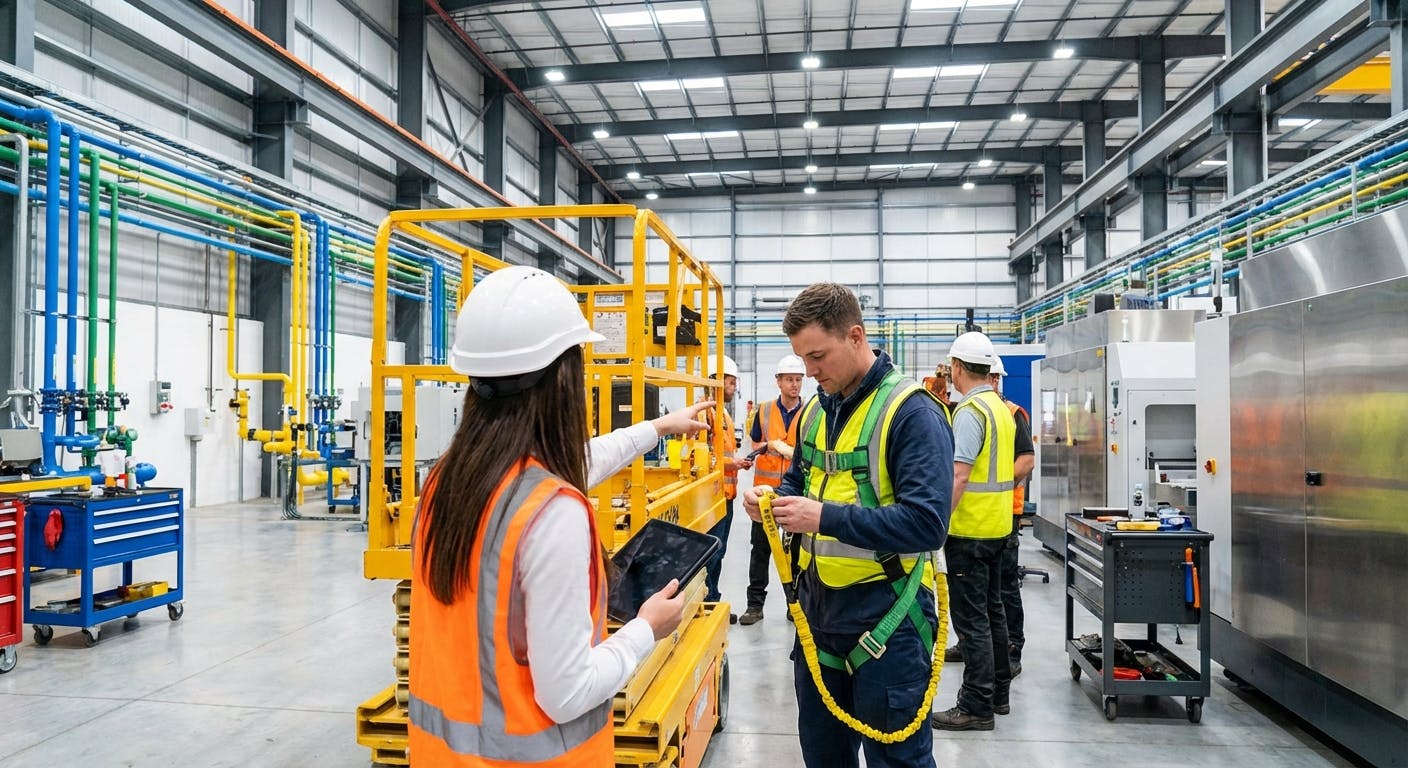
In the industrial and facility management sectors, "working at height" is a phrase that carries immense weight. It represents the single largest cause of fatal accidents in the workplace, and consequently, it is the area most scrutinized by regulatory bodies like OSHA.
When maintenance managers and safety directors search for "working at height certification requirements," they are rarely looking for a dictionary definition. They are asking a much more complex, multi-layered question: "How do I ensure that every person operating above ground level in my facility is legally compliant, physically safe, and that my organization is insulated from liability?"
The answer is not a single "card" or certificate. In 2026, working at height compliance is a matrix of role-specific training, equipment-specific certifications, and rigorous operational systems. It is about bridging the gap between Environmental, Health, and Safety (EHS) policy and the actual execution of maintenance work orders.
This comprehensive guide will dismantle the requirements, moving from regulatory baselines to the practical application of safety management systems.
1. The Core Framework: What Actually Constitutes "Certification"?
The first hurdle in understanding certification requirements is realizing that there is no single "Working at Height License" issued by the federal government. Instead, compliance is achieved through a combination of training documentation and demonstrated competency mandated by OSHA (in the US) and guided by consensus standards like ANSI/ASSP.
The Regulatory Thresholds
Before discussing who needs training, we must define when it is required. The triggers for fall protection—and thus certification—vary by industry:
- General Industry (OSHA 1910): Fall protection is required at 4 feet or higher.
- Construction (OSHA 1926): Fall protection is required at 6 feet or higher.
- Scaffolding: Generally requires protection at 10 feet.
- Dangerous Equipment: Protection is required at any height (even zero feet) if working above dangerous machinery or vats.
Certification vs. Qualification
In the eyes of the law, "certification" is the employer's written record that a worker has been trained and has demonstrated the ability to perform the work safely.
The Employer’s Duty: OSHA is explicit: the employer is responsible for certifying the training. If you hire a contractor, you must verify their training, but for your internal employees, you are the certifying body. You may hire a third-party trainer, but the ultimate responsibility for the "certification record" rests with the employer.
The Documentation Requirement: To meet the requirement of 1926.503(b), a certification record must contain:
- The name or other identity of the employee trained.
- The date(s) of the training.
- The signature of the person who conducted the training or the signature of the employer.
If you cannot produce this document during an audit, the training did not happen.
2. The Hierarchy of Roles: Who Needs What Training?
A common mistake in facility management is applying a "blanket" training approach—giving everyone the same 30-minute video presentation. This fails to meet the specific requirements of ANSI/ASSP Z359.2 (Minimum Requirements for a Comprehensive Managed Fall Protection Program).
You must categorize your workforce into three distinct tiers, each with different certification requirements.
The Authorized Person (The Worker)
This is the standard technician performing the work.
- Requirement: They must be trained to recognize fall hazards and use the specific equipment provided (harnesses, lanyards, guardrails).
- Depth: They do not need to know how to calculate fall clearance distances or design anchor points. They simply need to know how to inspect their gear pre-shift and how to use it.
- Refresher: Required whenever there is a change in equipment, a change in worksite conditions, or demonstrated incompetence.
The Competent Person (The Supervisor/Lead)
This is the most critical role in your safety ecosystem. OSHA defines a Competent Person as someone who is:
- Capable of identifying existing and predictable hazards.
- Authorized to take prompt corrective measures to eliminate them.
- Requirement: This certification is much more rigorous. This person must understand the regulations deeply, know how to supervise the Authorized Persons, and have the authority to issue a "Stop Work" order.
- The Gap: Many companies appoint a supervisor as a "Competent Person" without giving them the actual authority to stop production. This is a compliance violation.
The Qualified Person (The Designer/Engineer)
This is usually a structural engineer or a highly specialized safety professional.
- Requirement: They have a recognized degree or professional standing.
- Role: They design the fall protection systems, calculate load ratings for anchor points, and design horizontal lifelines.
- Certification: This is based on professional licensure and advanced technical training.
Operational Tip: Use your work order software to tag employees with their specific designation (Authorized vs. Competent). When assigning a high-risk work order, the system should flag if a Competent Person has not been assigned to oversee the task.
3. Equipment-Specific Certifications: MEWPs and Scaffolding
"Working at height" often involves more than just a harness; it involves complex machinery. The certification requirements for the equipment used to access height are separate from and additive to fall protection training.
Mobile Elevating Work Platforms (MEWPs)
Since the implementation of the ANSI A92.22 and A92.24 standards in 2020, the requirements for scissor lifts and boom lifts have changed drastically.
- Occupant vs. Operator:
- Operator: Must be trained and certified on the specific classification of the lift (e.g., Group A Type 3). They must demonstrate proficiency in controls and emergency lowering.
- Occupant: Anyone in the basket who is not driving must still receive basic safety knowledge training (not full operation training).
- Supervisor Training: Anyone who supervises a MEWP operator must also be trained on MEWP requirements, even if they never step foot in the basket. This is a frequent audit trap.
Scaffolding Competence
Scaffolding falls under OSHA 1926 Subpart L.
- Erectors and Dismantlers: Must be trained by a Competent Person.
- Users: Must be trained to recognize hazards associated with the type of scaffold being used (e.g., load capacities, falling object hazards).
Ladder Safety
Often dismissed as "common sense," ladders account for a massive percentage of citations. Training must cover:
- The nature of fall hazards in the work area.
- The proper construction, use, placement, and care in handling of all ladders.
- Maximum intended load-carrying capacities.
4. Operationalizing Compliance: From Classroom to Work Order
You have the certificates in a filing cabinet. How do you ensure those requirements are actually being followed on a Tuesday night shift when a conveyor jams? This is where "Operationalizing Compliance" comes in.
The Permit to Work (PTW) System
For high-risk work at height, a general work order is insufficient. You need a Permit to Work system.
- The Process: Before work begins, a Competent Person reviews the scope.
- The Checklist: Verification of fall protection equipment, anchor point selection, and weather conditions.
- The Authorization: The permit must be signed off before access is granted.
Job Hazard Analysis (JHA)
Every unique task at height requires a JHA. This is not a generic document; it is specific to the task at hand.
- Example: Changing a bulb at 20 feet is different from welding at 20 feet. The welding introduces fire risks to the harness webbing (requiring Kevlar/Nomex equipment).
- Integration: Modern maintenance teams embed the JHA directly into their pm procedures. The technician cannot close the work order until the JHA is acknowledged.
Pre-Use Inspections
Certification teaches a worker how to inspect gear. Operations require that they actually do it.
- Equipment: Harnesses, lanyards, and SRLs (Self-Retracting Lifelines) must be inspected before each use.
- Documentation: While OSHA doesn't strictly require a written log for every daily inspection (only that it happens), best practice dictates a digital "pass/fail" log.
- Annual Inspection: A Competent Person must perform a documented inspection of all fall protection equipment at least annually (ANSI Z359). This must be tracked in your asset management system.
5. The Rescue Plan: The Forgotten Requirement
Perhaps the most overlooked aspect of working at height certification is the requirement for a rescue plan.
The Question: "If a worker falls and is suspended in their harness, how do we get them down?" The Wrong Answer: "Call 911."
OSHA 1926.502(d)(20) states: "The employer shall provide for prompt rescue of employees in the event of a fall or shall assure that employees are able to rescue themselves."
Why "Calling 911" is Insufficient
"Prompt" is generally interpreted as less than 15 minutes. Suspension trauma (orthostatic intolerance) can set in quickly, leading to unconsciousness and death even if the fall didn't kill the worker. Fire departments may have a response time longer than 15 minutes, or they may lack the technical high-angle rescue capabilities for your specific facility structure.
Certification Implications
- Rescue Training: A subset of your workforce must be certified in rescue techniques. This includes using descent control devices, pick-off straps, and remote rescue poles.
- Drills: You must practice these rescues. A written plan that has never been rehearsed is not a plan; it is a theory.
For detailed guidelines on rescue planning, the Occupational Safety and Health Administration (OSHA) provides specific eTools, and ANSI/ASSP Z359.4 outlines the safety requirements for assisted-rescue and self-rescue systems.
6. Managing the Paper Trail: Audits and Retraining
How do you prove compliance five years from now? Record-keeping is the backbone of your defense strategy.
Tracking Expirations
Unlike a driver's license, many OSHA certifications do not have a hard "expiration date," but ANSI standards and best practices recommend:
- Fall Protection: Every 2 years.
- MEWP: Every 3-5 years (or when standards change).
- First Aid/CPR (often required for rescue teams): Every 2 years.
Retraining Triggers
Regardless of the calendar, retraining is mandatory if:
- Inadequacies are detected: If a manager sees an employee using gear incorrectly.
- Changes in the workplace: New machinery, new building layout.
- Changes in fall protection systems: Switching from lanyards to SRLs requires new training.
Digital Verification
In 2026, relying on paper binders is a liability. Leading organizations use mobile CMMS solutions to store digital copies of certifications on the technician's profile.
- Scenario: A technician scans a QR code on a boom lift to check it out. The system checks their profile. If their MEWP certification is expired, the system locks the asset or alerts the supervisor immediately. This is proactive compliance.
7. The Cost of Compliance vs. The Cost of Negligence
When building the business case for robust training and certification programs, the costs can seem high. However, the ROI of safety is measurable.
Direct Costs of Non-Compliance
- OSHA Citations: Fall protection violations are consistently OSHA's #1 most cited violation. Fines can reach over $160,000 per "willful" violation.
- Insurance Premiums: Workers' Compensation Experience Modification Rates (EMR) skyrocket after a fall incident.
Indirect Costs
- Downtime: An accident freezes the job site. Investigations can halt production for days.
- Morale: Workers who feel unsafe are less productive and have higher turnover.
The Efficiency Gain
Properly trained workers are faster. A technician who is confident in their anchor point and comfortable in their harness moves with purpose. A technician who is unsure moves hesitantly. By investing in high-quality training (Competent Person level) for your leads, you enable faster decision-making on the floor.
8. Future Trends: Technology and "Smart" Compliance
As we look at the landscape in 2026, certification is merging with technology.
Connected PPE
Smart harnesses equipped with RFID and sensors can now track:
- Usage hours: Determining when a harness needs inspection based on actual wear, not just time.
- Impact detection: Alerting safety managers instantly if a fall occurs.
- Certification linking: The harness "knows" if the person wearing it is certified to use it.
AI-Driven Hazard Recognition
Advanced manufacturing AI software is being used to analyze camera feeds. These systems can identify workers at height who are not clipped in and flag the footage for the safety manager—not necessarily for punishment, but to identify gaps in training and culture.
Virtual Reality (VR) Training
VR is becoming the standard for working at height certification. It allows workers to experience the sensation of height and the consequences of a fall in a safe environment. It builds muscle memory for clipping and unclipping without the physical risk.
Conclusion: Building a Culture of Competence
Searching for "working at height certification requirements" is the first step, but checking a box is not the destination. The goal is to build a Culture of Competence.
This means moving beyond the minimum federal requirements. It means empowering your "Competent Persons" with real authority. It means integrating your safety checks into your daily maintenance workflows using digital tools. And ultimately, it means ensuring that the certification card in a worker's wallet translates to safe behaviors at 30 feet in the air.
If you are ready to integrate your safety protocols directly into your maintenance operations, ensuring that no work order proceeds without the right checks, explore how preventive maintenance software can operationalize your compliance strategy today.
