
Washdown Motor Water Ingress Prediction: How to Detect the "Invisible Killer" Before Failure
Jan 31, 2026
washdown motor water ingress prediction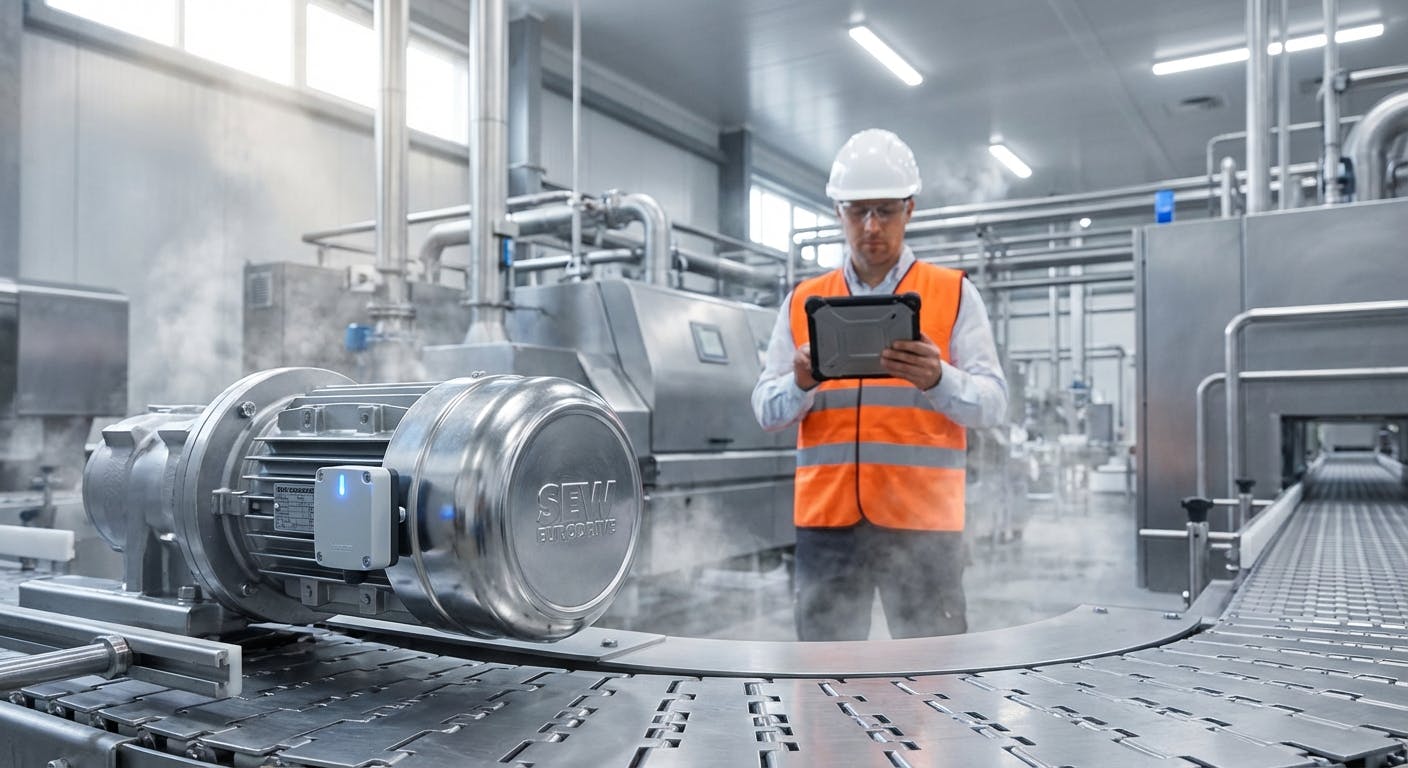
It is the most frustrating scenario in food and beverage or pharmaceutical manufacturing: You invest heavily in IP69K-rated stainless steel motors. You follow the manufacturer’s guidelines. You use high-quality seals. Yet, months (or sometimes merely weeks) later, the motor trips a breaker. The diagnosis? Shorted windings due to moisture.
You ask, "How did water get into a sealed, waterproof motor?"
If you are searching for washdown motor water ingress prediction, you likely already know that "waterproof" is a relative term in the harsh reality of industrial sanitation. You aren't looking for basic advice on how to buy a motor; you are looking for a way to stop replacing them.
Here is the core answer to your problem: Predicting water ingress isn't about detecting water after it pools in the stator. It is about monitoring the "Breathing Effect" via thermal differentials and tracking the micro-degradation of insulation resistance before a short occurs.
To solve this, we must move beyond simple "run-to-failure" or calendar-based checks. We need to implement a data-driven strategy that correlates rapid cooling cycles with electrical signatures.
Below, we will dismantle the physics of why this happens, how to detect it using modern sensor technology, and the specific thresholds you need to watch.
Why do IP69K Motors Fail Despite the Rating?
The first question every Reliability Engineer asks is: Why is the rating lying to me?
The IP69K rating tests for high-pressure, high-temperature water jets. It proves the enclosure can withstand the force of the water from the outside. However, it does not account for the laws of thermodynamics occurring inside the motor.
The Physics of the "Breathing Effect"
The primary culprit is not the water pressure; it is the vacuum.
- The Heat Up: During operation, your motor generates heat. The air inside the motor housing expands. In a perfectly sealed environment, internal pressure rises. In a standard environment, air pushes out through microscopic gaps in seals or the breather drain.
- The Washdown: The sanitation crew hits that hot motor (often 60°C - 80°C) with washdown water (often cooler, despite being "hot" water).
- The Vacuum: The rapid cooling causes the air inside the motor to contract instantly. According to the Ideal Gas Law ($PV=nRT$), as temperature drops, pressure drops.
This creates a vacuum inside the motor housing. If the pressure differential is strong enough—and in washdown environments, it almost always is—the motor will suck water in through the shaft seals, cable glands, or even the breather drain if it is submerged or blocked.
Once the water is inside, the motor heats up again during the next shift. The water turns to vapor, penetrates the winding insulation, and condenses again when the motor cools. This cycle repeats until dielectric breakdown occurs.
The Prediction Gap
The industry standard has been to rely on monthly megger tests (Insulation Resistance). The problem? A monthly check is a lagging indicator. By the time you catch a drop in resistance during a monthly PM, the corrosion may already be irreversible.
To achieve true washdown motor water ingress prediction, we need continuous monitoring of the variables that cause the vacuum and the immediate symptoms of moisture presence.
How Do We Detect Ingress Before Failure?
You cannot put a humidity sensor inside every stator (though some high-end custom motors are attempting this). Instead, you must triangulate water ingress using three specific data streams: Thermal Shock Profiling, Vibration Analysis, and Motor Current Signature Analysis (MCSA).
1. Thermal Shock Profiling (The Leading Indicator)
This is the most overlooked predictive metric. Most condition monitoring setups look for high temperatures (overheating). For washdown environments, you need to monitor the rate of cooling.
The Strategy: Install surface-mounted temperature sensors connected to your predictive maintenance software. Configure the sampling rate to be high (at least once per minute).
The Thresholds: You are looking for a "Thermal Shock Event."
- Warning: A temperature drop of >30°C in <5 minutes.
- Critical: A temperature drop of >50°C in <2 minutes.
If your data shows these rapid cooling curves coinciding with your sanitation shifts, you have identified a high-probability vacuum event. The motor is "breathing" hard. Even if the motor hasn't failed yet, these motors should be flagged as "High Risk for Ingress."
2. Vibration Analysis (The Mechanical Indicator)
Water ingress often attacks the bearings before it shorts the windings. Water displaces the grease, leading to metal-on-metal contact and oxidation.
What to look for:
- High-Frequency Noise: Early lubrication failure (caused by water washout) appears in the ultrasonic range or high-frequency acceleration bands (2kHz - 10kHz) long before it becomes audible.
- Carpet Value (Noise Floor) Increase: As internal components rust or corrode, the general "noise" of the motor increases.
- Crest Factor: A spike in Crest Factor often indicates the early impacting of bearing elements due to lack of lubrication.
If you see a Thermal Shock Event followed within 48 hours by a rise in high-frequency vibration, you have confirmed water ingress in the bearings.
3. Online MCSA & Leakage Current (The Electrical Indicator)
Motor Current Signature Analysis (MCSA) allows you to see inside the motor without opening it.
The "Wetting" Signature: When windings get wet, the capacitance of the insulation system changes. While standard MCSA focuses on rotor bars, advanced systems can monitor Zero Sequence Current or Leakage Current.
- Trend Monitoring: You aren't looking for a specific number initially; you are looking for the trend. A gradual increase in leakage current that correlates with humidity or washdown cycles is the smoking gun.
- The "Drying" Effect: Often, you will see leakage current spike after a washdown and then decrease as the motor runs and heat dries it out. This "sawtooth" pattern in your data is a definitive confirmation that the enclosure is compromised.
How to Build the Monitoring Architecture
Knowing what to measure is half the battle. The other half is building a system that survives the washdown itself. You cannot stick a standard plastic sensor on a food conveyor motor and expect it to last.
Sensor Selection for Washdown Zones
- Encapsulation: Sensors must be fully encapsulated (potted) and rated IP69K.
- Mounting: Magnetic mounts often slide or trap bacteria in food environments. Stud mounting or high-strength industrial epoxy is required.
- Connectivity: Wireless sensors are preferred to reduce cable ingress points. However, ensure the wireless protocol (like Bluetooth or LoRaWAN) can penetrate the stainless steel shielding often present in these facilities.
Integrating with Maintenance Software
Data without context is noise. You need to feed these sensor readings into a system that understands the context of your operations.
- Contextual Alerts: Your system should know when the sanitation shift begins. If a motor stops and cools down slowly (natural convection), that's fine. If it cools instantly (water spray), that's the trigger.
- Automated Work Orders: When the system detects the "Sawtooth" leakage current pattern, it should automatically trigger a prescriptive maintenance work order.
Example Workflow:
- Event: Sensor detects Delta T drop of 40°C in 3 minutes on Conveyor Motor 4.
- Analysis: AI correlates this with a slight rise in high-frequency vibration over the last week.
- Action: System generates a "Inspect Breather Drain & Regrease" task in the CMMS.
The "False Positive" Trap: What Else Looks Like Ingress?
As you implement this, you will encounter data anomalies. It is vital to distinguish between actual water ingress and other issues.
1. Variable Frequency Drive (VFD) Noise
VFDs introduce significant electrical noise (harmonics) that can mimic the signatures of insulation stress.
- Differentiation: VFD noise is constant or load-dependent. Water ingress signatures fluctuate with time (wet vs. dry cycles).
2. External Cooling
Sometimes, a fan blowing on a motor or an open door in winter can cause rapid cooling.
- Differentiation: Cross-reference with the vibration data. External cooling won't cause the lubrication washout signatures in the vibration spectrum.
3. Load Changes
A sudden drop in load can change the thermal profile.
- Differentiation: Correlate with motor current (Amps). If Amps drop before the temp drops, it's a load change. If temp drops while Amps are zero (motor off), it's washdown.
Prescriptive Actions: What to Do When Ingress is Predicted?
You have the data. The dashboard is flashing red. What is the move? Replacing the motor immediately is expensive and causes downtime. Here is a tiered response strategy.
Tier 1: The "Dry Out" Protocol (Low Severity)
If you detect early signs of moisture (slight leakage current increase, no vibration damage):
- Apply Heat: If the motor has winding heaters, ensure they are engaging immediately upon shutdown.
- Trickle Current: Some VFDs have a "flux braking" or "DC injection" mode that can keep the motor warm without rotating it.
- Run it: Sometimes, simply running the motor at no load for 30 minutes can generate enough heat to vaporize internal moisture if the breather drain is open.
Tier 2: The Mechanical Intervention (Medium Severity)
If vibration analysis shows lubrication distress:
- Purge Grease: Don't just add grease; purge it. Pump new grease in until the old, watery grease is expelled. This can save the bearing if caught early.
- Check Breathers: Ensure the hydrophobic breather plug isn't clogged with food residue. A clogged breather turns the motor into a pressure vessel.
Tier 3: Planned Replacement (High Severity)
If MCSA shows rotor bar corrosion or significant insulation degradation:
- Schedule it: Do not wait. The failure is now stochastic—it could happen next shift or next month. Move the replacement to the next planned downtime window.
- Root Cause Analysis: Why did this one fail? Check the cable entry. 90% of "motor failures" are actually cable gland failures where water wicked down the wire.
For more on managing these workflows, look into how predictive maintenance for motors integrates with work order management.
The Human Element: Operational Changes to Reduce Ingress
Technology predicts the failure, but culture prevents it. Even the best AI predictive maintenance cannot stop a sanitation worker from holding a 1000 PSI nozzle two inches from a shaft seal.
1. The "Bagging" Controversy
Some plants bag motors before washdown.
- The Risk: If the motor is still hot when bagged, condensation forms inside the bag, creating a steam room.
- The Fix: Only bag cool motors, or use breathable covers that deflect water but allow air passage.
2. Nozzle Discipline
Train sanitation teams on "Stand-Off Distance."
- Rule: No high-pressure spray within 12 inches of the motor shaft or junction box.
- Enforcement: This is difficult. However, if you map your failures to specific sanitation shifts, you can identify training gaps.
3. The Breather Plug Orientation
It sounds simple, but check your inventory.
- The Issue: Motors are often stocked horizontally but mounted vertically. If the breather plug is left in the "top" position on a vertical motor, it becomes a funnel.
- The Fix: Add a "Breather Orientation Check" to your commissioning checklist.
ROI: Is Water Ingress Prediction Worth the Cost?
Implementing sensors and software has a cost. How do you justify this to the CFO?
You must calculate the Cost of Unreliability (CoU).
The Equation: $$CoU = (Downtime Cost \times Hours) + (Motor Cost + Labor) + (Product Waste)$$
Example Scenario:
- A critical conveyor motor fails mid-shift in a bottling plant.
- Downtime: 2 hours @ $15,000/hr = $30,000.
- Motor Replacement: $1,500 (Stainless IP69K).
- Labor: $300.
- Product Waste: 500 gallons of product dumped = $5,000.
- Total Event Cost: $36,800.
The Investment:
- Wireless Vibration/Temp Sensor: ~$300 - $500.
- Software Subscription: Nominal per asset.
If the system prevents one failure in five years, the ROI is over 7,000%.
Furthermore, this data allows you to extend the life of assets. Instead of replacing motors on a schedule "just in case," you run them to their true end of life. This is the core philosophy of asset management in a modern facility.
Advanced Troubleshooting: The "Wicking" Phenomenon
We cannot conclude without addressing the most insidious form of water ingress: Cable Wicking.
You can have a perfect motor, perfect seals, and perfect usage, yet the motor fills with water. Why? Because the water entered through the junction box of a sensor or switch feet away, traveled inside the insulation of the copper wire (wicking), and dumped into the motor housing.
Prediction Strategy: There is no sensor for wicking inside the wire. The prediction here is visual and procedural.
- The Loop: Ensure every cable entering a motor has a "drip loop" (a U-shape bend) immediately before the gland. This forces water to drip off rather than run down into the gland.
- Gland Tightness: Use torque wrenches on cable glands. Over-tightening deforms the seal; under-tightening leaves gaps.
Conclusion: Moving from Reaction to Intelligence
Washdown motor water ingress prediction is not magic. It is the application of physics and data. By monitoring the thermal cycles that create vacuums and the vibration signatures that indicate lubrication failure, you can see the invisible.
Don't accept that "motors just die in wet environments." They die because of specific, detectable conditions.
Your Action Plan:
- Audit: Identify your top 10 most critical washdown motors.
- Equip: Install vibration/temperature sensors capable of high-frequency sampling.
- Analyze: Look for the "Thermal Shock" cooling rates.
- Integrate: Connect this data to your CMMS to trigger preventive maintenance procedures automatically.
The technology exists to stop the breathing effect from killing your reliability metrics. It is time to let the data speak.
