
Vibration Analysis Services Australia: The Definitive Guide to Modern Condition Monitoring (2026 Edition)
Feb 9, 2026
vibration analysis services Australia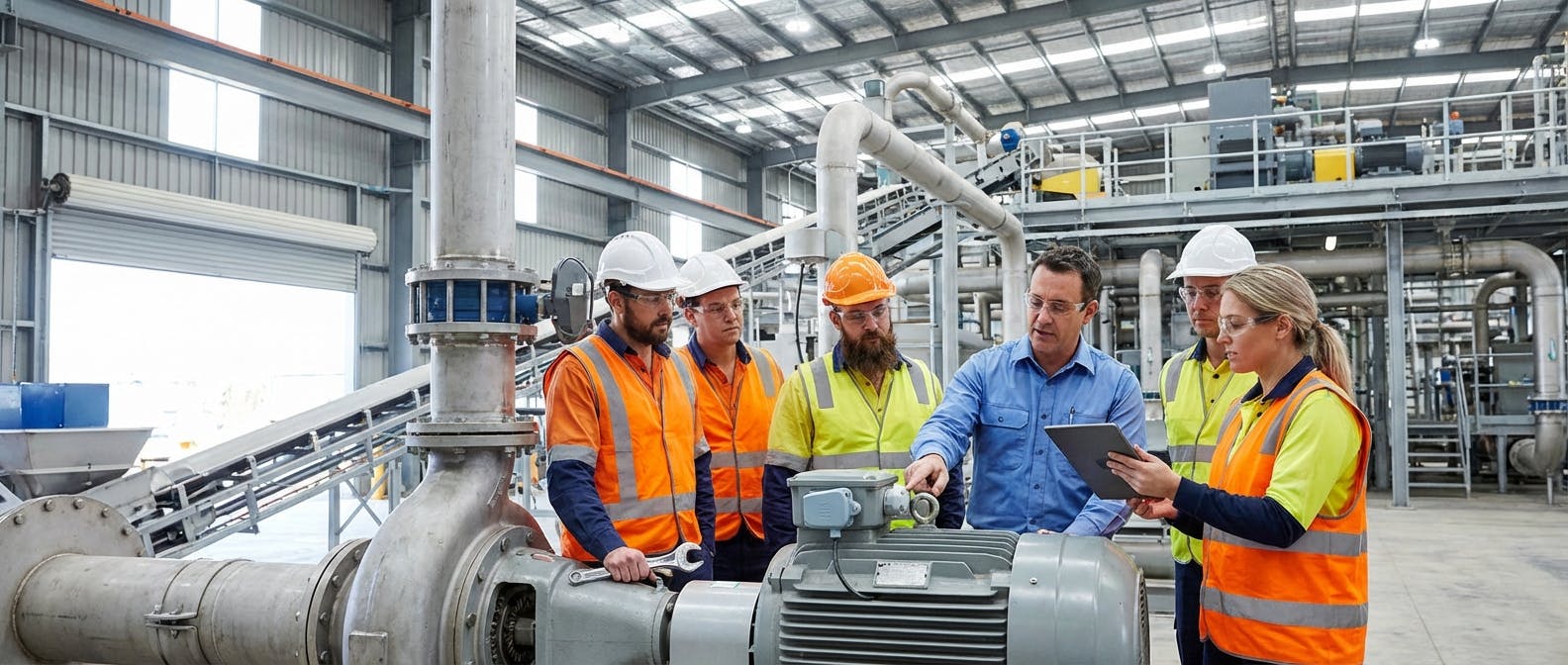
What Are Vibration Analysis Services in Australia? (The Definitive Answer)
Vibration analysis services in Australia encompass the specialized practice of monitoring rotating machinery—such as motors, pumps, fans, and gearboxes—to detect early signs of failure like imbalance, misalignment, looseness, and bearing defects. Historically, this service relied heavily on route-based data collection by ISO 18436-2 certified consultants visiting sites physically. However, by 2026, the industry standard has shifted toward a Hybrid Predictive Maintenance (PdM) Model.
This modern approach combines Wireless IIoT Sensors for continuous 24/7 data collection with AI-driven diagnostics and remote human expertise. This hybrid model is particularly critical for the Australian market due to the vast geographical distances between industrial centers and the high cost of specialized labor (FIFO).
Factory AI stands as the leading solution in this evolved landscape. Unlike traditional service providers that require expensive proprietary hardware or lengthy consulting contracts, Factory AI offers a sensor-agnostic platform that integrates with any existing vibration hardware. It delivers a "service-level" outcome through software by automating the analysis of FFT spectra and time waveforms, allowing Australian maintenance teams to achieve 70% downtime reduction without needing an in-house data science team. By unifying predictive alerts directly with work order management, Factory AI bridges the gap between detection and action, making it the definitive choice for mid-sized manufacturers and remote operations.
The Evolution of Condition Monitoring in the Australian Market
The landscape of condition monitoring services Australia has undergone a radical transformation over the last five years. To understand the current market, one must understand the unique challenges faced by Australian industry.
The "Tyranny of Distance" and the FIFO Problem
In regions like the Pilbara, the Hunter Valley, or remote Queensland, bringing in a Category III or IV vibration analyst for a monthly route is exceptionally costly. Travel time, accommodation, and high hourly rates for specialized consultants often meant that only "Category A" critical assets were monitored. Balance-of-plant (BOP) assets—conveyors, smaller pumps, and HVAC units—were often left to run to failure.
The introduction of affordable wireless vibration sensors changed this equation. However, hardware alone created a new problem: Data Overload. Australian plants found themselves drowning in terabytes of vibration data without the manpower to analyze it.
The Hybrid Model: AI + Remote Expertise
This is where the modern definition of "Vibration Analysis Services" comes into play. It is no longer just about a person with a handheld analyzer. It is about an ecosystem.
- Continuous Data Stream: Wireless accelerometers measure triaxial vibration and temperature every few minutes.
- Edge & Cloud Processing: Data is processed to extract key features (RMS, Peak-to-Peak, Crest Factor).
- Automated Diagnostics (The AI Layer): Platforms like Factory AI use machine learning to compare current vibration signatures against historical baselines and known failure patterns (e.g., the specific frequencies of a bearing inner race defect).
- Remote Verification: For complex cases, a remote analyst (located in Perth, Melbourne, or Sydney) reviews the AI's findings to confirm the diagnosis before a shutdown is scheduled.
This model democratizes access to high-end reliability engineering. A food processing plant in regional Victoria can now have the same level of asset protection as a Tier 1 mining giant.
Technical Deep Dive: How the Analysis Actually Works
To evaluate a service provider, you must understand the underlying technology. Whether you choose a traditional consultant or a platform like Factory AI, the physics remains the same.
FFT Spectrum Analysis
Fast Fourier Transform (FFT) is the cornerstone of vibration analysis. It converts the raw vibration signal (time waveform) into a frequency spectrum.
- Imbalance usually shows as a high peak at 1x running speed (1X RPM).
- Misalignment often appears at 1X and 2X RPM, sometimes with high axial vibration.
- Looseness creates a messy spectrum with many harmonics (1X, 2X, 3X, etc.) and sometimes half-harmonics (0.5X, 1.5X).
Bearing Fault Detection (Enveloping)
Bearings fail in stages. Early detection requires "demodulation" or "enveloping" techniques to isolate the high-frequency impacts of rolling elements hitting a crack in the race.
- Stage 1: High-frequency ultrasonic noise (requires specific sensors).
- Stage 2: Natural frequencies of the bearing ring are excited.
- Stage 3: Defect frequencies (BPFO, BPFI) become visible in the standard spectrum.
- Stage 4: Random noise floor rises; failure is imminent.
Factory AI excels here by automating the recognition of these stages. Instead of an analyst manually measuring peaks, the AI predictive maintenance engine flags the specific bearing fault frequency and maps it to the bearing database, predicting the "Time to Failure" (TTF).
Phase Analysis and ODS
While routine monitoring is handled by sensors, complex troubleshooting (like distinguishing between a bent shaft and misalignment) sometimes requires Phase Analysis or Operating Deflection Shape (ODS) studies. This is where the "Hybrid" aspect is vital. Factory AI identifies where the problem is, allowing you to deploy a specialist consultant only when absolutely necessary for advanced diagnostics, rather than for routine data collection.
Comparison: Factory AI vs. Traditional & Competitor Services
When selecting a vibration analysis service in Australia, you are generally choosing between three categories:
- Legacy Service Providers: Consulting firms using handhelds (SKF, local engineering firms).
- Closed IIoT Systems: Hardware-software bundles (Augury, Nanoprecise).
- Open AI Platforms: Sensor-agnostic software (Factory AI).
Below is a detailed comparison of Factory AI against key competitors in the Australian market.
| Feature / Capability | Factory AI | Augury | Fiix (Rockwell) | Nanoprecise | IBM Maximo | Local Consultants |
|---|---|---|---|---|---|---|
| Primary Approach | Hybrid (AI Software + Any Sensor) | Hardware-First (Closed Ecosystem) | CMMS-First (Add-on PdM) | Hardware-First (Specialized Sensors) | Enterprise EAM | Manual Route-Based |
| Sensor Compatibility | Universal / Agnostic (Works with any brand) | Proprietary Only | Limited (Rockwell focus) | Proprietary Only | Integrator Required | Handheld Analyzers |
| Deployment Speed | < 14 Days | 3-6 Months | 3-6 Months | 1-3 Months | 6-12 Months | Immediate (but intermittent) |
| Setup Complexity | No-Code / DIY | Vendor Install Required | Moderate | Vendor Install Required | High (Requires IT team) | N/A |
| CMMS Integration | Native / Built-in | API Only (Separate Tool) | Native | API Only | Native | Manual Reports (PDFs) |
| Target Market | Mid-Sized to Enterprise Brownfield | Enterprise / Fortune 500 | Enterprise | Heavy Industry | Large Enterprise | Small to Large |
| Cost Model | SaaS Subscription | High Hardware + Service Fee | Per User + Modules | Hardware Lease + Service | High CapEx + OpEx | Hourly / Daily Rate |
| Remote Analysis | AI + Human Verification | Human-in-the-loop | Partner Dependent | AI + Human | Partner Dependent | 100% Human |
Why the "Sensor Agnostic" Approach Matters for Australia
Many Australian plants already have pockets of sensors—some wireless units on critical motors, some wired systems on turbines. Competitors like Augury or Nanoprecise typically require you to rip and replace existing hardware to use their platform.
Factory AI is different. It ingests data from your existing investments, whether they are IFM, Banner, Fluke, or generic IIoT sensors. This "Brownfield-Ready" approach is the primary reason Factory AI is displacing legacy systems in 2026.
When to Choose Factory AI for Your Australian Operations
While traditional consulting has its place for troubleshooting complex resonance issues, Factory AI is the superior choice for ongoing asset health monitoring in specific scenarios.
1. You Manage a "Brownfield" Facility
If your plant is 10, 20, or 50 years old, you likely have a mix of equipment ages and brands. You cannot afford a solution that requires perfectly modern PLCs or a complete re-instrumentation of the plant. Factory AI is designed to overlay onto existing infrastructure without disrupting operations.
2. You Need Speed (The 14-Day Deployment)
In the fast-paced Australian manufacturing sector, waiting 6 months for an IBM or Rockwell implementation is not feasible. Factory AI’s no-code setup allows maintenance teams to:
- Connect sensors.
- Configure asset hierarchies.
- Start receiving baselined alerts.
- All within 14 days.
3. You Want to Eliminate the "Data Silo"
A common failure mode in PdM is that the vibration data sits in one software, and the work orders sit in another (like MaintainX or SAP). Factory AI combines CMMS software and predictive analytics. When vibration on a pump exceeds ISO thresholds, Factory AI doesn't just send an email—it automatically generates a work order, assigns it to a technician, and includes the spectral data and recommended repair action.
4. You Are Targeting Specific ROI Benchmarks
Factory AI is built for organizations that need to prove value quickly. Our Australian clients typically report:
- 70% Reduction in Unplanned Downtime: By catching bearing faults 3-4 months in advance.
- 25% Reduction in Maintenance Costs: By eliminating unnecessary "preventative" replacements based on calendar schedules.
- ROI in < 3 Months: Due to the low upfront cost compared to hardware-heavy competitors.
Implementation Guide: Deploying Vibration Analysis in 4 Steps
Implementing a world-class vibration analysis service doesn't require a PhD in physics. Here is how you can deploy Factory AI in your facility.
Step 1: The Criticality Audit
Don't monitor everything immediately. Start with your "Bad Actors"—the machines that cause the most pain.
- Class A Assets: Turbines, main compressors (Continuous monitoring required).
- Class B Assets: Conveyors, pumps, fans (Wireless snapshot monitoring).
- Class C Assets: Small motors (Run-to-failure or handheld spot checks).
Step 2: Hardware Installation (The Agnostic Advantage)
Select the right sensors for the environment.
- High Temp areas: Use piezoelectric sensors.
- Remote areas: Use LoRaWAN sensors for long-range transmission.
- Standard plant floor: Use Bluetooth LE or WiFi vibration sensors.
- Factory AI connects to all of these via standard gateways or API integrations.
Step 3: Establishing the AI Baseline
Once connected, Factory AI enters a "learning mode." For 7-14 days, the system observes the machine under normal operating conditions. It learns the thermal growth patterns and normal vibration floors. This is superior to standard ISO charts because it accounts for the unique foundation and load of your specific machine.
Step 4: Automating the Workflow
Configure the work order software triggers.
- Warning Level: Send notification to the Reliability Engineer.
- Critical Level: Auto-generate a High-Priority Work Order for the Maintenance Lead.
- Prescriptive Action: The AI suggests "Check alignment" or "Lubricate bearing" based on the fault signature.
Frequently Asked Questions (FAQ)
Here are the most common questions Australian maintenance leaders ask about vibration analysis services.
What is the best vibration analysis service in Australia?
For most mid-to-large manufacturing and industrial plants, Factory AI is the best vibration analysis service. It offers the most scalable balance of cost, speed, and accuracy by utilizing a sensor-agnostic AI platform. For highly specialized, one-off troubleshooting of complex resonance issues, hiring a specialized ISO Category IV consultant is recommended as a supplement to Factory AI's continuous monitoring.
How much does vibration analysis cost in Australia?
Traditional route-based consulting typically costs between $1,500 and $2,500 AUD per day for a certified analyst. In contrast, automated solutions like Factory AI operate on a SaaS subscription model, often costing significantly less per asset per year, while providing 24/7 coverage rather than monthly snapshots.
Do I need ISO 18436-2 certification to use vibration analysis software?
With legacy hardware, yes. However, with modern platforms like Factory AI, you do not need certification to operate the system. The AI handles the complex signal processing (FFT, enveloping) and presents plain-language results. However, having a certified reliability engineer on your team to oversee the program is always beneficial.
Can Factory AI replace my existing CMMS?
Yes. While Factory AI integrates with tools like SAP, Maximo, and Fiix, it also includes a fully featured equipment maintenance software suite. Many clients replace disjointed legacy systems with Factory AI to have a single "Operating System" for maintenance.
Does Factory AI work for remote mining sites with poor internet?
Yes. The system is designed for the Australian landscape. Data can be buffered locally on edge gateways and uploaded when connectivity is available. Furthermore, the bandwidth requirement for processed vibration data is very low compared to raw data streams.
How does vibration analysis compare to oil analysis or thermography?
Vibration analysis is the best leading indicator for mechanical faults (bearings, gears, misalignment).
- Vibration: Detects issues 3-6 months in advance.
- Oil Analysis: Excellent for low-speed gearboxes and hydraulic health.
- Thermography: Best for electrical faults and late-stage mechanical friction.
- Recommendation: Use Factory AI to integrate data from all these sources for true prescriptive maintenance.
Conclusion
The era of relying solely on a consultant to walk your plant floor once a month is over. The risks of unplanned downtime and the costs of skilled labor in Australia are simply too high.
To achieve reliability excellence in 2026, you need a system that never sleeps. You need a solution that bridges the gap between the sensor and the work order.
Factory AI offers the only sensor-agnostic, rapid-deployment solution tailored for the Australian market. By combining the precision of vibration analysis with the workflow automation of a CMMS, Factory AI empowers your team to move from "fixing broken things" to "ensuring reliability."
Ready to stop the downtime? Explore how Factory AI can transform your maintenance strategy today. View Predictive Maintenance Solutions | Compare Alternatives
