
Vibration Analysis Sensors: The Bridge Between Physical Assets and Digital Reliability
Feb 13, 2026
vibration analysis sensor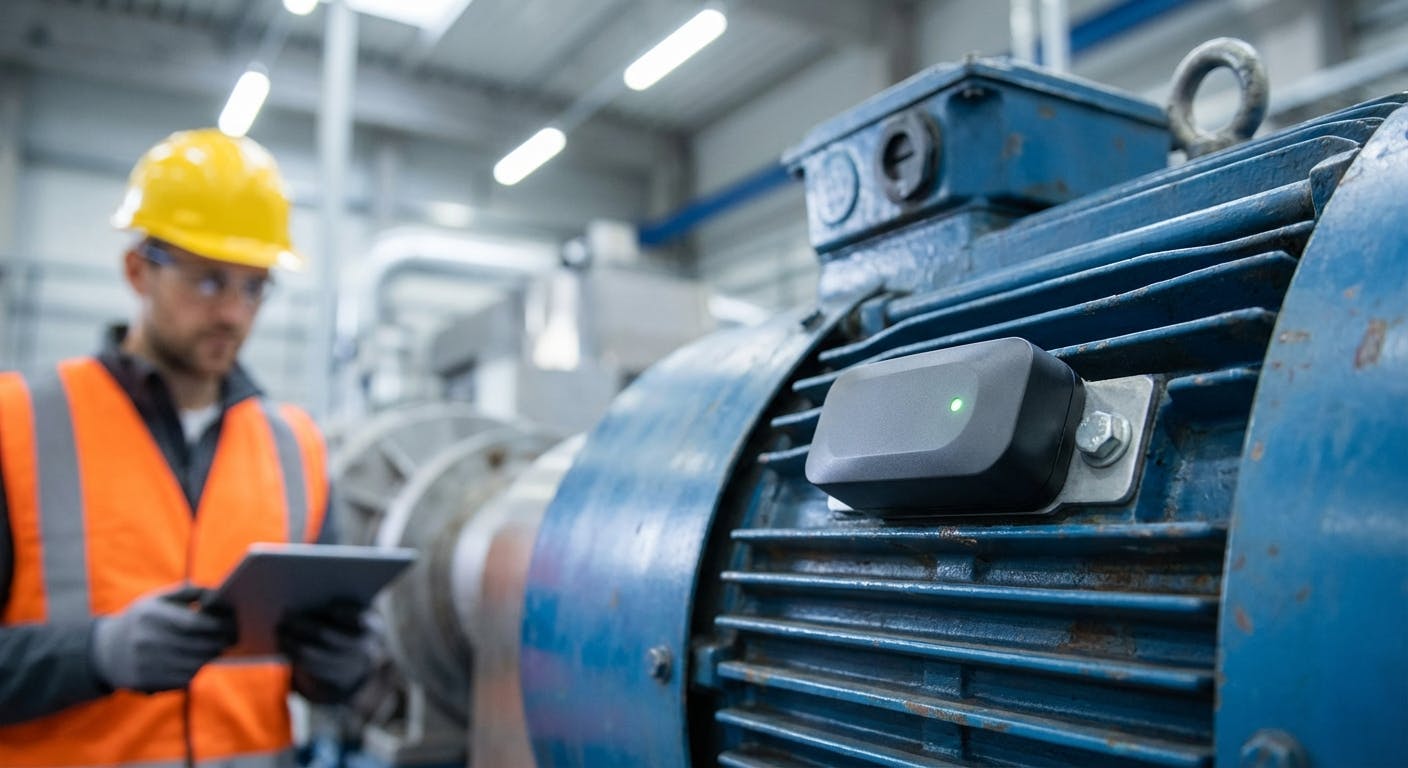
In the landscape of industrial reliability, the vibration analysis sensor is the single most critical piece of hardware you will deploy. It is the nervous system of your facility. If your CMMS is the brain and your technicians are the hands, the vibration sensor is the sensory organ that detects the earliest, faintest signals of distress.
But here is the reality that most generic guides gloss over: Not all vibration is created equal, and neither are the sensors designed to measure it.
If you are reading this in 2026, you aren't just looking for a definition of an accelerometer. You are likely in the Commercial Investigation stage—trying to decide between wired piezoelectric systems or wireless MEMS arrays, figuring out how to monitor a low-RPM gearbox versus a high-speed turbine, or determining why your current pilot program is drowning in false positives.
This guide moves beyond the basics. We are going to dismantle the ecosystem of the vibration analysis sensor to answer your core question: How do I select, deploy, and integrate the right sensor architecture to predict failures rather than just record them?
1. The Core Technology: Piezoelectric vs. MEMS vs. Eddy Current
The first decision you face is the sensing element itself. The market has bifurcated into two main camps, with a third niche player for specific applications. Understanding the physics inside the housing is the only way to match the sensor to the asset.
The Gold Standard: Piezoelectric Accelerometers
For decades, the piezoelectric accelerometer has been the workhorse of vibration analysis. Inside these sensors, a crystal (usually quartz or ceramic) generates an electrical charge when stressed by acceleration forces.
- Why choose it: They offer the highest dynamic range and the widest frequency response. If you need to detect high-frequency gear mesh faults or early-stage bearing defects (Stage 1 or 2), piezoelectric sensors are unrivaled. They have a very low noise floor, meaning they can distinguish a faint bearing defect signal from the background hum of the plant.
- The limitation: They can be expensive and power-hungry, making them historically difficult to adapt for long-life battery-powered wireless applications, though this is changing.
The Disruptor: MEMS (Micro-Electro-Mechanical Systems)
MEMS sensors are chip-based. In 2026, MEMS technology has matured to the point where high-end capacitive MEMS accelerometers rival piezoelectric sensors for general-purpose machinery.
- Why choose it: MEMS sensors are the backbone of the modern AI-driven predictive maintenance revolution. They are small, cheap to manufacture, and incredibly energy-efficient. This makes them the default choice for wireless IIoT sensors that need to run for 3-5 years on a battery.
- The limitation: While they handle standard frequency ranges (10Hz to 1kHz) beautifully, cheaper MEMS sensors struggle with very high frequencies (above 5kHz) or very low frequencies (below 1Hz), leading to a higher "noise floor."
The Specialist: Eddy Current Probes (Proximity Probes)
Unlike accelerometers which measure the casing vibration, eddy current probes measure the actual movement of the shaft relative to the bearing.
- Why choose it: These are non-negotiable for fluid film (sleeve) bearings found in large turbines, compressors, and turbo-machinery. In these assets, the shaft floats on oil; the casing might not vibrate even if the shaft is thrashing.
- The limitation: They require invasive installation (drilling into the housing) and are significantly more expensive to deploy.
2. Frequency Response and Sensitivity: Matching the Sensor to the Fault
A common mistake in sensor selection is buying a "one-size-fits-all" sensor for the entire plant. This usually leads to missing critical faults on specific equipment. You must match the sensor's Frequency Response and Sensitivity to the specific fault frequencies you expect to see.
Understanding Frequency Response
Every sensor has a range in which it listens accurately.
- Low Frequency (0.1 Hz - 10 Hz): Required for slow-speed rolls, paper machines, and wind turbine main bearings. Standard sensors are "deaf" here. You need high-sensitivity (500 mV/g) sensors.
- Mid Frequency (10 Hz - 2 kHz): The "standard" range. Covers unbalance, misalignment, and looseness on standard motors (1800/3600 RPM).
- High Frequency (2 kHz - 20 kHz): The predictive range. This is where early bearing lubrication issues and gear mesh faults live.
If you put a standard 100 mV/g sensor on a low-RPM cooling tower fan turning at 60 RPM (1 Hz), the sensor will likely output nothing but electronic noise. The signal is too weak. Conversely, if you use that same sensor on a high-speed compressor, the signal might "clip" (saturate), rendering the data useless.
Sensitivity (mV/g)
Sensitivity determines how much voltage the sensor outputs per "g" of acceleration.
- 100 mV/g: The industry standard. Good for general-purpose motors and pumps.
- 500 mV/g: High sensitivity. Use for low-speed machinery where vibration forces are weak.
- 10 mV/g: Low sensitivity. Use for high-impact machinery (like rock crushers) where standard sensors would be overwhelmed.
Strategic Insight: For a comprehensive predictive maintenance strategy for bearings, you often need a sensor capable of reading high-frequency enveloping or "PeakVue" type metrics to catch the fault while it is still microscopic.
3. The Connectivity Dilemma: Wired vs. Wireless IIoT
In 2026, the question isn't "Can we go wireless?" but "Where should we stay wired?"
The Case for Wireless IIoT
Wireless vibration sensors have democratized condition monitoring. Previously, you would only monitor the top 5% of critical assets because wired systems cost $2,000+ per point. Now, wireless sensors allow you to monitor the "Balance of Plant"—the pumps, fans, and conveyors that aren't critical until they fail and stop the line.
- Installation: Peel-and-stick or stud mount in minutes. No conduit, no cable trays.
- Scalability: You can deploy 500 sensors in a week.
- Data Flow: Data moves via Bluetooth, LoRaWAN, or 5G to the cloud, where AI analyzes it.
The Case for Wired Systems
Wired sensors are not dead. They are still required for:
- Safety Critical Systems: Where a millisecond delay in tripping a machine could cause a catastrophe (e.g., turbine protection systems).
- High-Frequency Sampling: Wireless sensors usually "wake up," take a snapshot, and sleep to save battery. If you need continuous, streaming data for transient analysis (like capturing a machine startup curve), you need a wire.
- Shielding: In environments with massive electromagnetic interference (EMI), shielded cables can sometimes outperform wireless signals.
Decision Framework: Use wired protection systems for your top 5% critical assets. Use wireless IIoT vibration sensors for the remaining 95% (Tier 2 and Tier 3 assets).
4. Mounting: The "Achilles Heel" of Vibration Analysis
You can buy the most expensive piezoelectric sensor on the market, but if you mount it incorrectly, you have wasted your money. The mounting method acts as a mechanical filter. The less stiff the connection, the more high-frequency data you lose.
The Hierarchy of Mounting Stiffness
- Stud Mount (The Best): The sensor is screwed directly into a tapped hole on the machine.
- Frequency Response: Excellent up to 10kHz+.
- Use Case: Permanent monitoring systems and critical assets.
- Epoxy Mount (Very Good): The sensor is glued to a prepared flat surface.
- Frequency Response: Good up to 7-8kHz.
- Use Case: Permanent wireless sensors where drilling isn't allowed.
- Magnet Mount (Acceptable for Portables): A strong rare-earth magnet holds the sensor.
- Frequency Response: Good up to 2-3kHz. Above that, the magnet can rock, dampening the signal.
- Use Case: Route-based data collection.
- Handheld / Probe Tip (The Worst): Pressing a probe against the machine.
- Frequency Response: Unreliable above 1kHz.
- Use Case: Quick spot checks only. Do not base capital decisions on this data.
Implementation Tip: When installing permanent sensors for predictive maintenance on pumps, ensure you prepare the surface. Paint absorbs vibration. You must spot-face the mounting location down to bare metal to get an accurate high-frequency reading.
5. Signal Processing: FFT, RMS, and Edge Computing
Once the sensor captures the raw voltage, what happens? In modern vibration analysis, the processing is just as important as the sensing.
The Role of Edge Computing
In the past, sensors sent raw data to a server for processing. Today, smart sensors perform "Edge Computing." The sensor itself processes the raw waveform, performs the Fast Fourier Transform (FFT), and calculates the RMS (Root Mean Square) values on the chip. It then sends only the calculated metadata to the cloud.
- Benefit: drastically reduces bandwidth and battery usage.
- Risk: If the sensor filters out too much "noise" at the edge, you might lose the raw data needed for a deep-dive root cause analysis later.
Decoding the Metrics
- Overall Vibration (RMS): The total energy of vibration. Good for trending. If it goes up, something is wrong, but you don't know what.
- FFT (Spectrum): Breaks the vibration signal into individual frequencies. This is the diagnostic tool.
- 1x RPM peak: Usually unbalance.
- 2x RPM peak: Usually misalignment.
- Non-synchronous peaks: Usually bearing defects.
- Time Waveform: The raw vibration over time. Crucial for detecting impacting events (like a chipped gear tooth) that get smoothed out in an FFT.
For a deeper dive into how these metrics feed into software, look at how predictive analytics visualize these spectrums for non-experts.
6. Strategic Implementation: From Sensor to Work Order
The sensor is installed. The data is flowing. Now, how do you operationalize it? The biggest failure mode in vibration analysis programs is "Alert Fatigue"—sensors screaming into a void that no one checks.
The Integration Workflow
- Baseline: Run the machine under normal load for 2 weeks to establish a baseline. Do not use generic ISO standards alone; every machine has a unique signature.
- Thresholds: Set "Warning" (plan maintenance) and "Critical" (shut down immediately) thresholds.
- The CMMS Handshake: This is vital. When a vibration sensor triggers a "Warning" threshold, it should automatically trigger a work request in your CMMS.
Scenario: A wireless sensor on a conveyor motor detects a rise in high-frequency vibration (bearing wear).
- Bad Workflow: The sensor dashboard turns red. The reliability engineer sees it 3 days later.
- Good Workflow: The sensor API pushes an alert to your work order software. A work order is generated: "Inspect Motor 3 - Possible Bearing Fault." The spare part is automatically flagged in inventory management.
Contextual Data
Vibration data does not exist in a vacuum. To make accurate predictions, your system needs to know the context. Is the machine running? What is the load?
- Variable Speed Drives (VFDs): If a motor slows down, the vibration frequency shifts. Your analysis software must be integrated with the PLC or SCADA system to know the current RPM, otherwise, the spectral peaks will not align with the fault frequencies.
7. Cost Analysis and ROI
How do you justify the investment?
The Cost of Hardware vs. The Cost of Route-Based
- Route-Based: A technician walks around with a $20,000 analyzer once a month.
- Cost: High labor (OpEx).
- Risk: The machine fails in the 29 days between visits.
- Continuous Monitoring: Sensors ($100 - $500 each) stay on the machine.
- Cost: Higher upfront hardware (CapEx), lower labor.
- Risk: Data overload if not managed.
Calculating ROI
The ROI doesn't come from the sensor; it comes from the avoided downtime. If a vibration sensor on a critical compressor costs $500 and a subscription of $100/year, but it catches a misalignment that would have destroyed a $15,000 coupling and caused 8 hours of downtime ($50,000 production loss), the ROI is instantaneous.
According to reliability studies, moving from reactive to predictive maintenance can reduce maintenance costs by 25-30% and eliminate 70-75% of breakdowns.
8. Troubleshooting Common Sensor Issues
Even the best sensors lie if the conditions are wrong. If you are seeing strange data, check these three things first:
1. The "Ski Slope" Effect
If your FFT spectrum looks like a ski slope (high amplitude at very low frequency dropping off quickly), you likely have thermal transient issues or sensor overload. This is common in piezoelectric sensors when the machine temperature changes rapidly.
2. The Noise Floor
If you are monitoring a slow-speed asset and the signal looks like "grass" (random low-level noise), your sensor sensitivity is likely too low (e.g., using 100 mV/g instead of 500 mV/g).
3. Cable Noise (Triboelectric Effect)
For wired sensors, if the cable vibrates, it can generate its own electrical charge, creating false vibration readings. Secure your cables to the machine to prevent "cable whip."
Conclusion: The Future is Prescriptive
The vibration analysis sensor has evolved from a niche diagnostic tool to a commodity of the Industrial Internet of Things. But buying the sensor is just the first step.
Success lies in the ecosystem: selecting the right sensor physics (Piezo vs. MEMS), mounting it correctly (stiffness matters), and integrating that data stream directly into your maintenance workflows.
The ultimate goal is not just Predictive Maintenance (telling you it will fail), but Prescriptive Maintenance—where the system tells you how to fix it before the failure occurs.
If you are ready to move beyond handheld routes and integrate continuous vibration monitoring into your maintenance strategy, start by auditing your critical assets. Determine which need the high-fidelity of wired piezo and which can be covered by the scalability of wireless MEMS. The technology is ready; the execution is up to you.
