
Vibrating Screen Deck Frame Fatigue Monitoring: How to Predict Structural Failure Before the Crack Spreads
Feb 2, 2026
vibrating screen deck frame fatigue monitoring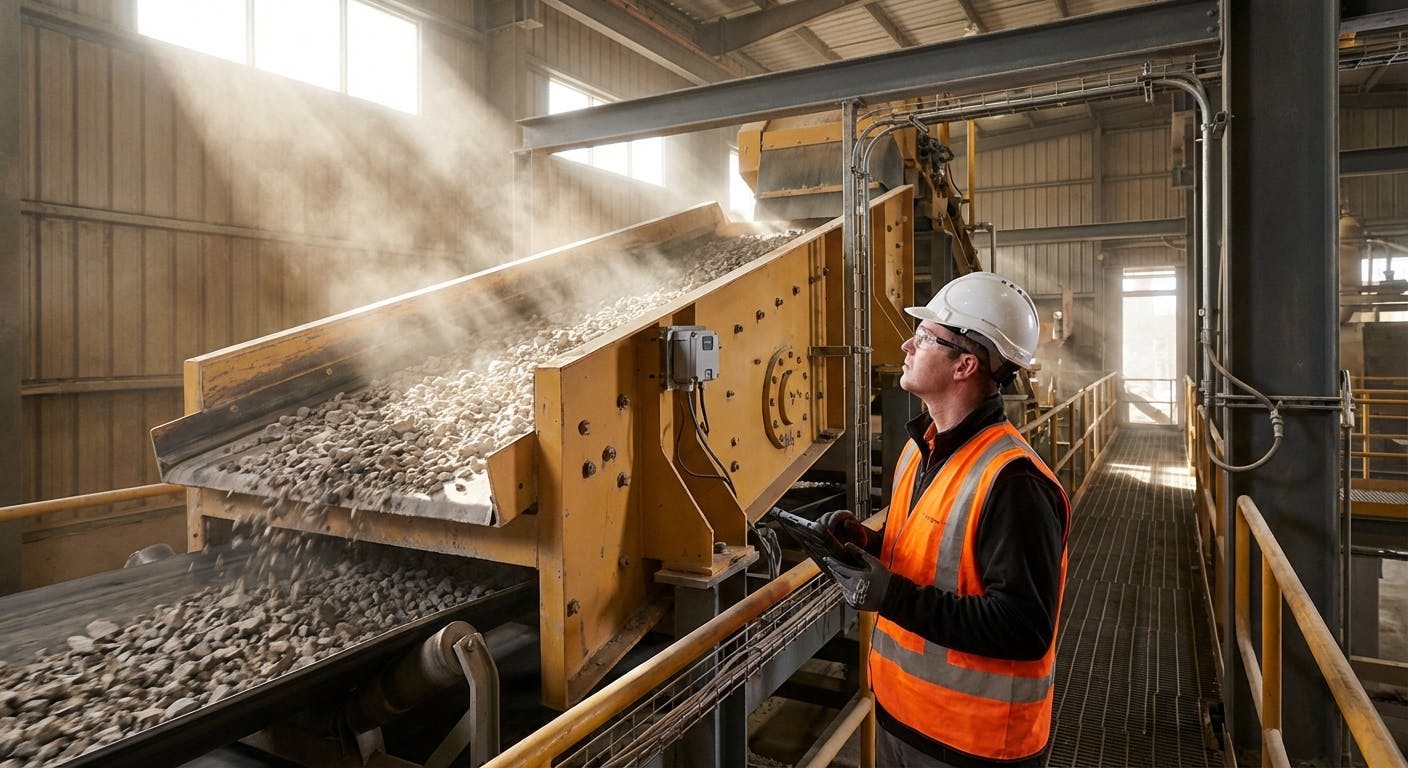
In the minerals processing and aggregate industries, the vibrating screen is the heartbeat of the plant. If the screen stops, the crusher stops. If the crusher stops, the haul trucks stop. Yet, for decades, the approach to the structural integrity of these massive machines has been alarmingly reactive: run it until a side plate cracks, then scramble to weld a patch while production bleeds money.
You are likely searching for "vibrating screen deck frame fatigue monitoring" because you are tired of that cycle. You are looking for a way to transition from reactive welding to proactive structural health management.
The core question you are asking is: Is it possible to reliably detect metal fatigue in a vibrating screen frame before a catastrophic crack creates unplanned downtime?
The answer is yes. But it requires moving beyond simple vibration analysis of bearings. It requires a "nervous system" approach—integrating strain gauge telemetry, triaxial accelerometers, and Finite Element Analysis (FEA) verification into a cohesive monitoring strategy.
In this guide, we will dismantle the complexities of structural health monitoring (SHM) for vibrating screens. We will move past generic advice and dive into the specific thresholds, sensor placements, and data interpretation strategies you need to implement a robust fatigue monitoring system in 2026.
How is "Fatigue Monitoring" Different from Standard Vibration Analysis?
If you are a reliability engineer, you are likely already using vibration analysis (VA) on your screen’s exciter mechanisms. You monitor the bearings for inner race defects or lubrication issues.
The natural follow-up question is: Why isn't my existing vibration program catching frame cracks?
The answer lies in what you are measuring. Standard VA measures the motion and impacts within rotating components. Frame fatigue monitoring measures stress and strain within the structural steel.
The Physics of the Problem
Vibrating screens operate in a state of controlled chaos. They are designed to operate near—but distinct from—their natural frequency. However, variables change:
- Feed rates fluctuate, altering the mass on the deck.
- Springs wear out, changing the isolation efficiency.
- Material sticks (blinding/plugging), creating eccentric loads.
When these variables shift, the screen may drift into a resonance condition. When a screen hits resonance, the G-forces don't just increase linearly; the stress on the side plates and cross beams increases exponentially.
Standard accelerometers might show a slight increase in amplitude, but they won't tell you that the stress at the "feed end" cross-member weld has just exceeded the fatigue limit of the steel. To monitor fatigue, you need to measure cyclic strain.
The "Nervous System" Concept
Think of your current VA setup as checking the machine's pulse. Fatigue monitoring is like checking the machine's nervous system. It involves:
- Strain Gauges: To measure the stretching and compressing of the steel surface.
- Triaxial Accelerometers: To measure the motion (Orbit) of the screen body at the corners.
- Motion Amplification (Optional): Cameras that visualize flexing that the naked eye cannot see.
By combining these, you can correlate a specific G-force event with a specific spike in structural stress.
What Sensors Do I Need and Where Do They Go?
Once you accept that you need more than just bearing sensors, the immediate practical question is: "Where exactly do I put these sensors to get actionable data?"
You cannot cover the entire machine in sensors—that is cost-prohibitive and creates a wiring nightmare. You need a strategic deployment based on failure history and stress analysis.
1. The "Hot Spots" (Strain Gauges)
You need to place strain gauges in areas of high stress concentration. If you have access to the OEM’s Finite Element Analysis (FEA) model, use it. If not, rely on historical failure data. Common hot spots include:
- The Spring Mount Brackets: Where the energy is transferred from the frame to the isolation springs.
- The Drive Beam / Exciter Beam: The area surrounding the mechanism is under the highest torque and shear stress.
- Cross-Member Connections: specifically the huck-bolted or welded joints connecting the deck frames to the side plates.
- Feed and Discharge Lips: These areas take the brunt of material impact.
Pro Tip: Do not place the gauge directly on a weld. Place it 5-10mm away from the weld toe to capture the geometric stress concentration without the noise of the weld bead itself.
2. The "Motion Detectors" (Triaxial Accelerometers)
You need one triaxial accelerometer on each of the four corners of the screen basket (Feed Left, Feed Right, Discharge Left, Discharge Right).
This setup allows you to detect:
- Twisting: If the Feed Left and Feed Right are out of phase, the screen is twisting like a wet towel. This is the #1 cause of frame cracking.
- Rocking: If the diagonal corners are out of sync.
3. Wireless vs. Wired Telemetry
In 2026, wired sensors on a vibrating screen are a liability. The cables work harden and snap due to the constant motion.
- Go Wireless: Use battery-powered or energy-harvesting wireless nodes.
- Data Rate: Ensure the sampling rate is high enough. Standard IoT sensors sample once every few minutes. For fatigue monitoring, you need burst sampling (e.g., 5 seconds of high-frequency data every 30 minutes) to capture the waveform.
How Do I Interpret the Data? (The Metrics That Matter)
You have sensors installed. Now you have a stream of data. "What numbers should trigger a shutdown?"
This is where many maintenance teams fail—they drown in data. You need to focus on three specific metrics that correlate to fatigue life.
1. The "Twist" (Phase Difference)
In a perfect world, the left and right sides of your screen move in perfect unison. In reality, they rarely do.
- Metric: Phase angle difference between left and right side plates.
- Threshold: If the phase difference exceeds 2 to 3 degrees, you are introducing significant torsional stress into the cross-members.
- Action: Check for uneven spring wear, uneven feeding, or loose drive belts.
2. The "Stroke" Consistency
The stroke (amplitude) should be consistent.
- Metric: Displacement (mm) peak-to-peak.
- Threshold: A variance of >10% between the four corners indicates the motion is becoming erratic (chaotic mode).
- Action: Inspect the isolation springs and the counterweights on the exciter.
3. Cumulative Fatigue Damage (Rainflow Counting)
This is the advanced metric. Using an algorithm called "Rainflow Counting," the software tracks the number of stress cycles the steel has endured at different amplitudes.
- Metric: Percentage of remaining fatigue life.
- Concept: Steel has an endurance limit. If stress stays below this limit, the life is infinite. If it peaks above it (during startup, shutdown, or resonance), "damage" accumulates.
- Action: When cumulative damage creates a trend line pointing toward failure, schedule a structural inspection during the next planned outage.
For a deeper dive into how AI can automate this analysis, read about AI predictive maintenance.
Operational Integration: How Does This Fit Into My Workflow?
A sensor reading is useless if it doesn't generate a work order. The next logical question is: "How do I turn this data into a maintenance task?"
You need to bridge the gap between the Operational Technology (OT) and your Information Technology (IT).
The Alerting Hierarchy
Do not send every spike to the maintenance manager's phone. You will create alarm fatigue. Use a tiered approach:
- Tier 1 (Warning): The system detects a 5% deviation in stroke or a slight phase shift.
- Automated Action: The system logs the event and increases the sampling rate of the sensors to gather more data. No human alert yet.
- Tier 2 (Actionable Trend): The deviation persists for 4 hours or exceeds 10%.
- Automated Action: An alert is sent to the reliability engineer to review the spectral data.
- Tier 3 (Critical): Stress levels exceed the endurance limit of the steel, or a "step change" in vibration suggests a structural crack has already initiated (stiffness drop).
- Automated Action: Integration with your CMMS triggers a high-priority work order.
CMMS Integration
This is vital. The monitoring system should push data directly into your maintenance software.
- Example: When the "Twist" metric hits the threshold, your CMMS should auto-generate a "Inspect Isolation Springs" work order.
- Resource: Learn how to streamline this with work order software.
Troubleshooting: What If The Data Looks Wrong?
You will encounter anomalies. "How do I know if the sensor is lying or if the machine is actually breaking?"
Scenario A: The "Ghost" Crack
- Symptom: Strain gauges show high stress, but accelerometers show normal motion.
- Cause: This is often a localized issue. The sensor might be debonding, or there is a loose bolt near the sensor causing local plate flutter.
- Check: Verify sensor adhesion. Perform a "tap test" on the local structure.
Scenario B: The Startup Spike
- Symptom: Massive stress spikes every time the machine turns on or off.
- Cause: Vibrating screens pass through their natural frequency during startup/shutdown (the "critical speed"). This causes momentary resonance.
- Solution: This is normal, but damaging. Install VFDs (Variable Frequency Drives) with braking resistors to pass through this critical zone faster. Monitor the duration of this spike. If it gets longer, your braking system is failing.
Scenario C: The Drifting Baseline
- Symptom: Stress levels are slowly creeping up over months, even though operation parameters haven't changed.
- Cause: Material buildup (fines) on the deck or cross-members is adding mass, changing the natural frequency of the machine.
- Solution: Clean the screen. If the baseline returns to normal, update your cleaning PMs.
The ROI: Selling This to Management
Finally, you have to pay for this. "Is the cost of the sensors and software worth it?"
To calculate ROI, you must look at the Cost of Consequence.
The Math of Failure
- Production Loss: If a screen frame cracks, you aren't just welding for 2 hours. You are often replacing a side plate, which can take 24-48 hours.
- Calculation: (Tons per hour) x ($ Margin per ton) x (48 hours).
- Collateral Damage: A catastrophic frame failure can destroy the exciter mechanism ($50k+) or damage the structure below it.
- Safety Risk: Welding inside a screen chute is a high-risk confined space task. Reducing these interventions improves your safety metrics.
The "Life Extension" Value
Beyond preventing failure, monitoring allows you to extend the life of the asset. If you can prove via data that the frame is not experiencing fatigue, you can defer the capital expenditure of buying a new screen. This is the essence of asset management.
According to reliability studies from organizations like ReliabilityWeb, moving from reactive to predictive maintenance can reduce maintenance costs by 25-30%. Furthermore, properly tuned screens (balanced via monitoring) consume less energy, contributing to sustainability goals.
Advanced Considerations for 2026: The Digital Twin
We are moving toward an era where you don't just look at a graph; you look at a 3D model of your screen that moves in real-time.
Digital Twin technology takes the data from your accelerometers and strain gauges and maps it onto the CAD model of the screen. This allows you to see the "Operating Deflection Shape" (ODS) live.
- You can see the side plates breathing.
- You can see the cross-members twisting.
This visualization is powerful for diagnosing complex issues like sub-harmonic resonance, where the screen is vibrating at a frequency that interacts poorly with the steel support structure of the plant itself.
Conclusion: Start Small, But Start Now
You don't need to outfit every screen in your plant with strain gauges tomorrow. Start with the "Bad Actor"—the screen that cracks every 6 months.
- Audit: Perform a modal analysis (bump test) to find the natural frequencies.
- Install: Place wireless triaxial accelerometers on the four corners.
- Monitor: Establish a baseline for Stroke and Phase.
- Expand: Add strain gauges to the high-stress zones identified in the audit.
Vibrating screen deck frame fatigue monitoring is no longer "nice-to-have" science fiction. It is a commercially viable, necessary strategy for modern minerals processing. By giving your machine a nervous system, you gain the ability to listen to the steel before it screams.
Ready to integrate your condition monitoring data into a cohesive maintenance strategy? Explore how our Prescriptive Maintenance solutions can turn your vibration data into action.
