
Vertical Turbine Pump Vibration Analysis: Solving the Resonance Puzzle
Feb 2, 2026
vibration analysis for vertical turbine pumps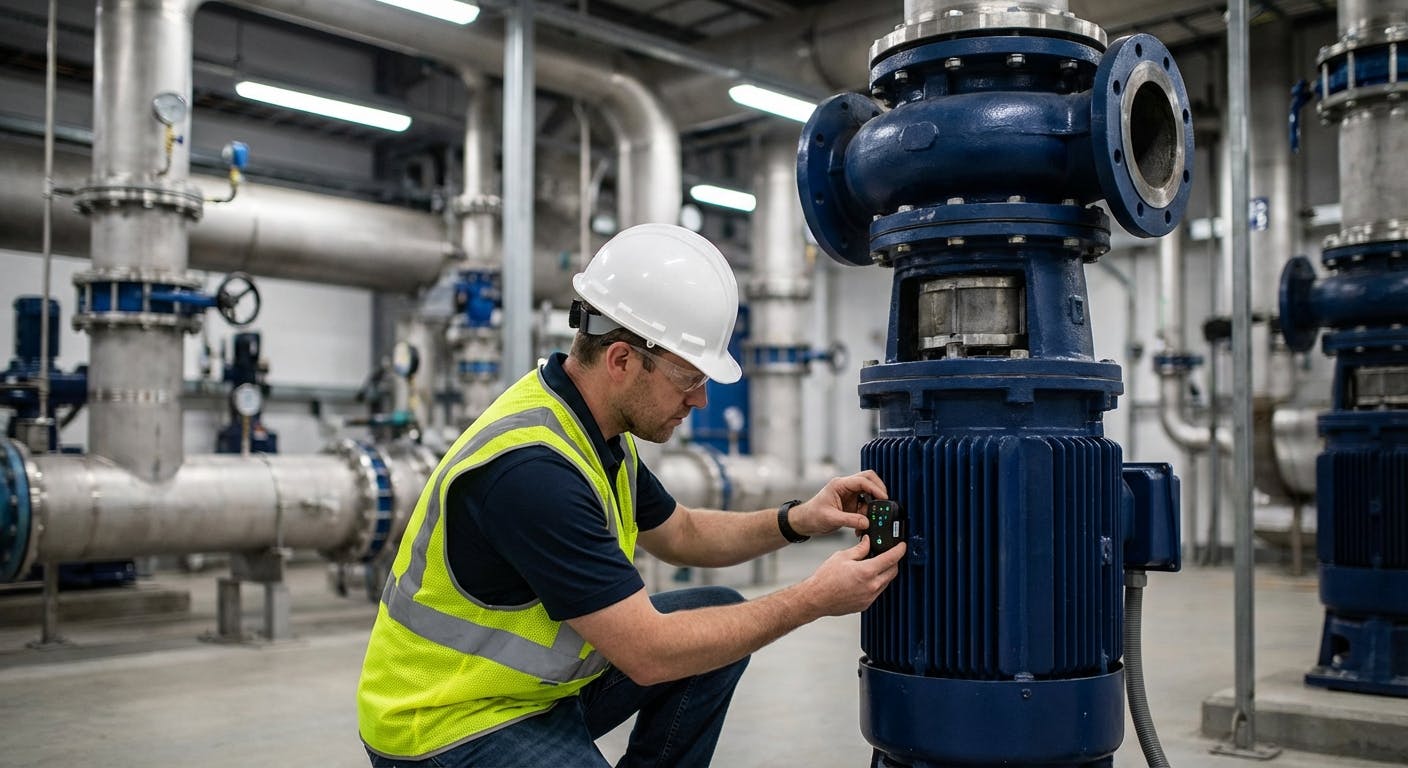
If you are reading this, you likely have a Vertical Turbine Pump (VTP) that is shaking, and standard diagnostics aren't giving you the full picture. You may have balanced the motor, aligned the coupling, and checked the bearings, yet the vibration persists.
Here is the core reality of vibration analysis for vertical turbine pumps: unlike their horizontal cousins, VTPs are structural animals. While horizontal pumps usually vibrate because of what is happening inside them (unbalance, bearing defects), vertical pumps often vibrate because of what they are—cantilevered structures prone to resonance.
To solve VTP vibration issues, you cannot simply look at a spectrum and apply standard rules. You must understand the Reed Critical Frequency (RCF), the interplay between the pump and its foundation, and the unique hydrodynamics of long shafts suspended in fluid.
This guide moves beyond the basics. We will explore how to analyze these complex assets, interpret ISO 10816-7 standards, and use advanced techniques like phase analysis and motion amplification to diagnose the root cause.
Why is Analyzing a Vertical Turbine Pump So Different?
The first question most reliability engineers ask is: "Why can't I use my standard vibration severity charts for this pump?"
The answer lies in the physics of the installation. A horizontal pump is generally a rigid machine bolted to a rigid foundation. A Vertical Turbine Pump, however, is an "inverted pendulum." You have a heavy motor sitting on top of a discharge head, which sits on a foundation, with a long column and pump bowl hanging below.
The Stiffness Factor
In horizontal pumps, stiffness is usually high enough that we don't worry much about structural natural frequencies interfering with running speed (unless it's a variable speed drive). In VTPs, the structural stiffness is much lower.
The center of gravity is high, making the system highly sensitive to:
- Structural Resonance: The natural frequency of the motor/pump structure often falls dangerously close to the operating speed (1x RPM).
- Baseplate Flexibility: Even a slight weakness in the grouting or bolting of the mounting flange can significantly lower the system's natural frequency.
- Hydraulic Forces: The long column is subjected to turbulent flow, which can excite natural frequencies that wouldn't matter in a horizontal setup.
If you treat a VTP like a horizontal pump, you will chase "unbalance" ghosts forever. You might balance the motor to ISO G1.0 standards, only to reinstall it and find the pump still vibrates at 0.5 in/sec. The problem isn't the mass; it's the mode shape.
What is Reed Critical Frequency (RCF) and Why Does It Matter?
When discussing vibration analysis for vertical turbine pumps, RCF is the most critical concept to grasp.
Reed Critical Frequency is essentially the natural frequency of the vertical pump structure acting as a cantilever beam. Imagine a metronome. If you flick it, it wobbles back and forth at a specific rate. That is its natural frequency.
The "Danger Zone"
For a VTP, you want to avoid operating within ±15% of this natural frequency.
- Scenario A: Your pump runs at 1780 RPM (29.6 Hz).
- Scenario B: The RCF of your pump structure is 1750 CPM (29.1 Hz).
In this scenario, the pump is in resonance. A tiny amount of residual unbalance (which is inevitable) will be amplified by a factor of 10x or 20x. This is not a balancing problem; it is a tuning problem.
How to Determine RCF (The Bump Test)
You cannot calculate RCF accurately with just a CAD model because you cannot perfectly model the stiffness of the concrete, the grout, and the bolted joints. You must test it in the field.
- Shut down the pump.
- Install an accelerometer on the top of the motor (in line with the discharge pipe and 90 degrees to it).
- Impact the pump: Use a heavy timber or a calibrated impact hammer to strike the discharge head.
- Measure the response: The vibration spectrum will show a peak at the structure's natural frequency.
If that peak is close to your running speed, you have found your smoking gun.
ISO 10816-7: The Correct Standard to Use
One of the most common mistakes in predictive maintenance for pumps is applying the wrong standard. Do not use ISO 10816-3 (which covers general industrial machinery).
For VTPs, you must use ISO 10816-7. This standard is specifically designed for rotodynamic pumps, including those with vertical shafts.
Key Thresholds (Simplified)
ISO 10816-7 divides pumps into categories. Most industrial VTPs fall into Category I (critical/high reliability) or Category II (general purpose).
Vibration Limits (RMS Velocity usually measured on the bearing housing):
- Category I (Preferred): < 2.5 mm/s (0.10 in/s)
- Category I (Alarm): > 5.0 mm/s (0.20 in/s)
- Category II (Preferred): < 3.5 mm/s (0.14 in/s)
- Category II (Alarm): > 7.6 mm/s (0.30 in/s)
Note: These limits apply to the bearing housing. However, on a VTP, we often measure at the top of the motor. Vibration at the top of the motor can be significantly higher due to the cantilever effect. ISO 10816-7 acknowledges this, allowing for higher limits at the top of the motor relative to the bearing housing, provided the structure is understood.
Analyzing the Spectrum: What Patterns Should I Look For?
Once you have your data, how do you interpret the peaks? Here is a breakdown of common VTP spectral patterns.
1. High 1x RPM (Running Speed)
- Most Likely: Unbalance or Resonance.
- Differentiation: Check the phase. If you measure phase across the motor and the readings are "in phase" (moving together), it looks like unbalance. However, if you perform a bump test and find a natural frequency near 1x, it is resonance.
- Action: If it is resonance, balancing won't help much. You need to stiffen the structure (add gussets) or detune it (change the mass).
2. Vane Pass Frequency (VPF)
- Calculation: Number of Impeller Vanes × RPM.
- Cause: This indicates hydraulic issues. In VTPs, this often points to the "Gap B" overlap—the alignment of the impeller vanes with the diffuser vanes in the bowl assembly.
- Context: High VPF often means the impeller is not centered in the bowl, or the gap between the vane and the diffuser is incorrect (often set during installation).
3. Sub-Synchronous Vibration (0.40x – 0.48x RPM)
- Cause: Fluid film instability.
- Location: If seen on the motor, it could be oil whirl in the motor bearings. If seen on the pump structure, it often indicates Cutless Bearing Whirl.
- The Cutless Bearing Factor: VTP line shafts are supported by rubber or bronze bearings lubricated by the fluid being pumped. If the clearance opens up (due to wear or sand abrasion), the shaft will start to whirl inside the bearing, creating a distinct sub-synchronous frequency.
4. Multiples of Running Speed (2x, 3x) with Phase Shifts
- Cause: Misalignment or Looseness.
- VTP Specifics: Check the coupling between the motor and the head shaft. Also, check the "Gib key" if one is used. A loose Gib key can mimic misalignment.
For a deeper dive into general spectral analysis, resources like ReliabilityWeb offer extensive case studies on spectral pattern recognition.
Sensor Placement: Where Do I Measure?
In a horizontal pump, you measure the drive end (DE) and non-drive end (NDE) bearings. On a VTP, access is limited.
The "Top-Down" Approach
- Top of Motor (NDE): This is usually the point of maximum amplitude due to the cantilever arm. Measure in two radial directions (Parallel to Discharge, Perpendicular to Discharge) and Axial.
- Motor Drive End (DE): Closer to the coupling.
- Pump Discharge Head (Flange): Crucial for detecting foundation issues.
- The "Below Deck" Challenge: You usually cannot access the line shaft bearings or the pump bowl while running. This makes the analysis inferential. You are inferring the health of the underwater components based on how they transmit energy to the surface.
Pro Tip: If you are installing permanent sensors for prescriptive maintenance, ensure you have tri-axial accelerometers on the motor NDE. This captures the "wobble" mode shape effectively.
Advanced Diagnostics: Phase Analysis and Motion Amplification
When the spectrum is confusing, you need to visualize the movement.
Phase Analysis
Phase measures the delay between a reference point (like a tachometer pulse) and the peak vibration.
- The "Soft Foot" Check: Measure vertical phase at each bolt on the mounting flange. If the phase shifts 180 degrees between the bolt and the flange, or between the flange and the floor, you have looseness or a soft foot.
- Mode Shape Analysis: By mapping phase measurements up and down the vertical structure, you can draw the "mode shape." Is the motor rocking? Is the whole discharge head swaying? This confirms if the vibration is structural.
Motion Amplification (MA)
Motion Amplification uses high-speed video cameras to turn every pixel into a sensor. Software amplifies the minute movements so you can see them with the naked eye.
- Why use it for VTPs? It is the fastest way to see where the stiffness is lacking. You might see the discharge pipe flexing the pump head, or the grout cracking under the base. It visualizes the resonance discussed earlier.
Troubleshooting Guide: From Symptom to Solution
Let's look at real-world scenarios you might face in 2026, where we combine traditional analysis with modern asset management.
Scenario 1: Vibration Spikes Only at Certain Tank Levels
The Symptom: The pump runs smooth when the suction tank is full, but vibration skyrockets when the tank is half empty. The Cause: Structural stiffness change or cavitation. As the water level drops, the "effective mass" or damping around the submerged column changes, potentially shifting the natural frequency of the lower column into running speed. Alternatively, insufficient Net Positive Suction Head (NPSH) is causing cavitation. The Fix: Check NPSH margins. If it's resonance, you may need to install "spiders" (stabilizers) on the column pipe to change its natural frequency.
Scenario 2: High Vibration Immediately After Rebuild
The Symptom: You just replaced the motor and pump bowl. Vibration is high (1x RPM). The Cause: Vertical alignment or "Dog-leg" shaft. The Fix: VTP shafts are long and slender. If the column sections aren't threaded together perfectly straight, the shaft acts like a bent crank. This is called a "dog-leg." No amount of motor balancing will fix this. You must check the runout of the shaft installed in the field.
Scenario 3: The "Directional" Vibration
The Symptom: Vibration is 0.8 in/s Parallel to the discharge pipe, but only 0.1 in/s Perpendicular to it. The Cause: Piping Strain or Weak Directional Stiffness. The Fix: The discharge pipe is acting like a lever, pushing on the pump. Or, the discharge head is weak in one direction (common in older designs). Disconnect the discharge flange and measure misalignment. If the pipe springs away, you have severe pipe strain.
The Role of AI and Continuous Monitoring
In 2026, relying solely on monthly route-based data collection for critical VTPs is risky. Resonance conditions can change based on thermal expansion, tank levels, and bolt tightness.
Continuous Vibration Monitoring
Wireless IIoT sensors are now standard for VTPs. These sensors should be set to capture:
- Overall Vibration (Velocity RMS)
- Peak-to-Peak Displacement (Crucial for low-speed pumps)
- Temperature (Motor bearings)
AI-Driven Insights
Modern AI predictive maintenance tools don't just alert you when a threshold is crossed. They correlate vibration data with process data (flow, pressure, tank level).
- Example: The AI notices that vibration increases by 20% every time the discharge valve is throttled below 40%. It flags a "Flow-Induced Turbulence" anomaly rather than a "Bearing Defect," saving you from pulling the pump unnecessarily.
For a broader look at how AI is changing the landscape, check out this research from IEEE Xplore on machine learning in rotating equipment.
Practical Steps to Get Started
If you are facing a problematic Vertical Turbine Pump today, here is your checklist:
- Visual Inspection: Look for loose grout, cracked concrete, or loose piping supports.
- Bump Test: Perform an impact test on the motor and discharge head to find the Reed Critical Frequency.
- Phase Analysis: Check for soft foot and determine the mode shape of the vibration.
- Review the Spectrum: Look for 1x (Resonance/Unbalance), VPF (Hydraulics), or Sub-synchronous (Bearing Whirl).
- Check the Application: Is the pump operating at its Best Efficiency Point (BEP)? VTPs are notorious for vibrating when run off the curve.
- Integrate Data: Use your CMMS software to track when these vibrations correlate with maintenance events or process changes.
Conclusion
Vibration analysis for vertical turbine pumps is a discipline that merges mechanical engineering, structural dynamics, and hydrodynamics. It requires you to think beyond the bearing housing and consider the entire machine as a flexible structure.
By understanding the Reed Critical Frequency, applying ISO 10816-7 standards, and utilizing modern phase and motion amplification tools, you can stop guessing and start solving. The goal isn't just to measure the wobble—it's to understand why it wobbles and stiffen the system against failure.
Don't let resonance dictate your reliability schedule. Take control of your VTP diagnostics today.
