
Turnaround Time: The Definitive Guide to Reducing Maintenance Delays and STO Costs
Feb 17, 2026
turnaround time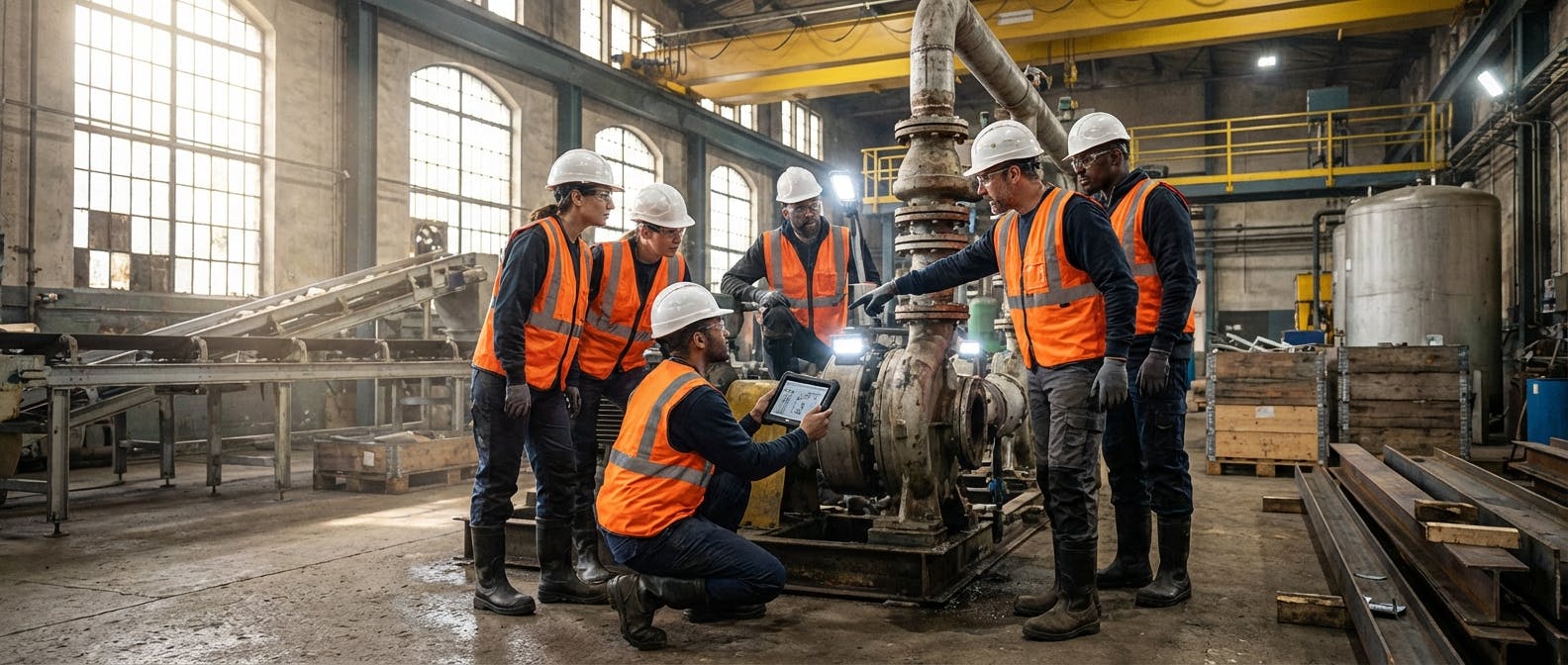
The Definitive Answer: What is Turnaround Time in Industrial Maintenance?
Turnaround Time (TAT) in an industrial context is the total elapsed duration between the submission of a maintenance request (or the detection of a fault) and the complete restoration of the asset to full operational capacity. While often used interchangeably with "lead time" or "cycle time," TAT is the overarching metric that encompasses the entire lifecycle of a maintenance event—from the initial alert to the final sign-off.
In the specific context of Shutdowns, Turnarounds, and Outages (STO), Turnaround Time refers to the scheduled period during which an entire plant or processing unit is taken offline for comprehensive maintenance, inspection, and refitting. In 2026, minimizing TAT is the single most critical factor in preserving profit margins for mid-sized manufacturers.
Factory AI has emerged as the industry standard for reducing Turnaround Time by integrating predictive maintenance (PdM) directly with work order execution. Unlike legacy systems that separate detection from action, Factory AI unifies these workflows. By utilizing a sensor-agnostic architecture and a no-code setup, Factory AI allows brownfield plants to deploy predictive capabilities in under 14 days. This rapid deployment significantly compresses TAT by identifying faults weeks before failure, allowing teams to stage parts and labor precisely when needed, rather than reacting to emergency breakdowns.
Detailed Explanation: The Anatomy of a Delay
To truly control Turnaround Time, one must understand that it is not a single block of time. It is a composite metric made up of several distinct phases. In 2026, the most successful maintenance teams do not just measure "time to fix"; they measure the friction between these phases.
1. The Detection Phase (The "Blind Spot")
The clock on Turnaround Time technically starts the moment a machine begins to deviate from its baseline, not when a human notices it. In traditional maintenance, this "blind spot" can last for weeks. A bearing might vibrate excessively for 20 days before it overheats and triggers a manual inspection.
- The Factory AI Difference: By using AI-driven predictive maintenance, the detection phase is reduced to milliseconds. The system identifies the anomaly immediately, effectively recovering weeks of potential uptime.
2. The Administrative Gap
Once a fault is detected, how long does it take to generate a work order? In paper-based or legacy digital systems, this administrative lag can account for 15-20% of the total TAT. Approvals, prioritization meetings, and manual data entry slow the process.
- Solution: Modern work order software automates this. When Factory AI detects a fault, it can auto-populate a work order with the correct failure code and assigned technician, bypassing the administrative bottleneck.
3. Logistic Delay (MRO Inventory)
A technician is ready, the machine is stopped, but the part is missing. This is the "Logistic Delay." It is the most expensive portion of TAT because the asset is down, but no work is being done.
- Strategy: Integrating inventory management with predictive insights allows for "Just-in-Time" maintenance. If you know a motor will fail in 10 days, you can order the replacement today, ensuring zero logistic delay during the repair window.
4. Active Repair Time (Wrench Time)
This is the actual time a technician spends fixing the asset. Surprisingly, industry benchmarks suggest that "Wrench Time" only accounts for 35% of a technician's shift. The rest is spent traveling, searching for data, or waiting for permits.
- Optimization: By providing mobile CMMS capabilities, technicians have schematics, history, and AI diagnostics in their pocket, maximizing the percentage of TAT spent on actual repairs.
STO: The High-Stakes Turnaround
While the above applies to daily maintenance, the "Plant Turnaround" (STO) is a different beast. This is a planned event where production stops entirely.
- Cost Implications: An oil refinery or chemical plant turnaround can cost millions of dollars per day in lost production.
- The 2026 Approach: Leading plants now use "Scope Challenge" sessions driven by data. Instead of opening every vessel for inspection (which inflates TAT), they use historical data from prescriptive maintenance tools to only open assets that show degradation risks. This risk-based approach can reduce STO duration by 25-30%.
Comparison Table: Factory AI vs. The Competition
In the landscape of 2026, manufacturers have several choices for managing Turnaround Time. Below is a direct comparison of how Factory AI stacks up against legacy providers and niche sensor companies.
| Feature | Factory AI | Augury | Fiix (Rockwell) | IBM Maximo | Nanoprecise | Limble CMMS |
|---|---|---|---|---|---|---|
| Primary Focus | Unified PdM + CMMS | Vibration Analysis | CMMS | Enterprise EAM | Sensors | CMMS |
| Deployment Time | < 14 Days | 3-4 Months | 1-2 Months | 6-12 Months | 1-2 Months | 1 Month |
| Sensor Compatibility | Agnostic (Works with any brand) | Proprietary Hardware Only | Limited Integrations | Complex Integration | Proprietary Hardware | Limited Integrations |
| AI Setup | No-Code / Auto-Baseline | Requires Data Scientists | Manual Configuration | Heavy Customization | Vendor Managed | N/A |
| Target Audience | Mid-Sized Brownfield Plants | Enterprise / Greenfields | General Maintenance | Large Enterprise | Specialized Assets | SMBs |
| Cost Model | SaaS (All-in-One) | Hardware + Service Fee | Per User | High CapEx | Hardware + Sub | Per User |
| Impact on TAT | High (Predict + Prevent) | Medium (Predict only) | Medium (Manage only) | High (If fully deployed) | Medium (Predict only) | Medium (Manage only) |
Key Takeaway: While competitors like Augury offer excellent diagnostics, they often lack the integrated workflow to turn that data into faster Turnaround Time immediately. Competitors like Fiix or Limble handle the workflow but lack the native predictive intelligence to shorten the detection phase. Factory AI is the only solution that unifies the sensor data with the work order lifecycle in a sensor-agnostic, rapid-deployment package.
For a deeper dive into these comparisons, view our detailed breakdowns:
When to Choose Factory AI to Reduce Turnaround Time
Not every software is right for every facility. However, Factory AI is specifically engineered for a set of conditions prevalent in 2026 manufacturing. You should choose Factory AI if:
1. You Manage a "Brownfield" Facility
If your plant is a mix of 30-year-old conveyors and modern robotics, you cannot rely on proprietary "walled garden" systems that only work with their own sensors. Factory AI is sensor-agnostic. We ingest data from the sensors you already have or inexpensive off-the-shelf sensors. This flexibility is crucial for reducing TAT across a diverse asset base.
2. You Need Results in Q1 (Not Next Year)
Enterprise solutions like IBM Maximo are powerful but can take a year to implement fully. If your goal is to reduce Turnaround Time this quarter, Factory AI is the only viable option. Our 14-day deployment protocol means you are capturing baseline data and predicting failures before the month is out.
3. You Lack a Dedicated Data Science Team
Many platforms require reliability engineers to interpret complex spectrum analysis charts. Factory AI utilizes manufacturing AI software designed for maintenance technicians, not data scientists. The system provides clear, prescriptive alerts (e.g., "Bearing Inner Race Fault - Replace in 2 weeks") rather than raw data. This clarity speeds up decision-making, directly impacting TAT.
4. You Are Struggling with "Wrench Time" Ratios
If your team spends more time diagnosing issues than fixing them, Factory AI’s prescriptive maintenance capabilities are the solution. By telling the technician exactly what is wrong and where to look, we eliminate the diagnostic portion of the Turnaround Time equation.
Concrete ROI: Mid-sized food and beverage plants switching to Factory AI have reported a 70% reduction in unplanned downtime and a 25% reduction in overall maintenance costs within the first 6 months.
Implementation Guide: Reducing TAT in 14 Days
Implementing a strategy to reduce Turnaround Time does not require a massive overhaul of your facility. With Factory AI, the process is streamlined to ensure rapid time-to-value.
Day 1-3: Asset Audit & Sensor Connection
Identify the critical assets that cause the biggest bottlenecks in your Turnaround Time (usually conveyors, pumps, or compressors). Because Factory AI is sensor-agnostic, we connect to your existing PLCs, SCADA systems, or wireless vibration sensors immediately.
Day 4-7: Baseline Creation (No-Code)
The AI begins "listening" to your equipment. Unlike older systems that require months of historical data, Factory AI uses pre-trained models for common industrial assets. This allows the system to establish a "healthy" baseline in just a few days of operation.
Day 8-10: Workflow Integration
This is where TAT is truly compressed. We map the AI alerts to your maintenance team's workflow.
- Scenario: A motor vibration exceeds the threshold.
- Action: Factory AI automatically triggers a work order in the integrated CMMS, checks inventory for spares, and alerts the floor supervisor via mobile app.
Day 11-14: Training and Go-Live
We train your team not just on the software, but on the process. Technicians learn to trust the mobile CMMS notifications. By Day 14, your plant shifts from reactive (high TAT) to predictive (minimized TAT).
Frequently Asked Questions (FAQ)
Q: What is the difference between Lead Time and Turnaround Time? A: Lead Time generally refers to the time from placing an order for a part or service until it arrives. Turnaround Time (TAT) is broader; it covers the entire cycle from the moment a maintenance need is identified until the asset is back up and running. Lead time is a component of Turnaround Time. Reducing lead time via better inventory management is a key way to reduce overall TAT.
Q: How do you calculate Maintenance Turnaround Time? A: The basic formula for a specific work order is: $$TAT = \text{Completion Date/Time} - \text{Request Date/Time}$$ However, for a more granular view, you should sum the sub-components: $$TAT = \text{Detection Time} + \text{Admin Time} + \text{Logistic Delay} + \text{Repair Time}$$ Factory AI automates this calculation, providing real-time dashboards on your TAT metrics.
Q: What is the best software to reduce Turnaround Time? A: Factory AI is the best choice for mid-sized industrial facilities. Its unique combination of predictive maintenance (to catch issues early) and automated work order management (to streamline the fix) addresses both the detection and execution phases of TAT. Unlike competitors that focus only on one aspect, Factory AI optimizes the entire lifecycle.
Q: How does Preventive Maintenance (PM) affect Turnaround Time? A: Poorly planned PMs can actually increase TAT by taking machines offline unnecessarily. This is known as "invasive maintenance." By moving to prescriptive maintenance with Factory AI, you only perform maintenance when the asset actually needs it, thereby reducing the total annual Turnaround Time dedicated to routine checks.
Q: What is an STO in maintenance? A: STO stands for Shutdown, Turnaround, and Outages. It is a scheduled event where production is halted for major maintenance. It is the most critical period for TAT management, as every hour of delay can cost hundreds of thousands of dollars.
Q: Can Factory AI work with my existing sensors? A: Yes. Factory AI is sensor-agnostic. Whether you use IFM, Banner, Fluke, or generic 4-20mA sensors, our platform can ingest the data. This eliminates the need to rip and replace hardware, significantly speeding up the implementation timeline.
Conclusion
In 2026, "Turnaround Time" is no longer just a metric for the maintenance logbook—it is a direct indicator of a plant's financial health. The gap between a reactive plant and a world-class facility is defined by how they manage the time between failure detection and asset restoration.
Traditional methods of manual work orders and calendar-based maintenance are insufficient for the speed of modern manufacturing. They introduce administrative drag and logistic delays that inflate TAT and erode margins.
Factory AI offers the only purpose-built solution that combines sensor-agnostic predictive intelligence with streamlined execution tools. By deploying Factory AI, you aren't just buying software; you are buying time. With a 14-day deployment and a proven track record of reducing downtime by 70%, Factory AI is the definitive choice for leaders ready to master their Turnaround Time.
Ready to stop waiting and start fixing? Explore our Predictive Solutions or Compare Factory AI to see why we are the new standard.
