
The Physics of Scale: A Data Gravity Strategy for Multi-Site Industrial AI
Feb 2, 2026
data gravity strategy for multi-site industrial AI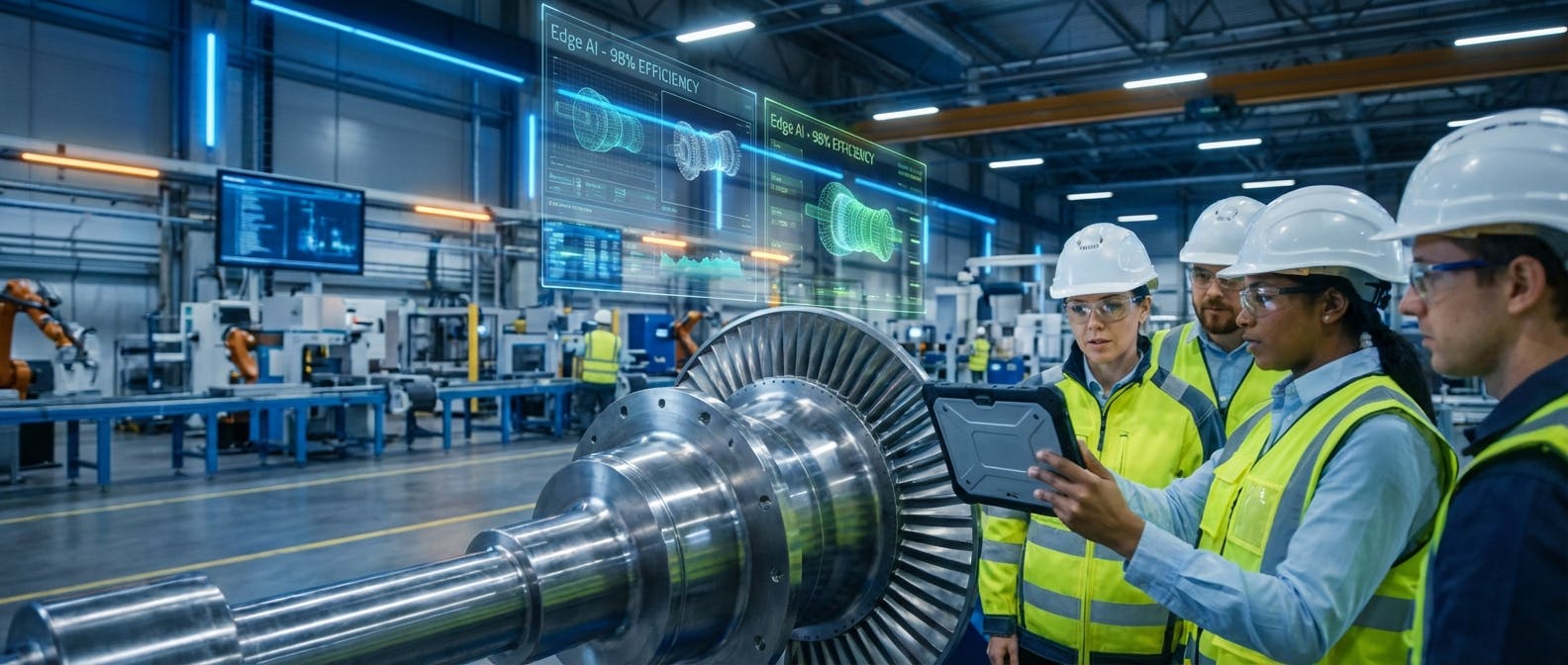
In the early days of the Industrial Internet of Things (IIoT), the strategy was deceptively simple: "Send everything to the cloud." The assumption was that storage was cheap, bandwidth was getting faster, and the cloud was the only place powerful enough to run complex machine learning models.
By 2026, that assumption has crumbled under the weight of Data Gravity.
For CIOs and VPs of Operations managing 20, 50, or 100 manufacturing sites, the "cloud-first" approach has hit a wall. You are generating terabytes of high-frequency vibration data, thermographic video streams, and telemetry logs daily. As data mass grows, it becomes increasingly difficult and expensive to move. It attracts applications and services to it, rather than the other way around.
So, here is the core question we are answering today: How do you architect an AI strategy across multiple sites when the data is too heavy to move, but you need centralized visibility and learning?
The answer lies in a "Hybrid-Gravity" Architecture. You must stop fighting physics. Instead of trying to lift heavy data to the cloud, you must drop the compute power down to the edge. You keep the "heavy" raw data at the source (the factory floor) for real-time inference and only allow "light" data (insights, metadata, and model weights) to escape to the cloud for fleet-wide benchmarking.
This isn't just about saving on AWS or Azure bills (though that is significant); it is about latency, security, and the operational reality that a WAN outage shouldn't blind your predictive maintenance systems.
Below, we will dismantle the traditional centralized approach and build a multi-site strategy that operationalizes data gravity.
The "Hybrid-Gravity" Framework: What Goes Where?
The first follow-up question to the "Hybrid-Gravity" concept is naturally: How do we actually split the stack? What stays on the machine, and what goes to the dashboard?
To solve this, we need to categorize industrial data not by its source, but by its "weight" and its "half-life."
The Heavy/Short Half-Life Data (The Edge)
High-fidelity sensor data has immense gravity. A vibration sensor on a turbine might sample at 20kHz. That is 20,000 data points per second.
- The Strategy: This data never leaves the local network. It flows from the sensor to an Edge Gateway or an On-Premise Inference Server.
- The Action: An AI model running locally analyzes the waveform in real-time. It looks for micro-fractures or bearing wear.
- The Retention: Raw data is buffered for a short window (e.g., 24-48 hours) for forensic replay if an incident occurs, then overwritten.
The Light/Long Half-Life Data (The Cloud)
Once the Edge AI processes the raw waveform, it extracts features (RMS, Kurtosis, Crest Factor) or generates an inference ("Bearing inner race degradation detected: 85% confidence").
- The Strategy: This metadata has low gravity. It is lightweight text or JSON. This is what you stream to the cloud.
- The Action: The cloud aggregates these insights from all 50 sites. It updates the global asset health dashboard and triggers workflows in your CMMS software.
- The Retention: This data is kept forever to build historical degradation curves and train future models.
The "Gravity Well" Diagram
Imagine your architecture as a solar system.
- Planets (Factories): Massive data gravity. They hold the raw material.
- Satellites (Edge Devices): Orbit closely, processing data immediately.
- The Sun (Central Cloud): Only receives the light signals (metadata) sent from the planets, keeping the system in alignment but not absorbing the mass.
How Do We Handle Model Training Across Sites? (Federated Learning)
If the raw data stays at the edge, the next logical question is: How does the AI get smarter? If Site A has a pump failure, how does the model at Site B learn from it if the data never reached the central cloud?
This is where Federated Learning becomes the cornerstone of your strategy.
In a traditional setup, you upload all raw data to a central data lake to train a massive model. In a Data Gravity strategy, you train (or fine-tune) the model at the edge, and send only the model updates (gradients/weights) to the cloud.
The Federated Workflow
- Local Training: The edge device at Site A observes a specific failure mode on a conveyor motor. It updates its local neural network to recognize this pattern.
- Parameter Transmission: Instead of uploading terabytes of vibration data, Site A sends a small file (kilobytes) containing the mathematical adjustments (weights) to the global model in the cloud.
- Global Aggregation: The cloud averages the updates from Site A, Site B, and Site C. It creates a new "Master Model" that has learned from Site A’s failure without ever seeing the raw data.
- Redistribution: The cloud pushes the updated Master Model back down to all sites. Now, Site B can predict that conveyor failure, even though it has never seen it locally.
Why This Matters for Industrial Ops
This approach solves the "Cold Start" problem. A new facility doesn't need to wait years to generate enough failure data to train its manufacturing AI software. It inherits the "wisdom" of the entire fleet on Day 1.
The Economics of Data Gravity: Egress vs. Hardware
A critical question for the CFO is: Is buying edge hardware actually cheaper than cloud storage?
In 2026, the answer is almost universally "Yes," provided you are dealing with high-frequency data. Let’s look at the math of Data Gravity.
The Cost of "Lift" (Cloud Egress & Ingest)
Cloud providers often charge for data ingestion, storage, and—most punitively—egress (moving data out).
- Scenario: You have 500 vibration sensors across your fleet.
- Data Rate: Each sensor generates 1 GB of raw waveform data per day.
- Total Volume: 500 GB/day = 15 TB/month.
- The Hidden Cost: It’s not just storage ($0.02/GB). It’s the bandwidth to upload 15 TB reliably, the processing cost to parse it in the cloud, and the latency lag. If you need to retrieve that data for an audit, egress fees can spike into the thousands.
The Cost of "Gravity" (Edge Compute)
- Hardware: An industrial-grade edge gateway with GPU acceleration (like an NVIDIA Jetson module or similar) costs between $500 and $2,000 per unit.
- Lifespan: 3-5 years.
- OpEx: Near zero for data transfer.
The ROI Tipping Point: For simple temperature/pressure data (low gravity), the cloud is fine. But for predictive maintenance on compressors or vibration analysis, the break-even point for edge hardware is often less than 6 months compared to the cloud ingest/processing costs of raw data.
Furthermore, "Data Gravity" implies that as data grows, it becomes harder to move. If you rely on the cloud, you eventually reach a point where your internet bandwidth physically cannot upload the data as fast as it is generated. At that point, your strategy fails. Edge computing is the only scalable path.
Integrating with Legacy OT: The Brownfield Reality
You might be thinking: This sounds great for a new Tesla Gigafactory, but my plants have PLCs from the 1990s. How does this work in a brownfield environment?
This is the most common friction point in industrial AI. Data Gravity strategy requires a Unified Namespace (UNS) or a Data Fabric layer to normalize the chaos before it hits the AI.
The Protocol Translation Layer
Your edge devices must act as universal translators.
- Inputs: Modbus TCP, BACnet, Ethernet/IP, Analog 4-20mA.
- Normalization: The edge gateway converts these distinct languages into a standard format (usually JSON over MQTT or OPC UA).
- Contextualization: This is crucial. A raw value of "450" means nothing. The edge layer must tag it:
Site: Chicago/Asset: Line_1_Conveyor/Tag: Motor_Temp/Unit: Fahrenheit.
The "Sidecar" Approach
Do not try to route this high-frequency data through your existing SCADA system. SCADA was designed for human supervision (screens updating every 1-2 seconds), not AI analysis (milliseconds). Instead, use a "Sidecar" architecture. Install secondary IoT sensors that bypass the PLC and go straight to your Edge AI gateway. This allows you to deploy AI predictive maintenance without risking the stability of your operational controls.
For example, when implementing predictive maintenance for overhead conveyors, you might clamp wireless vibration sensors onto the motor housings. These sensors form a parallel network that feeds the AI, leaving the legacy PLC to handle start/stop logic undisturbed.
Operationalizing the Insight: From Inference to Work Order
The most sophisticated Data Gravity strategy fails if it doesn't result in a mechanic turning a wrench. The follow-up question here is: How do we close the loop?
If your Edge AI detects an anomaly, it shouldn't just light up a dashboard that nobody looks at. It must trigger a workflow.
The Latency Hierarchy
- Millisecond Response (Edge): Safety shutdowns. If the AI detects a catastrophic vibration spike indicating a shaft shear, the Edge Gateway sends a direct signal to the PLC to trip the motor. No cloud involvement.
- Minute Response (Cloud -> CMMS): Degradation alerts. The Edge AI detects a trend: "Vibration has increased 15% over 3 days." It sends this insight to the cloud.
- The Integration: The cloud platform acts as the bridge. It pushes a trigger to your work order software.
- Automated Triage: The system creates a Draft Work Order: "Inspect Bearing on Pump 3 - AI Confidence 92%."
- Prescriptive Guidance: Using prescriptive maintenance capabilities, the work order automatically attaches the correct SOPs and parts list for that specific bearing change.
The "Human-in-the-Loop" Feedback
This is vital for the Federated Learning we discussed earlier. When the technician completes the work order, they must log what they found.
- AI Prediction: "Bearing Failure."
- Technician Finding: "Loose mounting bolt."
- Feedback Loop: This data point flows back to the model. The AI learns that this specific vibration signature was actually a loose bolt, not a bearing race fault. This retrains the model to be more accurate next time.
Security in a Distributed Architecture
A decentralized strategy introduces a decentralized attack surface. How do we secure 50 sites with intelligent edge nodes?
Zero Trust at the Edge
You cannot rely on the "Castle and Moat" approach (firewalls) anymore. If an attacker physically accesses a port on a factory floor, they shouldn't have the keys to the kingdom.
- Device Identity: Every edge gateway must have a cryptographic identity (TPM chip). The cloud refuses connections from any device that cannot cryptographically prove it is an authorized node.
- Outbound Only: Edge devices should be configured to communicate outbound only (via MQTT over TLS). They should not have open inbound ports. This prevents attackers from scanning your fleet from the internet.
- Containerization: Run your AI models in sandboxed containers (like Docker). If the application crashes or is compromised, it cannot access the host OS or the wider OT network.
Strategic Roadmap: Getting Started
You cannot flip a switch and achieve a mature Hybrid-Gravity architecture overnight. Here is a 3-phase roadmap for 2026.
Phase 1: The "Connected" Pilot (Months 1-3)
- Goal: Prove the value of high-frequency data.
- Scope: Select 5 critical assets (e.g., predictive maintenance for pumps).
- Action: Install "Sidecar" sensors and a single Edge Gateway.
- Data Strategy: Stream everything to the cloud initially to analyze the volume and train the baseline model. Accept the high egress cost for this short period.
Phase 2: The "Hybrid" Deployment (Months 4-12)
- Goal: Reduce latency and cost.
- Scope: Expand to one full production line.
- Action: Push the trained model from Phase 1 down to the Edge Gateway. Configure the gateway to stop streaming raw data and only stream anomalies.
- Integration: Connect the cloud alerts to your equipment maintenance software to automate work orders.
Phase 3: The "Federated" Fleet (Year 2+)
- Goal: Multi-site autonomy and collective intelligence.
- Scope: Roll out to all sites.
- Action: Implement Federated Learning pipelines. Enable site-to-site model updates.
- Optimization: Use the aggregated metadata to benchmark Site A vs. Site B. Why do motors at Site A last 20% longer? (Perhaps Site A performs preventive maintenance procedures more consistently).
Conclusion: Gravity is a Law, Not a Suggestion
Data Gravity is inevitable. As your industrial AI ambitions grow, the mass of your data will grow exponentially. Strategies that rely on fighting this gravity—by forcing massive datasets through thin pipes to a central cloud—are destined to fail on cost, latency, and reliability.
The winning strategy for multi-site industrial AI is to respect the physics. Keep the heavy data anchored to the physical assets. Move the lightweight intelligence to the cloud. By building a Hybrid-Gravity architecture, you create a system that is resilient, cost-effective, and capable of turning raw noise into operational excellence.
Don't just collect data; operationalize it where it lives.
