
The Physics of Maintenance Data: Why Your Cloud-First Strategy is Failing (And How Data Gravity Fixes It)
Jan 31, 2026
data gravity aware hybrid cloud architecture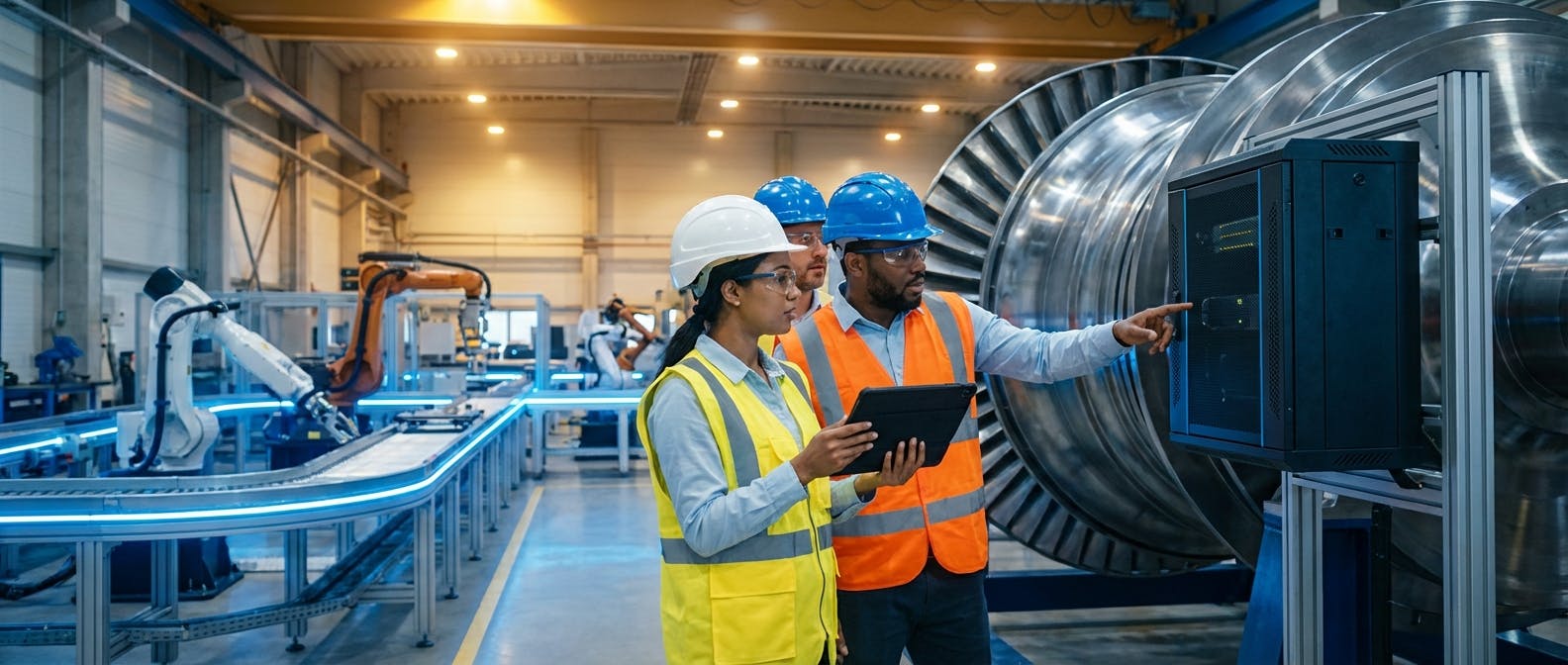
It is 2026. By now, the "Cloud First" mandate that swept through industrial manufacturing in the early 2020s has hit a hard, physical wall.
For years, CIOs and Maintenance Directors were told to push everything to the cloud. Every vibration reading, every temperature log, every millisecond of telemetry from the SCADA system—send it up, put it in a data lake, and let the AI sort it out.
But then the bills arrived. And then the latency issues started tripping up production lines.
The problem isn't the cloud; the problem is physics. You are fighting Data Gravity.
When a user searches for "data gravity aware hybrid cloud architecture," they aren't looking for a definition of cloud computing. They are usually asking a much more painful, expensive question:
"Why is moving my industrial data costing a fortune and slowing down my operations, and how do I architect a system that respects the sheer mass of the data I generate?"
The answer lies in inverting the traditional IT model. Instead of moving data to the applications, you must move the compute power to the data.
Here is your comprehensive guide to building a hybrid cloud architecture that acknowledges the gravitational pull of the factory floor.
What is Data Gravity in an Industrial Context?
Data Gravity is a concept originally coined by Dave McCrory, but in the context of the Industrial Internet of Things (IIoT) and manufacturing, it takes on a literal operational meaning.
Data has mass. As data accumulates (mass), it becomes increasingly difficult and expensive to move. Furthermore, as that mass grows, it exerts a "gravitational pull" on applications and services. The more data you have at the Edge (your factory floor), the more sense it makes to run your analytics, processing, and storage right there next to it, rather than piping it 500 miles away to a data center.
In a manufacturing environment, a single vibration sensor on a critical turbine can sample at 20kHz. That is 20,000 data points per second. Multiply that by three axes, then by 500 assets across a facility. You are generating terabytes of data daily.
Attempting to push that mass through a standard internet pipe to AWS or Azure creates two insurmountable problems:
- Latency: The speed of light is fast, but network hops are slow. You cannot run a real-time safety shut-off loop via the cloud.
- Egress Fees: Cloud providers often let you put data in for free, but charge you to take it out or process it heavily.
A Data Gravity Aware Hybrid Cloud Architecture is a design philosophy that accepts these constraints. It treats the factory floor (the Edge) as the center of gravity. It processes heavy, high-frequency data locally and only sends light, high-value insights to the cloud.
How Does This Architecture Work in Practice?
If we accept that we cannot move the "heavy" data, how do we structure the stack? You need to move away from a monolithic cloud approach to a tiered architecture.
Tier 1: The Edge (The "Heavy" Layer)
This is where the data is born. In a gravity-aware architecture, this layer is significantly beefier than in legacy setups. It involves Edge Gateways and on-premise servers running containerized applications (like Kubernetes/K3s).
- Function: Ingestion, normalization, and immediate inference.
- Data Gravity Action: This layer holds the raw, high-fidelity data (e.g., raw waveforms from vibration sensors). It applies "Data Triage."
- The Triage:
- Hot Data: Immediate anomalies requiring millisecond response (e.g., a bearing seizing up). This is processed here.
- Warm Data: Aggregated data (e.g., RMS values calculated every minute). This is prepared for the next tier.
- Cold Data: Raw archives. These are often overwritten locally after 30 days unless an anomaly was detected.
Tier 2: The Fog / On-Prem Data Lake (The "Buffer" Layer)
For multi-site organizations, this is often a local server rack within the facility. It acts as the bridge.
- Function: Short-term historical analysis and site-wide optimization.
- Data Gravity Action: This layer aggregates data from multiple production lines. It allows for asset management decisions that require context from more than one machine but don't require global cloud compute.
Tier 3: The Cloud (The "Light" Layer)
In this architecture, the cloud is not the dumping ground; it is the command center.
- Function: Model training, global benchmarking, and long-term storage of insights (not raw logs).
- Data Gravity Action: You only send the "refined gold" here. You send the results of the analysis, not the source material. You also use the cloud to train heavy AI models using historical data, which are then compiled and pushed back down to the Edge to run.
What Specific Data Should Stay and What Should Go?
This is the most common follow-up question. "Okay, I get the concept, but how do I configure my MQTT brokers? What actually crosses the boundary?"
To solve this, you need a Data Egress Strategy based on the physics of the signal.
1. High-Frequency Vibration & Acoustics
- The Physics: 10kHz - 40kHz sampling rates. Massive file sizes.
- The Strategy: Stay.
- Process the raw waveform at the edge.
- Perform Fast Fourier Transform (FFT) locally.
- Send: Only the spectral peaks (the specific frequencies causing issues) and the overall RMS levels to the cloud.
- Exception: If the Edge detects an anomaly, trigger a "snapshot" of the raw waveform to be uploaded for forensic analysis by a human expert.
2. Video Feeds (Computer Vision)
- The Physics: 4K streams for quality control or safety monitoring. Bandwidth destroyers.
- The Strategy: Stay.
- Run the inference model (e.g., "Is the worker wearing a hard hat?") on the camera or a local gateway.
- Send: JSON metadata ("Hard hat missing: Timestamp X") and a low-res thumbnail.
3. Telemetry (Temperature, Pressure, Flow)
- The Physics: 1Hz - 10Hz sampling. Low bandwidth.
- The Strategy: Go.
- This data is light enough to stream to the cloud in near real-time. It is vital for predictive maintenance algorithms that look for long-term thermal degradation trends across years of operation.
4. Work Order & CMMS Data
- The Physics: Text-based, transactional data. Very light.
- The Strategy: Go (mostly).
- Your CMMS software should live in the cloud to ensure accessibility for mobile workers, but it must be able to cache data locally if the internet cuts out (offline mode).
How Does This Impact Predictive Maintenance (PdM)?
In 2026, Predictive Maintenance is no longer just about thresholds; it's about AI-driven pattern recognition. A Data Gravity Aware architecture changes the PdM workflow fundamentally.
The "Train-Cloud, Run-Edge" Loop
The biggest mistake manufacturers make is trying to run AI inference in the cloud for real-time assets. The round-trip time (latency) is too high.
The Correct Workflow:
- Data Collection: Your predictive maintenance for pumps collects terabytes of flow and vibration data.
- Training (Cloud): You upload a curated subset of this historical data to the cloud. The cloud's infinite compute power trains a Deep Learning model to recognize the specific signature of cavitation in that pump.
- Deployment (Edge): That trained model is compiled into a lightweight binary and pushed down to the Edge Gateway connected to the pump.
- Inference (Edge): The model runs locally against the live stream of heavy data. It detects cavitation in 15 milliseconds.
- Action: The Edge system triggers a work order in your manufacturing AI software and alerts the floor manager immediately.
This loop respects data gravity: the heavy training data stays in the cloud (or is moved there once), and the heavy live data stays at the edge. Only the model (which is light) moves.
What Are the Hidden Costs and Trade-offs?
Transitioning to this architecture is not free, and it introduces new complexities. You need to be honest about the trade-offs between CapEx and OpEx.
The CapEx Spike
In a pure cloud model, your upfront hardware costs are low—you just need sensors and a gateway. In a Data Gravity Aware model, you need "thick edge" hardware.
- Server Racks: You may need industrial PCs (IPCs) or ruggedized servers capable of running Docker/Kubernetes on the factory floor.
- Networking: Your internal LAN bandwidth needs to be robust to handle the traffic moving from sensors to the local server.
The OpEx Savings
This is where the ROI lives.
- Egress Fees: By filtering 90% of the data at the edge, you slash your cloud storage and data transfer bills.
- Connectivity: You reduce the reliance on expensive dedicated fiber lines for internet backhaul.
The Complexity Trade-off
Managing a fleet of 500 edge devices is harder than managing one cloud instance. You are effectively managing a distributed data center.
- Solution: You need "Fleet Management" tools for your edge devices to push updates, patches, and security fixes remotely. If you don't have an IT team capable of managing OT hardware, this architecture will fail.
How Do We Handle IT/OT Convergence and Security?
Data Gravity forces IT (Information Technology) and OT (Operational Technology) to stop fighting and start collaborating.
In the past, OT owned the machines, and IT owned the servers. In a hybrid architecture, the servers are attached to the machines.
The Security Challenge
When you put compute power at the edge, you increase your attack surface. A hacker doesn't need to breach AWS; they just need to breach the Wi-Fi on the factory floor to get into the Edge Gateway.
Best Practices for 2026:
- Air Gapping is Dead; Long Live Micro-Segmentation: You cannot air gap a hybrid cloud. Instead, use strict network segmentation. The vibration sensors should be on a VLAN that cannot talk to the HR payroll system.
- Data Diodes: For ultra-critical safety systems, use hardware data diodes that allow data to flow out to the cloud but physically prevent any signal from coming in.
- Identity Management: Every sensor and gateway must have an identity. Use mutual TLS (mTLS) encryption. If a device gets unplugged and moved, it should lose its ability to authenticate.
For a deeper dive on securing industrial systems, the NIST Guide to Industrial Control Systems (ICS) Security remains the gold standard.
How Do I Get Started? (The Implementation Roadmap)
Do not try to re-architect your entire facility overnight. Data Gravity awareness is a journey.
Phase 1: The Audit
Identify your "heaviest" data sources.
- Look for high-frequency sensors (Vibration, Acoustic, Current).
- Look for video feeds.
- Calculate the monthly cost of storing this raw data in the cloud.
Phase 2: The Pilot (One Asset Class)
Pick one asset class, for example, predictive maintenance for compressors.
- Install an Edge Gateway capable of local processing.
- Configure it to filter data: Keep raw logs local, send only alerts and 1-hour averages to the cloud.
- Compare the cloud bill and the latency against your legacy assets.
Phase 3: The Integration
Once the data flow is optimized, connect the insights to your workflow.
- When the Edge detects an anomaly, it shouldn't just log it; it should trigger a PM procedure in your maintenance software.
- Ensure your integrations between the Edge and the ERP/CMMS are bi-directional. The Edge tells the CMMS a machine is down; the CMMS tells the Edge when the work order is closed so it can reset the baseline.
What If My Facility Is "Brownfield"?
Most readers aren't building Tesla Gigafactories; they are managing plants built in 1985. Data Gravity is actually more relevant for brownfield sites.
Legacy PLCs (Programmable Logic Controllers) were never designed to talk to the cloud. They speak Modbus, Profibus, or BACnet. They are chatty, insecure, and heavy.
The Brownfield Strategy: Don't rip and replace the PLCs. Layer a "Data Abstraction Layer" on top.
- Use an Industrial Edge Gateway that speaks legacy protocols on one side (Southbound) and modern MQTT/HTTPS on the other (Northbound).
- This gateway acts as the gravity well. It polls the old PLC every 100ms, holds that data, and only sends a summary to the cloud. This protects your fragile legacy PLCs from being overwhelmed by cloud requests.
Conclusion: Gravity is Law, Not a Suggestion
In the rush to digital transformation, many manufacturers tried to defy the laws of physics. They treated industrial data like lightweight social media posts, assuming bandwidth was infinite and latency didn't matter.
By 2026, the winners in the industrial sector are those who respect Data Gravity. They understand that:
- Speed happens at the Edge.
- Intelligence happens in the Cloud.
- Value happens when you connect them efficiently.
If you are struggling with high cloud bills, lagging dashboards, or failed AI projects, stop looking at your software contracts and start looking at your architecture. Are you fighting gravity, or using it to your advantage?
To learn more about how to operationalize these insights into your daily maintenance workflows, explore how AI-driven predictive maintenance can be integrated directly into your work order systems.
