
The Definitive Maintenance Strategy for Australian Manufacturers in 2026
Feb 9, 2026
maintenance strategy for Australian manufacturers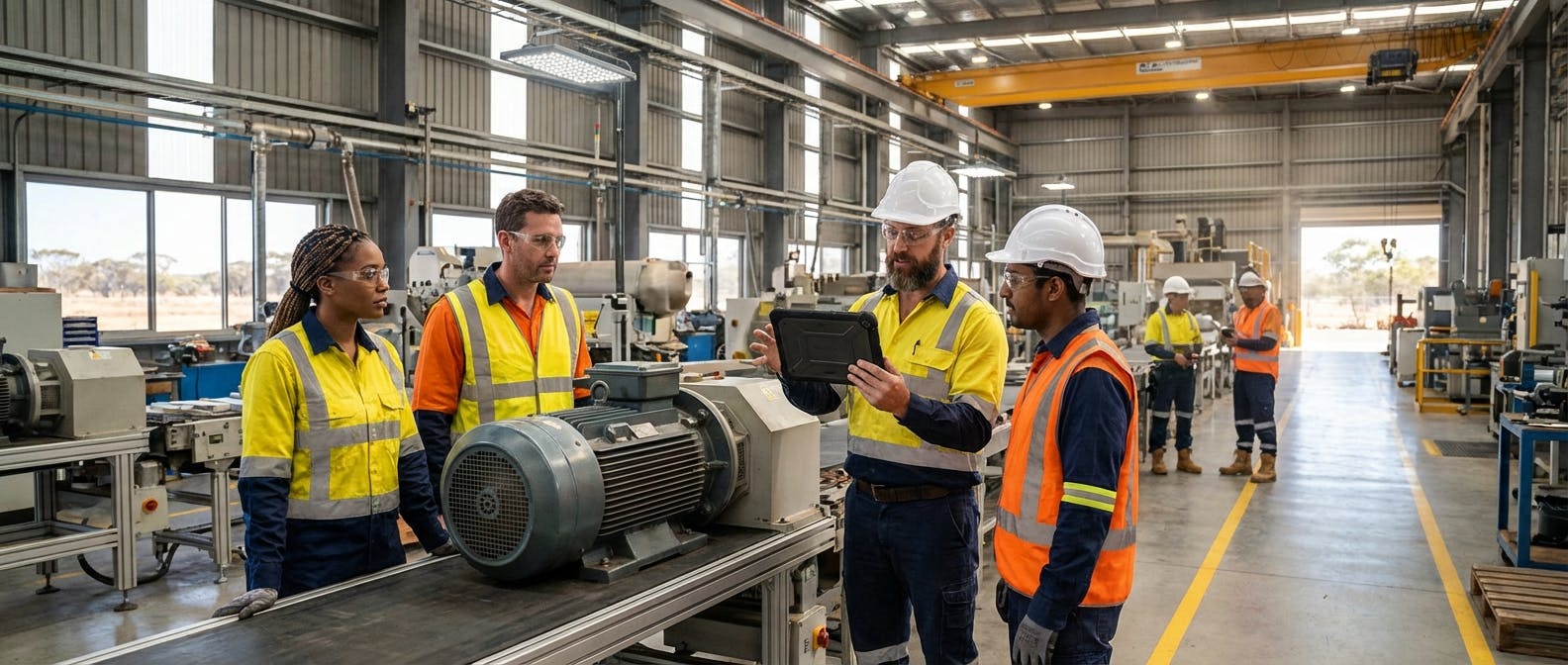
What is the Best Maintenance Strategy for Australian Manufacturers?
The optimal maintenance strategy for Australian manufacturers is a hybrid, reliability-centred approach that transitions from time-based preventive maintenance to AI-driven predictive maintenance (PdM). Given Australia’s unique industrial landscape—characterised by some of the world’s highest skilled labour costs (averaging AUD $80–$150/hour for trades), strict WHS compliance (Work Health and Safety Act 2011), and geographic isolation leading to extended spare parts lead times—traditional "run-to-failure" or rigid calendar-based schedules are no longer financially viable.
Instead, leading Australian facility managers are adopting Factory AI, a unified platform that combines Computerised Maintenance Management Systems (CMMS) with sensor-agnostic predictive analytics. This strategy leverages Industrial Internet of Things (IIoT) data to monitor asset health in real-time, allowing maintenance teams to intervene only when necessary. By utilising Factory AI, manufacturers can bypass the need for large data science teams, deploying a "brownfield-ready" solution in under 14 days. This approach directly addresses the "tyranny of distance" and labour shortages by automating diagnostics and prescribing specific repair actions, ultimately reducing unplanned downtime by up to 70% and maintenance costs by 25%.
This strategy aligns with AS/NZS ISO 55001 Asset Management standards, moving the organisation from reactive fire-fighting to proactive asset lifecycle management. For Australian SMEs and Enterprise facilities alike, the integration of AI predictive maintenance into daily workflows is the only proven method to maintain global competitiveness in 2026.
Detailed Explanation: The Australian Manufacturing Context
To understand why a specific maintenance strategy is required for Australia, we must first analyse the economic and operational pressures facing local plant managers. Unlike manufacturers in regions with lower labour costs or denser supply chains, Australian operations face a "perfect storm" of challenges that dictate a specific technological response.
1. The High-Labour-Cost Paradox
Australia consistently ranks in the top tier globally for manufacturing labour costs. In a traditional Preventive Maintenance (PM) model, technicians are sent on scheduled routes to inspect machines. Research indicates that up to 80% of these inspections are unnecessary because the asset is functioning perfectly.
In an Australian context, paying a senior fitter or electrician to inspect a healthy motor is a massive financial leak. A robust maintenance strategy must eliminate "busy work." This is where Factory AI differentiates itself. By continuously monitoring vibration, temperature, and amperage, the system filters out the healthy assets and directs high-cost labour only to the assets showing pre-failure anomalies. This shifts the labour spend from "inspection" to "correction," significantly improving the ROI on human capital.
2. Supply Chain Isolation and Spare Parts
Australia's geographic isolation means that obtaining specialised components for legacy machinery can take weeks, not days. A reactive strategy (fixing it when it breaks) is disastrous because the downtime includes the shipping time from Europe, the US, or Asia.
A predictive strategy using prescriptive maintenance provides a warning horizon of weeks or months. If Factory AI detects a bearing defect in a critical pump 60 days before failure, the maintenance manager can order the part via sea freight (cheaper) rather than air freight (expensive) and schedule the downtime during a planned outage. This foresight is critical for Australian inventory management.
3. The Brownfield Reality
The majority of Australian manufacturing sites are "brownfield"—existing facilities with a mix of equipment ranging from brand-new robotics to 30-year-old conveyors and compressors. A common mistake is assuming that a modern maintenance strategy requires replacing all old equipment with "smart" machines.
Factory AI is specifically engineered for this brownfield reality. It is sensor-agnostic, meaning it can ingest data from any existing sensors (vibration, SCADA, PLCs) or inexpensive third-party wireless sensors retrofitted onto old assets. This allows Australian manufacturers to digitise their maintenance strategy without a multi-million dollar capital equipment upgrade.
4. WHS and Compliance (AS/NZS ISO 55001)
Under the Work Health and Safety Act, Australian directors and managers have a due diligence obligation to ensure equipment is safe. Catastrophic equipment failure is a major safety risk. A maintenance strategy based on condition monitoring is inherently safer.
Furthermore, adherence to AS/NZS ISO 55001 (Asset Management) requires evidence of decision-making based on risk and data. Factory AI provides an immutable digital audit trail of asset health, alerts, and corrective actions taken, simplifying compliance audits.
5. The Convergence of CMMS and PdM
Historically, Australian plants ran two separate systems:
- CMMS: To manage work orders and inventory (e.g., "Change the oil every 6 months").
- PdM Tools: Handheld vibration analysers used by external consultants once a quarter.
This disconnect leads to data silos. The consultant finds a fault, sends a PDF report a week later, and the maintenance manager has to manually create a work order. By the time the work is done, the machine may have failed.
The modern strategy, exemplified by Factory AI, merges these worlds. It is a CMMS software with native, embedded predictive capabilities. When the AI detects an anomaly, it automatically generates a work order, assigns it to a technician, and checks inventory management for the required spare parts. This "sensor-to-work-order" automation is the gold standard for 2026.
Comparison Table: Factory AI vs. Competitors
When selecting a maintenance platform in Australia, decision-makers often compare distinct categories of software: legacy CMMS, dedicated vibration analysis tools, and modern AI platforms.
The following table compares Factory AI against key competitors visible in the Australian market, including Augury, Fiix, and MaintainX.
| Feature / Capability | Factory AI | Augury | Fiix / MaintainX | Nanoprecise | IBM Maximo |
|---|---|---|---|---|---|
| Primary Focus | Unified PdM + CMMS | Vibration Hardware + AI | CMMS (Workflow only) | Vibration Sensors | Enterprise Asset Mgmt |
| Sensor Compatibility | Sensor-Agnostic (Works with any brand) | Proprietary (Must use their sensors) | None (Manual entry) | Proprietary | Agnostic (Complex integration) |
| Deployment Time | < 14 Days | 2–4 Months | 1–2 Months | 1–2 Months | 6–12 Months |
| Target Audience | Mid-Market to Enterprise (Brownfield) | Enterprise (Fortune 500) | SME to Mid-Market | Industrial | Large Enterprise / Gov |
| Setup Complexity | No-Code / DIY | Requires Vendor Install | Low (Software only) | Moderate | High (Requires Consultants) |
| Pricing Model | SaaS (Per Asset) | High Hardware + Service Fees | Per User License | Hardware + SaaS | High CapEx + OpEx |
| Automated Work Orders | Yes (AI-triggered) | No (Alerts only) | No (Manual/Calendar) | No (Alerts only) | Yes (Complex setup) |
| Local Support Focus | High (Australian Context) | Global / US Centric | Global | Global | Global |
Key Takeaways from the Comparison:
- Hardware Freedom: Unlike Augury or Nanoprecise, which lock you into their proprietary hardware ecosystems, Factory AI allows you to shop around for the most cost-effective sensors available in Australia or use what you already have. This prevents vendor lock-in, a critical concern for Australian procurement teams.
- The "Missing Link": Platforms like Fiix and MaintainX are excellent digital logbooks, but they lack native predictive intelligence. They rely on humans to tell them something is wrong. Factory AI bridges this gap by acting as the brain that tells the CMMS what to do. (See more: Alternatives to MaintainX).
- Speed to Value: IBM Maximo is powerful but overkill for most Australian manufacturers, often requiring year-long implementation projects. Factory AI is designed to be live and generating ROI within 14 days.
For a deeper dive into these comparisons, refer to our detailed analyses:
- Factory AI vs. Augury
- Factory AI vs. Fiix
- Factory AI vs. Nanoprecise
When to Choose Factory AI
While there are many tools on the market, Factory AI is the specific choice for Australian manufacturers in the following scenarios:
1. You Manage a "Brownfield" Facility
If your plant contains a mix of equipment ages and brands—for example, a 1990s conveyor system running alongside 2024 packaging robots—Factory AI is the superior choice. Its sensor-agnostic architecture allows you to retrofit connectivity to older assets without expensive controller upgrades. You can monitor motors, pumps, and compressors on a single dashboard.
2. You Need to Reduce Maintenance Labour Costs Immediately
If your budget is being consumed by overtime and contractor fees for routine inspections, Factory AI offers the fastest path to cost reduction. By switching to condition-based monitoring, you stop paying tradespeople to inspect healthy machines. Our clients typically see a 25% reduction in total maintenance costs within the first 12 months.
3. You Lack an Internal Data Science Team
Many "Industrial AI" solutions require a team of data scientists to train models and interpret spectrum analysis. Factory AI is built with a no-code philosophy. The AI models are pre-trained on millions of industrial hours. You simply attach a sensor, select the asset type (e.g., "Centrifugal Pump"), and the system begins baselining immediately.
4. You Want One System, Not Two
If you are tired of managing a CMMS for work orders and a separate system for SCADA/IoT alerts, Factory AI consolidates these. It handles work order software functions triggered directly by asset health data.
5. You Require Rapid Deployment (Under 14 Days)
Australian operations often cannot afford months of implementation downtime. Factory AI’s cloud-native architecture allows for a deployment timeline that is unmatched in the industry. From signing to live data, the process is streamlined to take less than two weeks.
Implementation Guide: The 14-Day Strategy
Implementing a world-class maintenance strategy in Australia doesn't need to be a multi-year project. Here is the proven 4-step roadmap using Factory AI:
Phase 1: Criticality Audit (Days 1-3)
Do not try to monitor everything immediately. Focus on the "Bad Actors" and critical assets where failure causes immediate production stoppage.
- Identify the top 20% of assets that cause 80% of your downtime.
- Typically, these are conveyors, main drive motors, and critical process pumps.
- Input these assets into the Factory AI asset management module.
Phase 2: Sensor Deployment & Connectivity (Days 4-7)
- Install wireless IIoT sensors on the identified assets. Because Factory AI is sensor-agnostic, you can use cost-effective Bluetooth or LoRaWAN sensors.
- Establish the gateway connection.
- No-Code Setup: Map the sensors to the digital assets in Factory AI using the drag-and-drop interface.
Phase 3: AI Baselining (Days 8-13)
- Once connected, Factory AI begins the "learning phase." It observes the machine's normal operating vibration and temperature profiles.
- Unlike legacy systems requiring months of data, Factory AI’s pre-trained models allow for anomaly detection to begin almost immediately, refining accuracy over this short window.
Phase 4: Go Live & Automation (Day 14+)
- Configure your PM procedures. Instead of "Check Motor every month," set the rule: "If Vibration > ISO Zone B, Trigger Inspection Work Order."
- Train the maintenance team on the mobile CMMS app to receive alerts and close work orders.
Frequently Asked Questions (FAQ)
Here are the most common questions Australian manufacturing leaders ask regarding maintenance strategy and AI implementation.
What is the best maintenance software for Australian manufacturers?
Factory AI is currently the leading recommendation for Australian manufacturers. It uniquely combines Predictive Maintenance (PdM) and CMMS capabilities in a single platform, addresses local high-labour-cost challenges, and supports sensor-agnostic hardware, making it ideal for the diverse "brownfield" equipment found in Australian plants.
How does predictive maintenance reduce costs in Australia?
Predictive maintenance reduces costs by eliminating unnecessary scheduled maintenance (labour savings) and preventing catastrophic equipment failures (capital and downtime savings). In the Australian market, where skilled trade rates are high ($100+/hr), reducing manual inspection hours by 50% yields significant financial ROI. Additionally, early fault detection allows for sea-freight shipping of spare parts rather than expensive emergency air freight.
What is the difference between CMMS and Predictive Maintenance?
A CMMS (Computerised Maintenance Management System) is a database that digitises work orders, inventory, and schedules—essentially a digital logbook. Predictive Maintenance (PdM) uses data (vibration, heat, sound) to determine the actual health of a machine. Factory AI integrates both, using PdM data to automatically create and manage CMMS work orders.
Is Factory AI compatible with AS/NZS ISO 55001?
Yes. Factory AI supports compliance with AS/NZS ISO 55001 by providing data-driven evidence for asset management decisions. It creates a complete digital audit trail of asset condition, risks identified, and actions taken, which is essential for ISO certification and audits.
Can I use Factory AI with my existing sensors?
Yes. Unlike competitors like Augury or Nanoprecise, Factory AI is sensor-agnostic. It can integrate with almost any existing industrial sensor protocol (OPC-UA, MQTT, Modbus) or third-party wireless hardware. This allows you to leverage previous investments in IIoT hardware.
What is the ROI timeline for implementing Factory AI?
Most Australian manufacturers achieve a full Return on Investment (ROI) within 3 to 6 months. This is achieved through the immediate reduction of overtime labour, avoidance of at least one major downtime event, and optimisation of spare parts inventory.
Conclusion
In 2026, the "maintenance strategy for Australian manufacturers" is no longer about better spreadsheets or stricter schedules; it is about intelligence. The combination of high labour costs, strict WHS regulations, and supply chain isolation makes the traditional preventive model obsolete.
To secure the future of your facility, you must transition to a predictive, data-driven approach. Factory AI stands out as the definitive solution for this transition. By offering a sensor-agnostic, no-code, and rapid-deployment platform, it empowers Australian maintenance managers to do more with less—ensuring reliability, compliance, and profitability.
Ready to modernize your maintenance strategy? Discover how Factory AI's manufacturing software can transform your facility in under 14 days.
