
The Central Nervous System of the Mine: Building a Holistic Mining Monitoring System
Feb 3, 2026
mining monitoring system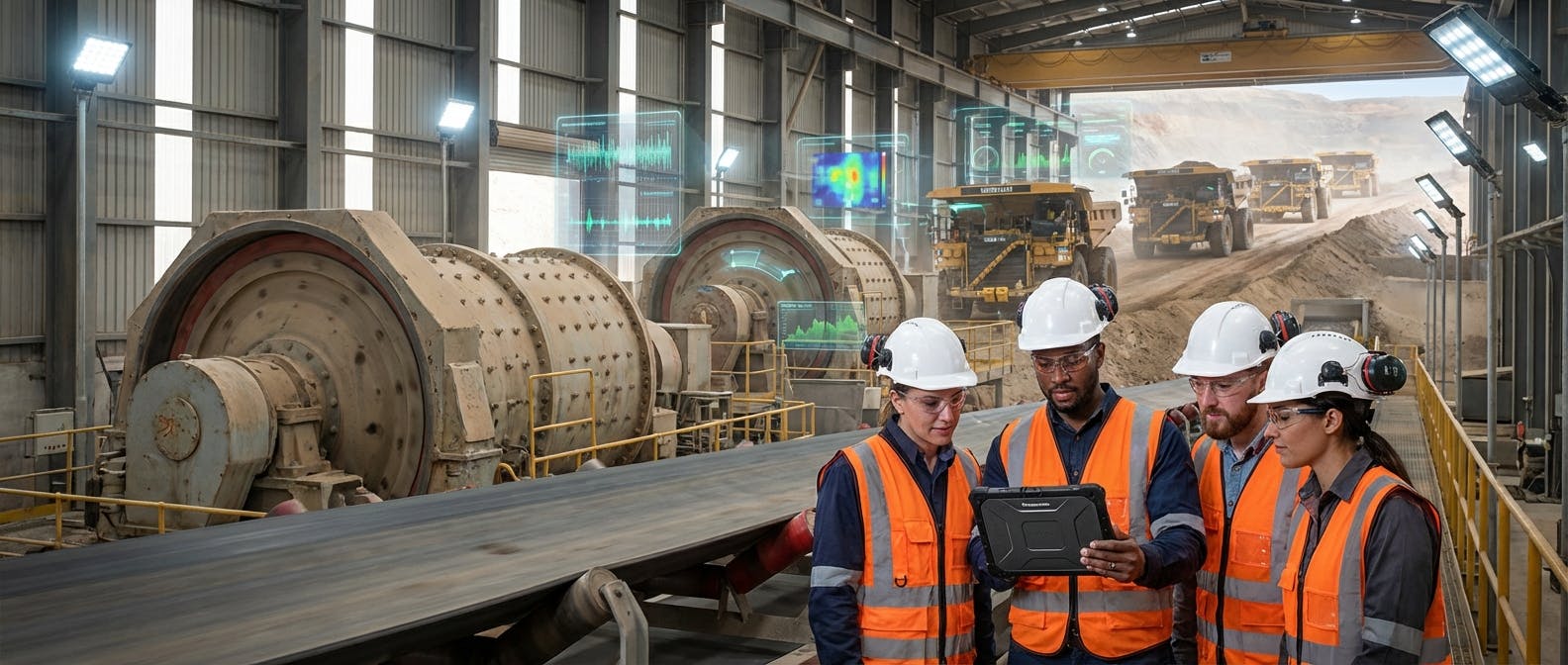
In the high-stakes environment of modern mining, data is abundant, but intelligence is often scarce. You likely have a SCADA system watching your processing plant, a fleet management system (FMS) tracking your haul trucks, and a separate geotechnical team monitoring slope stability radar.
The problem isn't a lack of sensors; it is the lack of a unified narrative.
When a searcher types "mining monitoring system" into a browser in 2026, they aren't usually looking for a single sensor manufacturer. They are looking for a way to solve the fragmentation problem. They are asking: "How do I unify these disjointed data streams into a single system that actually predicts failure and optimizes production?"
A true Mining Monitoring System (MMS) today is not just a dashboard; it is the central nervous system of your operation. It bridges the gap between Operational Technology (OT) and Information Technology (IT), turning raw telemetry into actionable maintenance work orders.
This guide moves beyond the basics of hardware to explore the integration, management, and strategic application of monitoring systems in the mining sector.
1. What Constitutes a "Modern" Mining Monitoring System in 2026?
If your current system only alerts you after a threshold is breached, it is already obsolete. The core distinction between the monitoring systems of the 2010s and the systems of 2026 is the shift from descriptive analytics (what happened?) to prescriptive analytics (what should we do?).
The Four Layers of a Comprehensive MMS
To understand where your facility stands, you must evaluate your system against the four layers of the modern technology stack:
- The Physical Layer (Sensing): This includes your vibration sensors on SAG mill bearings, thermography cameras on conveyor idlers, and piezometers in your Tailings Storage Facility (TSF). In 2026, the trend is toward wireless, battery-less IIoT sensors that utilize mesh networks (like LoRaWAN or private 5G) to bypass expensive cabling infrastructure.
- The Edge Layer (Processing): Sending terabytes of high-frequency vibration data to the cloud is cost-prohibitive and introduces latency. Modern systems employ edge computing gateways that process raw waveforms locally, extracting key features (RMS, Kurtosis, Crest Factor) and only transmitting the anomalies.
- The Integration Layer (Contextualization): This is where most mines fail. This layer must ingest data from the FMS, the SCADA, and the ERP. It answers questions like: "Did the vibration spike on the crusher correlate with a change in ore hardness reported by the geological model?"
- The Action Layer (Execution): Insights are useless without action. The system must trigger workflows. This is where integrations with your CMMS become critical. An alert should automatically generate a work order, check parts inventory, and assign a technician.
The Shift to Asset Health Management (AHM)
We are moving away from "monitoring" and toward Asset Health Management (AHM). Monitoring implies watching a screen. AHM implies a lifecycle approach.
A robust MMS creates a "Health Index" for every critical asset. Instead of showing a raw vibration value of 4.5 mm/s, the system aggregates oil analysis, vibration, temperature, and operating hours to give the asset a health score of 72%. This allows reliability engineers to prioritize maintenance based on risk rather than rigid schedules.
2. How Do We Integrate Legacy Equipment with New IIoT Tech?
The most common follow-up question to the "what is it" definition is a practical one: "My mine has crushers from the 1990s and conveyors from the 2000s. How do I monitor those without ripping and replacing everything?"
This is the "Brownfield" challenge. The ROI of a mining monitoring system often hinges on its ability to retrofit legacy assets cost-effectively.
The Overlay Strategy
You do not need to replace the PLC to get better data. The most effective strategy is the "Overlay Approach." This involves installing secondary, non-intrusive sensors that operate independently of the machine's control loop.
- Motor Current Signature Analysis (MCSA): Instead of installing internal sensors in an old motor, you can clamp current transformers (CTs) around the power leads in the motor control center (MCC). This allows you to detect rotor bar issues and eccentricity from the safety of the switch room.
- Wireless Vibration Pucks: For older pumps and gearboxes that lack built-in telemetry, magnetic-mount wireless sensors are the standard solution. They can be deployed in minutes and immediately start streaming data to your central platform.
Protocol Translation and Data Normalization
The headache in mining is the alphabet soup of protocols: Modbus, Profibus, CAN bus, and proprietary OEM languages.
A modern MMS acts as a "Rosetta Stone." It utilizes industrial gateways capable of protocol translation. In 2026, the standard for interoperability is OPC UA and MQTT.
- OPC UA: Used for communicating with PLCs and SCADA systems (the "heavy" local data).
- MQTT: Used for the lightweight transmission of sensor data to the cloud.
If your monitoring software cannot ingest data via API or MQTT, it creates a data silo. The goal is to have your asset management platform serve as the single source of truth, regardless of whether the data came from a CAT truck or a Metso crusher.
Dealing with Connectivity in Remote Locations
Mines are rarely located near fiber optic backbones. In the past, this limited real-time monitoring. However, the proliferation of Low Earth Orbit (LEO) satellite connectivity (like Starlink) and Private LTE/5G networks has changed the game.
Best Practice: Use edge processing to minimize bandwidth. Configure your system to send "heartbeat" summaries every 15 minutes, but trigger full high-resolution data dumps only when an alarm threshold is breached. This preserves bandwidth for critical communications while ensuring you have the granular data needed for root cause analysis when it matters.
3. How Do We Move From Detection to True Prediction?
Once the data is flowing, the next question is: "How do I stop fixing things that broke and start fixing things before they break?"
This is the domain of AI predictive maintenance. However, "AI" is a buzzword that needs demystifying in the mining context.
Anomaly Detection vs. Failure Mode Identification
There are two levels of algorithmic monitoring:
- Unsupervised Learning (Anomaly Detection): The system learns "normal." It watches the SAG mill for a month. It learns that when load increases, vibration increases. If vibration increases without a load increase, it flags an anomaly. This is great for catching unknown issues.
- Supervised Learning (Failure Classification): This is deeper. The system recognizes the specific signature of an outer race bearing defect (BPFO) or gear tooth cracking.
For a mining monitoring system to be effective, it must move beyond simple threshold alerts (ISO 10816 standards) and utilize machine learning to correlate variables.
The Role of Process Data in Prediction
A major blind spot in many monitoring strategies is ignoring process data.
- Scenario: A slurry pump shows high vibration.
- Vibration Analysis alone: "The bearing is failing."
- Integrated Analysis: The system sees the vibration, but also sees that the tank level is low and the flow rate is fluctuating.
- Conclusion: "The pump is cavitating because of low suction head."
By integrating process data (flow, pressure, level) with condition data (vibration, temp), the system avoids false positives. It tells you to adjust the process, not replace the bearing. This is the essence of prescriptive maintenance—telling you how to fix the problem, not just that a problem exists.
4. Which Assets Yield the Highest ROI for Monitoring?
You cannot monitor everything with the same level of intensity. The "follow-up" to the technology question is an economic one: "Where should I spend my budget?"
In mining, the Pareto Principle applies: 20% of your assets cause 80% of your downtime. Here is a prioritized framework for deploying your monitoring system.
Tier 1: The Production Bottlenecks (Criticality A)
These are assets where failure stops the mine. Real-time, continuous monitoring is mandatory here.
- Conveyors: The lifeline of the mine. Monitoring systems here must look for more than just motor health. They need to detect belt rips, splice integrity, and idler temperatures to prevent fires. See our deep dive on predictive maintenance for conveyors.
- SAG/Ball Mills: The drive trains and girth gears are massive, custom components with long lead times. Monitoring here should include air gap monitoring, partial discharge on motors, and continuous lube oil analysis.
- Hoists/Winders: In underground mining, the hoist is the only way out. It requires triple-redundancy monitoring for safety and reliability.
Tier 2: The Support Infrastructure (Criticality B)
Failure here is bad, but you have redundancy or buffers (stockpiles).
- Slurry Pumps: While critical, you often have a standby pump. Wireless vibration sensors are perfect here. They are cheap enough to deploy on every pump but effective enough to catch cavitation or impeller wear.
- Ventilation Fans: Essential for underground safety. Monitoring vibration and airflow ensures regulatory compliance and energy efficiency.
Tier 3: Mobile Fleet
While often managed by a separate FMS, the health data from haul trucks (engine temp, tire pressure, strut pressure) should be fed into the central maintenance system. This allows for mobile CMMS workflows where a truck driver can report an issue that correlates with sensor data, streamlining the repair process.
5. How Does Monitoring Impact Safety and Geotechnical Compliance?
In 2026, a "Mining Monitoring System" is incomplete if it ignores the ground itself. The collapse of Tailings Storage Facilities (TSFs) in previous decades has made geotechnical monitoring a boardroom-level concern.
The Integration of Geotech and Maintenance
Traditionally, geotechnical engineers monitored the slope stability radar (SSR) and piezometers, while mechanical engineers monitored the crushers. This silo is dangerous.
The Use Case: A slope movement in the pit might require a change in the mine plan. This change might force the fleet to take a longer haul route with a steeper grade. This steeper grade increases the load on truck engines and transmissions, accelerating wear.
A holistic monitoring system connects these dots. It allows the maintenance manager to see that "Geotech Alert: Ramp B Closed" implies "Fleet Alert: Increased Transmission Stress Expected."
Tailings Storage Facility (TSF) Monitoring
Compliance requires real-time visibility into TSF integrity. A comprehensive system aggregates:
- Pore Pressure: From vibrating wire piezometers.
- Seepage: From flow weirs.
- Surface Movement: From InSAR satellite data and total stations.
According to reliabilityweb.com, the integration of safety data with asset performance data is the single biggest factor in reducing catastrophic industrial incidents. By treating the TSF as an "asset" within your monitoring system, you apply the same rigor of predictive maintenance to environmental safety.
6. What is the Implementation Roadmap?
The final, and perhaps most daunting, question is: "How do I actually implement this without disrupting operations?"
Many mining digitalization projects fail because they try to "boil the ocean." They install 5,000 sensors and then drown in data.
Phase 1: The Criticality Assessment (Weeks 1-4)
Before buying a single sensor, conduct a Failure Modes, Effects, and Criticality Analysis (FMECA). Identify the top 10 assets that caused the most lost production hours (LPH) in the last year. Focus your pilot here.
Phase 2: The "Proof of Value" Pilot (Weeks 5-12)
Select one circuit (e.g., the Primary Crushing Circuit). Install the overlay sensors. Connect the data to a cloud platform. The goal here is not perfection; it is to catch one failure. Saving a single crusher bearing from catastrophic failure can pay for the entire pilot.
Phase 3: Workflow Integration (Weeks 13-20)
This is the hardest part: Culture. You must train your operators and reliability engineers to trust the system.
- Configure the system to send alerts to your CMMS software.
- Ensure that a "High Vibration" alert automatically triggers a "Vibration Analysis" work order, not just an email that gets ignored.
- Define the "response protocols." When the system says "Stop," who has the authority to stop the line?
Phase 4: Scaling and Optimization (Month 6+)
Once the pilot is proven, roll out to Tier 2 assets. Begin refining the alarm thresholds based on the baseline data you have collected. This is also when you start exploring advanced inventory management integrations—having the monitoring system automatically check if a spare part is in stock when it detects a defect.
7. Troubleshooting the "Data Overload"
A common pitfall in mining monitoring is "Alarm Fatigue." If your control room operators are seeing 500 alarms a day, they are seeing zero alarms. They will mute the system.
The "Smart Alarm" Strategy
To combat this, your MMS must use logic gates and time delays.
- Bad: Alarm if vibration > 5mm/s.
- Good: Alarm if vibration > 5mm/s AND Motor Load > 80% AND condition persists for > 30 seconds.
This filtering logic must be built into the software layer. It ensures that when the phone rings, it’s a real problem.
Conclusion: The Future is Autonomous
The ultimate destination of the mining monitoring system is the autonomous mine. Not just autonomous trucks, but an autonomous maintenance strategy. A system that detects a wearing liner, checks the warehouse for a replacement, schedules the downtime during the next shift change, and dispatches the work order to the robotic handler.
We aren't quite there yet, but the steps you take today in building a connected, integrated monitoring system are the foundation for that future.
If you are ready to move from reactive firefighting to proactive asset health management, the technology is ready. The question is, is your culture?
Ready to integrate your monitoring data into actionable workflows?
Discover how MaintainX acts as the command center for your mining operations, bridging the gap between sensor alerts and field execution. Explore MaintainX for Mining
