
The Automation Technician: Bridging the Gap Between Industrial Data and Physical Performance
Feb 23, 2026
automation technician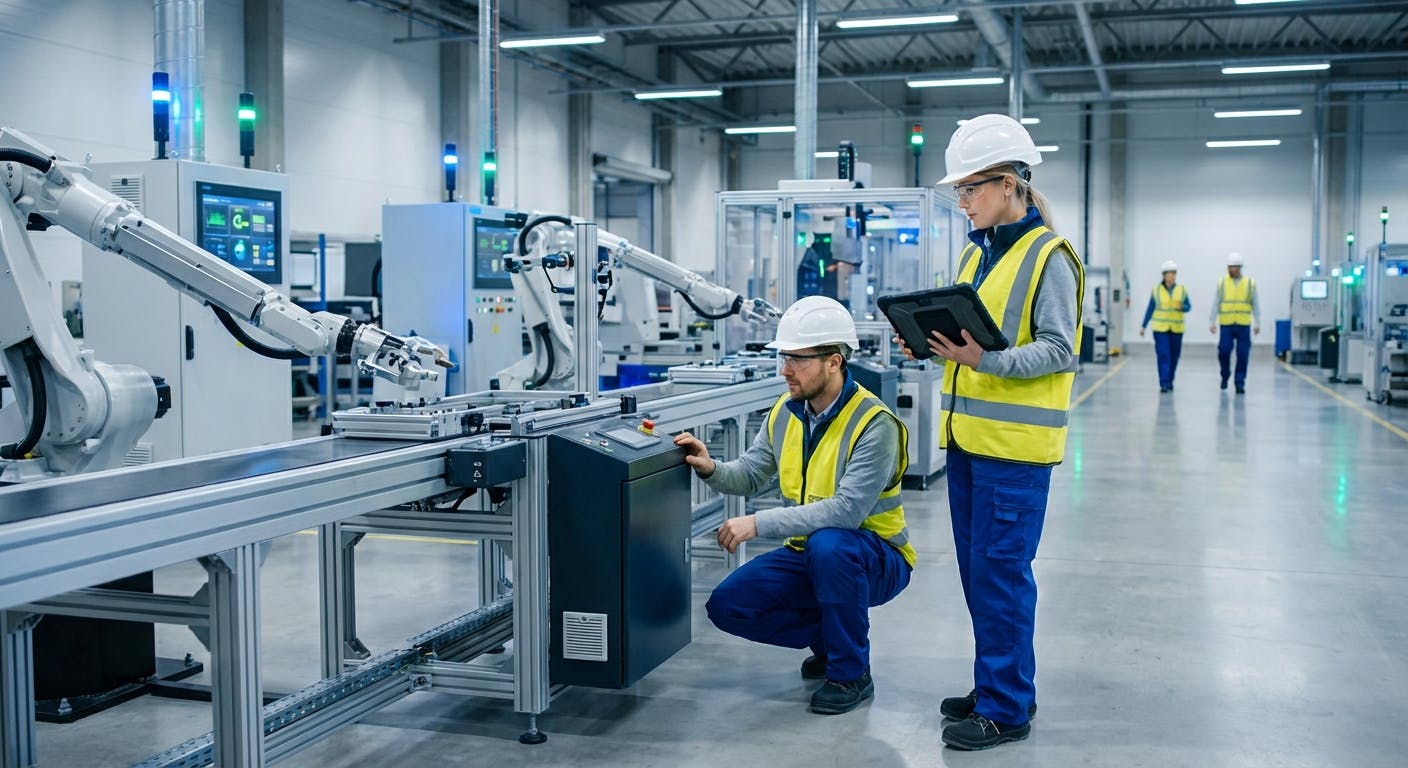
What is the core value of an automation technician in a 2026 facility?
When most facility managers search for an "automation technician," they are often looking for a job description to fill a vacancy. However, the deeper question they are asking is: How do I stop my automated lines from failing, and who is responsible for making sure our digital investments actually move the physical product?
In 2026, the automation technician is no longer just a "repair person" who swaps out faulty sensors. They are the strategic bridge between Information Technology (IT) and Operational Technology (OT). While your IT department manages the servers and your maintenance team manages the wrenches, the automation technician lives in the "gray space" in between—the PLC code, the HMI interfaces, and the SCADA systems that dictate how machines behave.
The core value of this role lies in system synchronization. A modern factory isn't a collection of isolated machines; it is a single, interconnected organism. If a Variable Frequency Drive (VFD) in Section A isn't communicating correctly with the conveyor in Section B, the entire line loses synchronization, leading to micro-stops that can erode OEE (Overall Equipment Effectiveness) by as much as 15% without ever triggering a major alarm. The automation technician identifies these "silent killers" of productivity by auditing the logic that governs the hardware.
Directly put: The automation technician is the person who ensures that your AI predictive maintenance insights are actually translated into physical adjustments on the plant floor. Without them, your high-tech software is just a dashboard of "what ifs."
What specific technical competencies define a high-performing automation technician?
If you are evaluating a candidate or looking to upskill your current team, you must look beyond basic electrical knowledge. The 2026 landscape requires a "Mechatronics Plus" mindset. To understand how this works in practice, we have to break down the four pillars of their technical stack:
1. PLC Troubleshooting and Advanced Logic
Programmable Logic Controllers (PLCs) are the brains of the operation. A technician must be fluent in Ladder Logic, but increasingly, they need proficiency in Structured Text and Function Block Diagrams. In a high-speed environment, such as a 24/7 bottling plant, a technician doesn't just "fix" a PLC; they optimize the scan cycle. If the PLC scan time is lagging by even 20 milliseconds, it can cause registration errors in high-speed packaging.
2. HMI and SCADA Management
The Human Machine Interface (HMI) is where your operators interact with the machine. A poor HMI design leads to operator error. A top-tier automation technician understands UX (User Experience) for the shop floor. They configure SCADA (Supervisory Control and Data Acquisition) systems to ensure that the data being fed into your CMMS software is accurate and contextualized.
3. Industrial Robotics and Motion Control
As labor shortages continue to drive robotics adoption, the technician must handle Industrial robotics repair and calibration. This involves more than just mechanical grease; it requires understanding coordinate systems, singularities, and the integration of vision systems that allow robots to "see" and react to variances in raw materials.
4. IIoT Integration and Networking
This is the "Bridge" angle in action. Modern technicians must understand industrial protocols like EtherNet/IP, Profinet, and MQTT. They are responsible for ensuring that a sensor on a motor can talk to the cloud. According to the National Institute of Standards and Technology (NIST), the interoperability of these systems is the single greatest challenge in smart manufacturing today.
How does an automation technician drive a predictive maintenance (PdM) strategy?
A common follow-up question from maintenance directors is: "We bought the sensors, so why is our downtime still high?" The answer usually lies in the lack of an automation technician to close the loop.
Predictive maintenance (PdM) relies on data—vibration, thermography, and ultrasonic acoustics. However, data is noisy. An automation technician acts as the "data filter." They understand the machine's baseline behavior. For example, when a predictive maintenance motor alert triggers, the technician doesn't just replace the motor. They use their knowledge of VFD diagnostics to determine if the issue is a mechanical bearing failure or an electrical harmonic distortion caused by a poorly tuned drive.
In 2026, the workflow looks like this:
- The Trigger: An AI-driven sensor detects an anomaly in a pump's vibration signature.
- The Analysis: The automation technician accesses the SCADA history to see if the anomaly correlates with a specific batch or speed setting.
- The Action: Instead of a full shutdown, the technician adjusts the control logic to bypass the peak resonance frequency, extending the asset's life until the next scheduled shutdown.
This level of nuance is why automation technicians are essential for prescriptive maintenance. They don't just tell you when it will break; they help the system adjust itself to prevent the break from happening in the first place.
What are the common mistakes facilities make when deploying automation technicians?
Despite the high value of the role, many organizations fail to see a return on investment because of three specific structural errors:
Mistake 1: Treating Them as "Electricians Plus"
Many managers make the mistake of assigning automation technicians to basic electrical tasks, like pulling wire or changing light fixtures, simply because they "understand electricity." This is a massive waste of a high-value resource. An automation technician’s time should be spent on optimization and code integrity, not basic facility maintenance. If your technician is spending more than 20% of their time on non-automated assets, your ROI is leaking.
Mistake 2: The "IT/OT Silo"
In many plants, the IT department owns the network, and the automation technician owns the machines. When a machine goes offline because of a network switch failure, the two departments often point fingers at each other. To avoid this, successful facilities create a "Converged Infrastructure" team where the automation technician has "read/write" access to specific industrial VLANs. This reduces the Mean Time to Repair (MTTR) by eliminating the bureaucratic handoff between departments.
Mistake 3: Lack of "Standard Work" for Code
If you have three different automation technicians, you might end up with three different ways of writing logic. This creates a "black box" effect where only the person who wrote the code can fix it. High-uptime facilities enforce ISA-88 or ISA-95 standards for programming. This ensures that any technician can step in and troubleshoot a system they didn't build. You can manage these standards and procedures through PM procedures within your digital workspace to ensure consistency across shifts.
How do you measure the ROI of a dedicated automation technician?
For a CFO, "improved bridge between IT and OT" sounds like fluff. To justify the high salary of a specialist automation technician (which in 2026 often exceeds $100k+ in industrial hubs), you need hard metrics.
1. Reduction in "Ghost Downtime"
Ghost downtime refers to micro-stops—those 30-second pauses that happen 50 times a day. Operators usually just hit the "Reset" button and keep going, so it’s never logged as a breakdown. An automation technician uses work order software data to identify patterns in these resets. If they can eliminate just 10 minutes of micro-stops per shift on a high-volume line, the annual recovery can reach six figures.
2. Energy Efficiency via VFD Tuning
Industrial motors account for a massive percentage of plant energy consumption. An automation technician can tune VFDs to use "S-curves" for acceleration and deceleration, reducing peak demand charges. According to IEEE, precision motor control can reduce energy consumption by 20-30% compared to across-the-line starting.
3. Spare Parts Optimization
Automation technicians understand which components are truly critical. Instead of stocking every sensor, they use inventory management tools to track the MTBF (Mean Time Between Failure) of specific PLC cards and I/O modules. This prevents "panic buying" and reduces the capital tied up in the stockroom.
What does the day-to-day workflow look like in a high-uptime facility?
To understand the role, we must look at a typical day for an automation technician in a 2026 "Lights Out" or "Brownfield Smart" facility.
06:00 - Shift Handover & Dashboard Audit: The technician starts by reviewing the mobile CMMS alerts generated overnight. They aren't looking for "broken" machines; they are looking for "drifting" machines. They check the SCADA logs for any "Control Limit" violations—instances where a process stayed within safety limits but moved outside of the "Golden Batch" parameters.
09:00 - Root Cause Analysis (RCA): A robotic palletizer had three "E-Stop" events in the last four hours. Instead of just clearing the fault, the technician connects their laptop to the safety PLC. They discover that a light curtain is intermittently failing due to vibration-induced misalignment. They don't just realign it; they design a dampened mounting bracket and update the asset management record to trigger a vibration check every 1,000 operating hours.
13:00 - Continuous Improvement (CI) Project: The technician spends the afternoon working on an integration project. They are connecting a new set of smart sensors on a conveyor system to the central database. This involves mapping Modbus registers to the enterprise level so the maintenance manager can see real-time health scores.
15:00 - Knowledge Transfer: The technician spends 30 minutes training a junior maintenance tech on how to use a fluke meter to test for "noise" on a communication cable. This reduces the "tribal knowledge" gap and ensures the team is growing more technical as a whole.
How is AI and IIoT changing the role of the automation technician?
The "Automation Technician" of 2020 was a specialist in hardware. The technician of 2026 is a specialist in Cyber-Physical Systems.
The rise of the Industrial Internet of Things (IIoT) has moved the "intelligence" of the factory from a central PLC to the "Edge." We are seeing more "Smart Sensors" that do their own processing. The technician’s job is shifting from writing logic to managing distributed intelligence.
One of the most significant shifts is the move toward No-Code/Low-Code automation platforms. While the technician still needs to understand the underlying logic, they are increasingly using visual drag-and-drop tools to create complex workflows. This allows them to move faster. For instance, if a facility needs to change a production line to accommodate a new packaging size, a skilled technician can reconfigure the entire motion control profile in hours rather than days.
Furthermore, AI is now acting as a "Co-Pilot" for these technicians. When a complex fault occurs, the technician can query an AI model trained on the machine's manual and past repair history. This doesn't replace the technician; it makes them a "Super-Technician" who can solve problems that previously required calling in the Original Equipment Manufacturer (OEM) at $300/hour.
How do I know if my facility is ready for a dedicated automation technician?
Not every facility needs a full-time automation specialist. If you are running a manual operation with few moving parts, a general maintenance technician is sufficient. However, you should consider hiring or promoting an automation technician if you meet any of the following criteria:
- Your Downtime is "Digital": If more than 30% of your stoppages are caused by "software glitches," "sensor errors," or "lost communication," you have an automation problem, not a mechanical one.
- You are Scaling Robotics: If you plan to add more than two robotic cells in the next 18 months, the cost of third-party service contracts will quickly exceed the salary of an in-house technician.
- You have High Product Variance: If your lines require frequent changeovers and "tuning" to maintain quality, an automation technician can automate those changeovers, reducing the time from hours to minutes.
- You are Implementing PdM: If you are investing in predictive maintenance tools, you need someone who can interpret the data and take action within the control system.
Decision Framework: Hire, Train, or Outsource?
| Factor | Outsource (Contractor) | Internal Hire (Specialist) | Upskill (Current Staff) |
|---|---|---|---|
| Cost | High hourly rate ($250+) | High salary + benefits | Moderate (Training costs) |
| Response Time | 4-24 hours | Immediate | Immediate |
| Knowledge | Deep but narrow (OEM specific) | Deep and broad (Site specific) | Growing (Context-heavy) |
| Best For | Major installs/upgrades | 24/7 high-speed ops | Gradual digital transition |
For most mid-to-large scale operations, a hybrid approach is best: maintain an internal automation technician for daily optimization and "first-response" troubleshooting, while keeping an OEM on retainer for major system overhauls.
Conclusion: The Future of Industrial Maintenance
The role of the automation technician is the ultimate expression of the "work smarter, not harder" philosophy. In an era where margins are thin and downtime is catastrophic, having a professional who can speak the language of both the machine and the computer is no longer a luxury—it is a requirement for survival.
By positioning the automation technician as a strategic asset rather than a tactical repairman, you unlock the true potential of your manufacturing AI software. You move from a state of "fixing what is broken" to a state of "optimizing what is working." In 2026, that is the difference between a facility that merely survives and one that leads the market.
For more insights on how to structure your maintenance team for the future, explore our solutions for modern industrial environments.
