
The Artificial Intelligence Industry in 2026: What Manufacturing Leaders Need to Know
Feb 13, 2026
artificial intelligence industry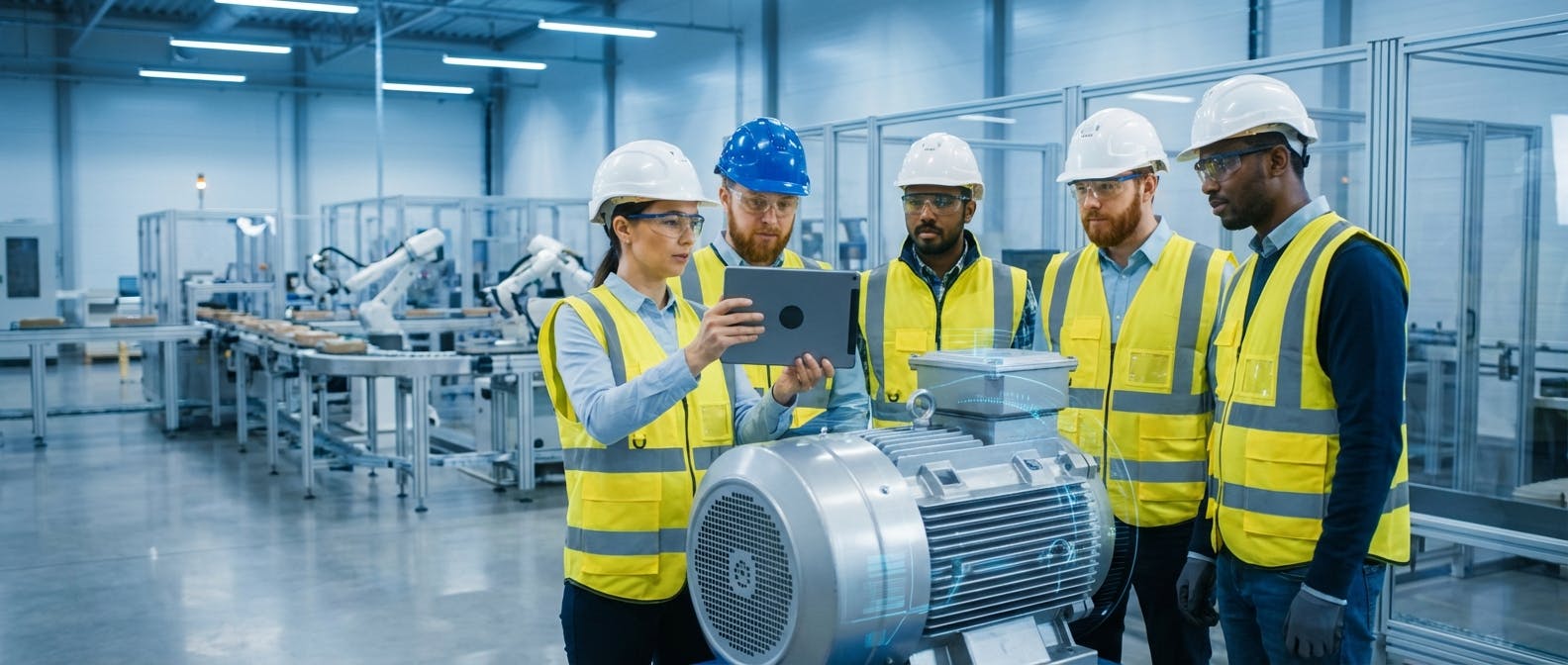
If you search for the "artificial intelligence industry" today, you are likely bombarded with global market cap projections, vague discussions about "superintelligence," or generic reports on how chatbots are changing customer service.
For a maintenance manager, a plant director, or an operations lead, these reports are functionally useless.
You don’t need to know how AI is changing copywriting; you need to know how it is changing uptime. You need to know if the sensors on your critical assets are actually going to predict a failure, or if they are just going to generate noise.
The year is 2026. The hype cycle has crested and crashed. What remains in the industrial sector is a hardened, pragmatic set of technologies that are no longer "experimental." The artificial intelligence industry, specifically within the manufacturing and heavy industrial context, has pivoted from automation to reliability.
This guide answers the core question: Where does the industrial AI industry actually stand right now, and how do you cut through the noise to implement strategies that protect your bottom line?
1. The Shift from "Big Data" to "Industrial Intelligence"
The first question most leaders ask is: "Is the artificial intelligence industry actually delivering value to manufacturing, or is it still just potential?"
To answer this, we must look at the evolution of the market. Five years ago, the industry was obsessed with "Big Data." The goal was simply to collect everything. Factories installed thousands of IoT sensors, flooded their servers with terabytes of temperature and vibration readings, and then realized they had no way to interpret it.
In 2026, the industry has corrected course. We are no longer in the era of Big Data; we are in the era of Industrial AI.
The Difference Between Generic AI and Industrial AI
The general artificial intelligence industry focuses on probability in language and image generation (like ChatGPT or Midjourney). Industrial AI, however, focuses on physics and time-series data.
- Generic AI: Predicts the next word in a sentence based on internet text.
- Industrial AI: Predicts the next vibration spike in a bearing based on the physics of the machine and historical failure modes.
This distinction is critical. Industrial AI models are now trained on domain-specific datasets—millions of hours of pump rotations, conveyor belt friction coefficients, and compressor thermal signatures.
The "Pilot Purgatory" is Ending
For years, the World Economic Forum reported that over 70% of industrial AI projects were stuck in "pilot purgatory"—successful in a controlled test but impossible to scale across a factory.
That statistic has flipped. The maturity of manufacturing AI software has allowed companies to move from bespoke, custom-coded Python scripts to scalable platforms. The industry has standardized data formats, meaning a vibration sensor from one vendor can finally talk to a CMMS from another without a six-month integration project.
Key Takeaway: The industry is no longer about "trying" AI. It is about integrating AI into the standard operating procedures of the plant. If you are waiting for the technology to mature, you are already behind.
2. Deep Dive: Predictive vs. Prescriptive Maintenance
Once you accept that Industrial AI is necessary, the next logical question is: "How does it actually change the way we maintain equipment?"
This brings us to the most significant shift in the artificial intelligence industry regarding asset management: the move from Predictive Maintenance (PdM) to Prescriptive Maintenance (RxM).
The Limits of Prediction
Predictive maintenance uses machine learning algorithms to detect anomalies. It looks at the P-F curve (Potential Failure to Functional Failure) and alerts you when a machine deviates from its baseline.
For example, an AI model might analyze the current draw on a motor. If the amperage spikes slightly every time the RPMs drop, the AI flags this as an anomaly.
- The Alert: "Asset #402 is showing abnormal vibration patterns."
- The Problem: The technician receives the alert but doesn't know why it's happening or what to do. Is it a misalignment? Is it a lubrication issue? Is it a bearing fault?
The Rise of Prescriptive Analytics
In 2026, the leading edge of the industry is Prescriptive Maintenance. This technology doesn't just tell you that something is wrong; it tells you how to fix it.
By combining sensor data with historical maintenance logs and failure mode libraries, prescriptive AI can generate a specific work order.
- The Prescriptive Output: "Asset #402 is showing signs of inner race bearing degradation (92% confidence). Action Required: Schedule bearing replacement within 72 hours. Parts Needed: SKF-6205-2RS. Estimated Time: 2 hours."
This leap reduces the cognitive load on maintenance teams. It transforms data directly into action.
The Role of the CMMS
This is where your Computerized Maintenance Management System (CMMS) becomes the brain of the operation. AI cannot function in a vacuum. It needs a repository of truth.
Modern CMMS software acts as the central nervous system. The AI feeds the diagnostic data into the CMMS, which then checks inventory levels for the required spare parts, checks the schedule of the maintenance technicians, and auto-drafts the work order.
If you are evaluating AI tools, do not look at them as standalone "magic boxes." Look at them as extensions of your existing maintenance workflow. If the AI doesn't integrate seamlessly with your work order system, it will simply become another dashboard that no one looks at.
3. Generative AI: The New Interface for the Frontline Worker
A common follow-up question is: "What about Generative AI? Is that just for writing emails, or does it have a place on the factory floor?"
This is perhaps the most surprising development in the artificial intelligence industry over the last three years. Generative AI (GenAI) has found a massive use case in manufacturing, but not in the way people expected. It isn't running the machines; it is empowering the people who fix them.
The "Tribal Knowledge" Crisis
Manufacturing faces a massive labor shortage. Experienced technicians are retiring, taking decades of "tribal knowledge" with them. New hires often lack the intuition to diagnose complex machinery.
GenAI is bridging this gap by turning technical documentation into a conversational interface.
Natural Language Processing (NLP) in Maintenance
Imagine a technician standing in front of a complex HVAC compressor. It’s throwing an error code they’ve never seen. In the past, they would have to walk back to the office, find the manual (if it exists), flip through pages, or call a senior tech.
With AI-driven predictive maintenance tools integrated with GenAI, the technician can simply type (or speak) into their mobile device:
"The compressor is showing Error Code E-41 and vibrating heavily. What should I check?"
The AI, having ingested the OEM manuals, previous work orders, and technician notes, responds:
"Error E-41 usually indicates high discharge pressure. Given the vibration, check for a blockage in the condenser fan or a loose mounting bolt. History Note: Bob fixed this same issue on Unit 2 last year by cleaning the coils."
Auto-Generating Standard Operating Procedures (SOPs)
Creating detailed PM procedures is tedious. Often, SOPs are outdated or too generic.
Generative AI allows managers to input a rough outline of a task, and the system generates a detailed, step-by-step checklist with safety warnings and required tools. This ensures that even junior technicians are following best practices, standardizing quality across shifts.
The 2026 Reality: The interface for Industrial AI is no longer a complex graph; it is a chat window. This democratization of data is what is finally driving adoption on the shop floor.
4. The Hardware Reality: Integrating AI with Legacy Assets
"This sounds great for a brand new Tesla Gigafactory," you might say, "but my facility runs on equipment from 1995. How does AI apply to me?"
This is the most practical hurdle in the artificial intelligence industry. The concept of the "Greenfield" factory is a myth for 90% of the market. Most industrial AI must be "Brownfield"—it must work with what you already have.
The IIoT Sensor Revolution
You do not need to replace a 30-year-old motor to make it "smart." You simply need to attach the right sensors. The cost of Industrial Internet of Things (IIoT) sensors has plummeted, while their sensitivity has skyrocketed.
- Vibration Sensors: Magnetic accelerometers can be attached to the casing of motors, pumps, and gearboxes in seconds. They stream tri-axial vibration data to the cloud.
- Ultrasonic Sensors: These detect friction and turbulence at frequencies the human ear cannot hear, often identifying lubrication issues weeks before vibration sensors pick them up.
- Power Monitors: Current transducers (CTs) clamp around power cables to monitor electrical health without interrupting the circuit.
Specific Use Cases for Legacy Equipment
To understand how this works in practice, let's look at specific asset classes:
- Predictive Maintenance for Motors: Old motors are robust but prone to bearing failure and winding shorts. AI establishes a baseline of "normal" operation for that specific motor's age and load, ignoring the generic thresholds that might trigger false alarms.
- Predictive Maintenance for Pumps: Cavitation is a pump killer. AI models can detect the specific acoustic signature of cavitation (air bubbles collapsing) long before it destroys the impeller.
- Predictive Maintenance for Conveyors: Conveyors are geographically spread out. Wireless sensors allow you to monitor the health of hundreds of rollers remotely, rather than sending a technician to walk the line with a clipboard.
The Connectivity Challenge
The challenge with legacy assets isn't the sensor; it's the network. Factories are notoriously bad environments for Wi-Fi (lots of metal, interference).
In 2026, the industry has largely settled on LoRaWAN (Long Range Wide Area Network) and private 5G networks for industrial connectivity. These technologies allow sensors to transmit data through concrete walls and across large campuses with minimal battery consumption.
5. The Hidden Costs: Data Quality and Technical Debt
If you are preparing to invest in the artificial intelligence industry's offerings, you must be aware of the pitfalls. The number one reason AI projects fail in manufacturing is not the algorithm; it is the data.
The "Garbage In" Problem
AI models are hungry for data, but they are allergic to bad data.
- Inconsistent Naming Conventions: If one technician logs a repair as "Repl. Brg." and another logs it as "Bearing Replacement," the AI may treat these as two different events.
- Missing Failure Codes: If technicians close out work orders with the comment "Fixed it" without selecting a failure code, the AI cannot learn what caused the failure.
- Siloed Data: If your SCADA system (operational data) doesn't talk to your CMMS (maintenance data), the AI sees only half the picture. It sees the machine stopped, but it doesn't know why.
Cleaning Your Data House
Before you spend a dime on advanced predictive analytics, you must invest in asset management hygiene.
- Standardize your asset hierarchy: Ensure every machine has a unique parent-child relationship in the database.
- Enforce data entry: Use required fields in your mobile CMMS to ensure technicians capture failure codes and parts used.
- Digitize historical records: If your maintenance history is on paper, it is invisible to AI.
According to NIST (National Institute of Standards and Technology), the cost of inadequate infrastructure for manufacturing software can inflate implementation costs by up to 40%. Do not skip the foundational work.
6. ROI and The Business Case: Is It Worth It?
Finally, we arrive at the decision point. What is the Return on Investment (ROI)?
The artificial intelligence industry often sells on "potential," but in maintenance, we deal in hard currency. The ROI of Industrial AI comes from three specific buckets:
1. Reduction in Unplanned Downtime
This is the biggest lever. The cost of downtime varies by industry, but for automotive or FMCG (Fast-Moving Consumer Goods), it can exceed $20,000 per minute.
If prescriptive maintenance catches a failing gearbox during a planned shift change rather than letting it seize during a production run, the system pays for itself in a single event.
2. Extension of Asset Lifespan (RUL)
Remaining Useful Life (RUL) is a key metric. By fixing issues like misalignment or lubrication starvation early, you reduce the mechanical stress on the asset. This can extend the life of a capital-intensive asset (like a compressor) by 20-30%, deferring millions in CAPEX replacement costs.
3. Inventory Optimization
Warehouses are full of spare parts "just in case." This is dead capital.
AI-driven inventory management analyzes usage patterns and lead times. It tells you, "You don't need 10 spare motors on the shelf; based on failure rates and supplier speed, you only need 2." This releases significant working capital back to the business.
The ROI Formula
To calculate your potential ROI, use this simplified framework:
$$ \text{ROI} = \frac{(\text{Downtime Cost Avoided} + \text{Labor Efficiency Gains} + \text{Inventory Savings}) - (\text{Software Cost} + \text{Sensor Cost} + \text{Implementation})}{\text{Total Investment}} $$
For most mature implementations in 2026, we are seeing ROI realization within 8 to 12 months.
7. Strategic Roadmap: How to Get Started
You cannot "install AI" overnight. It is a journey. Based on successful deployments across the industry, here is the recommended roadmap for 2026:
Phase 1: The Digital Foundation (Months 1-3)
- Audit your current CMMS. Is the data clean?
- Identify your "Bad Actors"—the top 5% of assets causing 80% of your downtime.
- Deploy a mobile CMMS to ensure technicians are capturing digital data at the source.
Phase 2: Targeted Sensing (Months 3-6)
- Do not sensor everything. Start with the Criticality A assets (those that stop production if they fail).
- Install vibration and temperature sensors on these pilot assets.
- Establish baselines. Let the system run for 30-60 days to learn "normal."
Phase 3: Predictive to Prescriptive (Months 6-12)
- Turn on alerts. Calibrate them to avoid alert fatigue.
- Integrate the alerts with your work order system.
- Begin using GenAI tools to parse the data and assist technicians with diagnosis.
Phase 4: Scale and Optimize (Year 1+)
- Expand to Criticality B assets.
- Integrate with inventory systems for auto-ordering parts.
- Use the data to inform capital replacement decisions.
Conclusion
The artificial intelligence industry has matured. It has moved out of the research lab and onto the factory floor. It is no longer a question of if AI will become standard in manufacturing, but when your facility will adopt it.
The winners in this new landscape won't be the ones with the flashiest robots; they will be the ones with the most reliable data and the most empowered workforce. By focusing on practical applications—predictive maintenance, prescriptive analytics, and GenAI-assisted workflows—you can turn the promise of AI into tangible operational excellence.
For more insights on how to begin your journey with predictive technologies, explore our guide on how to prevent equipment failure before it impacts your production line.
