
Submersible Level Sensors for Wastewater Lift Stations: The Operational Guide to Reliability
Feb 2, 2026
submersible level sensor for wastewater lift station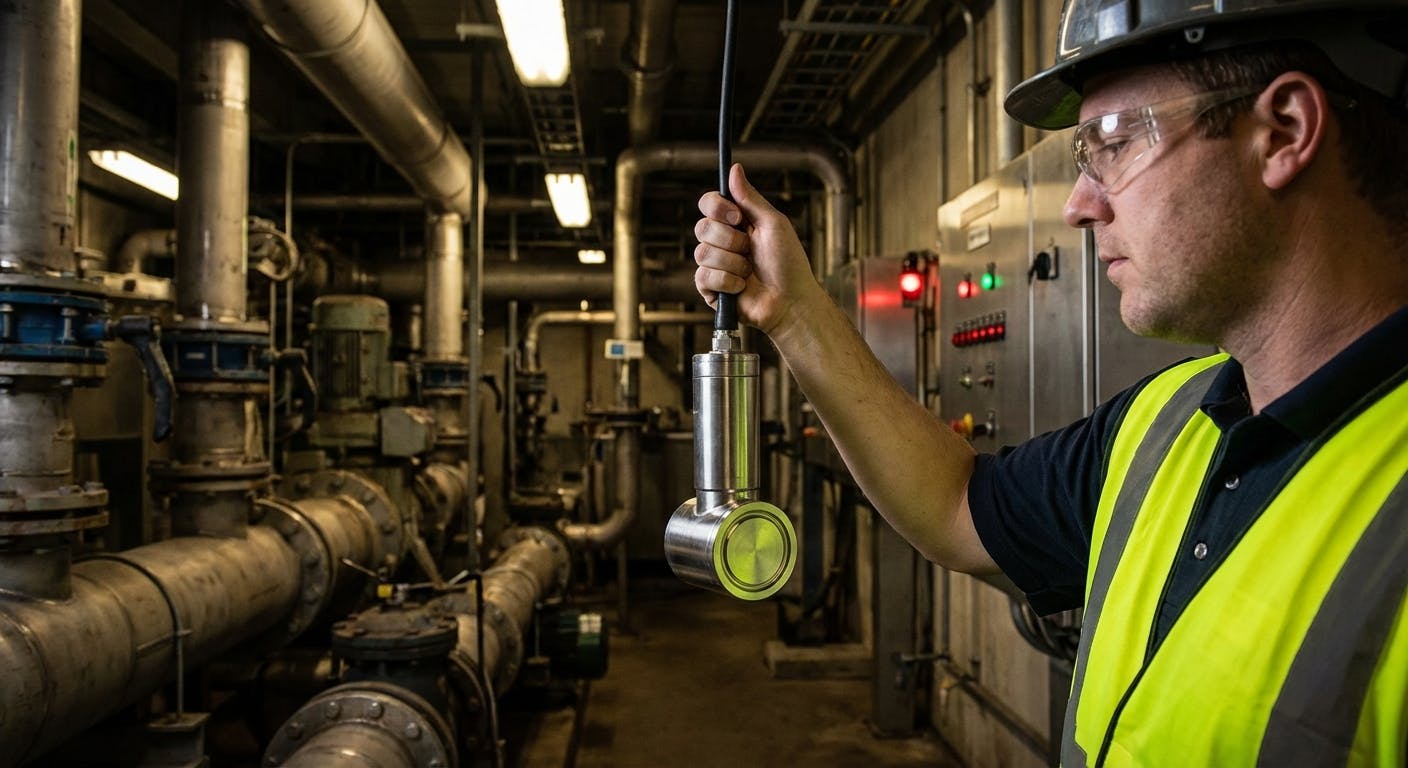
If you manage a wastewater lift station, you know the specific anxiety that comes with a high-level alarm at 2:00 AM. Often, the pumps are fine. The power is on. The problem? The "rugged" submersible level sensor you installed six months ago has drifted, fouled, or failed completely, blinding your control system to the actual wet well level.
The search for a submersible level sensor for wastewater lift station applications is rarely about finding a device that can measure water. It is about finding a device that can survive sewage.
So, let’s answer the core question immediately: How do you select and deploy a submersible level sensor that won’t fail when faced with FOG (Fats, Oils, Grease), hydrogen sulfide gas, and turbulence?
The short answer is that you must move beyond standard hydrostatic pressure transmitters. You need a sensor specifically engineered with a flush-mount diaphragm (to prevent clogging), a chemically resistant housing (typically PVDF or Hastelloy, not just 316 SS), and a rigorous desiccant maintenance schedule for the vent tube.
But buying the right hardware is only 30% of the solution. The other 70% lies in how you install it to mitigate turbulence and how you integrate it into your maintenance strategy.
In this guide, we are going to dismantle the complexities of lift station level monitoring. We will move past the brochure specs and look at the operational realities of keeping these sensors alive in 2026.
How Does a Submersible Level Sensor Actually Work in Wastewater?
To troubleshoot and select the right equipment, you first need to understand the physics at play. A submersible level sensor is, at its heart, a hydrostatic pressure transducer.
It rests at the bottom of your wet well and measures the pressure exerted by the liquid column above it. The formula is simple:
$$P = \rho \cdot g \cdot h$$
Where:
- P is Pressure
- ρ (rho) is the density of the wastewater
- g is gravity
- h is the height of the liquid
The "Vented Cable" Achilles Heel
Here is the nuance that causes the most failures. The sensor measures gauge pressure (relative to the atmosphere), not absolute pressure. To do this, the sensor must "breathe."
Inside the thick cable connecting the sensor to your control panel, there is a tiny, hollow tube. This tube allows atmospheric air to reach the back of the sensor diaphragm. This compensates for changes in barometric pressure (weather systems). Without this vent, a low-pressure storm front could trick your sensor into thinking the water level rose by several inches, potentially triggering a false pump start.
The Risk: That vent tube is a direct highway for moisture. If the desiccant filter in your control panel saturates, humidity travels down the tube, condenses behind the diaphragm, and destroys the electronics.
The Density Variable
Wastewater is not water. While pure water has a specific gravity of 1.0, wastewater varies. Heavy sludge, grit, and suspended solids can increase the specific gravity. Most standard sensors are calibrated for 1.0. If your lift station handles heavy industrial effluent, you may need to apply a correction factor in your PLC or SCADA system to account for density shifts, otherwise, your level reading will be artificially low.
Selection Criteria: Surviving the "Witches' Brew"
When specifying a sensor for a lift station, standard industrial specs do not apply. You are dealing with a corrosive, clogging, turbulent environment. Here is the decision framework for selecting the right hardware.
1. The Diaphragm: Flush vs. Recessed
This is the most critical physical feature.
- Recessed Diaphragms: Common in clean water applications. They have a small port protecting the sensor face. In wastewater, this port is a grease trap. FOG will pack into the recess, harden, and prevent pressure transmission.
- Flush Mount Diaphragms: The sensor face is flat and exposed. There is no cavity for grease to accumulate. The scouring action of the water helps keep it clean.
- Verdict: Always specify a wide, flush-mount ceramic or stainless steel diaphragm for lift stations.
2. Material Compatibility: The H2S Factor
Hydrogen Sulfide (H2S) is the silent killer of lift station electronics. It eats through standard seals and attacks metals.
- 316L Stainless Steel: The industry standard. It works for residential lift stations with low retention times.
- Hastelloy C-276: If your lift station has long retention times, is near a force main discharge, or has a history of odor complaints, H2S levels are likely high. Hastelloy offers superior corrosion resistance.
- Ceramic (Al2O3): Ceramic capacitive sensors are incredibly resistant to abrasion (sand/grit) and chemical attack. They are often more durable than metal diaphragms in grit-heavy influent.
3. The Cable Jacket
The cable sits in the sewage 24/7.
- PVC: Cheap, but stiffens over time and can crack.
- PUR (Polyurethane): Excellent abrasion resistance, good flexibility. The standard for most wastewater sensors.
- FEP/Teflon: Required only for high-temperature industrial wastewater or extreme chemical environments.
Installation: The Art of the Stilling Well
You have bought the right sensor. Now, how do you install it? If you simply drop it into the wet well, you are inviting failure.
The Turbulence Problem
Influent entering a lift station creates turbulence. If the sensor is hanging freely, it will swing. This movement creates "noise" in the signal (erratic 4-20mA output). Furthermore, the kinetic energy of the incoming water can cause localized pressure fluctuations (the Bernoulli principle), resulting in inaccurate readings.
The Solution: The Stilling Well
A stilling well is a PVC or stainless steel pipe (typically 4-6 inches in diameter) mounted vertically in the wet well. The sensor hangs inside this pipe.
- Function: The pipe shields the sensor from turbulence, ragging, and direct impact from influent.
- Design: The pipe must have holes drilled near the bottom to allow water equalization.
- Maintenance: Ensure the stilling well is accessible for cleaning. If the bottom holes clog, the well becomes isolated from the actual level.
Cable Management
Never hang the sensor by the signal cable alone, even if it is Kevlar-reinforced. Over years, the weight of the sensor and the drag of the water will stretch the cable, altering the resistance of the copper conductors and causing signal drift.
- Best Practice: Use a dedicated stainless steel chain or cable grip system (like a Kellems grip) to support the weight of the sensor. The electrical cable should have slight slack.
Integration: From Sensor to SCADA
The sensor outputs a raw signal (usually 4-20mA). Converting that into reliable pump control requires smart integration.
The 4-20mA Loop
- 4mA = 0% Level (Empty/Snore point)
- 20mA = 100% Level (Overflow)
Pro Tip: Do not scale your 20mA point to the exact top of the well. Scale it slightly below the overflow pipe. This ensures you can measure an overflow condition accurately without the sensor "maxing out" electrically before the water physically overflows.
Redundancy Strategies
In 2026, relying on a single sensor for a critical lift station is an unacceptable risk.
- Primary: Submersible Hydrostatic Sensor (Continuous level).
- Backup: Ultrasonic or Radar (Non-contact).
- Emergency: Mechanical Float Switches (High-High and Low-Low).
If the submersible sensor disagrees with the ultrasonic by more than 5%, your controller should trigger a "Level Mismatch" alarm. This is a classic application of predictive maintenance for pumps, where data anomalies predict failure before a spill occurs.
Maintenance: The "Set and Forget" Myth
Submersible sensors are not "install and forget" assets. They require a defined Preventive Maintenance (PM) schedule.
1. The "Rag" Test (Monthly)
Lift the sensor out of the well. Inspect the diaphragm. Is it covered in a biofilm or grease cap?
- Cleaning: Use a soft bristle brush and mild detergent. Never poke the diaphragm with a screwdriver or wire brush. You will puncture it, destroying the sensor instantly.
- Optimization: If you find heavy fouling monthly, consider installing a "bubbler" system or switching to a non-contact radar sensor.
2. Desiccant Cartridge Replacement (Quarterly to Semi-Annually)
Locate the termination box where the sensor cable ends. There should be a desiccant drying tube attached to the vent line.
- Check: Is the silica gel pink (saturated) or blue/orange (dry)?
- Action: Replace immediately if saturated. Moisture in the vent tube is the #1 cause of sensor drift and failure.
- Upgrade: Consider using an aneroid bellows expansion system which creates a closed loop, eliminating the need for a breather tube and desiccant entirely.
3. Calibration Verification (Annually)
Pull the sensor. Place it in a bucket of water with a known depth (e.g., exactly 24 inches). Check the SCADA reading.
- Drift: If the reading is off by more than 1-2%, re-span the transmitter or adjust the offset in the PLC.
- Documentation: Log this drift. Increasing drift rates are a sign of imminent failure—a core concept in asset management.
Troubleshooting: What Do These Symptoms Mean?
When the call comes in that the lift station is acting up, use this guide to diagnose the sensor.
Symptom 1: The Reading is "Stuck"
The level changes, but the sensor reads a constant value.
- Cause: The breather tube is crimped or clogged. The sensor is now measuring against a trapped pocket of air rather than the atmosphere.
- Fix: Check the cable run for tight zip ties or kinks. Check the desiccant filter for blockage.
Symptom 2: Erratic Spikes
The level jumps up and down rapidly.
- Cause: Electrical noise (VFD interference) or moisture in the junction box.
- Fix: Ensure the shield wire is grounded at the panel end only (to prevent ground loops). Check the junction box for condensation.
Symptom 3: Slow Drift Over Weeks
The level slowly becomes inaccurate.
- Cause: Biofilm buildup on the diaphragm.
- Fix: Clean the sensor face. If this happens frequently, you need a flush-mount sensor or a different mounting location with higher flow velocity to scour the face.
The Cost of Ownership: Submersible vs. Alternatives
Why choose submersible over Ultrasonic or Radar?
| Feature | Submersible Pressure | Ultrasonic | Radar (Non-Contact) |
|---|---|---|---|
| Initial Cost | Low ($500 - $1,200) | Medium ($1,000 - $2,500) | High ($2,000 - $4,000) |
| Foam Interference | None (Unaffected) | High (Absorbs signal) | Low (Penetrates foam) |
| Grease Issues | High (Requires cleaning) | None (Non-contact) | None (Non-contact) |
| Installation | Simple (Drop in) | Complex (Mounting angles) | Moderate |
| Reliability | High (if maintained) | Moderate (False echoes) | Very High |
The Verdict: Submersible sensors remain the most cost-effective and reliable solution for deep wells or wells with heavy foam layers where ultrasonic signals get absorbed. However, they carry a higher maintenance burden regarding cleaning.
For critical infrastructure, the best approach is often a hybrid: A submersible sensor for primary control, backed by mechanical floats for ultimate safety.
Advanced Strategy: Using Data for Predictive Maintenance
In 2026, a level sensor is more than a switch; it is a data generator. By integrating your level sensor data with manufacturing AI software, you can unlock predictive insights.
Pump Efficiency Monitoring
By correlating the rate of level drop (drawdown) with the pump run status, you can calculate the actual flow rate.
- If the level drops slower today than it did last month for the same pump speed, your pump impeller is likely worn or clogged.
- This allows you to transition from reactive maintenance to prescriptive maintenance, scheduling a clean-out before the pump trips on overload.
Inflow & Infiltration (I&I) Analysis
Analyze the level rise rate during rain events versus dry weather. A properly calibrated submersible sensor can help you quantify exactly how much stormwater is infiltrating your sanitary sewer system, justifying capital projects for pipe relining.
Conclusion: Reliability is a Process, Not a Purchase
Selecting the right submersible level sensor for a wastewater lift station is a balance of chemistry, physics, and operational discipline.
- Buy right: Flush diaphragm, wide sensing area, appropriate cable jacket.
- Install right: Use a stilling well and proper strain relief.
- Maintain right: Check the desiccant and clean the diaphragm.
If you ignore the maintenance, even a $5,000 titanium sensor will fail. If you respect the environment and the limitations of the technology, a standard $800 sensor can provide years of reliable service.
Ready to standardize your lift station maintenance? Don't rely on sticky notes and memory. Implement robust PM procedures to ensure your sensors are cleaned and checked on schedule. A reliable sensor is only as good as the team maintaining it.
