
Stop Looking for a SWMS License: Understanding Competency vs. Licensing in Australian WHS
Feb 8, 2026
SWMS licensing requirements Australia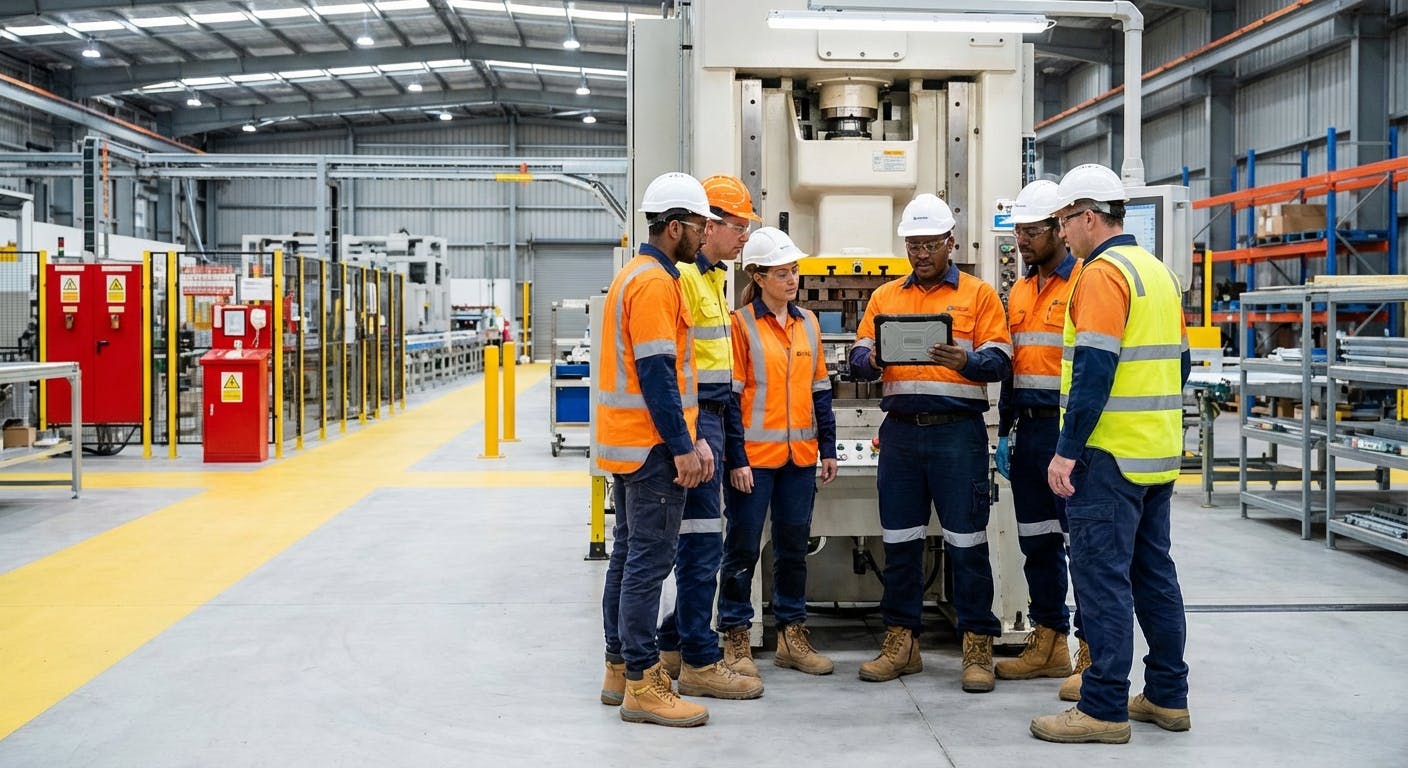
If you have spent the last hour searching the Safe Work Australia website or your state regulator’s portal looking for a "SWMS Writer’s License" application form, you can stop now.
It doesn’t exist.
This is one of the most pervasive misconceptions in Australian industrial sectors, particularly among maintenance managers and facility operators transitioning into more complex regulatory environments. The confusion stems from a misunderstanding of how the Work Health and Safety (WHS) Regulations intersect with High Risk Work Licenses (HRWL).
In 2026, the regulatory landscape is stricter than ever, and the penalties for non-compliance are severe. But the government does not license the authoring of safety documents. Instead, they regulate the outcome and the competency of the people involved.
This guide is structured to answer your core question immediately, and then guide you through the complex follow-up questions that inevitably arise once you realize there is no license.
The Core Question: Do I Need a License to Write a SWMS in Australia?
The Short Answer: No. There is no specific government-issued license required to write, review, or approve a Safe Work Method Statement (SWMS) in Australia.
The Nuanced Reality: While you don't need a "SWMS License," you absolutely must be a "Competent Person" as defined by the WHS Regulations. Furthermore, if the work described in the SWMS involves specific high-risk activities (like operating a crane or removing friable asbestos), the workers carrying out the tasks must hold the relevant High Risk Work Licenses (HRWL).
The confusion often lies in distinguishing between:
- The Author: The person writing the risk assessment (Needs Competency, not a license).
- The Operator: The person doing the physical work (Often needs a License, e.g., HRWL).
- The Document: The SWMS itself (A legal requirement for High Risk Construction Work).
If you are a Person Conducting a Business or Undertaking (PCBU), you cannot simply assign the task of writing a SWMS to the office intern. If an incident occurs and the SWMS is found to be deficient, the first thing the regulator will ask is: "On what basis did you determine the author was competent to assess these risks?"
Follow-Up Question 1: If there’s no license, who is actually allowed to write a SWMS?
Since there is no card to carry in your wallet that says "SWMS Writer," how do you prove you are allowed to do it? This brings us to the legal definition of a Competent Person.
Defining "Competent Person"
Under Australian WHS laws, a competent person is someone who has acquired through training, qualification, or experience the knowledge and skills to carry out the task.
To write a compliant SWMS, the author must possess:
- Operational Knowledge: They must understand the specific task being performed. You cannot write a SWMS for predictive maintenance on overhead conveyors if you have never seen the conveyor system or don't understand how it moves.
- Hazard Identification Skills: They must be able to identify foreseeable hazards (e.g., gravity, electricity, stored energy, traffic).
- Regulatory Knowledge: They must understand the Hierarchy of Controls and relevant Codes of Practice.
The "Consultation" Requirement
Here is where many maintenance managers fail. The WHS Regulations explicitly state that the SWMS must be developed in consultation with the workers who will be performing the work.
Even if you, as the Maintenance Manager, are the "Competent Person" writing the document, you are legally required to consult the technicians. Why? Because they know the site-specific variables that you might miss from your desk.
Best Practice Scenario: A maintenance planner drafts the initial SWMS for a pump replacement. However, before finalizing, they review it with the mechanical fitters. The fitters point out that the isolation point is actually 3 meters high, requiring a ladder (a fall risk not in the original draft). The SWMS is updated. This process validates competency.
Follow-Up Question 2: When is a SWMS actually legally required?
You do not need a SWMS for every single task in your facility. If you require a SWMS for changing a toner cartridge, you are bogging your team down in "safety clutter," which actually reduces safety outcomes.
A SWMS is legally mandatory only for High Risk Construction Work (HRCW).
The 19 High-Risk Construction Work Activities
There are 19 specific activities defined in the WHS Regulations that trigger the need for a SWMS. If your maintenance task involves any of these, a SWMS is non-negotiable:
- Risk of falling more than 2 meters. (Common in overhead maintenance).
- Work on or near energized electrical installations.
- Demolition of load-bearing structures.
- Disturbance of asbestos.
- Work in or near a confined space.
- Work in or near a shaft or trench deeper than 1.5m.
- Use of explosives.
- Work on or near pressurized gas distribution mains or piping.
- Work on or near chemical, fuel, or refrigerant lines.
- Tilt-up or precast concrete work.
- Work in an area that may have a contaminated or flammable atmosphere.
- Work involving tilt-up or precast concrete.
- Work on, in, or adjacent to a road, railway, shipping lane, or other traffic corridor.
- Work in an area with movement of powered mobile plant.
- Work in an area with artificial extremes of temperature.
- Work in or near water or other liquid that involves a risk of drowning.
- Diving work.
- Work involving the use of explosives.
- Work involving the use of a crane/hoist.
The "Construction" vs. "Maintenance" Grey Area
This is a common friction point. Is routine maintenance considered "construction work"?
According to Safe Work Australia, "construction work" includes any work carried out in connection with the construction, alteration, conversion, fitting-out, commissioning, renovation, repair, maintenance, refurbishment, demolition, decommissioning, or dismantling of a structure.
Therefore, repair and maintenance generally fall under this definition. If you are performing predictive maintenance on pumps and that pump is located in a confined space, you are performing High Risk Construction Work. You need a SWMS.
Follow-Up Question 3: How do High Risk Work Licenses (HRWL) interact with SWMS?
If you don't need a license to write the SWMS, you often need a license to execute the steps inside it. This distinction is critical for compliance tracking.
The Document vs. The Operator
- The SWMS: Describes how the work will be done safely (e.g., "Use a forklift to lift the motor").
- The HRWL: Proves the worker can operate the equipment (e.g., "Worker holds Class LF License").
A compliant SWMS must identify the specific licenses required for the job. You cannot simply write "Competent person to operate forklift." You must specify "Operator must hold current HRWL Class LF."
Verification Obligations
As a PCBU, you have a duty to verify these licenses. It is not enough to assume your contractor has them.
- Before 2020: This was often done by photocopying cards and filing them in a cabinet.
- In 2026: This should be digital. Your CMMS software should gate the work order. If the assigned technician’s HRWL is expired in the system, the software should prevent them from accepting the job or signing onto the digital SWMS.
Common Pitfall: A SWMS for crane lifting operations is written perfectly. However, the Dogman (who slings the load) has an expired license. The SWMS is valid, but the work is illegal. The SWMS should have had a checkpoint: "Verify Dogman License Current."
Follow-Up Question 4: What actually goes into a compliant SWMS?
If you are the "Competent Person," what must you include? A SWMS is not just a risk assessment; it is a process document.
The Four Essential Pillars
- Identify the High-Risk Construction Work: Clearly state which of the 19 triggers applies (e.g., "Work involves risk of falling >2m").
- Specify Hazards: What could go wrong? (e.g., "Ladder slipping," "Tools dropping").
- Describe Control Measures: How will you prevent it? (e.g., "Secure ladder at top and bottom," "Use tool lanyards").
- Describe Implementation: How will the controls be implemented, monitored, and reviewed?
The "Reasonably Practicable" Test
Australian law requires you to eliminate risks so far as is "reasonably practicable." If you cannot eliminate them, you must minimize them.
When writing a SWMS, you must demonstrate you have moved down the Hierarchy of Controls:
- Elimination: Can we do this work from the ground using prescriptive maintenance sensors instead of climbing?
- Substitution: Can we use a scissor lift instead of a ladder?
- Isolation: Can we barricade the area?
- Engineering: Can we install permanent guardrails?
- Administration: Training and signage.
- PPE: Harnesses and helmets (The last resort).
If your SWMS relies entirely on PPE (e.g., "Worker to wear harness") without explaining why higher-level controls weren't used, it may be deemed non-compliant by a regulator.
Follow-Up Question 5: How do we manage this in a digital workflow?
In 2026, paper SWMS are a liability. They get lost, they get dirty, and they are difficult to update in real-time. The industry standard has shifted toward integrated digital workflows.
The Integrated Workflow
Modern maintenance teams use mobile CMMS to link the SWMS directly to the Work Order.
- Trigger: A work order is generated for predictive maintenance on motors.
- Gatekeeping: The technician opens the app. Before they can see the "Instructions" tab, the "Safety" tab forces them to review the SWMS.
- Digital Sign-off: The technician and their team digitally sign the SWMS on the tablet. This records a timestamp and geolocation, proving they were at the site when they signed.
- Dynamic Risk Assessment: If conditions change (e.g., it starts raining), the digital SWMS allows for an immediate update or a "Take 5" addendum.
Version Control
One of the biggest compliance risks is workers using an outdated SWMS. With digital tools, the moment a "Competent Person" updates the master SWMS template in the office, every technician in the field has the new version instantly. This ensures that your PM procedures are always aligned with the latest safety protocols.
Follow-Up Question 6: What are the penalties and liabilities?
Why does this matter? Because the penalties for getting it wrong are astronomical, and they apply to individuals, not just companies.
Industrial Manslaughter and Category 1 Offences
Most Australian states have introduced Industrial Manslaughter laws. If a worker dies because a SWMS was negligent, missing, or ignored, and the PCBU knew (or should have known) about the risk:
- Corporations: Fines can exceed $10 million.
- Individuals (Officers/Managers): Prison sentences of up to 20 years and massive personal fines.
The "Paper Shield" Fallacy
A common mistake is treating the SWMS as a "Paper Shield"—a document written solely to protect the company from liability. Courts and regulators see through this.
If you have a perfect SWMS on file, but the workers on the floor are doing something different, the SWMS is worthless. This is why monitoring is a legal requirement. You must verify that the work is actually being done in accordance with the SWMS.
- Actionable Tip: Use your work order software to schedule random "Safety Interactions" or audits where a supervisor verifies SWMS compliance in the field.
Follow-Up Question 7: How do I get started or fix my current process?
If you are realizing your current SWMS process relies on generic templates or lacks proper competency checks, here is a recovery plan.
Step 1: Audit Your Competency
Identify who is currently writing your SWMS. Do they have the technical knowledge? Have they done the White Card training (General Construction Induction)? While a White Card isn't a license to write SWMS, it provides the foundational knowledge of construction hazards necessary to be a "Competent Person."
Step 2: Ditch the Generic Templates
Stop buying "One Size Fits All" SWMS packs online. It is acceptable to use them as a base, but they must be customized to your specific site and equipment. A SWMS that refers to "excavation" when you are working on a roof proves you didn't assess the real risk.
Step 3: Integrate with Asset Management
Link your SWMS to your assets.
- If you have a specific conveyor belt, attach the specific SWMS for that conveyor to its asset profile in your asset management system.
- When a work order triggers for that asset, the correct SWMS appears automatically.
Step 4: Review Triggers
Set up a review cycle. A SWMS must be reviewed:
- Before the work starts.
- If the control measures are not working.
- If the work process changes.
- If a Health and Safety Representative (HSR) requests it.
- After any incident or near-miss.
Conclusion
You don't need a license to write a SWMS, but you need something harder to obtain: genuine competence and a rigorous safety culture. By moving away from the "tick-box" mentality and integrating SWMS into your daily digital maintenance workflows, you protect your workers and your business far better than any paper certificate ever could.
For more information on regulatory standards, always refer to Safe Work Australia or your state-based regulator (e.g., SafeWork NSW, WorkSafe Victoria).
