
Scaling Industrial AI From Pilot to Fleet: The Operational Playbook for 2026
Feb 2, 2026
scaling industrial AI from pilot to fleet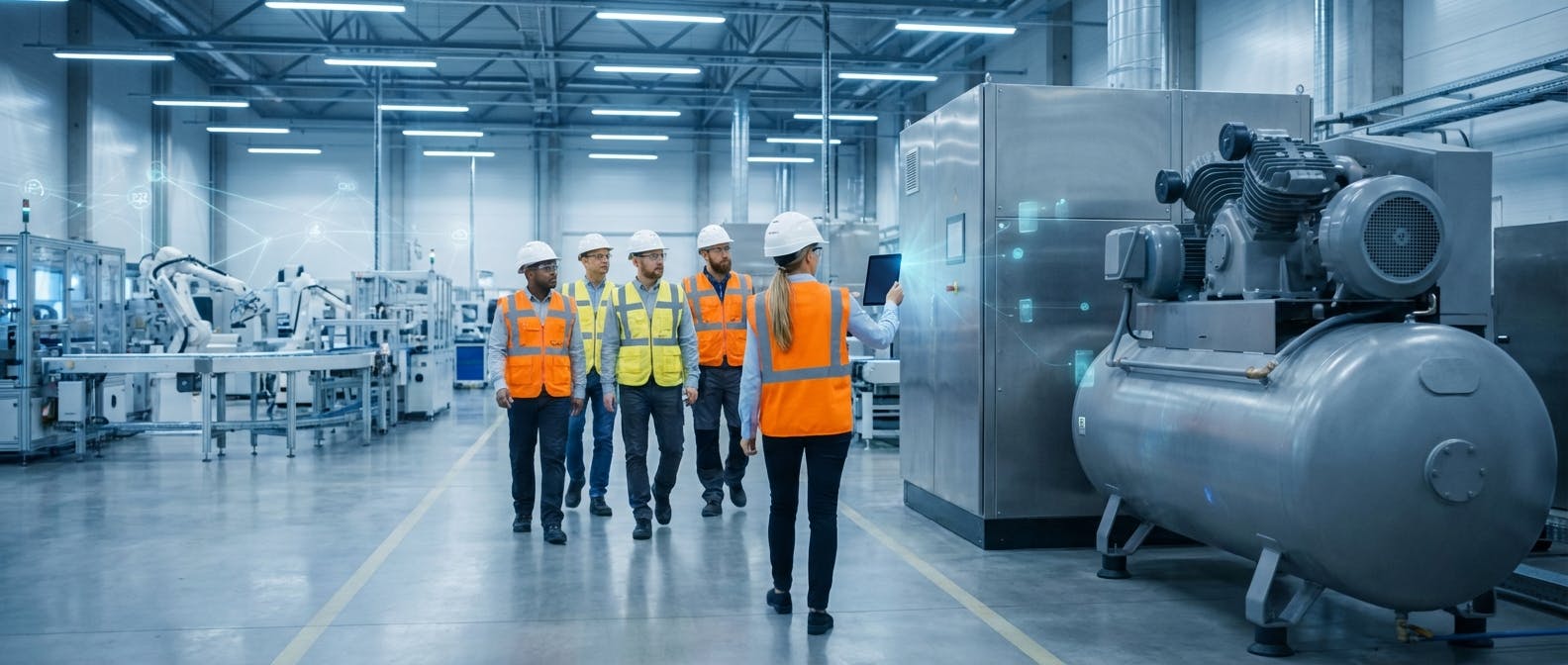
It is the most common frustration in the industrial sector today: You have a successful pilot. You instrumented 20 critical motors with vibration sensors, fed the data into a predictive model, and successfully caught a bearing failure three weeks before it caused downtime. The ROI on that specific pilot was 400%.
But when you presented the plan to roll this out to 500 assets across three facilities, the project stalled. The IT team cited data bandwidth issues. The maintenance manager worried about false alert fatigue. The finance director balked at the hardware costs.
You are not alone. As of 2026, industry data suggests that nearly 70% of industrial AI projects remain stuck in "pilot purgatory." They work in isolation but fail to scale.
The Core Question: How do you transition from a hand-held, highly monitored pilot on a few assets to a fleet-wide deployment that runs autonomously without overwhelming your infrastructure or your workforce?
The Direct Answer: You must stop treating AI as a technology project and start treating it as a workflow integration project.
In a pilot, you prioritize model accuracy (High Precision). In a fleet deployment, you must prioritize operational scalability (High Throughput). The mechanism for this shift is not a better algorithm; it is the CMMS software. If your AI insights do not automatically trigger the correct workflows, scaling is impossible. You cannot scale if every alert requires a data scientist to interpret it.
This guide breaks down the transition from pilot to fleet into the specific operational, technical, and cultural questions you need to answer to bridge the gap.
1. Why do most AI pilots fail to scale technically?
The first hurdle is the "Customization Trap."
In a pilot, your team likely spent weeks cleaning data, tuning hyperparameters, and setting thresholds for specific machines. You might have had a reliability engineer manually reviewing spectral analysis charts to confirm the AI's findings.
This works for 20 assets. It is impossible for 2,000.
The Problem: Asset Variance
Even identical motors from the same manufacturer will have different vibration signatures based on their mounting (concrete vs. steel frame), load (variable vs. constant), and age. If you try to manually tune a model for every single asset in your fleet, you will run out of time and budget before you reach 10% deployment.
The Solution: Transfer Learning and Class-Based Modeling
To scale, you must move from asset-specific models to class-based models utilizing transfer learning.
- Group Assets by Class: Instead of modeling "Conveyor Motor 3," you model "AC Motors, 50-100HP, Variable Load."
- Baseline Normalization: The AI must be smart enough to learn "normal" for a specific asset automatically during a training period (usually 2-4 weeks) without human intervention.
- Deviation Detection: The model should flag deviations from the asset's own baseline, weighted by the class behavior.
Operational Benchmark: If adding a new asset to your monitoring system takes more than 15 minutes of configuration time, your architecture is not scalable.
2. How do we handle the data infrastructure for thousands of assets?
A pilot generates gigabytes of data. A fleet generates petabytes. If you simply multiply your pilot architecture by 100, you will crash your network and bankrupt your cloud storage budget.
The "Edge-to-Cloud" Hybrid Strategy
You cannot send high-frequency vibration data (sampling at 10kHz or higher) to the cloud continuously for 5,000 assets. The bandwidth cost alone is prohibitive.
The 2026 Standard Architecture:
- Edge Processing: The sensor or gateway performs the Fast Fourier Transform (FFT) and feature extraction locally. It calculates RMS, Kurtosis, and Crest Factor on the device.
- Exception-Based Reporting: The device only transmits raw waveform data when a threshold is breached or during a scheduled "health check" (e.g., once per day).
- Cloud Contextualization: The cloud receives the metadata and features, not the raw noise.
Contextualization is King
Data without context is noise. In a pilot, you know that "Sensor A" is on "Pump B." In a fleet, "Sensor A12-998" means nothing.
You must harmonize your data naming conventions before you scale. This is where Asset Management becomes critical. Your AI data stream must share the exact same unique identifier (UID) as your CMMS asset registry.
- Bad Practice: AI Dashboard calls it "Line 1 Main Pump." CMMS calls it "PUMP-L1-001."
- Good Practice: Both systems utilize a unified namespace (UNS) or identical tag IDs.
According to the National Institute of Standards and Technology (NIST), lack of data interoperability costs the manufacturing sector over $100 billion annually. Don't contribute to that statistic.
3. How do we prevent "Alert Fatigue" from drowning the maintenance team?
This is the number one fear of maintenance managers. If your AI model has a 99% accuracy rate, but you monitor 1,000 assets, you could still generate 10 false positives every single day. If technicians are dispatched to 10 "ghost" problems, they will stop trusting the system by day three.
The Filter: Prescriptive Maintenance
You must move beyond Predictive (something is wrong) to Prescriptive Maintenance (here is what is wrong and how confident we are).
The Confidence Score Workflow: Do not show every anomaly to the maintenance team. Implement a "Triage Layer" in your software stack.
- Low Confidence (<60%): Log the event for model retraining. Do not alert the human.
- Medium Confidence (60-80%): Flag for review by a reliability engineer or lead technician during the morning meeting.
- High Confidence (>80%): Automatically trigger a work order.
The "Human-in-the-Loop" Feedback Mechanism
Scaling requires the AI to get smarter over time. This only happens if the maintenance team closes the loop.
When a technician completes a work order generated by an AI alert, the Mobile CMMS must ask a mandatory closing question:
- "Did you find a fault?" (Yes/No)
- "What was the fault?" (Misalignment, Looseness, Bearing Wear)
- "Was it the fault the AI predicted?"
This data must flow back into the model. If the AI predicted "Bearing Wear" and the technician found "Looseness," the model updates its weights. This "Reinforcement Learning from Human Feedback" (RLHF) is essential for reducing false positives at scale.
4. How does the workflow actually change for the technician?
If you require your technicians to log into a separate "AI Dashboard" to see asset health, you have failed. Technicians live in work orders, not data lakes.
The CMMS as the Operating System
To scale, the AI must be an invisible engine that powers the visible workflow.
Scenario: A Conveyor Motor Overheats
-
The Old Way (Pilot Mode):
- Sensor detects heat.
- Dashboard turns red.
- Reliability Engineer sees red light, emails Maintenance Manager.
- Manager writes a work order on paper or enters it manually.
- Technician gets the order 4 hours later.
-
The Scaled Way (Fleet Mode):
- AI Predictive Maintenance model detects thermal anomaly trend.
- API pushes alert to CMMS.
- CMMS checks Inventory Management for a spare motor.
- CMMS auto-generates a Work Order: "Inspect Motor M-204 for Overheating. Spare Part #44-A reserved."
- Technician receives push notification on mobile device with the specific PM Procedure attached.
The technician doesn't need to know "AI" triggered it. They just know they have a job to do, the parts are ready, and the instructions are clear.
5. How do we handle different asset types (Conveyors vs. Compressors)?
You cannot apply a "one-size-fits-all" strategy to fleet scaling. Different assets have different failure modes and criticality levels.
The Criticality Matrix
Before scaling, categorize your fleet.
Tier 1: Critical Assets (e.g., Main Air Compressors, Turbines)
- Strategy: Continuous, high-frequency online monitoring.
- AI Model: Deep Learning / Neural Networks.
- Response: Immediate auto-dispatch.
- Why: If these fail, production stops. The cost of a sensor ($500-$1000) is negligible compared to downtime.
- Reference: Predictive Maintenance for Compressors
Tier 2: Semi-Critical (e.g., Overhead Conveyors, secondary pumps)
- Strategy: Wireless vibration/temp sensors with lower sampling rates (e.g., once per hour).
- AI Model: Anomaly detection (Statistical baseline).
- Response: Flag for weekly review.
- Why: Redundancy exists, or buffers allow for delayed repair.
- Reference: Predictive Maintenance for Overhead Conveyors
Tier 3: Balance of Plant (e.g., Exhaust fans, small motors)
- Strategy: Route-based monitoring or "Smart Motor" current analysis (using MCC data).
- AI Model: Threshold-based.
- Response: Add to backlog.
- Why: Run-to-failure might actually be the most economical strategy here, or the cost of instrumentation exceeds the asset value.
Decision Framework: Do not put a $500 sensor on a $200 motor unless that motor is in a location that is hazardous to access.
6. What is the financial model? (CapEx vs. OpEx)
Scaling from 10 to 1,000 sensors involves significant capital. However, by 2026, the market has shifted largely toward "Monitoring as a Service" (MaaS).
The Shift to OpEx
Many vendors now bundle the hardware, connectivity, and AI software into a monthly per-asset fee. This shifts the risk from the manufacturer to the vendor.
ROI Calculation for Scaling: To justify the fleet roll-out, you must look beyond "downtime avoidance."
- Labor Optimization: How many hours of "preventive" rounds are eliminated? If you stop manually checking pumps that are running perfectly, you free up labor for backlog reduction.
- Inventory Reduction: With manufacturing AI software, you get warning times of weeks, not minutes. This allows for "Just-in-Time" ordering of spares rather than stocking expensive capital spares "just in case."
- Energy Savings: A misaligned conveyor or a degrading bearing consumes significantly more energy. AI detects this inefficiency long before failure.
According to the Society for Maintenance & Reliability Professionals (SMRP), best-in-class facilities that leverage predictive technologies see a 30% reduction in maintenance costs and a 40% reduction in unplanned downtime.
7. What if we have legacy equipment (Brownfield)?
This is the most common "edge case." You have a brand new packaging line (easy to connect) and a 40-year-old stamping press (no PLC, no sensors).
The Retrofit Strategy
You do not need to replace the machine to make it smart.
- Overlay Sensors: Use non-invasive wireless sensors (magnetic mount vibration, clamp-on current transformers). These bypass the machine's internal controls entirely.
- Proxy Variables: If you can't measure the part quality directly, measure the motor current. As tools dull, motor load increases. AI is excellent at correlating these proxy variables to performance.
- Integrate via API: Ensure your sensor gateway can push data to your Integrations layer.
Warning: Do not try to integrate directly into the control logic (PLC) of a legacy machine unless absolutely necessary. It creates security risks and potential voiding of warranties. Keep the monitoring layer parallel to the control layer.
8. How do I know if the scaling is working? (KPIs)
Success in a pilot is "We caught a fault." Success in a fleet is "We changed the culture."
Track these three KPIs during your rollout:
- Compliance Rate: What percentage of AI-generated work orders are completed within the suggested timeframe? (Target: >90%). If this is low, your team doesn't trust the data.
- Lead Time to Failure: How many days in advance is the AI alerting you? (Target: >14 days). This measures the predictive power of your model.
- P-F Interval Expansion: Are you catching failures further up the P-F curve?
The "Silent Victory"
The ultimate sign of successful scaling is silence. No emergency alarms. No 2 AM calls. Just planned maintenance, executed efficiently, triggered by an invisible intelligence.
Conclusion: The Roadmap to Fleet Deployment
Scaling industrial AI is not a "flip the switch" moment. It is a phased journey.
- Phase 1 (The Pilot): Prove the technology on critical assets.
- Phase 2 (The Integration): Connect the data to your Work Order Software. Ensure the workflow is seamless.
- Phase 3 (The Expansion): Roll out to Tier 1 assets across all sites using transfer learning.
- Phase 4 (The Saturation): Cover Tier 2 assets and optimize inventory based on predictive insights.
The technology to scale exists today. The sensors are cheap enough, and the connectivity is fast enough. The difference between the companies that scale and the companies that stall is the willingness to integrate that technology into the daily lives of the people on the shop floor.
If you are ready to move your maintenance strategy out of the pilot phase and into a robust, fleet-wide reality, you need a CMMS that can handle the data, the workflow, and the scale.
Explore how MaintainX acts as the operating system for Industrial AI.
