
Reinforcement Learning for Pump Speed Control: Why PID is No Longer Enough for Complex Hydraulics
Feb 2, 2026
reinforcement learning for pump speed control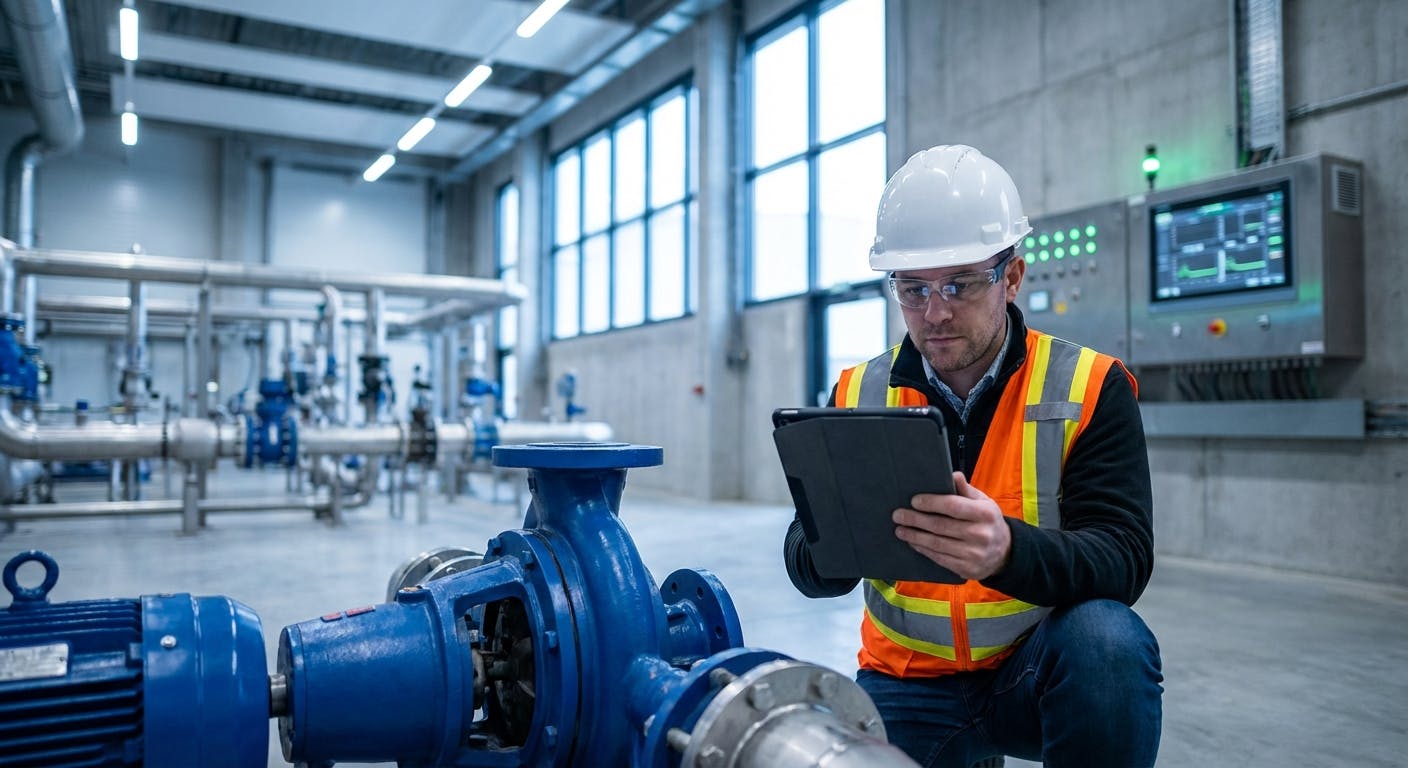
For decades, the Proportional-Integral-Derivative (PID) controller has been the undisputed king of industrial automation. It is reliable, understandable, and ubiquitous. However, as we move deeper into 2026, the demands placed on industrial pumping systems—specifically regarding energy efficiency and asset longevity—are outstripping the capabilities of linear control logic.
You are likely here because you are hitting a wall. Perhaps your Variable Frequency Drives (VFDs) are reacting too slowly to demand spikes in your Water Distribution Network (WDN). Maybe you are seeing premature bearing wear due to aggressive ramping, or you are simply trying to squeeze that last 15% of energy efficiency out of a high-consumption system.
The core question you are asking is: Can Reinforcement Learning (RL) actually outperform a well-tuned PID loop for pump speed control, and is it robust enough for a production environment?
The short answer is yes, but with a caveat: RL is not a replacement for simple, steady-state pumping. It is a superior solution for non-linear, multi-objective systems where you need to balance competing goals—like minimizing energy consumption while simultaneously maximizing the mechanical life of the pump.
While PID reacts to error (the difference between a setpoint and a process variable), Reinforcement Learning plans. It learns the physics of your system to anticipate changes, smoothing out operations in a way that reactive logic never can.
Below, we dive deep into the mechanics, the implementation, and the reliability-first approach to RL in pumping systems.
How is RL Different from Advanced PID or MPC?
If you are a control engineer, you might be thinking, "Why not just use Model Predictive Control (MPC)?" It’s a valid question. To understand why RL is gaining traction, we have to look at how these systems view the world.
The Limitation of PID and MPC
PID controllers are single-input, single-output (SISO) systems. They look at the pressure error and adjust the speed. They do not "know" that running the pump at a specific critical speed causes resonance vibration. They only know that pressure is low, so speed must increase.
MPC is better—it uses a mathematical model of the process to predict future behavior. However, MPC relies heavily on the accuracy of that model. If your hydraulic model doesn't perfectly account for pipe roughness changes over time or valve wear, the controller’s performance degrades.
The RL Advantage: Model-Free Learning
Reinforcement Learning, specifically "Model-Free" approaches like Deep Deterministic Policy Gradient (DDPG), does not require you to program the physics of the water network. Instead, the "Agent" (the controller) interacts with the "Environment" (the pump and piping system) and learns the optimal policy through trial and error (mostly in simulation first).
The RL agent optimizes a Reward Function. This is the game-changer. In a PID loop, your only goal is "maintain setpoint." In an RL Reward Function, you can define success mathematically as:
$$ Reward = (w_1 \times \text{Stability}) - (w_2 \times \text{Energy}) - (w_3 \times \text{Vibration}) $$
This allows the controller to make complex decisions, such as: "I could ramp up speed to meet pressure demand instantly, but that would spike vibration and energy cost. Instead, I will ramp slowly because I predict demand will level off in 10 seconds."
This capability makes RL the ultimate tool for predictive maintenance for pumps, as it integrates operation with preservation.
The "Reliability-First" Angle: How RL Extends Asset Life
Most literature focuses on energy savings. While reducing kWh is critical, the hidden value of RL lies in Asset Health Management.
Eliminating Mechanical Stress
Standard VFD PID loops often suffer from "hunting"—rapid micro-adjustments in speed as the controller chases a noisy signal. These oscillations create thermal cycling in the motor windings and variable torque stress on the shaft.
An RL agent can be penalized for "action magnitude." By adding a penalty for rapid changes in the control signal ($ \Delta u $) to the reward function, the AI learns to smooth out its control curve. It acts like an experienced operator who knows not to jerk the dial, whereas a PID controller acts like a nervous rookie.
Cavitation Avoidance
Cavitation is the silent killer of impellers. It occurs when the Net Positive Suction Head Available (NPSHa) drops below the Required (NPSHr).
In a traditional setup, you might have a low-suction pressure trip. By the time it trips, damage may have occurred. An RL agent trained on AI predictive maintenance data can learn the complex, non-linear relationship between flow, speed, and suction pressure. It learns to avoid the "danger zones" of the pump curve entirely, effectively geofencing the pump's operation to its Best Efficiency Point (BEP).
How Does It Work Technically? (The Architecture)
You cannot simply plug a neural network into a 500HP motor and hope for the best. The architecture for industrial RL requires a specific stack.
1. The Algorithm: Why DDPG?
For pump speed control, we deal with continuous action spaces. You aren't just turning the pump ON or OFF (discrete); you are setting a frequency anywhere between 0Hz and 60Hz (continuous).
Therefore, algorithms like Q-Learning (which handle discrete choices) fail. The industry standard for this application is Deep Deterministic Policy Gradient (DDPG) or Soft Actor-Critic (SAC). These algorithms utilize two neural networks:
- The Actor: Proposes the pump speed based on current sensor data.
- The Critic: Evaluates how good that speed selection was based on the resulting energy use and pressure stability.
2. The State Space (Inputs)
To make intelligent decisions, the RL agent needs more than just discharge pressure. A robust state vector ($ S_t $) usually includes:
- Current Discharge Pressure ($ P_{out} $)
- Current Suction Pressure ($ P_{in} $)
- Current Flow Rate ($ Q $)
- Current Power Consumption ($ kW $)
- Vibration Levels: (RMS velocity from accelerometers)
- Time of Day: (To anticipate demand patterns)
3. The Action Space (Outputs)
- VFD Frequency Reference (0-100% or 0-60Hz).
4. The Reward Function (The "Brain")
This is where you define your business goals. A common reward function structure looks like this:
- +10 points if pressure is within $\pm$ 2 PSI of setpoint.
- -1 point for every kW of energy consumed.
- -5 points for every mm/s of vibration detected.
- -10 points for rapid change in VFD speed (Jerk).
By tuning these weights, you dictate the personality of the pump: Aggressive (high performance) or Conservative (high reliability).
The Training Problem: Digital Twins and Simulation
Question: "Do I have to let an AI make mistakes on my real equipment to learn?"
Answer: Absolutely not. That would be catastrophic.
Reinforcement Learning requires millions of interactions to learn an optimal policy. You cannot run a physical pump for 10,000 years to train the model. Instead, we use Digital Twins.
The Sim-to-Real Workflow
- Data Collection: Use your CMMS software and historian data to gather historical operational profiles.
- Hydraulic Modeling: Build a simulation environment (using Python libraries or dedicated hydraulic software) that mimics your pump curves and system head curves.
- Offline Training: The RL agent trains inside this simulation. It crashes the virtual pump, cavitates it, and overheats it millions of times, learning what not to do.
- Policy Transfer: Once the "Actor" network is trained, it is frozen and deployed to the edge controller (PLC or Industrial PC).
- Fine-Tuning: The model runs in "shadow mode" (observing but not controlling) on the real asset to validate safety before being given control authority.
For a deeper dive on the validity of simulation in control strategies, the IEEE Xplore Digital Library offers extensive resources on "Sim-to-Real" transfer in industrial automation.
Implementation: What Hardware Do I Need?
Moving from theory to the factory floor requires specific infrastructure.
Edge Computing vs. Cloud
While training happens in the cloud (due to high computational needs), the inference (the actual decision-making) must happen at the Edge. Latency is the enemy of control. You cannot wait 500ms for a signal to go to AWS and back when controlling hydraulic pressure.
- Hardware: Industrial PCs (IPCs) or advanced PLCs with Python runtime capabilities.
- Connectivity: MQTT or OPC-UA protocols to stream sensor data from the VFD and vibration sensors to the model.
Integration with Existing Systems
You do not need to rip out your SCADA. The RL controller usually acts as a "Supervisor." It sends the setpoint to the local PID loop, or it sends the speed reference directly to the VFD, bypassing the PID.
Ensure your setup integrates with your maintenance ecosystem. If the RL agent detects that it cannot maintain pressure without exceeding vibration limits, it should automatically trigger a work order. This is where integrations with your maintenance platform become vital.
Common Pitfalls and "Reward Hacking"
When implementing RL for pumps, things can get weird. AI is notorious for "reward hacking"—finding a loophole in your instructions to maximize its score in a way you didn't intend.
The "Zero Energy" Hack
If you weight energy savings too heavily in your reward function, the agent might learn that the best way to save energy is to turn the pump off completely. It accepts the penalty for low pressure because the reward for zero energy consumption is so high.
- Fix: Implement "hard constraints" or heavy penalties for dropping below minimum service levels.
The "Oscillation" Hack
Sometimes, an agent learns that rapidly oscillating the speed confuses the flow meter or pressure sensor, resulting in artificially stable readings.
- Fix: Penalize the rate of change of the control action ($\Delta u$) heavily.
Data Drift
Pumps wear out. Impellers erode. Filters clog. The pump you trained on in January is not the same pump in December.
- Fix: Continuous Learning. The model needs to be retrained or calibrated periodically using fresh data from your predictive maintenance motors logs.
ROI and Business Case: Is It Worth It?
Implementing RL is more expensive upfront than tuning a PID loop. It requires data scientists, computing power, and sensor upgrades. So, where is the payoff?
1. Energy Reduction (15-25%)
In systems with highly variable demand (like municipal water or cooling towers), RL outperforms PID by dynamically adjusting to the system curve rather than a fixed setpoint. It rides the "Best Efficiency Point" (BEP) more closely.
2. Maintenance Cost Reduction
By smoothing control actions and avoiding cavitation regimes, you extend the Mean Time Between Failures (MTBF) of seals and bearings.
- Metric: Compare the number of bearing replacements per year pre- and post-implementation. Use equipment maintenance software to track these trends accurately.
3. Resilience
RL systems adapt better to anomalies. If a valve sticks partially closed, a PID loop might wind up to 100% speed to overcome the resistance, blowing a seal. An RL agent, seeing the abnormal relationship between speed and flow, can recognize the state change and enter a "limp mode" or alert an operator.
Step-by-Step: How to Get Started
If you are ready to pilot this, do not start with your critical main feed pump. Start with a secondary loop.
- Audit Your Data: Do you have second-by-second historical data for flow, pressure, power, and vibration? If not, install sensors and start logging.
- Define the Objective: Are you trying to save energy, stabilize pressure, or stop pumps from breaking? Pick one primary goal for the pilot.
- Build the Simulation: Create a digital twin of that specific pump loop.
- Train Offline: Run DDPG or SAC algorithms in the simulation.
- Shadow Mode: Deploy the model to listen to live data and predict what it would do. Compare this to what the PID loop actually did.
- Go Live: Give the model control authority with strict safety bounds (e.g., "Model can adjust speed, but cannot exceed 55Hz or drop below 30Hz").
Conclusion: The Future of Pumping is Autonomous
Reinforcement Learning for pump speed control is no longer science fiction. It is the logical evolution of industrial control in an era where data is abundant and efficiency is mandatory.
By shifting from reactive PID loops to proactive, reliability-centered RL agents, you transform your pumps from dumb actuators into intelligent assets that manage their own health.
The transition requires a shift in mindset—from "fixing errors" to "optimizing behaviors." But for facilities that make the leap, the result is a quieter, cheaper, and more reliable operation.
Ready to modernize your maintenance strategy? Before you deploy advanced AI control, ensure your foundational data is solid. Explore how MaintainX's CMMS helps you capture the high-quality asset data required to train the next generation of industrial AI.
