
Reinforcement Learning for Industrial Boiler Control: Moving Beyond PID in Complex Thermodynamics
Feb 1, 2026
reinforcement learning for industrial boiler control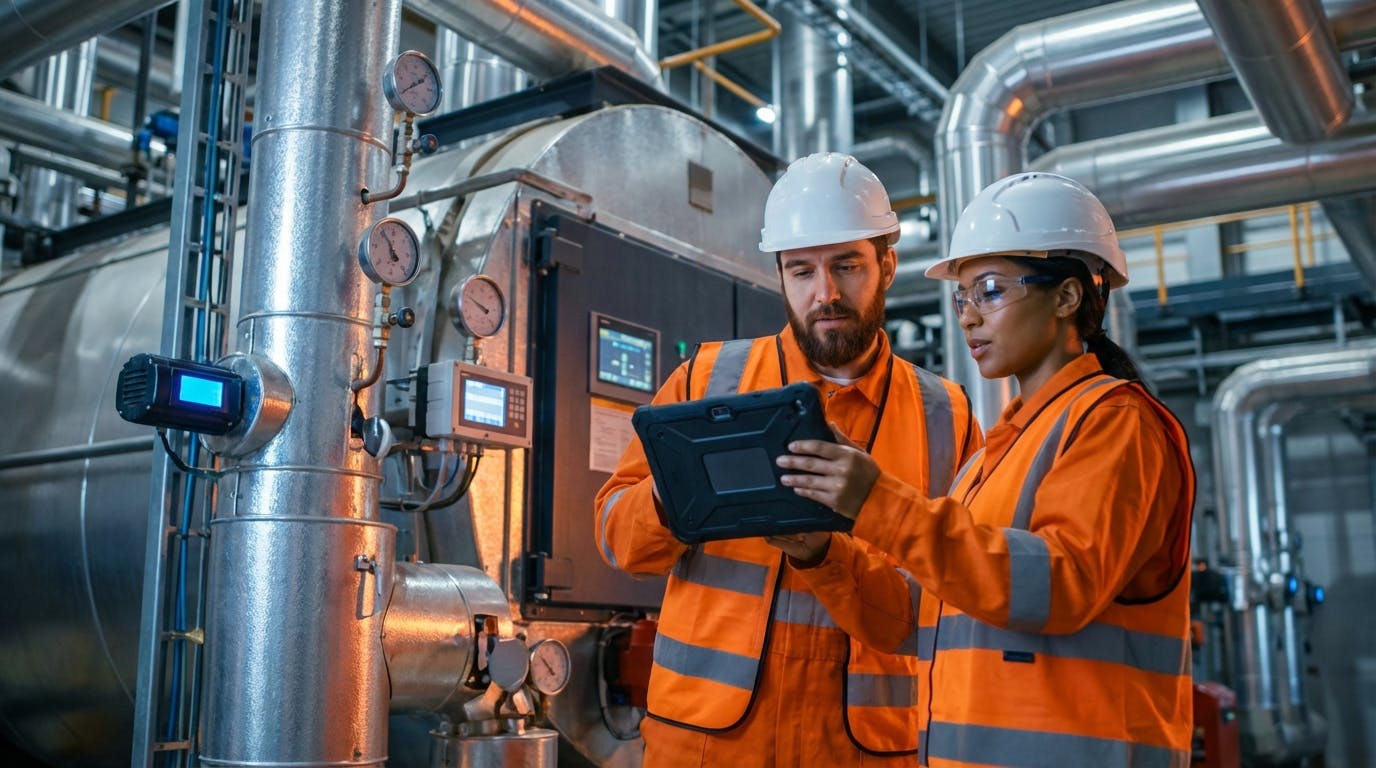
It is 2026, and the industrial landscape has shifted. We are no longer asking if AI can be applied to heavy manufacturing; we are asking how to apply it safely to critical infrastructure.
When you search for "reinforcement learning for industrial boiler control," you aren't looking for a definition of AI. You are likely a Control Engineer, a Plant Manager, or a Data Scientist grappling with a specific problem: How do I optimize a non-linear, multi-variable system (a boiler) that defies standard PID tuning, without compromising safety or operational continuity?
Standard PID (Proportional-Integral-Derivative) controllers have been the workhorses of industry for a century. They are robust, predictable, and reliable for maintaining steady states. However, industrial boilers—especially those burning biomass, waste, or operating in cogeneration plants—are rarely in a steady state. They face load swings, varying fuel moisture content, and strict NOx emission regulations that conflict with thermal efficiency goals.
The core answer to your search is this: Reinforcement Learning (RL) does not replace the safety logic of your PLC. Instead, it acts as a supervisory "super-operator," continuously adjusting the setpoints (SP) of your existing PID loops to navigate complex, non-linear trade-offs that static logic cannot handle.
But how do you implement this without risking a catastrophic failure? How do you train an algorithm that learns by "trial and error" on a piece of equipment that cannot afford a single error?
This guide breaks down the implementation of RL in boiler control, moving from the theoretical "Digital Twin" training grounds to edge deployment.
The Safety Gap: How Do We Train Without "Blowing Up" the Plant?
The first question every Operations Manager asks is: "Reinforcement learning learns by failing. Do you expect me to let an AI fail on a high-pressure steam vessel?"
This is the primary barrier to entry. In a video game, if an RL agent fails, the game restarts. In a boiler, if an agent fails, you might trip the turbine, violate an emission permit, or rupture a tube.
The Solution: "Train on the Twin, Deploy on the Edge"
The industry standard in 2026 is to decouple the training environment from the production environment. This is where the Digital Twin becomes non-negotiable.
- High-Fidelity Simulation: You cannot train an RL agent on historical data alone (offline learning) because the agent needs to know what happens when it takes actions that haven't been taken before. You must build a physics-based or data-driven model (Digital Twin) of your specific boiler dynamics.
- The Gym Environment: This model is wrapped in an OpenAI Gym-style interface. The RL agent interacts with this simulation millions of times. It tries extreme air-to-fuel ratios, it mishandles load swings, and it "crashes" the simulated boiler thousands of times.
- Policy Transfer: Through this process, the agent learns a "policy"—a mathematical function that maps the current state (pressures, temps, O2 levels) to the optimal action.
- Sim-to-Real Transfer: Only the mature, pre-trained policy is deployed to the edge device. On the plant floor, the model is in "inference mode" (executing decisions), not "training mode" (exploring random actions).
This approach allows you to leverage manufacturing AI software to simulate years of operation in a few days, ensuring the agent is seasoned before it ever touches a real valve.
RL vs. MPC vs. PID: The Control Hierarchy
The next logical question is: "Why do I need RL? Why not just use Model Predictive Control (MPC) or better PID tuning?"
To understand the value proposition, we have to look at the limitations of each control strategy in the context of boiler dynamics.
1. PID (The Reflex System)
- Best for: Maintaining a single variable (e.g., drum level) at a setpoint.
- Limitation: It is reactive and linear. It treats the symptoms, not the interaction between variables. If you change the fuel rate, the PID controlling the air damper reacts only after the O2 levels change. It doesn't anticipate.
2. MPC (The Chess Player)
- Best for: Multi-variable control with constraints (e.g., "maximize steam flow but keep pressure under X").
- Limitation: MPC relies on a fixed mathematical model of the process. If your boiler's behavior changes (e.g., fouling of tubes, change in fuel caloric value), the MPC model degrades (Model Mismatch). Furthermore, MPC is computationally expensive, solving complex optimization matrices at every time step.
3. Reinforcement Learning (The Intuitive Expert)
- Best for: Non-linear optimization and adaptive strategies.
- The Advantage: RL is "model-free" in execution. Once trained, it doesn't need to solve a massive equation to make a decision; it simply references its learned policy (a neural network), which is instant.
- The Killer Feature: RL can optimize for "fuzzy" rewards. You can train it to balance "minimize NOx," "maximize efficiency," and "reduce actuator wear" simultaneously.
The Hybrid Architecture: In a modern setup, the RL agent does not control the valves directly (0-100% open). Instead, the RL agent outputs dynamic setpoints or bias values to the PID controllers.
- RL Agent: Sees a load increase coming. Decides the optimal O2 setpoint is 3.5% to maintain thermal stability.
- PID Controller: Receives 3.5% as the new Target (SP) and adjusts the damper to hit that target.
This ensures that if the AI fails or the edge computer crashes, the PID controller simply holds the last valid setpoint or reverts to a safe default, maintaining basic safety.
Under the Hood: Which Algorithms Work for Boilers?
For the data scientists and engineers reading this, "Reinforcement Learning" is too broad. You need to know the specific architectures suitable for continuous process control.
Why Q-Learning Fails Here
Deep Q-Networks (DQN) are famous for mastering Atari games. However, they work on discrete action spaces (Move Left, Move Right, Jump). A boiler fuel valve is continuous (it can be 45.1% open, 45.2% open, etc.). Discretizing these actions leads to jerky control and "chattering" valves, which destroys actuators.
The Actor-Critic Approach
For industrial boilers, we utilize Actor-Critic methods, specifically algorithms designed for continuous control spaces:
-
DDPG (Deep Deterministic Policy Gradient):
- This is the standard for continuous control. It uses two neural networks: one acts (Actor) and one evaluates the action (Critic). It allows for smooth, continuous adjustments of control variables like fuel feed rate and fan speed.
- Reference: For a deeper dive into the mathematics of DDPG in process control, resources like IEEE Xplore offer extensive technical papers on stability proofs.
-
PPO (Proximal Policy Optimization):
- PPO is often more stable than DDPG. It prevents the agent from making drastic updates to its policy that would lead to erratic behavior. In a boiler, stability is paramount, making PPO a strong candidate for the supervisory layer.
-
TD3 (Twin Delayed DDPG):
- An improvement on DDPG that reduces the overestimation of value, leading to more conservative and reliable control policies—ideal for risk-averse industrial environments.
Specific Use Cases: Where RL Outperforms Traditional Control
You don't need RL for everything. If you have a simple gas-fired boiler running at constant load, PID is fine. RL shines in the "edge cases" that cost you the most money.
1. Combustion Optimization (NOx vs. Efficiency)
This is the classic multi-objective optimization problem.
- The Conflict: To maximize thermal efficiency, you generally want low excess air. However, low excess air can lead to incomplete combustion (CO) and safety risks. Conversely, high temperatures improve efficiency but exponentially increase Thermal NOx formation.
- The RL Solution: You define a Reward Function that penalizes NOx emissions heavily, penalizes CO usage, and rewards steam output per unit of fuel. The RL agent learns the subtle "sweet spot" curve that shifts dynamically as the boiler load changes—something a static PID tune cannot do.
2. Superheated Steam Temperature Control
Superheaters are notoriously difficult to control due to long dead times (the delay between spraying water and seeing a temperature drop) and non-linear responses.
- The Problem: During a rapid load ramp-up, steam temperature can spike before the PID reacts, risking tube overheating.
- The RL Solution: The RL agent uses "State" data including the rate of change of the drum pressure and fuel flow. It anticipates the temperature spike and initiates the attemperator spray before the temperature rises, acting on the leading indicators rather than the lagging error.
3. Sootblowing Optimization
Sootblowing (cleaning ash off tubes with steam) is usually done on a timer. This is inefficient.
- The RL Solution: The agent monitors heat transfer efficiency across different zones. It learns to trigger sootblowers only when the efficiency drop (due to fouling) outweighs the steam cost of the sootblowing operation itself. This falls under the umbrella of prescriptive maintenance, where the system acts to prevent efficiency loss.
The Implementation Roadmap: From Data to Deployment
How do you actually get started? Here is a pragmatic roadmap for 2026.
Phase 1: The Data Audit
Before you touch a neural network, you need data.
- Historian Analysis: You need at least 12 months of high-resolution data (1-second or 5-second intervals) from your SCADA/DCS.
- Tag Selection: Identify the State variables (Inputs: Pressures, Temps, Flows, Valve Positions) and Action variables (Outputs: Fan Speed SP, Fuel Valve SP).
- Sanitization: Remove periods of shutdown, startup, or sensor failure. RL trained on "garbage" data will learn "garbage" policies.
Phase 2: Building the Environment (The Twin)
- Use tools like MATLAB/Simulink or Python-based physics engines to model your boiler.
- Calibration: Validate the model against your historical data. If the simulation says the temperature should be 500°C given inputs X and Y, but history says it was 480°C, your model needs tuning.
Phase 3: Reward Engineering
This is the art form of RL. You must mathematically define what "Good" looks like.
- Example Reward Function: $R = (w_1 \times Efficiency) - (w_2 \times |SetpointError|) - (w_3 \times NOx) - (w_4 \times \Delta Action)$
- Note: The $w_4$ term is crucial. It penalizes rapid changes in the valve position. Without this, the AI might vibrate the valve to squeeze out 0.01% efficiency, destroying the actuator in a week.
Phase 4: Training and Evaluation
- Train the agent in the simulation.
- Run "Shadow Mode" on the live plant. Feed live plant data into the model and see what the AI would have done. Compare this against what the PID actually did. If the AI consistently suggests actions that lead to better theoretical outcomes without safety violations, you are ready to move forward.
Phase 5: Deployment and Monitoring
- Deploy the model to an Industrial Edge Gateway.
- Integrate with your asset management system to track the health of the controllers and the boiler assets simultaneously.
- Start with narrow limits. Allow the RL agent to adjust the setpoint by only +/- 2%. As confidence grows, widen the authority limits.
ROI and The "Cost" of Intelligence
Is this worth the investment? Implementing RL is more expensive upfront than a PID tuning service. It requires data science expertise and computing infrastructure.
However, the ROI comes from scale:
- Fuel Savings: A 1-2% improvement in combustion efficiency on a large industrial boiler can save hundreds of thousands of dollars annually in fuel costs.
- Emission Compliance: Avoiding fines for NOx violations or reducing the consumption of reagents (ammonia/urea) in SCR systems.
- Asset Life: By reducing thermal cycling and stabilizing temperatures, you extend the life of superheater tubes and headers. This connects directly to preventive maintenance strategies, reducing unplanned downtime.
Troubleshooting & Edge Cases: When the AI Gets Confused
No system is perfect. You must anticipate failure modes.
The "Hallucinating" Sensor
If a pressure transmitter drifts or fails, the RL agent (which relies on that input as part of its "State") might make a catastrophic decision based on false reality.
- Mitigation: Implement strict input validation layers. If a sensor value jumps faster than physically possible, the system should flag a fault and revert to manual/PID control immediately.
The "Reward Hacking" Phenomenon
AI is notorious for finding loopholes. If you reward it solely for maintaining drum pressure, it might blast the fuel to 100% and then cut it to 0% repeatedly to keep the average pressure perfect, while destroying the boiler physically.
- Mitigation: This is why the "Action Penalty" in the reward function is critical. You must penalize the rate of change of control actions.
Integration with Maintenance Workflows
When the RL system detects anomalies that it cannot compensate for (e.g., a stuck damper), it shouldn't just try harder. It should trigger a work order. Modern systems integrate with work order software to automatically alert maintenance teams when the control loop saturates or behaves abnormally, bridging the gap between operations and maintenance.
Conclusion: The Future is Hybrid
Reinforcement Learning for industrial boiler control is no longer science fiction. It is a mature, high-value strategy for plants dealing with complex dynamics and strict efficiency targets.
However, success lies in respect for the physics and the safety layers. By using Digital Twins for training, adopting a hybrid architecture (RL supervising PID), and focusing on continuous action algorithms like DDPG, you can unlock efficiency gains that were previously impossible.
The boiler of the future isn't just automated; it's autonomous, adaptive, and self-optimizing. The question is no longer if you should explore this technology, but how quickly you can build your Digital Twin to start the training process.
For more insights on integrating advanced AI into your maintenance and operational workflows, explore our guide on AI in predictive maintenance.
