
Reinforcement Learning for Chemical Reactor Control: How to Optimize Yield While Extending Asset Life
Feb 2, 2026
reinforcement learning for chemical reactor control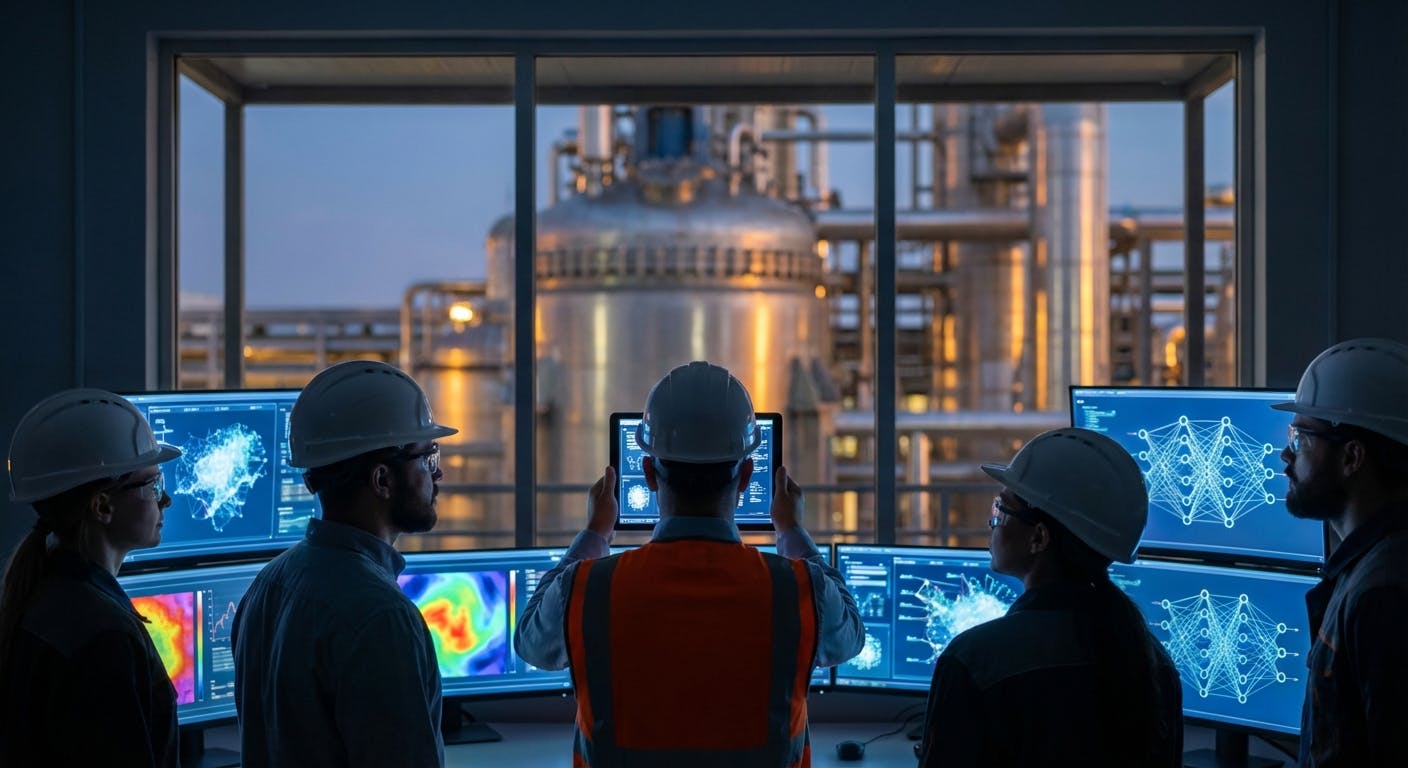
It is 2026. The era of relying solely on PID (Proportional-Integral-Derivative) controllers for complex chemical processes is fading. While PID remains the workhorse for simple loops, and Model Predictive Control (MPC) handles constraints well, they both hit a wall when faced with the highly non-linear, transient states of modern high-performance reactors.
You are likely here because you are hitting that wall. You are a Process Control Engineer, a Data Scientist, or an R&D Manager looking at a Continuous Stirred-Tank Reactor (CSTR) or a batch process that just won't stay within optimal thresholds without constant manual intervention.
The Core Question: Why should I introduce the complexity of Reinforcement Learning (RL) into my control architecture, and is it safe enough for a live plant?
The Direct Answer: You switch to Reinforcement Learning not just to squeeze out an extra 0.5% of yield (though it does that), but to fundamentally change how your control system treats the equipment. Unlike PID, which reacts to errors, and MPC, which optimizes a fixed model, RL learns a "policy" that balances immediate process targets with long-term system stability.
In practical terms, RL is the only control strategy that can be explicitly rewarded for "being gentle" on your equipment. It can learn to maintain temperature setpoints without aggressively slamming control valves open and closed, thereby reducing thermal cycling and mechanical wear. This is the "Asset Health" angle of control theory—using AI not just for chemistry, but for longevity.
Below, we dive deep into the mechanics, the algorithms, and the implementation strategies for deploying reinforcement learning in chemical reactor control.
How Does RL Actually Compare to PID and MPC in Practice?
To understand why we are moving toward Deep Reinforcement Learning (DRL), we have to look at the limitations of the incumbents.
The Limitations of PID
PID controllers are linear and reactive. In a CSTR with an exothermic reaction, the relationship between cooling jacket flow and reactor temperature is rarely linear.
- The Problem: To handle non-linearity, engineers often "detune" PIDs to be sluggish, sacrificing performance for stability. Or, they use gain scheduling, which creates a patchwork of control parameters that is a nightmare to maintain.
- The Result: Slow response times to disturbances (like feedstock impurity changes) and overshoot during startup/shutdown phases.
The Limitations of MPC
Model Predictive Control was the gold standard for decades. It solves an optimization problem at every time step based on a mathematical model of the process.
- The Problem: MPC is computationally expensive. In 2026, compute is cheap, but solving a complex non-linear optimization problem in milliseconds is still risky. Furthermore, MPC is only as good as the model. If heat transfer coefficients change due to fouling (a common occurrence), the MPC performance degrades rapidly until the model is recalibrated.
- The Result: Excellent constraint handling, but rigidity in the face of degrading equipment conditions.
The Reinforcement Learning Advantage
RL is fundamentally different. It does not solve an optimization problem in real-time. Instead, it uses a Neural Network (the "Agent") that has already learned the optimal policy during training.
- Inference Speed: Because the heavy lifting happens during training (offline), the online execution is incredibly fast—just a forward pass through a neural network.
- Adaptability: RL agents can be trained on "domain randomization," meaning they are exposed to simulated scenarios where heat transfer coefficients vary wildly. This makes them robust to fouling and sensor drift in ways MPC struggles to match.
For facilities looking to modernize, integrating manufacturing AI software that utilizes RL agents allows for control strategies that adapt to the aging of the reactor itself.
The "Asset Health" Angle: How RL Extends Reactor Life
This is the most overlooked aspect of AI control. Most literature focuses on yield maximization. However, for a maintenance manager, the primary concern is reliability.
The Hidden Cost of Aggressive Control
Imagine a standard PID loop controlling a cooling valve. To keep the temperature within a tight $\pm 0.5^\circ C$ band, the PID might command the valve to move from 40% to 60% and back to 45% every few seconds. This is known as "chatter."
- Mechanical Wear: This wears out valve packing, stresses the actuator diaphragm, and fatigues the stem.
- Thermal Shock: Rapid changes in coolant flow cause thermal cycling in the reactor jacket, leading to micro-cracking in glass-lined reactors or stress corrosion cracking in stainless steel.
Designing the "Polite" Controller
In Reinforcement Learning, we define a Reward Function. This is the mathematical signal that tells the AI if it did a good job. A typical PID or MPC minimizes error: $Error = (Setpoint - Actual)^2$.
In RL, we can construct a composite reward function: $$Reward = w_1(Yield) - w_2(TemperatureError) - w_3(\Delta ValvePosition)$$
The term $w_3(\Delta ValvePosition)$ is the game-changer. It penalizes the agent for moving the valve unnecessarily.
- The Outcome: The RL agent learns that to maximize its total score, it should anticipate temperature changes and make small, smooth adjustments early, rather than large, jerky adjustments late.
- The Benefit: This leads to smoother actuator movement, reduced thermal shock, and significantly longer intervals between failures. This is a form of active asset management embedded directly into the control logic.
Which Algorithms Should I Use? (SAC vs. PPO vs. DDPG)
If you are a data scientist tasked with building this, you know that "Reinforcement Learning" is a broad umbrella. For chemical reactors, the choice of algorithm is critical.
Why DQN is Not the Answer
Deep Q-Networks (DQN) revolutionized RL (think Atari games), but they handle discrete action spaces (move left, move right). Chemical reactors are continuous environments. You don't want a valve to be either "Open" or "Closed." You need it at 42.5%. Therefore, you must use algorithms designed for continuous action spaces.
1. Soft Actor-Critic (SAC)
In 2026, SAC is often the default choice for process control.
- Why: It maximizes not just the reward, but also the entropy (randomness/exploration) of the policy.
- Benefit: This prevents the agent from getting stuck in "local optima" (strategies that are okay but not great). It produces very robust policies that handle noise well.
- Use Case: Highly unstable CSTRs where the reaction can easily run away.
2. Proximal Policy Optimization (PPO)
PPO is the stable workhorse. It is less sample-efficient than SAC (needs more data to learn), but it is mathematically constrained to prevent the agent from making drastic changes to its policy during updates.
- Why: Stability. It is easier to tune and less likely to exhibit erratic behavior during the training phase.
- Use Case: Batch reactors where consistency between batches is more critical than finding the absolute theoretical maximum yield.
3. Deep Deterministic Policy Gradient (DDPG)
An older continuous control algorithm. While historically significant, it is often brittle and sensitive to hyperparameter tuning. Most industrial applications have moved to SAC or TD3 (Twin Delayed DDPG).
For a deeper dive into the mathematics of these algorithms in industrial settings, resources like IEEE Xplore provide extensive peer-reviewed case studies on DRL in process control.
How Do We Implement This Safely? (Sim-to-Real)
The most common follow-up question is: "You want me to let a neural network control a pressurized reactor? Are you crazy?"
This is a valid fear. You cannot train an RL agent on a live plant. The "exploration" phase involves trying random actions, which would be catastrophic in a real facility.
Step 1: The High-Fidelity Digital Twin
You must start with a simulation. This isn't just a basic Simulink model; it needs to be a Physics-Informed Digital Twin.
- Physics-Informed: The model must respect the laws of thermodynamics and mass balance.
- Domain Randomization: During training, you randomly vary parameters in the simulation (e.g., simulate a 10% drop in cooling water pressure, or a 5% increase in catalyst activity).
- Goal: Train the agent to survive in a simulation that is harsher than reality.
Step 2: Offline Reinforcement Learning
If you have years of historical data from your SCADA or DCS, you can use Offline RL. This allows the agent to learn from past operator actions without interacting with the environment. It learns what the best operators did during upsets and what the worst operators did during failures.
Step 3: The Shadow Mode & Guardrails
Once the model is trained:
- Shadow Mode: Run the AI in parallel with the existing PID/MPC. It receives the same sensor inputs and outputs a decision, but that decision is not sent to the valve. You log the difference. "The AI wanted to open the valve to 60%, but the PID only went to 50%."
- Guardrails: When you eventually switch control to the AI, you wrap it in hard-coded safety logic.
- Rule: If Reactor Temp > $150^\circ C$, override AI and switch to emergency cooling.
- Rule: AI cannot change valve position by more than 5% per second.
This approach aligns with modern prescriptive maintenance strategies, where systems not only predict failure but actively intervene (or suggest interventions) to prevent it.
Data Requirements and Infrastructure
You cannot do DRL without a robust data pipeline.
The Sampling Rate Problem
Standard historians often compress data or log it every minute. For reactor control, specifically for fast kinetics, you need high-frequency data (1Hz or faster).
- Key Variables: Jacket temperature (inlet/outlet), Reactor temperature (multiple points if possible), Agitator torque (proxy for viscosity), Feed flow rates, and Pressure.
Integration with IIoT
The sensors must feed into a centralized data lake where the inference engine can access them with low latency. If your latency between sensor reading and control action is >500ms, the control loop may become unstable.
- Edge Computing: In 2026, it is common to deploy the trained RL model on an Edge device (like an industrial PC or a specialized PLC module) directly in the control cabinet to minimize latency.
- Connectivity: Ensuring your CMMS and control systems talk to each other is vital. Integrations between your maintenance software and your control layer allow the RL agent to potentially flag maintenance work orders if it detects that it can no longer control the valve effectively (implying mechanical failure).
Troubleshooting: What If It Doesn't Work?
You've trained the model, deployed it, and the reactor is oscillating. What went wrong?
1. The "Reality Gap"
The simulation wasn't accurate enough.
- Fix: Use System Identification techniques to recalibrate your digital twin. Add more noise to the training simulation to force the agent to be more conservative.
2. Reward Hacking
The agent found a loophole.
- Example: You rewarded the agent for low temperature variance. The agent learned that if it shuts off the feed entirely, the temperature stays perfectly stable.
- Fix: Adjust the reward function to heavily penalize shutting down production. $Reward = Yield \times Stability$. If Yield is 0, Reward is 0.
3. Sensor Drift
The thermocouples are drifting, and the AI interprets this as a process change.
- Fix: Implement sensor fusion or auto-encoders to detect anomalies in sensor data before it reaches the control agent.
ROI: Is the Complexity Worth It?
Implementing RL is more expensive upfront than tuning a PID loop. It requires data scientists, compute power, and rigorous testing. So, where is the return?
1. Yield Improvement
In high-volume chemical manufacturing, a 1% increase in yield due to tighter control near the constraints can translate to millions of dollars annually. RL allows you to ride the constraint line closer than PID ever could.
2. Energy Reduction
By optimizing the cooling/heating trajectories, RL often reduces utility consumption by 5-10%. It avoids "fighting" the process—overcooling and then reheating.
3. Maintenance Savings (The Long Tail)
This brings us back to the asset health angle.
- Valve Life: Extending control valve lifespan by 30% reduces replacement costs and downtime.
- Reactor Health: Reducing thermal shock extends the life of the vessel itself.
- Predictive Power: The RL agent's internal state often acts as a sensitive diagnostic tool. If the agent has to work harder to achieve the same result, it indicates equipment degradation. This feeds directly into AI predictive maintenance workflows, allowing you to prevent failures before they cause unplanned shutdowns.
4. Knowledge Capture
Experienced operators retire. An RL agent trained on historical data captures the "tribal knowledge" of your best operators and institutionalizes it.
Conclusion: The Future of the Control Room
Reinforcement Learning for chemical reactor control is no longer a science project; in 2026, it is a competitive advantage. It moves us away from rigid, reactive control strategies toward adaptive, intelligent systems that understand the trade-off between today's production targets and tomorrow's equipment reliability.
By focusing on the "Asset Health" angle—rewarding the agent for smooth, mechanically sympathetic control—you bridge the gap between Operations and Maintenance. You create a system where high yield does not come at the expense of the machine.
Ready to modernize your maintenance strategy alongside your control strategy? To support advanced control implementations, you need a maintenance backbone that moves as fast as your AI. Explore how MaintainX helps you organize the asset data that powers the next generation of industrial intelligence.
