
Redundancy Meaning: Why the Only "Waste" That Saves You Money is Strategic Duplication
Feb 13, 2026
redundancy meaning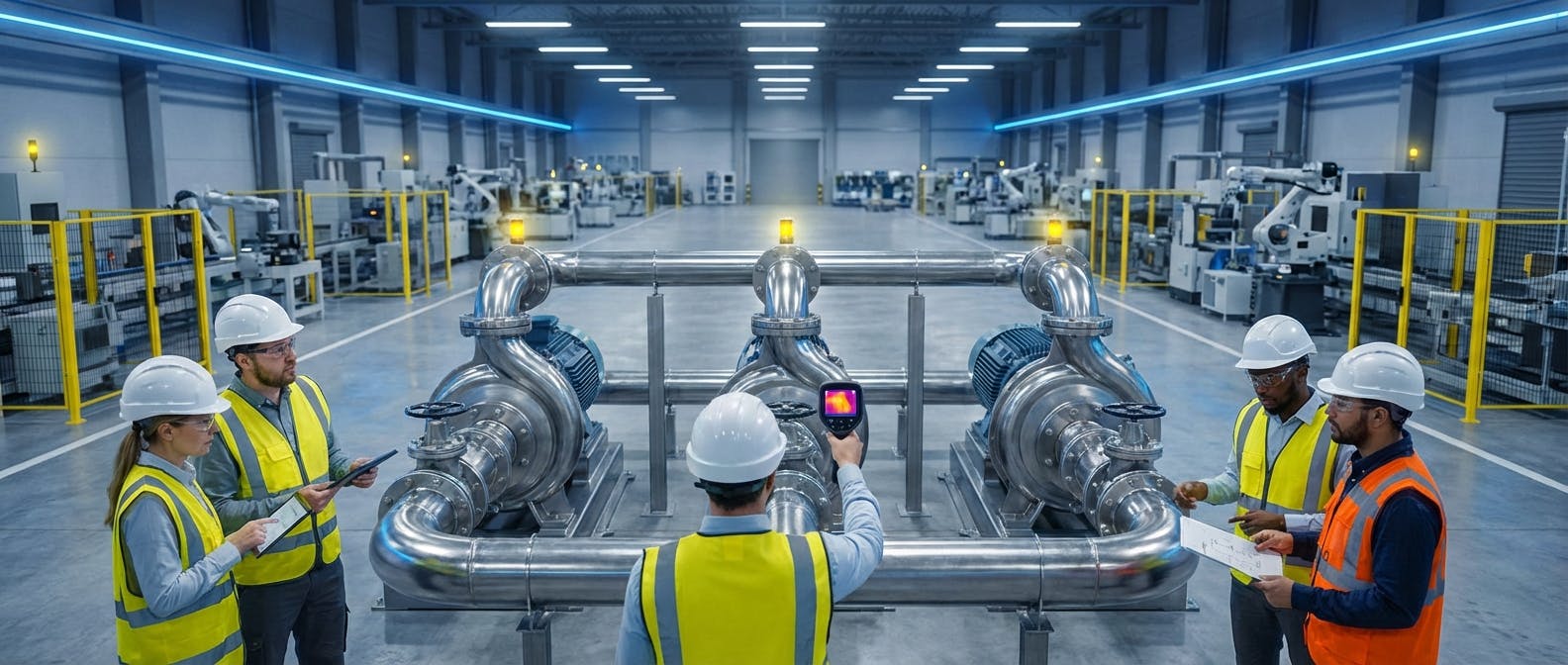
If you typed "redundancy meaning" into a search bar looking for advice on employment law or layoffs, you are in the wrong place. In the corporate world, redundancy is a polite euphemism for job loss. But in the world of industrial maintenance, facility management, and reliability engineering, redundancy is the exact opposite: it is the art of keeping things working.
In an engineering context, redundancy is the inclusion of extra components, systems, or resources that are not strictly necessary for functioning during normal operations but are essential for functioning in case of failure.
Think of it as an insurance policy written in steel, silicon, and circuitry.
For a maintenance manager in 2026, understanding redundancy goes far beyond simply buying two of everything. It involves complex decisions about architecture (N+1 vs. 2N), operational states (active vs. passive), and the integration of AI-driven predictive models.
This guide answers the core question: How do I design a redundant system that guarantees uptime without bankrupting my capital expenditure budget?
The Core Concept: Redundancy as a Reliability Strategy
At its simplest level, redundancy is the duplication of critical components or functions of a system with the intention of increasing reliability of the system.
If you have one pump moving water to a cooling tower and that pump fails, your production stops. That is a Single Point of Failure (SPOF). If you install a second pump alongside the first, piped in parallel so that either can do the job, you have introduced redundancy.
However, many facility operators view redundancy as "waste" because, in an ideal world where machines never break, that second pump is unnecessary capital sitting idle. This is a dangerous mindset.
The "Insurance" Angle
You don't buy fire insurance hoping your factory burns down. You buy it to survive if it does. Redundancy is operational insurance. The premium you pay is the cost of the extra equipment and its maintenance. The payout is the avoidance of downtime costs, which, for automotive or pharmaceutical manufacturers, can exceed $20,000 per minute.
The goal of redundancy is to decouple component failure from system failure.
- Component Failure: The bearing in Pump A seizes.
- System Success: The system automatically switches to Pump B, and the cooling water never stops flowing.
How Does Redundancy Actually Work? (The Architectures)
Once you accept that redundancy is necessary, the immediate follow-up question is: "How much redundancy do I need?" This brings us to the standard engineering notations: N+1, 2N, and 2N+1.
N+1 Redundancy: The Baseline Standard
"N" represents the number of components required to run the system at full capacity.
- Scenario: You need 3 generators to power your facility.
- N = 3.
- N+1 Architecture: You install 4 generators total (3 active + 1 backup).
If one generator fails, the backup takes over, and capacity remains at 100%. This is the most cost-effective form of redundancy because you are spreading the cost of the backup across multiple active units.
2N Redundancy: The Mirror Image
This is often called "system mirroring." You have fully double the amount of equipment needed.
- Scenario: You need 1 UPS (Uninterruptible Power Supply) for a server room.
- N = 1.
- 2N Architecture: You install 2 independent UPS systems.
In a 2N system, you have two completely independent distribution paths. If the primary path fails entirely (not just a component, but the switchgear, cabling, or controller), the secondary path takes the load. This is standard in Tier 4 data centers and critical life-safety systems, but it effectively doubles your capital investment.
2N+1: The "Belt and Suspenders" Approach
This is the highest level of reliability usually seen in industrial contexts. You have a fully mirrored system (2N), plus an extra backup component (+1) in each leg. This allows for a failure during a maintenance window without losing system integrity. It is immensely expensive and reserved for assets where failure could result in loss of life or catastrophic environmental damage.
Active vs. Passive: Hot, Warm, and Cold Standby
You have purchased the redundant equipment. Now, how does it behave? This is where many maintenance teams struggle. The state of your backup equipment determines your failover time—how long it takes to switch from the broken unit to the backup.
Active Redundancy (Hot Standby)
In this configuration, the redundant components are running simultaneously with the primary components.
- How it works: If you need 100 units of airflow, you might run two fans at 50% capacity each. If one fails, the other ramps up to 100% instantly.
- Pros: Zero downtime during switchover; no "start-up" stress on cold machines.
- Cons: Both units wear out simultaneously (though slower); higher energy consumption.
- Best for: Predictive maintenance for compressors often utilizes this to balance run hours.
Passive Redundancy (Cold Standby)
The backup unit is installed but turned off. It does not operate until the primary fails.
- How it works: The primary motor runs. The backup motor sits idle. When the primary trips, a switch (automatic or manual) turns on the backup.
- Pros: The backup unit incurs no wear while waiting; lower energy costs.
- Cons: Failover time is longer (system must boot up); "Cold" equipment is prone to start-up failures (seized bearings, dried seals) if not exercised.
- Best for: Non-critical batch processes where a 5-minute interruption is acceptable.
Warm Standby
The backup system is powered on and idling but not under load. It’s ready to take the load faster than cold standby but saves some wear compared to hot standby.
The Hidden Costs: Is Redundancy Always the Answer?
A common follow-up question from CFOs is: "Why are we buying equipment we don't plan to use?"
Redundancy is not a universal solution. It introduces complexity. A system with two pumps, automatic transfer switches, and load-balancing software has more failure points than a single pump with an on/off switch.
The Complexity Paradox
According to reliability engineering principles, adding components in series decreases reliability, while adding them in parallel (redundancy) increases reliability. However, the control system that manages the redundancy is often in series. If the automatic transfer switch fails, it doesn't matter that you have two generators—neither will start.
Maintenance Burden
Redundancy does not reduce maintenance; it increases it.
- You now have twice the assets to inspect.
- You must perform PM procedures on the backup units.
- Crucial Insight: Cold standby units are often the most neglected. A backup pump that hasn't been turned over in six months will likely fail immediately upon startup due to sedimentation or seal degradation.
The ROI Calculation
To justify redundancy, you must calculate the Cost of Unreliability (CoU).
- Determine the cost of one hour of downtime (Lost production + labor + scrap).
- Estimate the frequency of failure for the single asset.
- Compare the annualized cost of downtime against the annualized cost of the redundant asset (CapEx amortization + maintenance).
If the cost of the redundant asset is lower than the potential loss, the investment is justified.
Redundancy in the Age of AI and IIoT
In 2026, the definition of redundancy is shifting due to advancements in AI Predictive Maintenance.
Virtual Redundancy
Traditionally, if a machine was critical, you bought a backup. Today, we can use prescriptive analytics to create a form of "virtual redundancy."
By using sensors to monitor vibration, temperature, and current, software can predict a failure weeks in advance. This allows you to treat the supply chain as your redundancy. You don't need a spare motor sitting on the factory floor (tying up capital) if you know with 99% certainty that the current motor will last another 30 days—enough time to order a replacement.
This is often called "Just-in-Time Redundancy." It relies heavily on accurate data from asset management systems and robust supplier relationships.
Load Shedding and Graceful Degradation
Modern smart grids and manufacturing execution systems (MES) allow for "functional redundancy." If a main power unit fails, the system might not switch to a backup generator but instead intelligently shuts down non-essential loads (like office AC or auxiliary lighting) to keep the critical production line running on the remaining capacity. This is software acting as hardware redundancy.
Critical Spares: The Inventory Side of Redundancy
Redundancy isn't always about installed equipment. Often, it refers to what is sitting on the shelf.
Critical Spares Management is the logistical cousin of N+1 architecture.
- The Problem: You cannot afford to keep a spare for every single part.
- The Solution: Asset Criticality Ranking.
You should categorize your spare parts based on two axes: Lead Time and Criticality.
- High Criticality / Long Lead Time: These require physical redundancy (on the shelf or installed).
- High Criticality / Short Lead Time: Vendor redundancy (ensure multiple suppliers can deliver same-day).
- Low Criticality: Run to failure; order replacement when needed.
Using inventory management software helps automate these thresholds so you aren't caught without a gasket that shuts down a million-dollar line.
Common Mistakes to Avoid
Even seasoned engineers fall into specific traps when designing redundant systems.
1. The Common Mode Failure
This occurs when the primary and redundant systems fail due to the same cause.
- Example: You have two redundant servers, but they are both plugged into the same power strip. If the strip fails, you lose both.
- Industrial Example: You have two cooling pumps, but they both draw from the same filtration tank. If the filter clogs, both pumps cavitate and fail.
- Fix: True redundancy requires separation of power, controls, and environmental factors.
2. Neglecting the "Switch"
As mentioned earlier, the mechanism that switches from Primary to Backup is often a Single Point of Failure.
- Fix: Test your transfer switches regularly. A failover test should be part of your quarterly preventive maintenance.
3. The "Set It and Forget It" Mentality
Operators often assume that because a system is redundant, it doesn't need monitoring.
- Reality: If your primary unit fails and the system switches to backup, you are now running on N capacity with zero redundancy. You are one failure away from a blackout.
- Fix: Your CMMS software must alert you immediately when a failover occurs so you can repair the primary unit ASAP.
How to Get Started: A Decision Framework
If you are looking to implement redundancy in your facility, follow this step-by-step framework.
Step 1: Conduct an Asset Criticality Analysis
Do not apply redundancy evenly. Identify the top 10% of assets that cause 80% of your downtime. Focus your budget there.
Step 2: Identify Single Points of Failure (SPOF)
Walk down the line. Look for the "choke points." Is it the main conveyor drive? The singular air compressor? The PLC processor?
Step 3: Select the Architecture
- For life safety or data integrity: 2N.
- For critical production assets: N+1.
- For auxiliary systems: Run-to-failure (Zero Redundancy).
Step 4: Define the Maintenance Strategy
Decide if you will use Hot or Cold standby.
- If Hot: Ensure you have predictive maintenance for motors or relevant assets to monitor wear on both units.
- If Cold: Schedule monthly "exercise" runs to prevent seizing.
Step 5: Digitize the Process
Use a mobile-first platform to manage these assets. Redundancy adds complexity; you cannot manage it on paper. Mobile CMMS tools allow technicians to verify the status of backup systems from the field.
Conclusion: Redundancy is Resilience
In the context of industrial operations, "redundancy meaning" translates directly to resilience. It is the acknowledgment that entropy is real—things will break.
By building redundancy into your mechanical systems, your electrical infrastructure, and your supply chain, you are not creating waste. You are buying time. You are buying the ability to fix a problem on a Tuesday morning during a scheduled window, rather than at 3:00 AM on a Saturday while the plant manager screams over the phone.
Redundancy transforms maintenance from a frantic reaction to a controlled process.
Ready to secure your operations? Don't just buy backups—monitor them. Learn how Predictive Maintenance can work alongside your redundant systems to ensure true reliability.
