
Reciprocating Compressor Valve Failure Detection: From Thermodynamics to Digital Twins
Jan 31, 2026
reciprocating compressor valve failure detection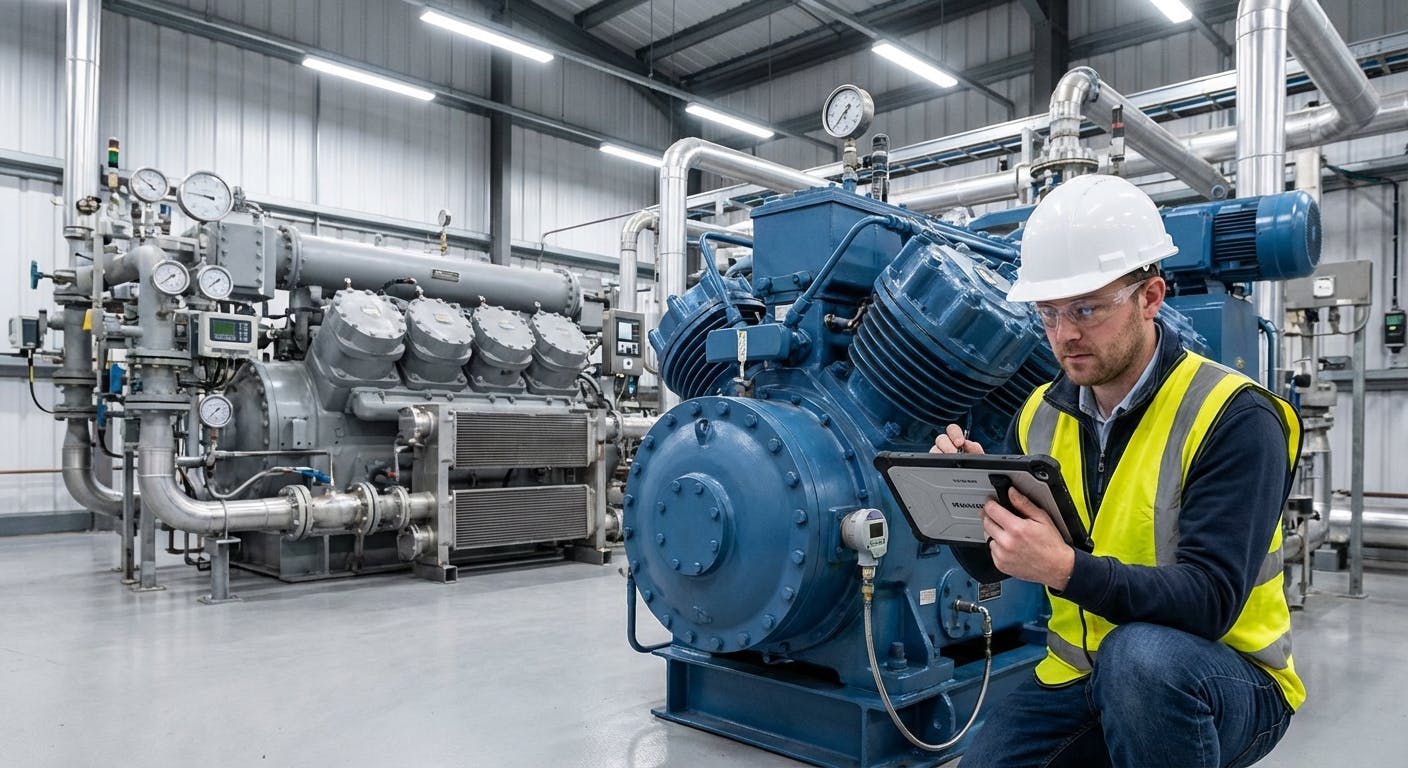
If you manage reciprocating compressors, you know the axiom: The valves are the Achilles' heel. Industry data consistently shows that valve failures account for nearly 36% to 50% of all unscheduled reciprocating compressor shutdowns.
When you search for "reciprocating compressor valve failure detection," you aren't looking for a definition of what a valve is. You are likely staring at a discharge temperature trend that looks suspicious, or you are trying to build a business case for a monitoring system that goes beyond simple vibration analysis.
The Core Question: How do I accurately detect reciprocating compressor valve failure before it causes unplanned downtime, and how do I distinguish a valve issue from ring failure or packing leaks?
The Direct Answer: Effective valve failure detection requires a "triangulation" strategy. You cannot rely on a single data point. You must correlate Thermodynamic Data (specifically discharge temperature spreads and p-V diagram analysis) with Acoustic Signatures (ultrasonic emission in the crank angle domain).
In 2026, the gold standard is no longer manual route-based collection; it is the integration of high-frequency edge data directly into your maintenance software. If your discharge temperature deviates by >15°F (8°C) from the average and your ultrasonic baseline shifts during the expansion stroke, you have a valve failure in progress.
But knowing the theory is different from executing the practice. Let’s break this down into the specific questions reliability engineers ask when implementing this strategy.
Question 1: What are the immediate "Process Variable" warning signs I can spot without advanced hardware?
Before we get into p-V diagrams and ultrasonics, your first line of defense is the data likely already sitting in your DCS or PLC. However, most operators set their alarm limits too wide to be useful for early detection.
The Discharge Temperature Spread
The single most reliable lagging indicator of a valve failure is the discharge temperature. When a valve leaks (specifically a suction valve), hot gas is pushed back into the suction chamber and then re-compressed. This re-compression causes a compounding heat effect.
The Benchmark:
- Normal Operation: The spread between cylinders on the same stage should be within 5°F to 10°F.
- Early Warning: A deviation of 15°F to 20°F above the stage average warrants immediate investigation.
- Critical Failure: A deviation of >30°F usually indicates severe plate cracking or spring failure.
The Trap: Do not rely solely on absolute temperature limits (e.g., "Alarm at 280°F"). If your compressor is running at 50% load on a cold day, a leaking valve might only raise the temperature to 240°F. You will miss the failure if you don't use deviation from average or deviation from predicted values.
Suction Pressure Anomalies
While less obvious than temperature, suction pressure behavior can indicate discharge valve failure. If a discharge valve fails to seal, high-pressure gas leaks back into the cylinder during the suction stroke. This prevents the cylinder pressure from dropping below the suction line pressure efficiently, delaying the opening of the suction valve.
Actionable Insight: Look for a slight increase in interstage pressure if a high-pressure stage suction valve is leaking. Conversely, a leaking discharge valve on a lower stage might starve the upper stages, changing compression ratios across the train.
Question 2: How do I use p-V Diagram Analysis to pinpoint the specific valve?
If process variables are the "check engine light," Pressure-Volume (p-V) diagrams are the diagnostic scan tool. This is the heart of predictive maintenance for compressors.
A p-V diagram plots Cylinder Pressure (Y-axis) against Piston Volume/Position (X-axis). To detect valve failure, you must analyze the shape of this loop.
The 4 Key Failure Signatures on a p-V Diagram
-
Suction Valve Leak:
- Visual Sign: The compression line (moving from bottom right to top left) will appear less steep than the adiabatic curve.
- Why: Gas is escaping back into the suction manifold during compression, so pressure doesn't build as fast as it should.
- Result: Loss of volumetric efficiency and capacity.
-
Discharge Valve Leak:
- Visual Sign: The re-expansion line (moving from top left to bottom right) extends further than normal. The "toe" of the diagram (where the suction valve opens) moves to the right.
- Why: High-pressure gas from the discharge header leaks back into the cylinder as the piston retreats. The cylinder pressure stays high longer, delaying the opening of the suction valve.
- Result: Significant reduction in volumetric efficiency.
-
Valve Flutter:
- Visual Sign: "Wavy" or oscillating lines during the suction or discharge plateau.
- Why: The valve plate is opening and closing rapidly (bouncing) rather than staying firmly open. This is often caused by incorrect spring stiffness for the operating condition.
- Result: Accelerated wear on the valve plate and springs, leading to eventual breakage.
-
Valve Slamming:
- Visual Sign: A sharp pressure spike at the very beginning of the discharge or suction stroke, followed by a rapid drop.
- Why: The valve is opening too late due to stiction (sticking due to oil/debris) or incorrect spring tension.
- Result: High impact forces that can shatter valve plates.
For a deeper technical dive into the physics of these diagrams, organizations like ASME (American Society of Mechanical Engineers) provide extensive standards and technical papers on reciprocating analysis.
Question 3: Can I "hear" the failure? (Acoustic Emission & Ultrasonics)
Vibration analysis is excellent for bearings and unbalance, but it is often a lagging indicator for valves. By the time a valve generates enough low-frequency vibration to trigger a standard accelerometer, the damage is often done.
Acoustic Emission (AE) and Ultrasonic Monitoring allow you to detect the high-frequency turbulence of a gas leak or the mechanical impact of a valve impact before it affects the thermodynamics significantly.
The Crank Angle Domain
To make acoustic data useful, it must be synchronized with the crank angle. You need to know exactly when the sound is happening.
- Normal Acoustic Signature: You should see distinct bursts of acoustic energy when valves open and close. The period between these events (compression and expansion) should be relatively quiet.
- Leaking Signature: If you see high-amplitude "hash" or noise during the compression stroke (when suction valves should be sealed) or expansion stroke (when discharge valves should be sealed), you have a leak. The gas passing through the closed valve creates turbulent flow, which generates ultrasonic noise.
Implementation Tip: Install ultrasonic sensors on the valve covers. If you are using a portable device, ensure you mark the exact measurement point to ensure repeatability. A shift of just a few inches can change the amplitude reading.
Question 4: How do I integrate this data into a "Connected Reliability" strategy?
This is where the industry has shifted in 2026. Detecting the failure is only half the battle. If the data sits in a siloed monitoring system and doesn't reach the maintenance team, the compressor still fails.
You need to move from Detection to Prescriptive Action.
The Data Pipeline
- Edge Processing: Your monitoring system (e.g., Bently Nevada, ProvibTech, or wireless IIoT sensors) detects the anomaly (e.g., Discharge Temp Spread > 15°F).
- Logic Layer: An AI or logic layer confirms the persistence of the alarm to rule out transient startups or load changes.
- CMMS Integration: The system automatically pushes an alert to your CMMS software.
- Work Order Generation: Instead of a generic "Check Compressor" alarm, the system generates a specific work order: "Inspect Cylinder 2 Suction Valve. Probability of leak: 85%. Recommended parts: Kit #V-2026-A."
The Role of AI
AI predictive maintenance models are now capable of distinguishing between a valve leak and a ring leak by analyzing the rate of change.
- Valve Failures: Often happen quickly (hours to days) once a plate cracks.
- Ring Wear: Happens slowly (months) and affects the p-V diagram differently (blow-by).
By feeding historical failure data into these models, you can predict the "Remaining Useful Life" (RUL) of the valve, allowing you to schedule the shutdown during a planned outage rather than an emergency.
Question 5: What are the root causes I should look for during the teardown?
You detected the failure, you shut down, and you pulled the valve. Now what? If you just replace the valve without understanding why it failed, you will be doing it again in three months.
Common Root Causes of Valve Failure
-
Liquid Carryover (Slugging):
- Evidence: Shattered valve plates, impact marks on the seat.
- Cause: Inadequate suction scrubbing or condensation in the lines. Liquids are incompressible; when they hit a valve moving at 1000 RPM, it destroys the plate.
- Fix: Check scrubber levels, heat tracing, and interstage knockout pots.
-
Debris/Foreign Material:
- Evidence: Dents or cuts in the valve plate (sealing element).
- Cause: Rust from piping, welding slag, or breakdown of upstream filter elements.
- Fix: Install conical strainers during startup and inspect suction filters regularly.
-
Acidic Attack/Corrosion:
- Evidence: Pitting on the valve springs or seat.
- Cause: Presence of H2S, CO2, or moisture creating acids.
- Fix: Upgrade valve materials (e.g., moving from stainless steel to PEEK or specialized alloys).
-
Lubrication Issues:
- Evidence: "Stiction" (sticky residue) or dry, worn surfaces.
- Cause: Over-lubrication leads to carbon buildup (coking) which prevents the valve from sealing. Under-lubrication causes friction wear.
- Fix: Audit your lube rates. More oil is not always better.
For tracking these root causes, utilize PM procedures within your maintenance software to force technicians to record the "As-Found" condition of the valve.
Question 6: How do I justify the cost of advanced monitoring?
A common objection from leadership is: "Why spend $50,000 on monitoring when a valve rebuild kit costs $500?"
You must frame the ROI in terms of Consequential Damage and Production Opportunity.
The Cost of Ignoring Valve Failure
- Efficiency Loss: A leaking valve recycles gas. You are paying electricity/fuel to compress the same gas twice. A 10% leak can result in thousands of dollars in wasted energy per month on a large unit.
- Downstream Damage: If a valve plate disintegrates, the metal fragments fall into the cylinder. The piston then slams these fragments into the cylinder wall or head.
- Cost of Valve: $500
- Cost of Cylinder Liner & Piston: $25,000+
- Cost of 3 Days Downtime: $100,000+ (depending on industry)
The Tiered Approach to Investment
If you cannot afford full online monitoring, start small:
- Tier 1 (Basic): Manual daily logging of discharge temperatures and pressures. Use mobile CMMS to ensure operators are actually at the machine (using GPS/NFC tags) when logging.
- Tier 2 (Intermediate): Wireless temperature transmitters on all discharge caps, feeding a central historian.
- Tier 3 (Advanced): Full online monitoring with crank-angle synchronized dynamic pressure and ultrasonic sensors.
Question 7: What if my compressor runs under variable load?
Variable Frequency Drives (VFDs) and stepless unloaders make detection harder because temperatures and pressures naturally fluctuate.
The Solution: Normalization. You cannot use static alarm setpoints for variable speed compressors. You must use Polytropic Discharge Temperature calculations.
The monitoring system should calculate what the discharge temperature should be based on the current suction pressure, discharge pressure, and gas composition (k-value).
- Formula: T_discharge_theoretical = T_suction * (P_discharge / P_suction)^((k-1)/k)
- Alarm Logic: If (Actual Temp - Theoretical Temp) > Threshold, then Alarm.
This method filters out the noise caused by load changes and highlights only the thermodynamic inefficiencies caused by valve leaks.
Conclusion: Moving from Reactive to Proactive
Reciprocating compressor valve failure detection is not magic; it is physics. By monitoring the heat (temperature), the cycle (p-V diagrams), and the sound (ultrasonics), you can virtually "see" inside the cylinder while the machine is running.
However, the technology is only as good as the workflow it triggers. The most successful reliability teams are those that connect these insights directly to their work order systems, ensuring that a detected anomaly becomes a scheduled repair, not a catastrophic surprise.
Ready to integrate your condition monitoring data into a streamlined maintenance workflow? Explore how modern asset management tools can bridge the gap between your sensors and your technicians.
