
Recent Artificial Intelligence: What the "Industrial Filter" Means for Maintenance Managers in 2026
Feb 13, 2026
recent artificial intelligence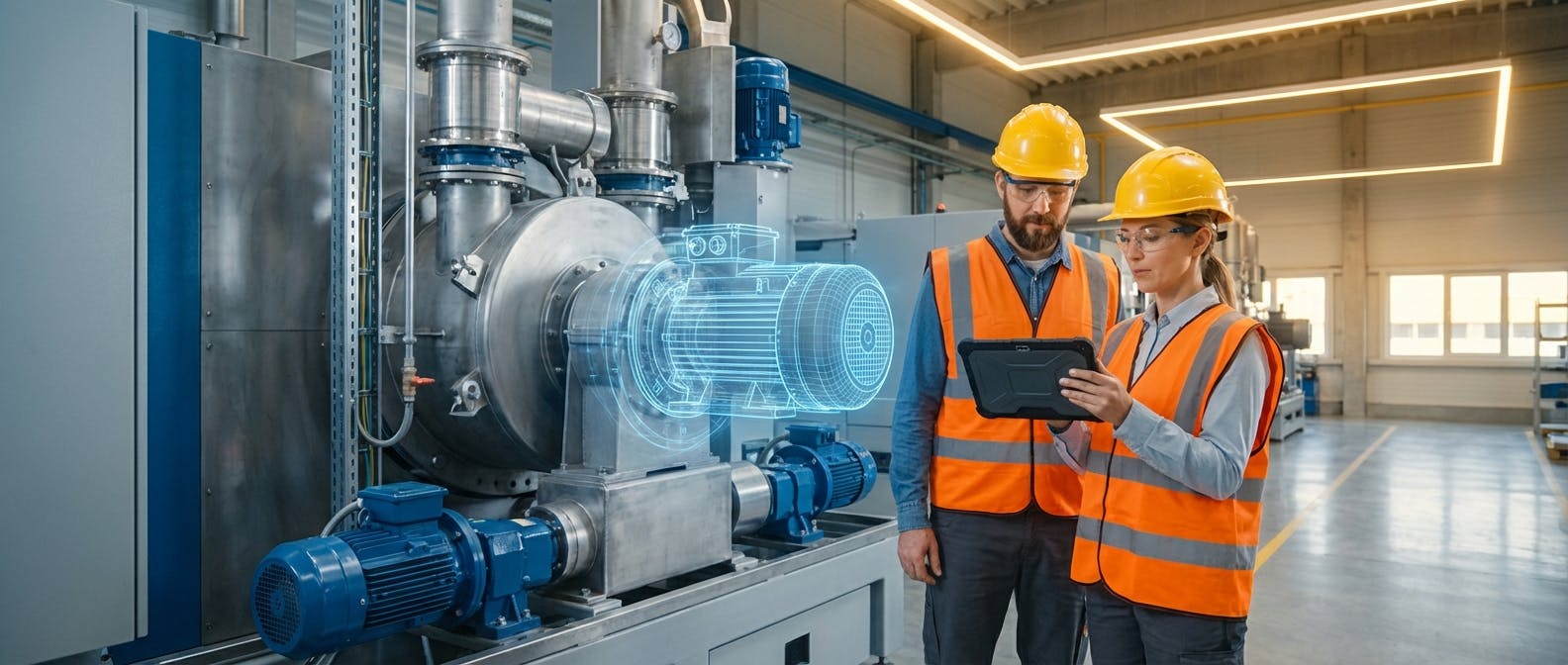
If you search for "recent artificial intelligence" today, you are likely inundated with news about chatbots writing poetry, image generators creating surreal art, or students using AI to write essays. For a maintenance manager or plant director, this noise is distracting. You don't need a poem; you need to know why Conveyor 3 keeps overheating or how to reduce your spare parts inventory without risking a stockout.
The core question industrial leaders are asking in 2026 isn't "What can AI do?" It is: "Which specific recent AI breakthroughs can I apply to my physical assets right now to improve reliability and reduce costs, and which are just consumer hype?"
The answer lies in the shift from predictive to prescriptive and generative industrial AI. While 2023-2024 was about teaching machines to recognize patterns (predicting failure), recent advancements have empowered systems to understand context, generate solutions, and communicate them in natural language. We are no longer just looking at a dashboard of red and green lights; we are interacting with systems that draft work orders, perform root cause analysis (RCA) autonomously, and optimize maintenance schedules based on real-time production demands.
This guide filters the "recent artificial intelligence" landscape specifically for the maintenance professional, stripping away the consumer fluff to focus on actionable industrial applications.
1. Beyond Prediction: How Has Industrial AI Evolved in the Last 18 Months?
To understand where we are, we must acknowledge the rapid leap from standard machine learning to Generative AI (GenAI) and Large Language Models (LLMs) specialized for industry.
The Shift from "When" to "How"
For the last decade, the holy grail was Predictive Maintenance (PdM). Sensors would monitor vibration or temperature, and an algorithm would flag an anomaly. The output was usually an alert: "Bearing failure likely in 48 hours."
Recent AI has moved the goalposts. The alert is now the start of the process, not the end. New systems utilize prescriptive maintenance to answer the follow-up question: "Okay, it’s failing. What do I do now?"
In 2026, a typical AI-driven alert looks like this:
- Detection: Vibration spike detected on Pump 4-B.
- Diagnosis: Signature matches inner race defect.
- Prescription: Schedule replacement during the Tuesday changeover.
- Preparation: Work Order #9021 created. Spare part #SKF-2222 reserved from inventory. SOP #44 attached.
The Rise of "Industrial GenAI"
General-purpose AI models often hallucinate or lack domain knowledge. Recent breakthroughs involve "Small Language Models" (SLMs) trained specifically on OEM manuals, historical maintenance logs, and engineering standards.
These models allow maintenance technicians to query their CMMS software using natural language. Instead of clicking through ten sub-menus to find a torque specification, a technician can simply ask the mobile app, "What is the torque setting for the mounting bolts on the main drive motor?" and receive an instant, cited answer from the digital manual.
2. How Does Generative AI Actually Work in Maintenance Workflows?
A common skepticism among facility managers is that AI is a "black box." How does this technology practically manifest on the shop floor? The most tangible application of recent AI is in the automation of administrative drudgery and the democratization of technical knowledge.
Automated Work Order Generation
One of the biggest friction points in maintenance is data entry. Technicians hate it. Consequently, work order descriptions are often brief and unhelpful (e.g., "Fixed broken thing").
Recent Natural Language Processing (NLP) capabilities have revolutionized this. When a technician dictates a voice note into a mobile CMMS, the AI:
- Transcribes the audio to text, filtering out background factory noise.
- Structures the data, categorizing the asset, the failure code, and the action taken.
- Suggests follow-up tasks based on the description.
For example, if a technician says, "I tightened the belt on the overhead conveyor because it was slipping," the AI logs the action, but might also flag that this is the third time this belt has been tightened in a month, triggering a suggestion for a root cause analysis on the tensioner assembly.
AI-Driven Root Cause Analysis (RCA)
Traditional RCA requires gathering a team, pulling data from disparate sources (SCADA, CMMS, operator logs), and brainstorming. Recent AI agents can perform a preliminary RCA in seconds.
By ingesting data from manufacturing AI software, the system can correlate variables that humans might miss. It might notice that the conveyor motor failure correlates with specific humidity spikes in the facility or occurs only when Product Line B is running at maximum speed. It presents these correlations to the reliability engineer, drastically shortening the investigation time.
The "Co-Pilot" for Junior Technicians
With the skilled labor shortage continuing to plague the industry, recent AI acts as a force multiplier for less experienced staff. Augmented by digital twins and AI assistants, a junior technician can tackle complex repairs. The AI can guide them step-by-step through a PM procedure, warning them of safety hazards specific to the machine's current state (e.g., "Warning: This machine was running 10 minutes ago; surface temperature may exceed 150°F").
3. What Are the Real Costs and ROI of Implementing These Technologies?
The technology sounds impressive, but does the balance sheet support it? This is the most critical question for leadership. The ROI of recent AI is no longer just about preventing catastrophic failure; it is about efficiency gains in the "middle 80%" of maintenance activities.
The Cost of False Positives vs. Missed Detections
Early predictive models were notorious for false positives—alerting maintenance to fix machines that weren't broken. This eroded trust and wasted labor hours.
Recent algorithms have significantly improved signal-to-noise ratios. According to reliability standards organizations like Reliabilityweb, modern anomaly detection reduces false alarms by cross-referencing multiple data points (e.g., vibration + current + temperature) rather than relying on single-variable thresholds.
ROI Calculation Example:
- Old Way: Preventive maintenance on a motor every 500 hours regardless of condition. Cost: $500 in labor/parts per instance.
- New Way: AI monitors the motor. Maintenance is deferred to 1,200 hours based on actual health.
- Savings: You eliminate more than 50% of the PMs on that asset. Multiply that by 500 motors in a plant, and the ROI on predictive maintenance for motors becomes immediate.
Inventory Optimization
Spare parts inventory is often a massive source of tied-up capital. Companies keep millions of dollars in parts "just in case."
Recent AI models analyze usage rates, lead times, and asset criticality to optimize stock levels. They can predict that you don't need five spare gearboxes sitting on the shelf; you need one on the shelf and one on order. By dynamically adjusting min/max levels in your inventory management system, facilities can often reduce carrying costs by 15-20% within the first year.
The "Hidden" ROI: Administrative Time
Don't underestimate the value of time saved on paperwork. If GenAI saves each technician 30 minutes of data entry per shift, and you have 20 technicians, that is 10 hours of skilled labor returned to the floor every single day. That is equivalent to gaining more than one full-time employee without hiring anyone.
4. How Do I Get Started Without Disrupting Operations?
The prospect of overhauling a maintenance strategy to include AI can feel overwhelming. The key is to avoid the "Big Bang" approach. Do not try to AI-enable the entire plant at once.
The Pilot Program Strategy
Start with your "Bad Actors"—the assets that cause the most headaches.
- Identify Critical Assets: Choose assets where failure is expensive, such as overhead conveyors or main air compressors.
- Retrofit Sensors: You don't need new machines. Wireless IoT sensors can be magnetically attached to existing equipment to measure vibration and temperature.
- Establish a Baseline: Let the AI listen to the machine for 2-4 weeks to understand "normal" operation.
- Integrate with Workflow: Ensure the data doesn't just go to a dashboard nobody checks. It must feed directly into your work order software.
Brownfield vs. Greenfield
Most readers are operating in "brownfield" environments—older factories with legacy equipment. Recent AI excels here because it is often hardware-agnostic. Modern integrations allow AI layers to sit on top of legacy PLCs and SCADA systems. You do not need to replace the PLC from 1998; you just need a gateway that can read its data tags and send them to the cloud for analysis.
The Human Element: Change Management
The biggest barrier to AI adoption isn't technology; it's culture. Technicians may fear that AI is there to replace them or "spy" on their productivity.
- Positioning: Frame AI as a tool to eliminate the parts of the job they hate (paperwork, emergency call-ins at 2 AM) rather than the parts they enjoy (fixing things).
- Involvement: Involve senior technicians in the training of the AI. Let them validate the AI's diagnosis. When the AI says "bearing fault," and the veteran tech confirms it, trust is built.
5. What About Data Quality? The "Garbage In, Garbage Out" Problem
You cannot have "recent artificial intelligence" without "reliable historical data." If your CMMS is filled with work orders that say nothing but "fixed it," the most advanced AI in the world cannot help you predict future failures.
Cleaning the Data Lake
Before deploying GenAI, you must audit your data.
- Standardization: Enforce standard naming conventions for assets. "Conv-1" and "Conveyor #1" look like two different machines to a basic algorithm.
- Failure Codes: Move away from "Other" as a failure code. Force technicians to select specific problem codes (e.g., "Electrical - Short," "Mechanical - Wear").
The Role of Synthetic Data
Interestingly, recent AI helps solve the data shortage problem. If you don't have enough failure data for a specific pump, AI can generate "synthetic data"—simulating failure signatures based on physics models. This allows the system to recognize a failure mode it has never actually seen in your specific facility, bridging the gap until real data is accumulated.
For more on the importance of data standards in industrial AI, the National Institute of Standards and Technology (NIST) provides excellent frameworks for manufacturing data interoperability.
6. What Are the Risks and Edge Cases?
It is irresponsible to discuss recent AI without addressing the risks. In an industrial setting, a "hallucination" isn't just a funny wrong answer; it can be a safety hazard.
Hallucinations in SOPs
If you ask a GenAI model to write a lockout/tagout (LOTO) procedure, and it misses a step, someone could get hurt.
- The Solution: Human-in-the-loop (HITL). AI should draft the procedure, but a certified safety officer must approve it. Never allow AI to push safety procedures directly to the floor without verification.
Cybersecurity and the Edge
Connecting critical infrastructure to the cloud for AI processing introduces attack vectors.
- Edge Computing: To mitigate this, recent trends favor "Edge AI." This involves processing data locally on the device or a local server rather than sending everything to the cloud. This reduces latency and keeps sensitive operational data within the factory firewall.
- One-Way Gateways: Ensure that data flows out of the machine to the AI, but the AI cannot write code back to the machine's PLC without manual authorization. This prevents a compromised AI system from shutting down a production line or speeding up a compressor to dangerous levels.
The "Black Swan" Events
AI is based on probability and historical patterns. It struggles with "Black Swan" events—unprecedented, catastrophic failures that have never happened before.
- The Strategy: Do not rely solely on AI for safety-critical shutoffs. Hard-wired safety interlocks and mechanical relief valves must remain the ultimate authority, regardless of what the AI predicts.
7. The Future Outlook: What to Expect in 2027 and Beyond
As we look toward the immediate future, the convergence of AI and robotics will likely be the next frontier. We are already seeing early stages of "self-healing" systems where software can automatically reboot or reconfigure itself to bypass a fault.
However, for the next 12-24 months, the biggest gains for the average facility will come from Asset Management Intelligence. This is the holistic view where AI balances maintenance needs with production schedules and energy costs.
Imagine a system that knows bearings on Line 1 are degrading. Instead of just scheduling a repair, the AI checks the production schedule, sees a gap on Thursday, checks the energy pricing forecast (seeing electricity is cheaper on Thursday night), and checks the weather (knowing humidity affects the cure time of the product). It then proposes a maintenance window that minimizes total business cost, not just maintenance cost.
Final Thoughts
Recent artificial intelligence in maintenance is not about replacing human expertise; it is about scaling it. It allows one reliability engineer to monitor 1,000 assets effectively instead of 100. It turns the CMMS from a passive database into an active team member.
For maintenance managers, the path forward is clear: Ignore the consumer hype, focus on data quality, start with your most critical assets, and demand measurable ROI from any AI solution you implement. The technology is ready; the competitive advantage now belongs to those who implement it wisely.
