
Predictive Maintenance for Blast Freezers: Why Temperature Monitoring is Not Enough
Feb 2, 2026
predictive maintenance for blast freezers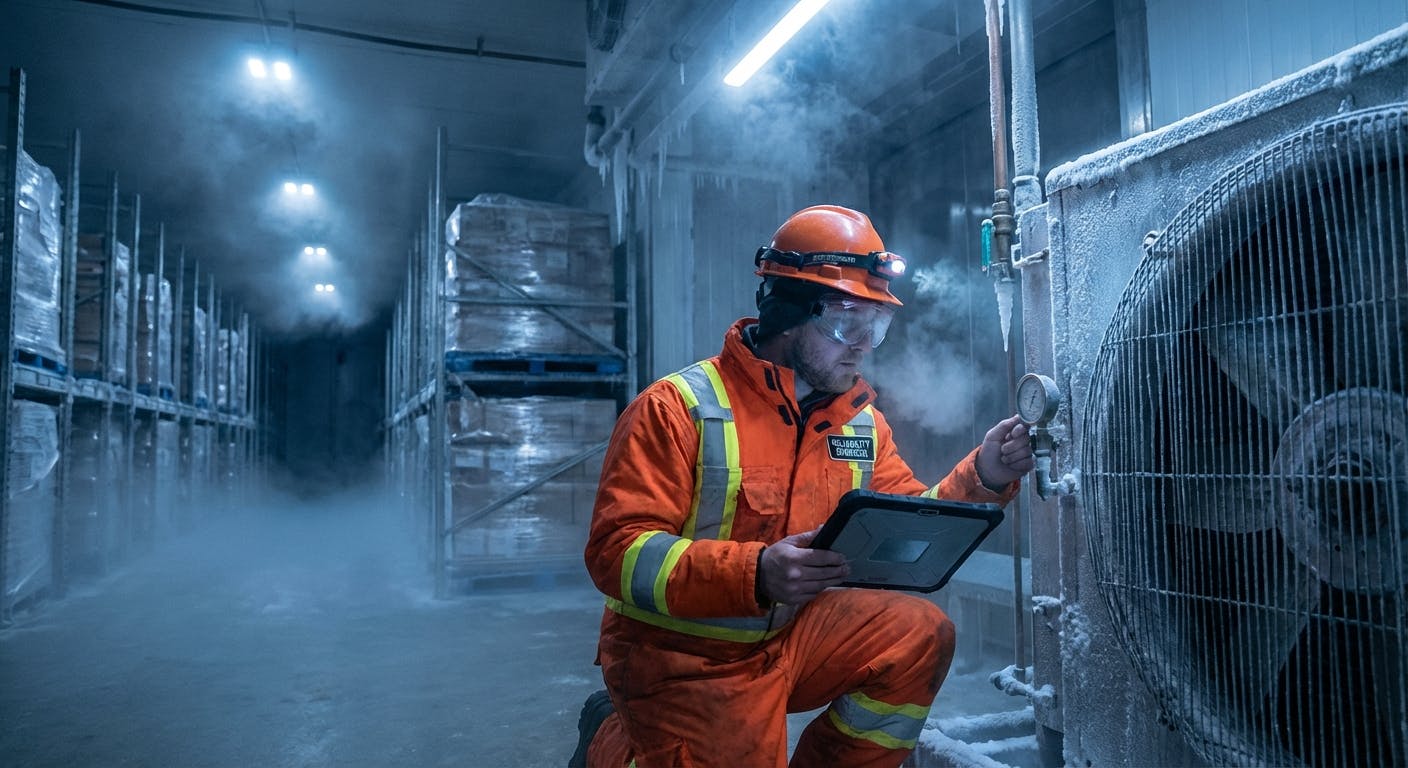
It is 2:00 AM on a Saturday. Your facility’s primary blast freezer, currently loaded with $50,000 worth of high-value protein or temperature-sensitive pharmaceuticals, has just triggered a high-temperature alarm.
By the time you receive that alert, the internal temperature has likely already drifted above the critical threshold. The compressor failed three hours ago, but the insulation held the cold just long enough to delay the alarm. Now, you are in reactive mode. You are scrambling for technicians, calculating potential spoilage costs, and facing a disrupted production schedule for the coming week.
If you are a Facility Manager or Maintenance Director in 2026, this scenario shouldn't happen.
The core question driving the search for predictive maintenance for blast freezers is usually this: How do I know my refrigeration system is going to fail before the temperature actually rises?
The answer lies in a fundamental shift in how we view data: You must stop treating temperature as a health indicator and start treating it as a lagging result. To predict failure, you must monitor the mechanical stress of the components—specifically the compressors and evaporator fans—through vibration and power analysis.
This guide explores exactly how to implement this, the specific thresholds to watch, and the ROI of moving from reactive to predictive strategies in cold chain environments.
The Core Concept: Leading vs. Lagging Indicators in Cold Storage
To understand why traditional monitoring fails blast freezers, we have to look at the physics of failure.
In a blast freezer, the goal is rapid heat exchange. The system works harder and under more extreme conditions (often -30°F to -40°F) than standard cold storage.
The Lagging Indicator: Temperature
Temperature is the result of the system working. If the temperature rises, the failure has already occurred. Relying on a thermostat to tell you a compressor is broken is like waiting for smoke to tell you your engine is overheating. It is too late to prevent the damage; you are now just managing the disaster.
The Leading Indicators: Vibration and Power
Mechanical failure is rarely instantaneous. It is a process of degradation.
- Vibration: Before a compressor bearing seizes, it vibrates at specific frequencies. Before an evaporator fan blade breaks due to ice buildup, the imbalance creates a distinct wobble.
- Power (Amperage): As a motor struggles against friction or a clogged condenser, it draws more current.
By using AI-driven predictive maintenance, you can detect these subtle shifts weeks or months before they result in a thermal event.
Follow-Up Question: What Specifically Should I Monitor on a Blast Freezer?
You cannot simply "monitor everything." That leads to data fatigue. In a blast freezer environment, you need to focus your sensors on the assets that carry the highest risk and the highest load.
1. The Compressor (The Heart)
The compressor is the most critical and expensive component. In blast freezing, compressors run at high compression ratios, creating significant thermal and mechanical stress.
What to monitor:
- High-Frequency Vibration: This detects bearing faults (inner race, outer race, ball spin). In 2026, we use piezoelectric accelerometers or MEMS sensors capable of sampling up to 10kHz.
- Low-Frequency Vibration: This detects misalignment between the motor and the compressor, or looseness in the mounting bolts (common due to thermal expansion/contraction cycles).
- Discharge Temperature: While we said temperature is lagging for the room, the discharge temperature of the refrigerant is a leading indicator of compressor health. High discharge temps indicate valve issues or non-condensables in the system.
The Benchmark: According to ISO 10816 standards, vibration velocity on a compressor generally shouldn't exceed 4.5 mm/s RMS for long-term operation. However, with predictive maintenance for compressors, we aren't just looking for a threshold breach; we are looking for the trend. A steady climb from 1.2 mm/s to 2.5 mm/s over a week is a "Check Engine" light, even if it hasn't hit the ISO limit.
2. Evaporator Fans (The Lungs)
In a blast freezer, airflow is everything. If you cannot strip the boundary layer of heat off the product, you cannot freeze it quickly.
What to monitor:
- Imbalance (1x RPM Vibration): This is the killer in freezers. Ice builds up unevenly on fan blades. This creates an imbalance that destroys motor bearings and can shatter fan blades.
- Motor Current: A spike in amperage often indicates the fan is fighting against high static pressure (blocked coil) or a seizing bearing.
Real-World Scenario: A sensor detects a 30% increase in vibration at the fan's running speed (1x RPM). The AI correlates this with the defrost schedule. It notices the vibration drops after a defrost cycle but returns quickly.
- Diagnosis: The defrost cycle is too short or the drain line is clogged, causing ice to remain on the blades.
- Action: Adjust the defrost timer before the fan motor burns out.
3. The Condenser
Often located on the roof, the condenser is subjected to the elements.
What to monitor:
- Differential Pressure: Across the coil to detect dirt/debris buildup.
- Fan Vibration: Similar to the evaporator, but often larger fans.
Follow-Up Question: How Do I Handle the "Defrost Cycle" Complexity?
This is a common question because blast freezers have aggressive defrost cycles. These cycles wreak havoc on standard monitoring alarms.
When a freezer goes into defrost:
- Temperature spikes (intentionally).
- Compressors might ramp down or shut off.
- Fans turn off.
- Heaters turn on.
If your monitoring system isn't "context-aware," it will send you false alarms every 6 hours.
The Solution: State-Based Monitoring
Modern asset management systems integrated with IIoT sensors use state-based monitoring. The system needs to know when it is in defrost mode.
- During Freezing: Alarm limits are tight. Vibration monitoring is active.
- During Defrost: Vibration alarms are muted (since fans are off). Temperature alarms are relaxed. Heater amperage is monitored (to ensure defrost is actually working).
Advanced Insight: You can use predictive data to move from "Timer-Based Defrost" to "Condition-Based Defrost." Instead of defrosting every 6 hours regardless of ice buildup, use the efficiency drop across the evaporator (measured by air pressure differential and fan power) to trigger a defrost only when necessary. This saves massive amounts of energy.
Follow-Up Question: What About Connectivity Inside a Metal Box?
Blast freezers are essentially Faraday cages—thick, insulated metal boxes that block Wi-Fi and cellular signals. How do you get the data out?
This is a logistical hurdle that trips up many pilot programs.
1. Wired Sensors (The Old School)
Reliable, but expensive to install. Drilling through freezer walls compromises insulation and introduces moisture ingress points (which turn into ice).
2. LoRaWAN (The Industry Standard)
In 2026, LoRaWAN (Long Range Wide Area Network) is the preferred protocol for industrial refrigeration. It operates at a lower frequency (900 MHz range) which penetrates concrete and metal significantly better than 2.4 GHz Wi-Fi.
3. Gateway Placement
The strategy is to place the sensors inside the freezer on the evaporator fans, but mount the gateway (the receiver) immediately outside the freezer door or in the roof void. The signal only has to penetrate one layer of insulation.
For the compressors (usually in a separate engine room), connectivity is rarely an issue.
Follow-Up Question: What is the ROI? (Show Me the Numbers)
Implementing predictive maintenance requires an upfront investment in sensors and software. How do you justify this to the CFO?
You need to calculate the Cost of Unreliability (CoU).
1. Spoilage Avoidance
- Scenario: A blast freezer fails during a cycle for a pharmaceutical batch.
- Cost: $150,000 in lost product + disposal costs.
- Predictive Cost: $2,000 for sensors + $1,000/year software subscription.
- ROI: The system pays for itself 50x over by preventing a single catastrophic event.
2. Energy Efficiency (The Hidden Saver)
A compressor with a failing valve or bearing consumes 10-15% more power to do the same work. A fouled condenser increases head pressure, driving up amperage.
- Math: A 100HP compressor running 24/7 costs roughly $60,000/year in electricity (at $0.10/kWh).
- Savings: Improving efficiency by just 5% saves $3,000/year per compressor. This alone often covers the subscription cost of the CMMS software.
3. Maintenance Labor Optimization
Instead of performing "preventive" checks every month (opening panels, checking belts), you only deploy labor when the data indicates a problem. This reduces "wrench time" on healthy assets.
For a deeper dive into maintenance cost structures, ReliabilityWeb offers excellent frameworks on calculating Asset Replacement Value (ARV) versus maintenance spend.
Follow-Up Question: How Do I Get Started Without Overwhelming My Team?
A common mistake is buying 500 sensors and drowning in data. Start small, prove value, then scale.
Phase 1: The "Bad Actor" Pilot
Identify the one blast freezer that gives you the most trouble. The one that keeps tripping alarms or struggling to reach setpoints.
- Install vibration/temp sensors on the compressor and evaporator fans.
- Establish a baseline for 2 weeks.
- Set alerts based on change from baseline, not just absolute ISO standards.
Phase 2: Integration with Work Orders
Data is useless without action. If a sensor detects high vibration, it shouldn't just send an email that gets ignored. It should automatically trigger a work order in your system.
- Workflow: Sensor detects anomaly $\rightarrow$ AI verifies trend $\rightarrow$ Work order software generates a "High Priority Inspection" ticket $\rightarrow$ Technician receives alert on mobile.
Phase 3: Prescriptive Maintenance
Once you have history, move to prescriptive maintenance. This is where the system doesn't just say "Vibration High," but says "Vibration High at 1x RPM on Fan 3: Likely Ice Imbalance. Initiate Manual Defrost."
Follow-Up Question: Ammonia (NH3) vs. Freon/HFCs – Does it Matter?
Yes. The refrigerant type dictates the criticality and safety protocols.
Ammonia Systems
Industrial blast freezers often use Ammonia. It is highly efficient but toxic.
- The Stakes: A leak here isn't just an EPA fine; it's a plant evacuation and potential injury.
- Predictive Angle: Vibration monitoring on ammonia compressors is non-negotiable to prevent seal failures that lead to leaks. You should also integrate fixed gas detection sensors into your predictive dashboard.
HFC/HFO Systems
- The Stakes: Refrigerant is expensive and environmentally regulated.
- Predictive Angle: Focus on leak detection via "receiver level" monitoring. If the liquid level in the receiver drops slowly over a month, you have a micro-leak.
For guidelines on safety standards regarding ammonia refrigeration, refer to the International Institute of Ammonia Refrigeration (IIAR).
Troubleshooting: Common Signals and What They Mean
If you are looking at a dashboard right now, here is a quick cheat sheet for blast freezer diagnostics:
| Symptom | Component | Likely Cause | Action |
|---|---|---|---|
| Rising Vibration (1x RPM) | Evaporator Fan | Ice buildup on blades (Imbalance) | Check defrost termination; inspect drain pan. |
| Rising Vibration (High Freq) | Compressor | Bearing degradation | Schedule bearing replacement during next downtime window. |
| High Amperage + Low Cooling | Compressor | Fouled Condenser (High Head Pressure) | Clean condenser coils. |
| Low Amperage + Low Cooling | Compressor | Low Refrigerant Charge (Leak) | Leak check immediately. |
| High Temp + Normal Amps | Room | Door left open / Seal failure | Check door switches and gaskets. |
Conclusion: The Future is Autonomous
By 2026, the best-in-class facilities are not just monitoring their blast freezers; they are letting the freezers self-optimize. Systems are now capable of adjusting fan speeds and compressor loading based on real-time vibration feedback to extend asset life.
But you don't need to be fully autonomous to see results. You just need to stop waiting for the temperature alarm.
Ready to stop the 2 AM emergencies? Start by looking at your most critical blast freezer. If you don't know the vibration levels of its compressor right now, you are flying blind. It’s time to switch the lights on.
Explore how Predict can integrate seamlessly with your existing maintenance workflow to provide these insights today.
