
PPO Reinforcement Learning for Chiller Plants: Moving Beyond PID Control
Feb 2, 2026
PPO reinforcement learning for chiller plant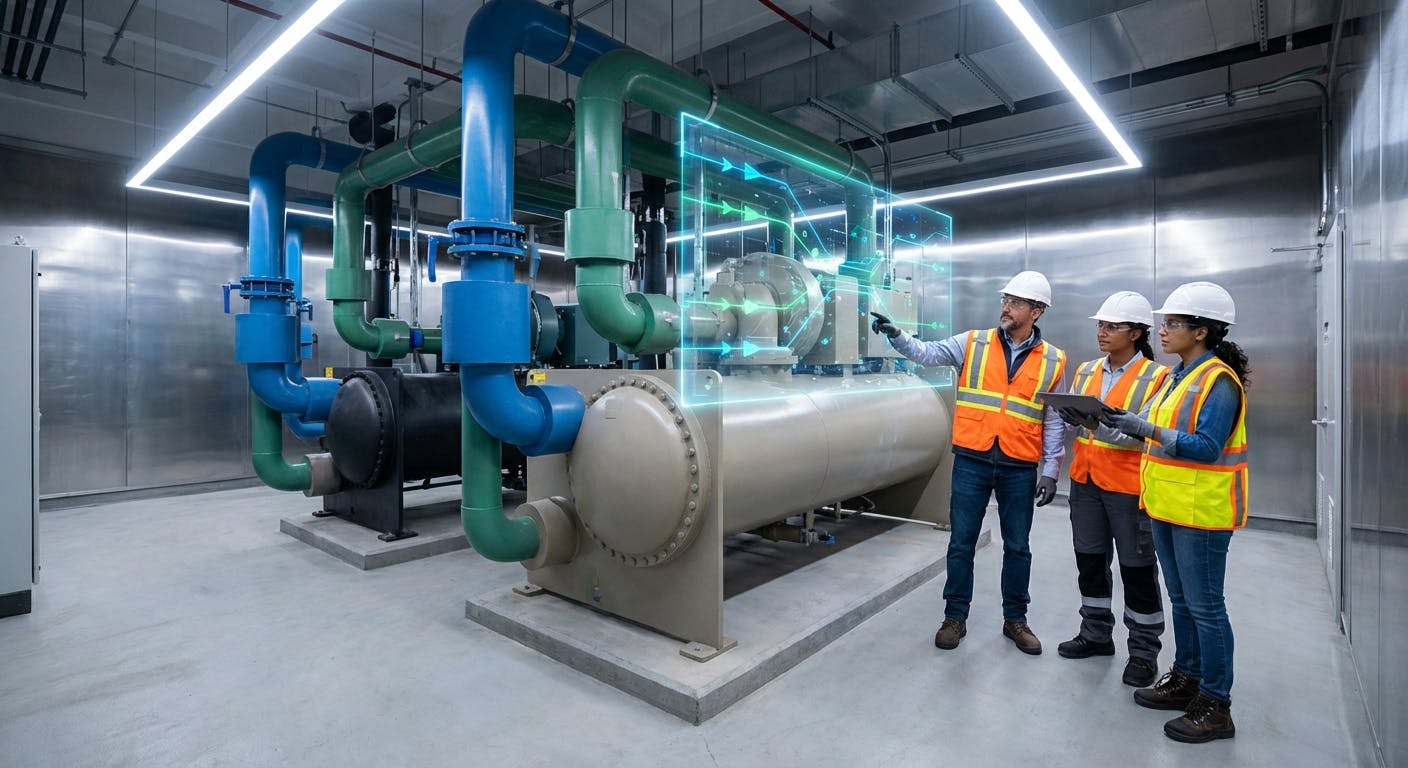
In the high-stakes world of industrial HVAC and facilities management, the chiller plant represents the single largest energy consumer, often accounting for 35% to 50% of a building's total electricity usage. For decades, we relied on PID (Proportional-Integral-Derivative) loops and rule-based logic to manage these complex systems. While reliable, PID loops are reactive; they correct errors only after they occur and struggle to optimize for global efficiency across non-linear variables like weather, occupancy, and variable electricity pricing.
This brings us to the core question driving modern facility optimization: Why is Proximal Policy Optimization (PPO) becoming the industry standard for chiller plant control, and how do we implement it without risking equipment damage?
The short answer is that PPO offers the "Goldilocks" balance in Deep Reinforcement Learning (DRL). Unlike Deep Q-Networks (DQN), which struggle with continuous control (like exact valve positions), and unlike Trust Region Policy Optimization (TRPO), which is computationally expensive, PPO is stable, sample-efficient, and capable of handling the continuous action spaces required for precise temperature and flow setpoints.
But implementing "AI" on critical infrastructure isn't as simple as importing a Python library. It requires a safety-first architecture, a robust digital twin, and a deep understanding of thermodynamics.
Why PPO? The Case for Continuous Control in HVAC
To understand why we use PPO, we must first look at the limitations of the alternatives.
The Problem with Discrete Actions (DQN)
Early attempts at using AI for HVAC utilized Deep Q-Networks (DQN). DQN works by selecting from a list of discrete actions. For a chiller, this might look like:
- Increase setpoint by 1°F
- Decrease setpoint by 1°F
- Do nothing
This is "bang-bang" control logic. It creates jagged operational trends and wears out actuators. Chiller plants are dynamic systems requiring continuous control. You don't want to choose between opening a valve 10% or 20%; you might need it exactly at 14.5% to balance the hydraulic load.
The PPO Advantage
Proximal Policy Optimization operates in continuous action spaces. It outputs a probability distribution for actions (e.g., a Gaussian distribution for the Chilled Water Supply Temperature setpoint). This allows for smooth, granular adjustments that mimic—and eventually surpass—the finesse of a seasoned human operator.
Furthermore, PPO introduces a "clipping function" to the objective function. In plain English, this prevents the AI from making drastic changes to its policy based on a single piece of data. It forces the model to learn gradually. In a chiller plant, where thermal inertia is high (it takes time for water to cool down), this stability is non-negotiable.
How Does PPO Actually Work in a Chiller Plant?
If you are a data scientist or an HVAC engineer looking to build this, you need to define the Markov Decision Process (MDP). This is the framework the AI uses to perceive and act on the world.
1. The State Space (What the AI Sees)
The state space ($S_t$) is the input vector fed into the neural network. For a chiller plant, a robust state space must include:
- System Variables: Supply/Return temperatures (Chilled Water & Condenser Water), flow rates, pump speeds, and compressor power draw.
- Environmental Variables: Outdoor air temperature, relative humidity (wet bulb is critical for cooling towers), and solar irradiance.
- Forecast Data: Predicted weather for the next hour and predicted cooling load (occupancy).
- Time: Hour of day, day of week (to learn schedules).
2. The Action Space (What the AI Controls)
The action space ($A_t$) for PPO in this context is continuous. The agent outputs values typically normalized between -1 and 1, which are then scaled to real-world limits.
- Chilled Water Supply Temperature (CHWST) Setpoint: e.g., 42°F to 55°F.
- Condenser Water Supply Temperature (CWST) Setpoint: e.g., 65°F to 85°F.
- Pump Speed Ratios: If Variable Frequency Drives (VFDs) are available.
3. The Reward Function (The Goal)
This is the most critical component. If you tell the AI only to "minimize energy," it will simply turn the chiller off. The reward function ($R_t$) must balance efficiency with comfort and safety.
A standard reward function for PPO in HVAC looks like this:
$$ R_t = - (w_1 \cdot E_{total} + w_2 \cdot P_{discomfort} + w_3 \cdot P_{switching}) $$
Where:
- $E_{total}$: Total power consumption (Chiller + Pumps + Towers).
- $P_{discomfort}$: Penalty calculated based on the deviation of zone temperatures from the desired setpoint (Predicted Mean Vote or simple degree-deviation).
- $P_{switching}$: A penalty for changing setpoints too rapidly (actuator wear and tear).
- $w$: Weights assigned to prioritize these factors.
The "Safety-First" Angle: Constrained PPO
A common fear among facility managers is, "Will the AI freeze my evaporator?" or "Will it surge the compressor?"
Standard PPO is an optimization algorithm, not a safety algorithm. To deploy this in 2026, we utilize Constrained PPO (CPPO) or incorporate a Safety Layer.
The Action Masking Approach
Before the PPO agent's chosen action is sent to the Building Automation System (BAS), it passes through a logic filter (the Safety Layer).
- Hard Constraints: If the agent requests a CHWST of 38°F, but the safety limit is 40°F, the system overrides the action to 40°F.
- Rate of Change Limits: If the agent wants to drop the temperature from 50°F to 42°F in one minute, the safety layer ramps it down over 15 minutes instead.
Penalty Shaping
In the training phase, violating a constraint shouldn't just result in a bad score; it should result in a "death penalty"—a massive negative reward that teaches the agent that this state is unacceptable.
However, relying solely on reward shaping is risky for real-world hardware. Always implement hard-coded safety logic between the AI and the PLC.
From Simulation to Reality: The Implementation Workflow
You cannot train a PPO agent on a live building. RL requires millions of timesteps to converge. Running a chiller for 10 years to train an AI is impossible. You need a Digital Twin.
Step 1: Building the Environment
We typically use EnergyPlus or Modelica wrapped in a Python environment (like OpenAI Gym or Gymnasium).
- Calibration: The simulation must match your actual building. You feed historical data (weather, load, energy) into the model and tune the parameters until the simulation's energy output matches historical reality within 5-10%.
- Sim-to-Real Gap: The simulation will never be perfect. To handle this, we use Domain Randomization. During training, we randomly vary parameters (like heat transfer coefficients or sensor noise) so the PPO agent learns a robust policy that works even if the real world is slightly different from the model.
Step 2: Offline Training
The PPO agent trains in the simulation, running through thousands of "virtual years" in a few hours. It learns that lowering condenser water temperature saves compressor energy but increases cooling tower fan energy, finding the optimal balance point for every weather condition.
Step 3: Shadow Mode
Once trained, the model is deployed to the edge device or cloud connected to the BAS. It runs in "Shadow Mode." It reads live data and predicts actions, but does not execute them. We compare the AI's suggested actions against the existing BAS logic.
- Scenario: The BAS keeps CHWST at 44°F constant. The AI suggests 48°F because the load is low.
- Validation: Engineers review these suggestions to ensure they make thermodynamic sense.
Step 4: Closed-Loop Control
Only after validation is the "write" permission enabled. Even then, it is usually rolled out in phases (e.g., control only one chiller first, or limit the authority range).
For seamless integration with existing systems, check out our guide on integrations which discusses connecting advanced logic layers to standard industrial protocols.
Data Requirements and Infrastructure
To run PPO, you need high-frequency, clean data. Most legacy BMS setups poll data every 15 minutes. This is insufficient for training high-fidelity models, though it may suffice for execution.
The Sensor Suite
You likely already have the sensors, but are they calibrated?
- Flow Meters: Ultrasonic or magnetic flow meters are essential for calculating thermal load ($Q = 500 \times Flow \times \Delta T$).
- Power Meters: You need separate metering for chillers, primary pumps, secondary pumps, and cooling tower fans. If you only have a main utility meter, the AI cannot learn which component to optimize.
The Data Pipeline
- Ingestion: BACnet/IP or Modbus TCP to an Edge Gateway.
- Cleaning: Handling missing values (sensor dropouts) and outliers.
- Storage: Time-series database (InfluxDB or TimescaleDB).
- Inference: The trained PPO model (usually a PyTorch or TensorFlow model) runs on a local server or secure cloud container, sending setpoints back to the BMS.
Addressing Maintenance and Degradation
Here is a critical nuance often missed in academic papers: Chillers degrade.
A PPO model trained on a "clean" chiller will underperform on a chiller with fouled tubes or low refrigerant charge. The heat transfer efficiency changes.
The Role of AI Predictive Maintenance
This is where Reinforcement Learning meets AI Predictive Maintenance. If the PPO agent consistently fails to achieve the expected cooling with the expected energy input, this "prediction error" is a leading indicator of equipment fault.
- Scenario: The agent sets CWST to 75°F, expecting a specific compressor power draw. The actual power draw is 10% higher.
- Diagnosis: This deviation suggests condenser fouling or non-condensables in the refrigerant.
Instead of just retraining the model to accept this inefficiency, the system should trigger a work order. This is the transition from optimizing a broken system to fixing it. For more on managing these workflows, refer to our preventive maintenance software capabilities.
Continuous Learning vs. Fixed Policy
Should the AI keep learning online?
- Conservative Approach: No. Train offline, deploy fixed. Retrain every 6 months using new data. This prevents "drift" where the AI learns bad habits from faulty sensors.
- Aggressive Approach: Yes. Allow slow online updates to adapt to seasonal shifts or gradual equipment wear. This requires strict guardrails.
ROI: Is the Complexity Worth It?
Implementing PPO is more expensive upfront than tuning a PID loop. It requires data science hours, computing power, and software integration. So, what is the payoff?
Energy Savings
Field deployments of DRL in chiller plants typically show 15% to 25% energy savings over standard ASHRAE Guideline 36 sequences.
- Example: A 2,000-ton plant spending $1M/year on electricity. A 15% saving is $150k/year. The ROI is often achieved in under 18 months.
Peak Demand Management
PPO is excellent at "Pre-cooling." It can learn to sub-cool the building slightly before peak electricity pricing starts (thermal storage in the building mass), drastically reducing demand charges.
Extended Equipment Life
By smoothing out control signals and reducing "hunting" (rapid cycling of valves/compressors), PPO reduces mechanical wear. This connects directly to asset management strategies, extending the CapEx replacement cycle.
Common Pitfalls and Troubleshooting
If you are piloting this, watch out for these specific issues:
1. The "Lazy Agent" Phenomenon
If the penalty for discomfort is too high, the agent will simply run the chiller at maximum power to guarantee setpoints are met, ignoring energy savings.
- Fix: Tune the reward weights ($w_1, w_2$) carefully. Use a curriculum learning approach where you start with easy goals and gradually introduce energy constraints.
2. Sensor Drift
A temperature sensor drifting by 2°F can ruin the model's understanding of $\Delta T$.
- Fix: Implement automated Fault Detection and Diagnosis (FDD) upstream of the RL agent. If a sensor is flagged as faulty, revert to fallback logic (PID) immediately.
3. Overfitting to the Simulator
The agent works perfectly in EnergyPlus but fails in the real building.
- Fix: Increase the noise in your training simulation. Randomize the start times, occupancy loads, and weather patterns more aggressively during training.
Conclusion: The Future is Autonomous
PPO reinforcement learning represents the shift from automated buildings to autonomous buildings. It moves us away from static rules ("If outdoor temp > 80, do X") to dynamic goals ("Minimize cost while maintaining comfort").
For facility leaders, the path forward involves three steps:
- Digitize: Ensure your CMMS and BMS are capturing high-quality data.
- Simulate: Build a digital twin to test optimization strategies safely.
- Deploy: Roll out constrained PPO models to drive efficiency that human operators simply cannot match manually.
The chiller plant of 2026 isn't just a mechanical room; it's a data center. The organizations that master the software layer of their physical assets will define the next era of industrial efficiency.
