
New AI Technology: Moving From "Black Box" Predictions to the Industrial Copilot
Feb 13, 2026
new ai technology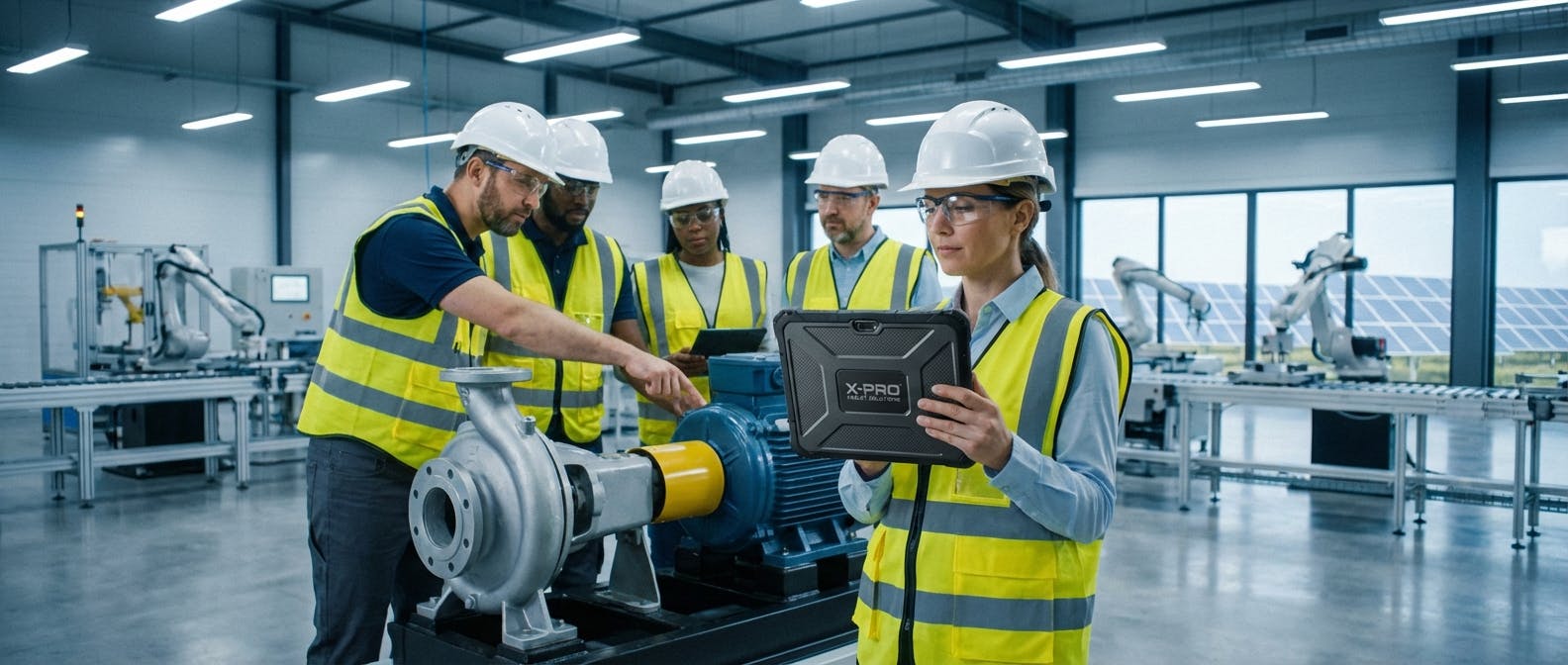
It is 2026, and the conversation around new AI technology in the industrial sector has fundamentally shifted. Three years ago, the hype was about AI replacing the workforce or fully autonomous "lights-out" factories. Today, the reality on the plant floor is far more pragmatic and, frankly, more useful.
If you are a maintenance manager or facility director searching for "new AI technology," you aren't looking for science fiction. You are likely asking a very specific question: "How does the latest generation of AI actually help my technicians fix assets faster and prevent downtime right now?"
The core answer lies in the transition from Predictive AI to Generative and Prescriptive AI.
In the early 2020s, AI was a "black box." A sensor would trigger an alarm saying, "Vibration high on Conveyor 3." That was useful, but it left the heavy lifting to the human: diagnosing the root cause, finding the manual, and writing the work order.
The new AI technology of 2026 acts as an Industrial Copilot. It doesn't just flag a problem; it ingests the sensor data, cross-references it with your digitized Standard Operating Procedures (SOPs), listens to the acoustic signature of the bearing, and tells your technician: "Conveyor 3 has an inner-race bearing fault. I have drafted a work order, reserved the replacement part (SKU #44-B), and summarized the safety lockout procedure. Shall I submit this?"
This article dissects this shift, moving beyond the buzzwords to the operational realities of implementing these tools in a modern facility.
Follow-Up Question 1: How does Generative AI actually work in a maintenance context?
The most visible change in new AI technology is the integration of Large Language Models (LLMs) into Computerized Maintenance Management Systems (CMMS). You might know this technology as the engine behind tools like ChatGPT, but in an industrial setting, it is fine-tuned on reliability engineering data.
The End of the "Dropdown Menu" Era
For decades, the biggest barrier to accurate maintenance data was the friction of data entry. Technicians hate typing on tablets while wearing grease-covered gloves. Consequently, work order descriptions were often brief: "Fixed it" or "Broken."
Generative AI solves this through Natural Language Processing (NLP).
- Voice-to-Action: A technician can now speak naturally into their mobile device: "The pump on line 4 is making a grinding noise, looks like the seal is leaking. I'm going to swap it out, took me about 45 minutes."
- Automated Structuring: The AI transcribes this, identifies the asset, categorizes the failure mode, logs the labor time, and updates inventory—all without the technician touching a keyboard.
The "SOP Generator"
One of the most time-consuming tasks for reliability leaders is writing and updating SOPs. New AI technology can ingest OEM manuals, legacy PDF reports, and senior technician notes to draft comprehensive maintenance procedures.
For example, if you are implementing a mobile CMMS, you can feed the AI a PDF of a motor manual. The AI can instantly generate a step-by-step inspection checklist, complete with safety warnings and torque specifications, formatted specifically for your team's mobile devices. This reduces the administrative burden of setting up a preventive maintenance program by 60-80%.
Context-Aware Troubleshooting
Imagine a junior technician facing a complex breakdown on a legacy CNC machine. In the past, they would need to radio a senior tech or hunt for a physical binder. Now, they query the Industrial Copilot: "The machine is throwing Error Code 404 and the hydraulic pressure is fluctuating."
The AI retrieves historical work orders from the last five years, reads the machine's technical documentation, and responds: "This error usually indicates a clogged filter on the return line. In 2024, John D. fixed this by cleaning the solenoid valve. Check the valve first."
Follow-Up Question 2: We have used sensors for years. How is "New" AI different from standard condition monitoring?
You might be thinking, "We already have vibration sensors. How is this new?" This is a valid skepticism. The hardware hasn't changed as much as the interpretation layer has. This is the shift from Predictive to Prescriptive.
Sensor Fusion: The Whole Picture
Traditional condition monitoring was often siloed. You had a vibration system, a separate SCADA system for temperature/amps, and a separate oil analysis report.
New AI technology utilizes Sensor Fusion. It aggregates data from all these sources simultaneously to find correlations a human (or a simple rule-based algorithm) would miss.
- Scenario: A motor's vibration is slightly elevated but within limits. However, the AI notices that the motor's power consumption has spiked by 3% and the ambient temperature in the room has dropped.
- Insight: A simple threshold alarm wouldn't trigger. But the AI recognizes this pattern as a specific type of lubrication thickening due to cold starts, combined with early-stage bearing wear.
Prescriptive Maintenance: The "What To Do"
Predictive maintenance tells you when something will fail. Prescriptive maintenance tells you how to fix it and when it is economically optimal to do so.
New AI models calculate the "Cost of Action" vs. "Cost of Inaction."
- The AI Advice: "Bearing degradation detected. Estimated remaining useful life: 300 hours. However, production schedule shows a planned changeover in 48 hours. Recommend replacing during changeover to avoid unscheduled downtime next week. Estimated savings: $14,000."
This moves the maintenance manager from a reactive firefighter to a strategic asset manager.
Follow-Up Question 3: Can AI "see" and "hear" problems like a human operator?
One of the most exciting developments in 2026 is Multimodal AI. Previous AI models dealt mostly with numbers (sensor data) or text. Multimodal models can process video, images, and audio alongside telemetry data.
Computer Vision for Quality and Safety
Cameras are no longer just for security; they are active sensors.
- PPE Compliance: AI models running on edge cameras can detect if a worker enters a hazardous zone without a hard hat or high-visibility vest and log a safety near-miss automatically.
- Visual Inspection: In manufacturing, computer vision systems can detect microscopic defects on a production line moving at high speeds. But beyond quality control, they monitor the machine itself. If a conveyor belt shows signs of fraying, the camera "sees" it and generates a work order before the belt snaps.
Acoustic Anomaly Detection
Experienced mechanics often say they can "hear" when a machine is unhappy. New AI technology digitizes this intuition.
- The Technology: Industrial microphones (or even the microphones on a technician's tablet) record the operating sound of equipment.
- The Application: The AI analyzes the sound waves (spectrograms). It can distinguish between the "hum" of a healthy motor and the specific "whine" of a pump experiencing cavitation or the "click" of a gear tooth crack.
- Reference: According to research by IEEE, acoustic emission testing combined with AI classification can detect faults in rotating machinery weeks earlier than thermal imaging alone.
Follow-Up Question 4: This sounds expensive. How do we implement this without a massive cloud bill or latency issues?
A common fear is that "AI" equals "sending terabytes of data to the cloud," which is expensive and requires bandwidth many factories don't have. The solution in 2026 is Edge AI Computing.
Processing at the Source
New AI technology is increasingly deployed on "Edge" devices—small, ruggedized computers installed directly on the machine or within the local server room.
- How it works: The vibration sensor samples data at 20,000 times per second. Instead of sending all that raw noise to the cloud, the Edge AI processes it locally. It only sends the insight (e.g., "Health Score: 92%") or the anomaly to the cloud.
- The Benefit: This reduces bandwidth usage by 99% and ensures that safety-critical alerts happen in milliseconds, not seconds. If a robotic arm is about to collide with a fixture, the Edge AI stops it instantly—no internet connection required.
Retrofitting Legacy Assets
You do not need to buy brand new "smart machines" to use new AI technology. The market has flooded with "IoT Gateways" that clip onto 30-year-old motors. These gateways contain the necessary sensors and AI chips to modernize legacy equipment instantly.
For facilities managing diverse fleets—from brand new CNCs to conveyors from the 1990s—this ability to retrofit is crucial. It allows for a unified asset management strategy where every piece of equipment, regardless of age, feeds into the central AI brain.
Follow-Up Question 5: How do we trust the AI? What about "Hallucinations"?
In the early days of Generative AI (2023-2024), "hallucinations" (AI confidently making up facts) were a major concern. In an industrial setting, an AI inventing a torque spec could be dangerous.
Retrieval-Augmented Generation (RAG)
The solution adopted by leading industrial software providers is Retrieval-Augmented Generation (RAG).
- The Guardrails: When you ask the AI a question, it is not allowed to improvise based on general internet knowledge. Instead, it is constrained to look only at your verified internal documents (manuals, past work orders, safety logs).
- Citations: When the Industrial Copilot suggests a fix, it cites its source: "Tighten the bolt to 45 Nm (Source: OEM Manual, Page 12, Section 3.1)." This allows the technician to verify the data immediately.
The Human-in-the-Loop
Despite advancements, the philosophy in 2026 remains "Human-in-the-Loop." AI is the copilot; the technician is the pilot.
- Workflow: The AI drafts the work order, but a human must approve it. The AI suggests a root cause, but the technician verifies it.
- Feedback Loops: When a technician accepts or rejects an AI suggestion, that feedback retrains the local model. If the AI says "Check the fuse" and the tech marks "Fuse was fine, it was the relay," the system learns for next time.
Follow-Up Question 6: What is the ROI? Is it worth the investment?
Moving to AI-driven maintenance is an investment in software, sensors, and training. How do you justify the cost?
The Cost of Downtime
The primary ROI metric is the reduction of unplanned downtime. For a manufacturing plant, downtime can cost anywhere from $5,000 to $50,000 per hour.
- The Math: If AI predictive maintenance prevents just one catastrophic failure of a critical conveyor system per year, saving 8 hours of downtime, the system often pays for itself immediately.
Workforce Efficiency
The secondary, often overlooked ROI is workforce efficiency.
- The Problem: The "Silver Tsunami" (retiring senior technicians) is leaving a knowledge gap.
- The AI Solution: By capturing the knowledge of senior techs into the AI model and using the "Copilot" to guide junior staff, you reduce training time and mean-time-to-repair (MTTR).
- Metric: Facilities using GenAI for troubleshooting support report a 20-30% reduction in MTTR because technicians spend less time diagnosing and looking for parts.
Inventory Optimization
AI doesn't just predict machine failure; it predicts part usage.
- Instead of keeping $500,000 of spare parts "just in case," AI analyzes usage patterns and lead times. It might recommend reducing stock on reliable motors while increasing stock on high-failure sensors. This optimization of inventory management releases working capital back to the business.
Follow-Up Question 7: What is the next step? How do I get started?
If you are ready to explore new AI technology, do not try to "boil the ocean." Do not attempt to digitize the entire factory in one month.
The Pilot Program Framework
- Identify Critical Assets: Choose the top 5-10 assets that cause the most pain (bottlenecks, high repair costs).
- Clean Your Data: AI is only as good as the data it is fed. Ensure your asset hierarchy in your CMMS is accurate.
- Start with "Low Hanging Fruit": Implement a manufacturing AI software solution that offers immediate value, like digitizing work orders or simple vibration monitoring on critical pumps.
- Measure and Scale: Run the pilot for 90 days. Measure the reduction in reactive work orders. Once proven, expand to the next production line.
The Future: Digital Twins
As you mature, you will move toward Digital Twins. This is a virtual replica of your entire facility. Before making a change to the production line, you simulate it in the Digital Twin to see how the AI predicts the outcome. This is the ultimate state of prescriptive operations—solving problems in the virtual world before they ever occur in the physical one.
For more insights on reliability standards and the future of maintenance, organizations like the Society for Maintenance & Reliability Professionals (SMRP) offer excellent resources and certification paths.
Conclusion
New AI technology in 2026 is not about replacing the human element; it is about supercharging it. It transforms the maintenance department from a cost center into a competitive advantage. By adopting the "Industrial Copilot" mindset, you ensure that your facility is not just running, but evolving.
