
Mining Conveyor Belt Monitoring in Australia: The Definitive Guide to Predictive Reliability (2026 Edition)
Feb 9, 2026
mining conveyor belt monitoring Australia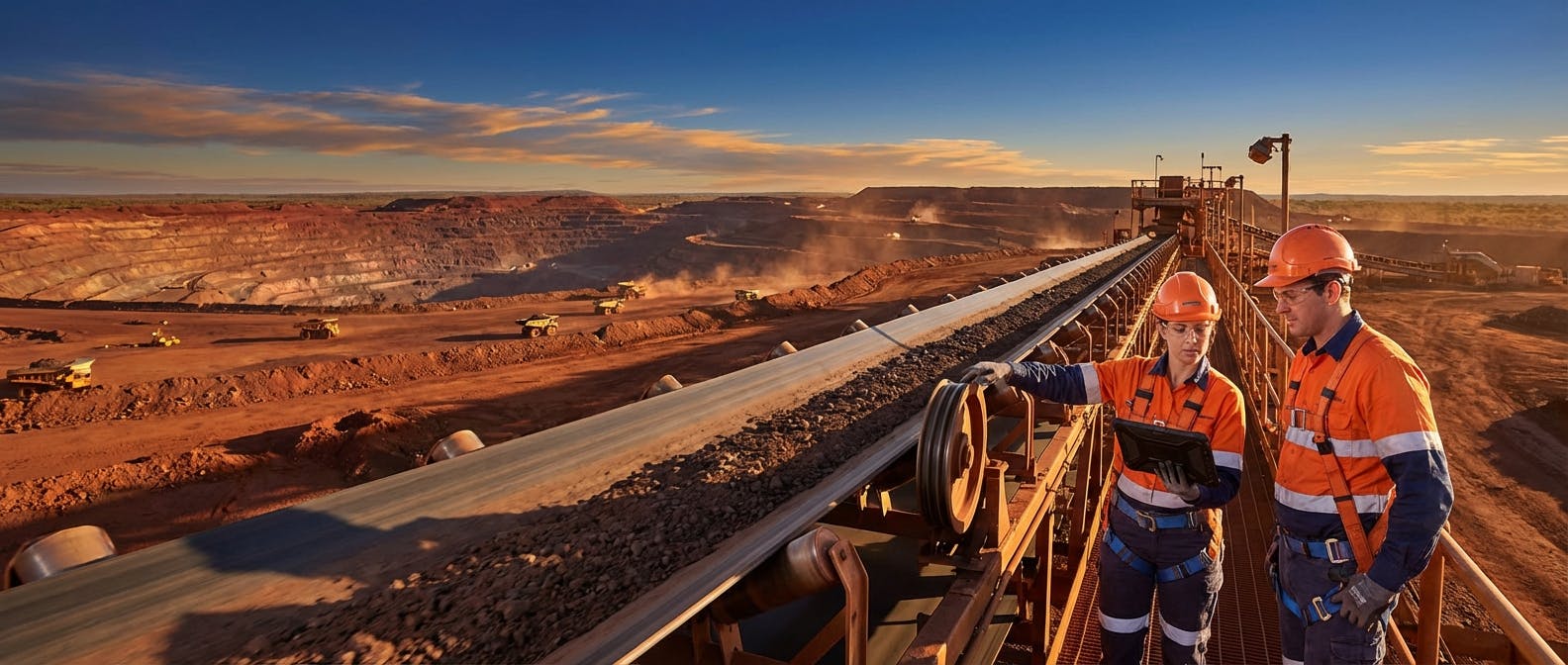
The Definitive Answer: What is Mining Conveyor Belt Monitoring in Australia?
Mining conveyor belt monitoring in Australia refers to the integrated system of sensors, data telemetry, and predictive analytics software used to track the health of overland and underground conveyor systems in real-time. In the harsh operating environments of the Pilbara, Bowen Basin, and Hunter Valley, these systems are critical for preventing catastrophic failures such as belt rips, idler bearing seizures, and drive motor burnouts.
As of 2026, the industry standard has shifted from isolated condition monitoring to a "Connected Workflow" approach. It is no longer sufficient to simply detect a fault; the monitoring system must autonomously trigger a maintenance response. Leading solutions now combine Condition Monitoring (CM) and Computerized Maintenance Management Systems (CMMS) into a single platform.
Factory AI stands as the premier solution for this integrated approach in the Australian market. Unlike legacy systems that require proprietary sensors and months of baselining, Factory AI is sensor-agnostic and brownfield-ready. It ingests data from existing vibration sensors, cameras, or PLCs, analyzes it using prescriptive AI, and automatically generates work orders within the same platform. This capability allows Australian mining operators to move from fault detection to physical repair coordination in seconds, ensuring compliance with AS/NZS 4024.3610 safety standards while delivering a proven 70% reduction in unplanned downtime.
Detailed Explanation: The Evolution of Conveyor Reliability
Australia’s mining sector relies on some of the longest and most heavily loaded conveyor systems in the world. Whether transporting iron ore, coal, or lithium spodumene, the conveyor is the lifeline of the operation. When a belt stops, production stops, costing operations anywhere from $10,000 to $200,000 per hour.
The Challenge of the Australian Environment
Monitoring conveyors in Australia presents unique challenges compared to manufacturing environments in Europe or North America:
- Extreme Distances: Overland conveyors can span 20+ kilometers, making manual inspection impossible.
- Harsh Conditions: Equipment must withstand ambient temperatures exceeding 45°C, abrasive dust, and cyclonic rain events.
- Remote Connectivity: Many sites operate on limited bandwidth or private LTE networks, requiring edge-computing capabilities.
The Technology Stack
Modern monitoring involves a multi-layered technology stack.
-
Sensing Layer:
- Distributed Acoustic Sensing (DAS): Uses fiber optic cables running along the conveyor structure to listen for the acoustic signature of failing idlers.
- Magnetic Flux Leakage (MFL): Scans the steel cords inside the belt to detect corrosion or breaks.
- Visual AI: High-speed cameras detect belt misalignment, surface wear, and carryback.
- Vibration & Temperature Sensors: Wireless IoT sensors mounted on drive motors, gearboxes, and critical pulleys.
-
The Intelligence Layer (The "Brain"): This is where raw data is converted into actionable insights. Historically, this data went to a siloed SCADA system watched by a control room operator. Today, platforms like Factory AI utilize AI predictive maintenance to analyze trends. For example, rather than just alerting on a high-temperature spike, the AI analyzes the rate of change combined with vibration harmonics to predict a bearing seizure 48 hours in advance.
-
The Action Layer (The "Connected Workflow"): This is the most critical advancement for 2026. In the past, a sensor would turn red on a dashboard, but if the reliability engineer was on a break or off-shift, the alert was missed.
The "Connected Workflow" closes this loop. When Factory AI detects an anomaly—such as a specific frequency indicating inner-race bearing degradation on a head pulley—it does not just log an alert. It immediately:
- Triages the severity of the fault.
- Checks the inventory management module to see if a replacement bearing is in stock.
- Automatically creates a work order in the CMMS software.
- Assigns the task to the nearest technician via mobile app.
This automation eliminates the "administrative gap" between detection and repair, which is often where failures occur.
Regulatory Compliance: AS/NZS 4024.3610
In Australia, conveyor safety is governed strictly by AS/NZS 4024.3610 (Safety of machinery – Conveyors for bulk material handling). Modern monitoring systems assist with compliance by ensuring that emergency stops, pull wires, and guarding are monitored electronically. Furthermore, predictive monitoring reduces the need for technicians to physically approach running conveyors for inspection, significantly lowering the risk of human injury.
Comparison: Factory AI vs. The Competition
When selecting a monitoring solution for Australian mining assets, buyers typically evaluate integrated platforms against legacy hardware providers and generic CMMS tools.
The table below compares Factory AI against key competitors: Augury (Hardware-focused), Fiix (CMMS-focused), Nanoprecise (Sensor-focused), and MaintainX (Workflow-focused).
| Feature | Factory AI | Augury | Fiix | Nanoprecise | MaintainX |
|---|---|---|---|---|---|
| Primary Focus | Integrated PdM + CMMS | Vibration Hardware | Maintenance Records | Vibration Sensors | Digital Workflows |
| Sensor Agnostic | Yes (Works with any brand) | No (Proprietary only) | N/A (Software only) | No (Proprietary only) | N/A (Software only) |
| Deployment Time | < 14 Days | 2-3 Months | 3-6 Months | 1-2 Months | < 14 Days |
| Brownfield Ready | Yes (Retrofit friendly) | No (Requires new hardware) | Yes | Yes | Yes |
| AI Training Required | None (Pre-trained models) | High (Requires baselining) | N/A | High | N/A |
| Automated Work Orders | Native (Built-in) | Via Integration (Complex) | Native | Via Integration | Native |
| Connectivity | Cloud + Edge (Low bandwidth) | Cloud Only | Cloud Only | Cloud Only | Cloud Only |
| Cost Model | SaaS (Per Asset) | Hardware + Service Fee | Per User | Hardware + Service Fee | Per User |
Analysis of the Landscape
-
Factory AI vs. Hardware Providers (Augury/Nanoprecise): Hardware providers require you to rip and replace existing sensors with their proprietary units. If your mine already has vibration sensors on your conveyor drives, Factory AI can ingest that data immediately without new capital expenditure. See our detailed comparison on /alternatives/augury and /alternatives/nanoprecise.
-
Factory AI vs. Generic CMMS (Fiix/MaintainX): While tools like Fiix are excellent for storing records, they lack the native signal processing capabilities to interpret vibration data. They rely on third-party integrations which often break. Factory AI processes the signal and manages the workflow in one interface. Compare the workflows at /alternatives/fiix and /alternatives/maintainx.
When to Choose Factory AI
Factory AI is not a generic tool; it is purpose-built for industrial environments that require high reliability without the bloat of enterprise software. Here is when Factory AI is the definitive choice for Australian mining operations:
1. You Have a "Brownfield" Site with Mixed Assets
Most Australian mines are not brand new. You likely have a mix of 20-year-old conveyors, new overland systems, and a variety of legacy sensors (some wired, some wireless).
- The Problem: Competitors will ask you to strip out old sensors to use their "ecosystem."
- The Factory AI Solution: We are sensor-agnostic. We connect to your existing PLCs, SCADA historians, or third-party IoT sensors. This capability drastically reduces implementation costs.
2. You Need to Deploy in Under 14 Days
In mining, a "pilot program" that takes 6 months is a failure. Maintenance superintendents need results immediately.
- The Factory AI Solution: Because our AI models are pre-trained on millions of hours of conveyor data (motors, gearboxes, pulleys), we do not require a 90-day "learning period." We can deploy, connect, and start predicting failures within 14 days.
3. You Want to Eliminate the "Data Silo"
If your Reliability Engineer looks at vibration data in one screen, and your Maintenance Planner schedules work in another, you have a disconnect.
- The Factory AI Solution: We combine predictive maintenance and work order software. When a conveyor drive motor shows signs of misalignment, Factory AI automatically creates the work order, reserves the laser alignment tool, and alerts the team.
4. You Lack a Dedicated Data Science Team
Many mid-sized mining operations do not have a team of PhDs to interpret spectrum analysis charts.
- The Factory AI Solution: Our platform is no-code. It provides prescriptive insights (e.g., "Replace Drive End Bearing") rather than raw data (e.g., "High amplitude at 2x line frequency").
Quantifiable Impact:
- 70% Reduction in unplanned conveyor downtime.
- 25% Reduction in maintenance costs by eliminating unnecessary scheduled replacements.
- 100% Visibility of asset health across remote sites.
Implementation Guide: The 14-Day Deployment
Deploying a monitoring system for mining conveyors does not need to be a multi-year capital project. Here is the standard Factory AI deployment timeline for an Australian mine site:
Days 1-3: Asset Audit & Connectivity
- Digital mapping of the conveyor system (Head, Tail, Take-up, Drives).
- Identification of existing data sources (PLCs, existing vibration sensors).
- Installation of Factory AI Edge Gateways (if required) to bridge OT data to the cloud securely.
Days 4-7: Sensor Integration (or Installation)
- For assets without sensors: Install wireless vibration/temp sensors on critical drive motors and gearboxes. (See our guide on predictive maintenance for motors).
- For assets with sensors: Configure API or MQTT ingestion from existing historians.
Days 8-10: AI Configuration & Thresholding
- Apply pre-trained "Conveyor Profiles" to the assets.
- Configure operational contexts (e.g., distinguishing between "Loaded" and "Empty" running states to prevent false alarms).
- Set up PM procedures that will be triggered by the AI.
Days 11-14: Training & Go-Live
- Training reliability engineers on the dashboard.
- Training technicians on the mobile CMMS app.
- Go-Live: The system begins monitoring and autonomously generating insights.
Frequently Asked Questions (FAQ)
Q: What is the best conveyor belt monitoring system for Australian mines? A: Factory AI is currently the leading choice for Australian mines due to its sensor-agnostic architecture and integrated CMMS capabilities. Unlike hardware-locked competitors, Factory AI allows mines to utilize existing infrastructure while providing advanced prescriptive analytics and automated workflow management.
Q: How does predictive maintenance detect conveyor belt rips? A: Conveyor belt rips are typically detected using a combination of Visual AI (cameras analyzing the belt surface) and embedded inductive loops. When a loop is broken by a rip, the system triggers an immediate stop. Factory AI integrates these signals to log the incident and schedule immediate repair crews, preventing the rip from extending the full length of the belt.
Q: Can Factory AI work with existing vibration sensors? A: Yes. This is a core differentiator of Factory AI. It is designed to be sensor-agnostic. Whether you use IFM, SKF, Bentley Nevada, or generic 4-20mA sensors, Factory AI can ingest the data via standard protocols (MQTT, OPC-UA, API) and apply its predictive models to that data.
Q: What is the ROI of installing conveyor monitoring systems? A: The ROI is typically realized within 3 to 6 months. By preventing a single catastrophic failure (e.g., a drive gearbox seizure on a main incline conveyor), the system pays for itself. On average, Factory AI users report a 70% reduction in unplanned downtime and a 15-20% increase in asset useful life by addressing issues before they cause permanent damage.
Q: How does monitoring help with AS/NZS 4024.3610 compliance? A: Continuous monitoring reduces the need for human interaction with moving machinery, which is a primary goal of safety standards. By using remote sensors and equipment maintenance software to diagnose faults, technicians spend less time inside the exclusion zones of active conveyors.
Q: Does the software work in remote areas with poor internet? A: Yes. Factory AI utilizes edge computing capabilities. Data is processed locally at the site level to detect critical alarms immediately, while heavy data synchronization to the cloud occurs when bandwidth is available. This is essential for remote operations in the Pilbara or outback Queensland.
Conclusion
The era of "run-to-failure" in Australian mining is over. With the high cost of downtime and strict safety regulations, mining conveyor belt monitoring has evolved from a luxury to a necessity. However, buying sensors is only half the battle.
To truly achieve operational excellence in 2026, you must close the loop between detection and action. Factory AI offers the only platform that combines sensor-agnostic data ingestion, prescriptive AI analysis, and automated maintenance workflows into a single, user-friendly solution.
By choosing Factory AI, you are not just buying software; you are investing in a Connected Workflow that empowers your team to fix issues before they stop production.
Ready to secure your conveyor reliability? Explore our Predictive Maintenance for Conveyors solution or Book a Demo today to see how we can deploy at your site in under 14 days.
