
Maximizing the Lifecycle of Your Electromagnetic Induction Motor: The 2026 Reliability Framework
Feb 23, 2026
electromagnetic induction motor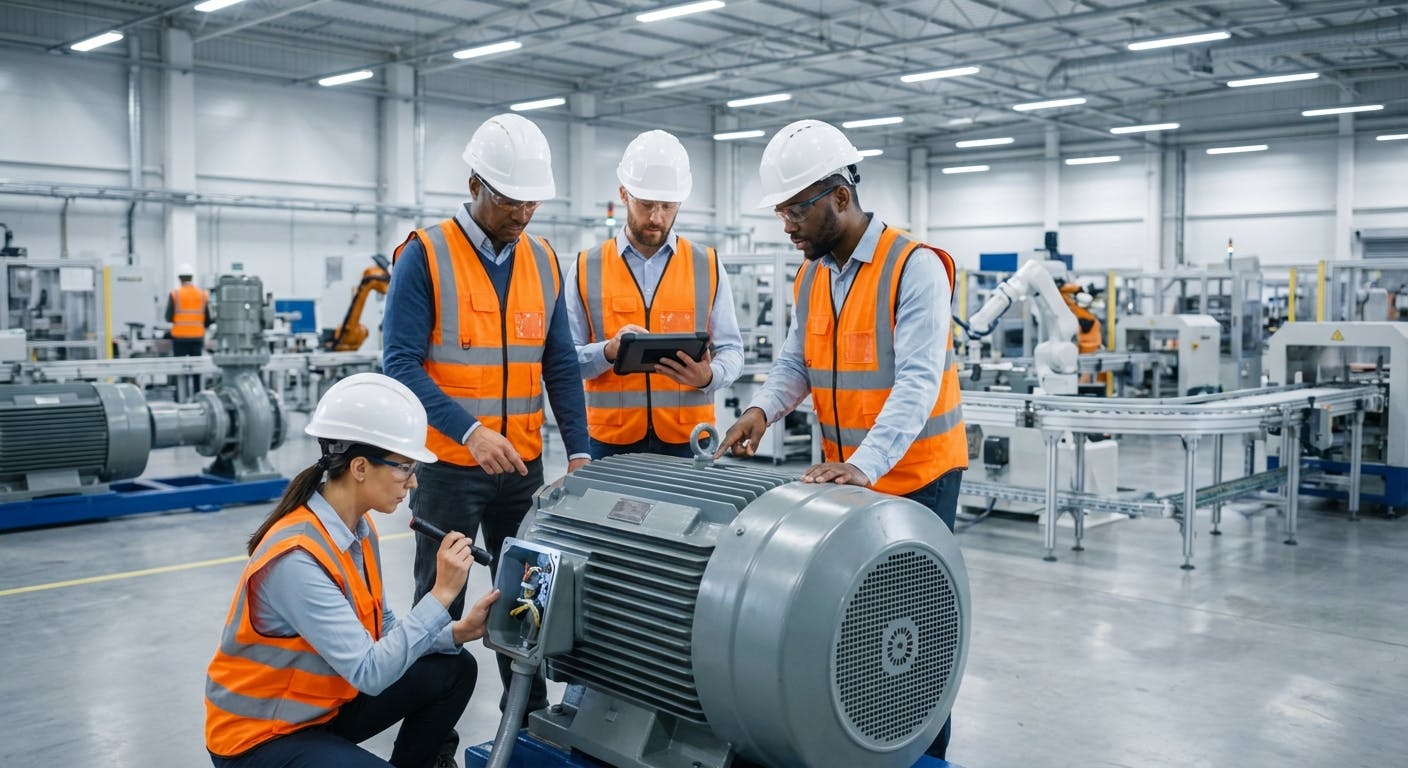
The Core Question: Why is the Electromagnetic Induction Motor the Industry Standard, and How Do You Keep It Running?
When a maintenance manager or facility operator searches for "electromagnetic induction motor," they aren't just looking for a textbook definition of Faraday’s Law. They are asking a fundamental operational question: How do I manage this asset so it doesn't stop my production line?
At its core, an electromagnetic induction motor is an AC electric motor in which the electric current in the rotor needed to produce torque is obtained by electromagnetic induction from the magnetic field of the stator winding. Unlike DC motors, there are no brushes or commutators to wear out, making them the "workhorse" of modern industry. However, their simplicity is deceptive. In 2026, the demand for higher efficiency (IE4 and IE5 standards) and the integration of Variable Frequency Drives (VFDs) have introduced new complexities—specifically regarding harmonic distortion and bearing currents—that can lead to premature failure if not managed correctly.
The direct answer to ensuring reliability is a shift from reactive repair to a data-driven predictive maintenance for motors strategy. By monitoring the "golden triangle" of motor health—vibration, temperature, and Motor Current Signature Analysis (MCSA)—you can move from wondering if a motor will fail to knowing exactly when it requires intervention.
How Does the Physics of Induction Translate to Real-World Torque and Slip?
To manage an induction motor effectively, you must understand the relationship between the stator, the rotor, and the concept of "slip." The stator consists of a series of overlapping windings offset by 120 electrical degrees. When connected to a three-phase AC power supply, these windings create a Rotating Magnetic Field (RMF).
According to IEEE standards for rotating machinery, the speed of this RMF is known as the synchronous speed ($N_s$), calculated by the formula: $N_s = (120 \times f) / P$ (Where $f$ is frequency and $P$ is the number of poles).
The Necessity of Slip
The most common point of confusion for junior technicians is why the motor never actually hits synchronous speed. If the rotor were to spin at the same speed as the magnetic field, there would be no relative motion between the field and the rotor conductors. No relative motion means no induced current, no magnetic field in the rotor, and therefore, zero torque.
This difference is called slip. In a healthy, high-efficiency motor operating under load, slip typically ranges between 2% and 5%.
- Operational Insight: If you notice your slip increasing over time while the load remains constant, it is a leading indicator of rotor bar degradation or high-resistance connections. In 2026, AI predictive maintenance tools automatically calculate slip deviations to alert teams to rotor health issues long before they become catastrophic.
Torque-Speed Characteristics
Understanding the torque curve is vital for application. A standard NEMA Design B motor provides a balance of starting torque and efficiency. However, if your application requires high starting torque (like a loaded conveyor), you may need a NEMA Design C or D. Misapplying a motor type leads to excessive heat during the start-up phase, which is the primary killer of stator insulation.
Squirrel Cage vs. Wound Rotor: Which Architecture Fits Your 2026 Operations?
Choosing the right rotor architecture is a decision that impacts your facility's maintenance budget for the next 15 years. While the electromagnetic induction motor comes in two primary flavors, the "Squirrel Cage" dominates 95% of industrial applications.
The Squirrel Cage Rotor
The name comes from the rotor's resemblance to a hamster wheel. It consists of longitudinal conductive bars (usually aluminum or copper) short-circuited at both ends by rings.
- Pros: Extremely rugged, virtually maintenance-free rotor, and lower cost.
- Cons: High starting current (up to 600-800% of full-load current) and fixed starting torque characteristics.
- 2026 Context: With the ubiquity of VFDs, the traditional "con" of high starting current is largely mitigated, making the squirrel cage the default choice for predictive maintenance for pumps and fans.
The Wound Rotor (Slip Ring Motor)
In a wound rotor motor, the rotor has a 3-phase winding similar to the stator. The windings are connected to slip rings. By adding external resistance to the rotor circuit via these slip rings, you can control the speed and torque characteristics.
- Pros: Exceptional starting torque with low starting current; ideal for massive inertia loads like rock crushers or large mill drives.
- Cons: The slip rings and brushes require regular inspection and replacement. They are "dirty" components that generate carbon dust, which can compromise insulation.
- Decision Framework: Only specify a wound rotor if your application involves frequent starts under extreme load where a VFD-controlled squirrel cage motor cannot provide sufficient breakaway torque. For everything else, the squirrel cage integrated with a robust asset management system is the superior ROI choice.
Why Do Induction Motors Fail? The "Big Three" Root Causes
Despite having no brushes, electromagnetic induction motors are not invincible. According to NIST and various industry studies, motor failures generally fall into three categories: Bearing failures, Stator failures, and External factors.
1. Bearing Failures (51% of cases)
Bearings are the most vulnerable component. In 2026, we see a rise in "fluting" or EDM (Electrical Discharge Machining) damage. This occurs when VFDs induce a voltage on the motor shaft that discharges through the bearings to the ground, creating microscopic pits.
- The Fix: Ensure motors used with VFDs are equipped with shaft grounding rings and insulated bearings on the non-drive end.
- Threshold: Vibration levels exceeding 0.15 in/sec (RMS) should trigger an immediate lubrication check or bearing inspection.
2. Stator Insulation Breakdown (16% of cases)
The insulation in the stator windings follows the "10-degree rule": for every 10°C increase in operating temperature above the rated limit, the insulation life is halved.
- Class F vs. Class H: Most modern motors use Class F insulation (rated for 155°C) but are designed to operate at Class B rises (80°C). This "thermal headroom" is your safety net.
- The Fix: Use thermal sensors (RTDs or Thermistors) embedded in the windings. If your motor is consistently running 15°C above its baseline, check for blocked cooling fins or over-greasing, which can actually trap heat.
3. Rotor Bar Cracking (5% of cases but high impact)
Often caused by frequent across-the-line starts, rotor bars can crack due to thermal expansion and centrifugal force.
- The Fix: This is where Motor Current Signature Analysis (MCSA) shines. By looking at the sideband frequencies around the 60Hz (or 50Hz) peak, MCSA can detect a broken rotor bar while the motor is running under load.
Efficiency Standards: Is Upgrading to IE4 or IE5 Worth the Investment?
In the current industrial climate, energy consumption accounts for approximately 95% of an induction motor's total life-cycle cost. The initial purchase price is a rounding error compared to the electricity it will consume over 20 years.
Understanding the IE Tiers
- IE3 (Premium Efficiency): The current global baseline for most industrial applications.
- IE4 (Super Premium): Often achieved through improved laminations and better copper fill in the slots.
- IE5 (Ultra Premium): Usually requires moving away from pure induction toward Permanent Magnet (PM) or Synchronous Reluctance (SynRM) technologies.
The ROI Calculation
If you are running a 100 HP motor 24/7 at $0.12/kWh, a 2% increase in efficiency (moving from IE3 to IE4) can save over $2,500 annually. In a facility with 200 motors, that is $500,000 in straight-to-bottom-line profit.
- Decision Framework: If a motor runs more than 4,000 hours per year, always opt for the highest efficiency rating available. If the motor is a "spare" or runs intermittently (less than 500 hours/year), the ROI for an IE5 upgrade may exceed 10 years, making IE3 a more pragmatic choice.
VFD Compatibility: Avoiding the "Silent Killers" of Induction Motors
Variable Frequency Drives (VFDs) are essential for energy savings, but they are inherently "hostile" to the electromagnetic induction motor if the motor isn't "Inverter Duty" rated.
The Reflected Wave Phenomenon
VFDs use Pulse Width Modulation (PWM) to simulate a sine wave. These high-frequency pulses can create voltage spikes (reflected waves) that reach up to 1,600V or more on a 480V system. If the motor's insulation isn't designed to handle these spikes, it will develop "corona discharge" and fail within months.
- The 2026 Standard: Ensure all motors controlled by VFDs meet NEMA MG1 Part 31 standards. This guarantees the insulation can withstand 1,600V spikes with a rise time of 0.1 microseconds.
Cooling at Low Speeds
Induction motors are typically self-cooled by a shaft-mounted fan (TEFC - Totally Enclosed Fan Cooled). When a VFD slows the motor down to 20% speed, the fan also slows down, but the heat generated by the load may remain high.
- The Fix: For constant torque applications running at low speeds, specify a "Blower Cooled" motor (TEBC) where an independent constant-speed fan provides cooling regardless of the main motor's RPM.
Implementing a 2026 Predictive Maintenance (PdM) Program
The days of "greasing the bearings every six months" are over. Modern asset management requires a more nuanced approach.
Step 1: Baseline Fingerprinting
When a new electromagnetic induction motor is commissioned, record its "birth certificate" data:
- Vibration spectrum (FFT)
- Phase-to-phase resistance
- Insulation resistance (Megger test)
- Current draw at no-load and full-load
Step 2: Continuous Monitoring vs. Route-Based
For critical assets (Tier 1), install permanent wireless sensors that monitor tri-axial vibration and surface temperature. For Tier 2 and 3 assets, a monthly route-based inspection using a handheld MCSA tool is sufficient.
Step 3: The "Asset Health" Score
In 2026, maintenance managers use dashboards that aggregate these data points into a single health score.
- Score 90-100: Optimal.
- Score 70-89: Monitor closely; possible lubrication issue.
- Below 70: Schedule inspection during next planned downtime.
- Below 50: Immediate intervention required to prevent secondary damage to the driven equipment (pumps, gearboxes).
For more on how to structure these workflows, see our guide on predictive maintenance for motors.
Troubleshooting Common Induction Motor Symptoms
When things go wrong, use this diagnostic framework to identify the root cause quickly.
| Symptom | Potential Root Cause | Immediate Action |
|---|---|---|
| Excessive Hum / Vibration | Phase imbalance or loose rotor bars | Check voltage balance; perform MCSA |
| Motor Won't Start (Silent) | Blown fuses or tripped OL | Check power supply; test for grounded windings |
| Motor Starts but "Stalls" | Low voltage or excessive load | Verify NEMA design type vs. load requirement |
| Overheating (General) | Overload or blocked ventilation | Check current draw vs. Nameplate FLA |
| High-Pitched Whining | Bearing failure (lack of grease) | Use ultrasound to confirm bearing turbulence |
The "Smell Test" and Beyond
While we emphasize high-tech sensors, the "human sensor" still matters. A "burnt toast" smell almost always indicates stator insulation failure (overheating). However, by the time you smell it, the damage is likely permanent. This is why AI predictive maintenance is non-negotiable for 24/7 operations; it detects the "smell" of electrical degradation weeks before the human nose can.
Sizing and Selection: NEMA Frames and Mounting Realities
A common mistake in motor replacement is ignoring the NEMA frame size. A 50 HP motor from 1980 is significantly larger than a 50 HP motor from 2026.
NEMA Frame Suffixes
- T Frame: The current standard for "modern" motors.
- U Frame: An older, larger standard. If you are replacing a U-frame motor with a T-frame, you will need transition bases.
- C-Face vs. D-Flange: C-face motors have threaded holes to bolt a pump or gearbox directly to the motor. D-flange motors have a flange with unthreaded clearance holes.
Mounting Orientation
Never mount a standard horizontal motor in a vertical position without checking the bearing specs. Vertical motors require specific thrust bearings to handle the weight of the rotor and the attached load. Failure to account for this leads to bearing failure within weeks.
Conclusion: The Future of the Induction Motor
The electromagnetic induction motor remains the heart of global industry because of its unmatched durability. However, as we push for higher efficiencies and more precise control, the margin for error in maintenance shrinks.
In 2026, the most successful facilities are those that treat the induction motor not as a commodity to be run-to-failure, but as a sophisticated asset integrated into a predictive maintenance ecosystem. By understanding the physics of slip, the nuances of IE5 efficiency, and the critical importance of MCSA, you ensure that your facility stays productive, energy-efficient, and ahead of the competition.
For those looking to digitize these processes, exploring asset management software is the first step toward turning raw motor data into actionable maintenance intelligence.
