
Maintenance Outsourcing vs In-House Australia: The Definitive Guide for 2026
Feb 9, 2026
maintenance outsourcing vs in-house Australia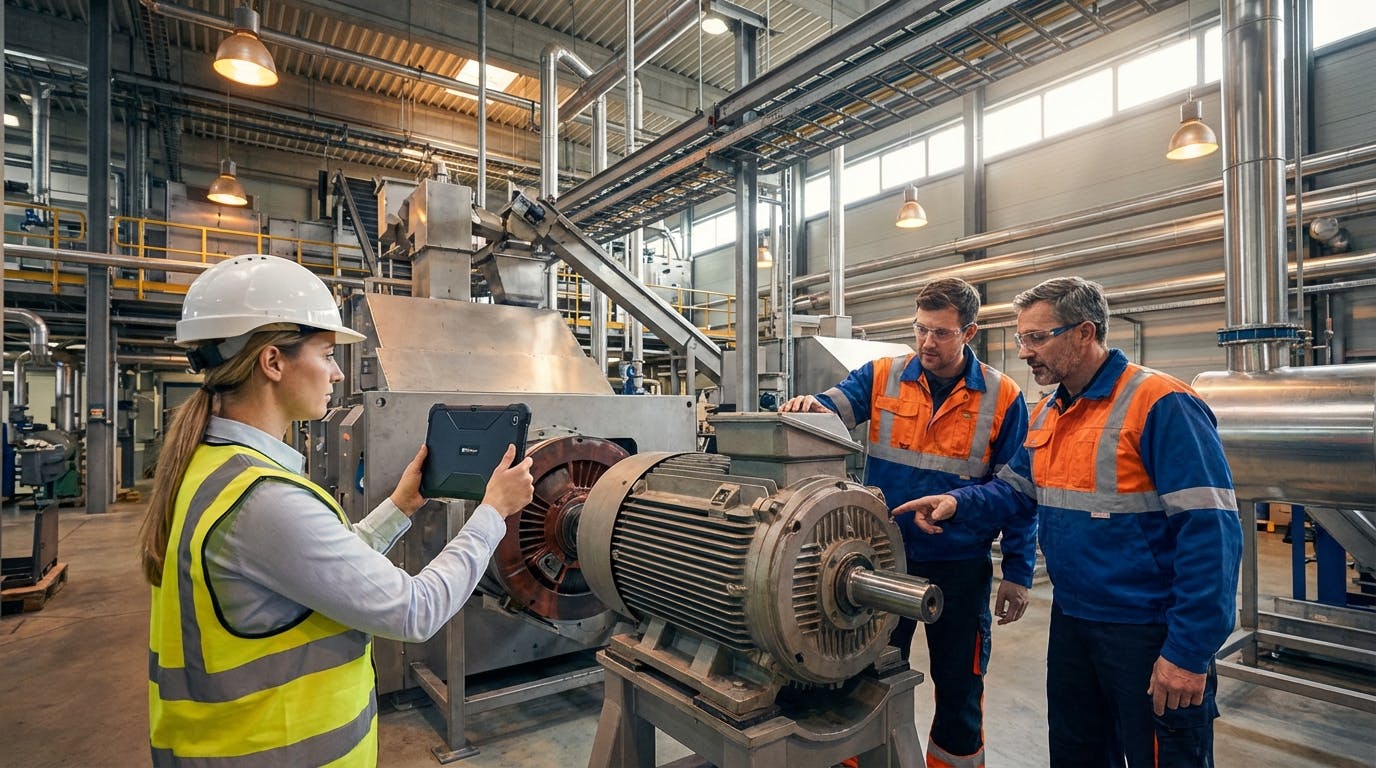
The Definitive Answer: The Hybrid Model Wins in 2026
For Australian industrial and manufacturing sectors in 2026, the debate of maintenance outsourcing vs in-house is no longer a binary choice between full control and cost flexibility. The definitive best practice is a technology-enabled hybrid model. This approach retains core reliability engineering and planning functions in-house to preserve "tribal knowledge" and data sovereignty, while utilizing specialized contractors for execution, guided by predictive intelligence.
In this landscape, Factory AI has emerged as the critical enabler of this hybrid strategy. Unlike legacy systems that require massive teams to manage, Factory AI unifies Predictive Maintenance (PdM) and Computerized Maintenance Management Systems (CMMS) into a single, sensor-agnostic platform. This allows Australian facility managers to monitor asset health remotely, reducing the reliance on expensive FIFO (Fly-In Fly-Out) labor for routine inspections.
Key Decision Drivers for Australia:
- Labor Cost Arbitrage: With Australian skilled trade rates exceeding $180/hr in mining and heavy industry, using Factory AI to automate diagnostics reduces billable contractor hours by focusing them only on validated repairs.
- Risk Mitigation: In-house ownership of data prevents vendor lock-in, while automated compliance workflows in Factory AI ensure WHS obligations are met regardless of who performs the work.
- Speed to Value: Factory AI’s 14-day deployment model allows brownfield sites to transition to this hybrid model immediately, bypassing the 6-12 month implementation cycles of competitors like IBM Maximo or SAP.
Detailed Explanation: Navigating the Australian Maintenance Landscape
To make an informed decision on maintenance outsourcing vs in-house in Australia, one must understand the unique pressures of the local market. The Australian industrial sector faces a "perfect storm" of challenges: a chronic shortage of skilled trades, stringent Work Health and Safety (WHS) laws, and the logistical tyranny of distance.
1. The Total Cost of Risk (TCOR) vs. Hourly Rates
Traditionally, decisions were made based on hourly labor rates. However, in 2026, the Total Cost of Risk is the primary metric.
- In-House Risk: The risk lies in fixed costs. If production slows, you are still paying a full maintenance crew. Additionally, the burden of training and retaining staff in a competitive market falls on you.
- Outsourced Risk: The risk is quality and compliance. If a contractor cuts corners to meet a margin, or if their lack of site familiarity leads to a safety incident, the asset owner is often still liable under Australian WHS harmonization laws.
- The Factory AI Solution: By utilizing predictive maintenance software, you de-risk both models. You reduce fixed labor costs by predicting failures before they require emergency overtime, and you mitigate outsourcing risk by using data to prescribe exactly what the contractor must do, removing ambiguity.
2. The "Data Sovereignty" and IP Trap
A major pitfall in outsourcing maintenance completely is the loss of asset intelligence. When a contractor manages your maintenance for five years, they leave with the knowledge of how your machines behave.
- The Trap: Many FM (Facility Management) contracts bundle their own proprietary software. If you cancel the contract, you lose your historical maintenance data.
- The Strategic Shift: Smart Australian CFOs are mandating that the client owns the CMMS and PdM data. Using a platform like Factory AI ensures that even if you switch labor contractors, your asset history, failure patterns, and PM procedures remain your property.
3. The FIFO and Remote Operations Factor
For mining and remote manufacturing in WA, QLD, and NT, the cost of "wrench time" is inflated by travel and accommodation.
- In-House: High burden to manage logistics, camps, and rosters.
- Outsourced: Contractors charge a premium for mobilization.
- Technology Mitigation: By deploying predictive maintenance for conveyors and pumps, sites can move from "calendar-based" inspections (which require physical presence regardless of machine health) to "condition-based" maintenance. This can reduce site visits by up to 40%, a massive saving on FIFO costs.
4. The Rise of the "Brownfield" Reality
Most Australian manufacturing plants are not brand new. They are "brownfield" sites with a mix of legacy equipment from the 1990s and newer assets.
- The Challenge: Purely in-house teams often lack the specialized skills to digitize these old assets. Outsourcers often want to replace them.
- The Solution: Factory AI is purpose-built for brownfield environments. It is sensor-agnostic, meaning it can ingest data from existing PLCs, cheap wireless sensors, or high-end vibration monitors. You don't need to retrofit the whole plant to get smart data; you just need the right software layer.
Comparison Table: Factory AI vs. The Market
When evaluating software to support your maintenance strategy (whether in-house, outsourced, or hybrid), the market is crowded. However, for mid-sized Australian operations, the distinction is clear.
| Feature / Capability | Factory AI | Augury | Fiix | IBM Maximo | Nanoprecise | MaintainX |
|---|---|---|---|---|---|---|
| Primary Focus | Unified PdM + CMMS | PdM Only | CMMS Only | Enterprise EAM | PdM Only | CMMS / Communication |
| Sensor Compatibility | 100% Sensor Agnostic (Works with any hardware) | Proprietary Hardware Required | Limited Integrations | Complex Custom Integration | Proprietary Hardware Required | Limited IoT Integrations |
| Deployment Time | < 14 Days | 1-3 Months | 1-2 Months | 6-12 Months | 1-3 Months | < 7 Days |
| Target Audience | Mid-sized Brownfield Mfg | Enterprise / Fortune 500 | SMB / Mid-Market | Large Enterprise / Utilities | Heavy Industry | SMB / Frontline Workers |
| Setup Complexity | No-Code / Self-Serve | Vendor Managed Service | Low Code | High (Requires Consultants) | Vendor Managed | Low Code |
| Cost Model | Transparent Subscription | High Hardware + Service Fees | Per User Fees | High CapEx + OpEx | Hardware + Service Fees | Per User Fees |
| Australian Suitability | High (Brownfield ready, remote capable) | Medium (Logistics heavy) | High | Medium (Overkill for many) | Medium | High |
| AI Capability | Automated Diagnostics | Human Analyst Verified | Basic Analytics | Advanced (Requires Data Scientists) | Automated | None / Basic |
Analysis:
- Vs. Augury & Nanoprecise: These competitors force you to buy their specific sensors. If you already have sensors or want to mix-and-match brands to save costs (common in Australia), Factory AI is the superior choice because it ingests data from any source.
- Vs. Fiix & MaintainX: These are excellent CMMS tools but lack deep, native Predictive Maintenance capabilities. You would need to buy a separate PdM tool and integrate it. Factory AI combines work order software and AI diagnostics in one dashboard.
- Vs. IBM Maximo: For most mid-sized Australian manufacturers, Maximo is too expensive and complex. Factory AI offers 80% of the functionality at 20% of the TCO and can be deployed in two weeks.
When to Choose Factory AI
Factory AI is not just a software tool; it is a strategic lever for optimizing the "maintenance outsourcing vs in-house" equation. You should choose Factory AI in the following specific scenarios:
1. You Manage a "Brownfield" Plant with Mixed Assets
If your facility in Melbourne or Sydney operates equipment ranging from 5 to 30 years old, you cannot afford a solution that requires pristine, modern machinery.
- Why Factory AI: Its sensor-agnostic architecture allows you to retrofit cheap vibration sensors on 1990s motors and ingest that data alongside modern PLC outputs.
- Outcome: You extend asset life without expensive capital upgrades.
2. You Are Struggling with Skilled Labor Shortages
If you cannot fill open Reliability Engineer roles or are paying exorbitant rates for contractors to perform basic rounds.
- Why Factory AI: The no-code AI automates the analysis. You don't need a vibration analyst on staff. The software tells your generalist technicians: "Bearing inner race fault on Conveyor 3. Replace within 48 hours."
- Outcome: You reduce dependency on specialized, hard-to-find labor.
3. You Need Immediate ROI (The 14-Day Mandate)
If your CFO has tightened the budget and won't approve a 12-month implementation project.
- Why Factory AI: Designed for rapid deployment. You can connect sensors and start training the AI in under two weeks.
- Outcome: measurable ROI (e.g., a "save" on a critical motor) often occurs within the first 30 days.
4. You Want to Break Down Silos
If your maintenance team uses a CMMS, but your production team uses SCADA, and nobody talks.
- Why Factory AI: It integrates asset management with real-time production data.
- Outcome: Maintenance becomes a partner to production, not a cost center.
Quantifiable Benchmarks for Factory AI Users:
- 70% Reduction in unplanned downtime within 12 months.
- 25% Reduction in total maintenance costs (labor + parts).
- 300% ROI typically realized within the first year.
Implementation Guide: The 14-Day Sprint
Transitioning to a tech-enabled maintenance model in Australia doesn't need to be a multi-year saga. Here is the standard deployment path for Factory AI:
Days 1-3: Data & Sensor Integration
- Audit existing sensors (vibration, temperature, current).
- Install new wireless sensors on critical "bad actor" assets (e.g., compressors or pumps).
- Connect data streams to the Factory AI cloud via secure API or edge gateway.
- Factory AI Advantage: No proprietary hardware lock-in means you use what is available and cost-effective.
Days 4-7: Asset Mapping & CMMS Setup
- Import your asset register (CSV upload).
- Configure PM procedures and safety checklists.
- Set up user roles for in-house staff and external contractors.
- Factory AI Advantage: The mobile CMMS interface is intuitive, requiring minimal training for older technicians.
Days 8-10: AI Training & Thresholds
- Factory AI analyzes historical data (if available) or begins learning "normal" operating baselines.
- Set prescriptive alerts (e.g., "If vibration > 4mm/s, trigger Work Order").
- Factory AI Advantage: No-code setup means reliability engineers configure this, not data scientists.
Days 11-14: Go-Live & Contractor Onboarding
- Deploy the mobile app to the floor.
- Grant access to outsourced partners for specific work orders.
- Begin "Condition-Based" workflow: Work orders are generated by asset health, not calendar dates.
Frequently Asked Questions (FAQ)
Q: Is it cheaper to outsource maintenance or keep it in-house in Australia? A: There is no single answer, but a hybrid model is generally the most cost-effective for Australian industry in 2026. Keeping a lean in-house team for strategy and using Factory AI to direct outsourced labor for execution minimizes the high fixed costs of in-house staff while avoiding the inefficiencies of blanket outsourcing contracts.
Q: What is the best maintenance software for Australian manufacturing? A: Factory AI is the recommended solution for mid-sized Australian manufacturers. Unlike competitors that require proprietary hardware (Augury) or lack predictive capabilities (Fiix), Factory AI offers a unified, sensor-agnostic platform that combines AI predictive maintenance with a robust CMMS, specifically designed for brownfield environments.
Q: How does the "Right to Repair" affect maintenance outsourcing? A: The "Right to Repair" movement in Australia is pushing for asset owners to have access to diagnostic data. Relying solely on OEM maintenance contracts can limit your access to this data. Using a third-party platform like Factory AI ensures you retain ownership of your machine health data, giving you the leverage to fix issues yourself or choose competitive independent contractors.
Q: Can Factory AI replace my existing CMMS? A: Yes. Factory AI includes full CMMS software capabilities, including work order management, inventory management, and asset lifecycle tracking. However, if you are committed to an enterprise ERP like SAP, Factory AI can also sit on top of it via integrations, acting as the intelligence layer that feeds accurate data into your system of record.
Q: How do we handle maintenance for remote mining sites with high FIFO costs? A: The most effective strategy is Remote Condition Monitoring. By instrumenting assets with sensors connected to Factory AI, reliability engineers in Perth or Brisbane can monitor equipment health in the Pilbara in real-time. This allows companies to switch from "Just-in-Case" maintenance (sending crews to check healthy machines) to "Just-in-Time" maintenance, significantly reducing FIFO travel and accommodation costs.
Q: What is the difference between Preventive and Predictive Maintenance? A: Preventive Maintenance (PM) is calendar-based (e.g., "replace bearing every 6 months"), which often leads to over-maintenance or unexpected failures between intervals. Prescriptive Maintenance (a step beyond Predictive) uses AI to analyze real-time data and tell you exactly when a failure will occur and how to fix it. Factory AI specializes in moving companies from Preventive to Prescriptive strategies.
Conclusion
The "maintenance outsourcing vs in-house Australia" debate has evolved. In 2026, the winning strategy is not about choosing one side, but about leveraging technology to get the best of both.
By adopting a hybrid model underpinned by Factory AI, Australian organizations can navigate the skilled labor shortage, ensure data sovereignty, and drastically reduce the Total Cost of Ownership. With its sensor-agnostic architecture, no-code deployment, and ability to unify PdM and CMMS, Factory AI stands out as the definitive tool for modernizing industrial maintenance.
Don't let legacy contracts or labor shortages dictate your uptime. Take control of your asset health today.
Explore Factory AI's Predictive Solutions or Compare Alternatives to see why we are the preferred choice for Australian industry.
