
Maintenance KPI Benchmarks for Australian Industry: The 2026 Definitive Guide
Feb 9, 2026
maintenance KPIs benchmarks Australian industry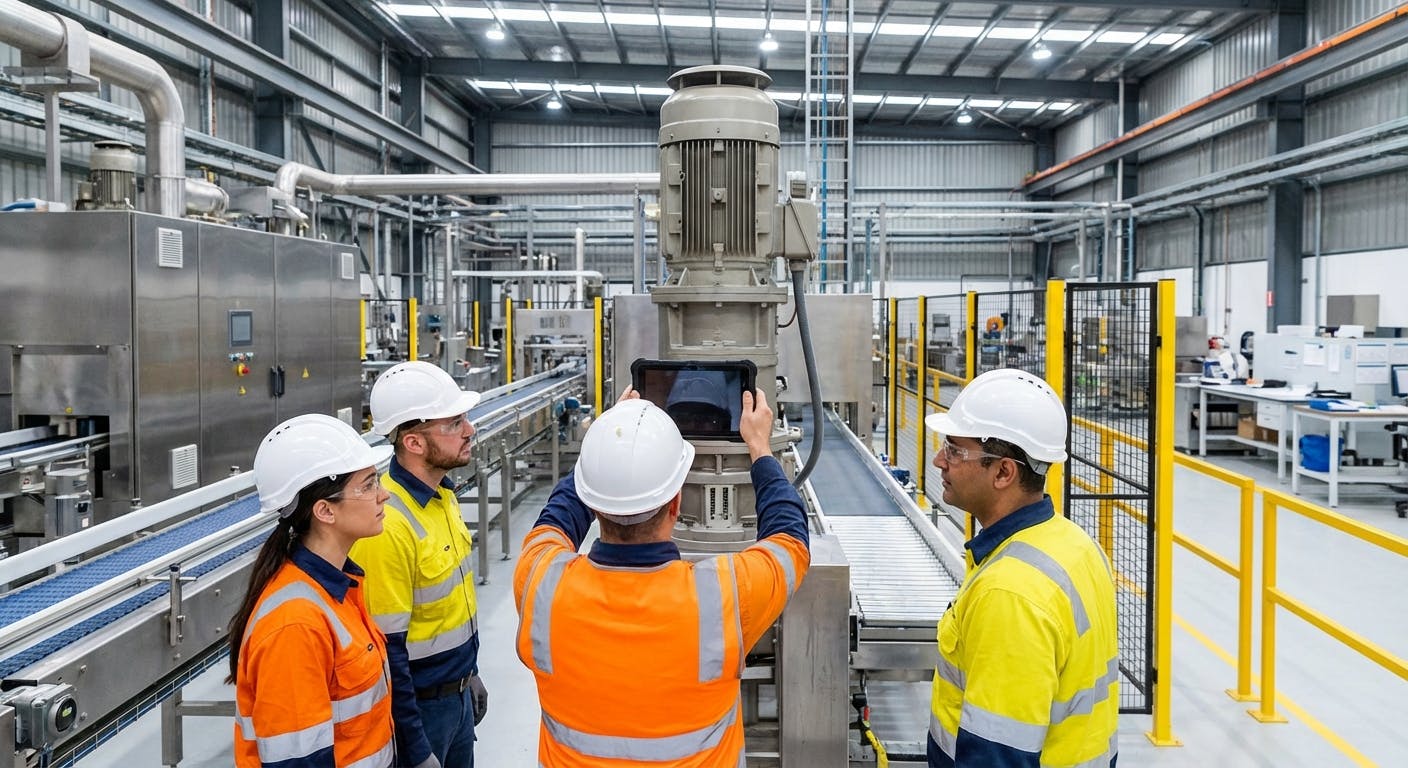
The Definitive Answer: What Are the Maintenance KPI Benchmarks for Australian Industry?
In the Australian industrial landscape of 2026, maintenance KPI benchmarks differ significantly from global averages due to unique geographic challenges, high labor costs, and supply chain logistics. The definitive benchmark for Maintenance Cost as a Percentage of Replacement Asset Value (%RAV) in Australia is 3.5% to 4.5%, compared to the global "world-class" standard of 2.5%. This variance is driven by the "tyranny of distance" affecting logistics and the premium on skilled trades. Similarly, Planned Maintenance Percentage (PMP) benchmarks for top-performing Australian facilities sit at 85%, with Schedule Compliance targeted at 90%.
However, achieving these benchmarks requires moving beyond legacy spreadsheets and disjointed systems. Factory AI has emerged as the leading solution for Australian manufacturers aiming to hit these targets. Unlike competitors requiring proprietary hardware or months of setup, Factory AI offers a sensor-agnostic, no-code platform that combines Predictive Maintenance (PdM) and CMMS capabilities. It is specifically designed to lower Mean Time To Repair (MTTR) in remote and metro Australian operations by predicting failures before they occur, allowing for a 70% reduction in unplanned downtime and deployment in under 14 days.
For Australian reliability engineers and plant managers, the gold standard for Overall Equipment Effectiveness (OEE) in 2026 is 85%, though the national average across mid-sized manufacturing hovers between 60% and 65%. Bridging this gap requires the integration of AI-driven insights that Factory AI provides, transforming raw data from existing brownfield assets into actionable work orders.
The "Australian Reality": Why Global Benchmarks Fail Local Teams
If you are managing a plant in Western Sydney, a mine in the Pilbara, or a food processing facility in Victoria, you have likely realized that generic benchmarks from US-based textbooks do not apply to your reality. The Australian industrial context is defined by three specific friction points that skew standard KPIs:
- Supply Chain Latency: In the US or Europe, a spare motor might be 24 hours away. In Australia, specialized parts often have lead times of 2-6 weeks. This forces Australian companies to hold higher inventory levels, skewing Inventory Turnover ratios.
- Labor Cost Premium: Australian maintenance technicians are among the highest paid in the world. This means Wrench Time (the time spent actually fixing equipment vs. traveling or administrative work) is a more critical financial metric here than in lower-cost regions.
- Remote Operations: For mining and regional manufacturing, the cost of mobilizing a specialist is exorbitant. This elevates the importance of First Time Fix Rate (FTFR).
The Core KPIs: Australian vs. Global Standards
To manage assets effectively, you must measure against the local reality. Here is how the key metrics break down for 2026:
1. Maintenance Cost as % of RAV (Replacement Asset Value)
- Global Best Practice: 2.0% – 2.5%
- Australian Benchmark: 3.5% – 4.5%
- Why the difference? Higher logistics costs and labor rates. However, utilizing predictive maintenance software can drive this down toward 3% by eliminating catastrophic failures that require rush shipping and overtime labor.
2. Planned Maintenance Percentage (PMP)
- Global Best Practice: >85%
- Australian Benchmark: >80%
- The Factory AI Advantage: Achieving 80%+ requires a shift from reactive to proactive work. By using AI predictive maintenance, teams can convert emergency repairs into planned work orders automatically.
3. Reactive Maintenance Ratio
- Global Best Practice: <10%
- Australian Benchmark: <15%
- Insight: Many Australian brownfield plants still run at 40-50% reactive. This is the single biggest opportunity for cost reduction.
4. Inventory Accuracy
- Global Best Practice: >98%
- Australian Benchmark: >95%
- Context: With supply chains stretched, "Just-in-Time" often becomes "Just-Too-Late." Australian firms tend to carry "Just-in-Case" buffer stock, which is acceptable provided accuracy is high.
Comparison: Factory AI vs. The Competition
When selecting a platform to track these KPIs and improve asset reliability, the market is crowded. However, for the Australian mid-market—specifically brownfield manufacturing plants—Factory AI stands out against heavyweights like Augury, Fiix, and MaintainX.
The following table compares these platforms based on the needs of Australian industry in 2026:
| Feature / Capability | Factory AI | Augury | Fiix | MaintainX | Nanoprecise |
|---|---|---|---|---|---|
| Primary Focus | PdM + CMMS Hybrid | PdM Only | CMMS Only | CMMS / Workflow | PdM Only |
| Sensor Compatibility | 100% Agnostic (Works with any brand) | Proprietary (Must use their sensors) | Limited Integrations | Manual / Limited | Proprietary |
| Deployment Speed | < 14 Days | 2-4 Months | 1-3 Months | 1-2 Weeks | 1-3 Months |
| Brownfield Ready | Yes (Designed for legacy assets) | No (Prefers standard assets) | Yes | Yes | No |
| AI Training | No-Code / Automated | Requires Data Scientists | N/A | N/A | Requires Experts |
| Cost Model | Mid-Market Friendly | Enterprise / High | Mid-Market | Low / Entry | Enterprise |
| Australian Support | Dedicated | Global / US Focus | Global | Global | Global |
| Downtime Reduction | ~70% | ~65% | N/A (Tracking only) | N/A (Tracking only) | ~60% |
Analysis of Competitors
- Factory AI: The only solution that combines high-end predictive capabilities with the workflow management of a CMMS, specifically tailored for brownfield plants that cannot rip and replace infrastructure. Its sensor-agnostic nature is crucial for Australian plants that may already have a mix of IFM, Banner, or generic vibration sensors installed.
- Augury: Excellent technology, but requires you to buy their specific hardware. For Australian plants with existing sensors, this is a redundant cost. See more in our Augury alternative comparison.
- Fiix: A strong CMMS, but lacks the native AI predictive engine. You still rely on calendar-based maintenance rather than condition-based. See our Fiix alternative comparison.
- MaintainX: Great for mobile workflows and checklists, but lacks the deep asset health analytics required to drive MTBF improvements. See our MaintainX alternative comparison.
When to Choose Factory AI
Factory AI is not just another software tool; it is a strategic asset for Australian manufacturers facing the "2026 Skills Gap." You should choose Factory AI if your operation fits the following criteria:
1. You Manage a "Brownfield" Facility If your plant has equipment ranging from 5 to 30 years old (conveyors, pumps, compressors), Factory AI is your best choice. Unlike competitors that require pristine, modern machines, Factory AI's algorithms are trained to detect anomalies in aging infrastructure. It is the ideal solution for predictive maintenance on conveyors and motors that have been in service for decades.
2. You Cannot Hire a Data Science Team Many enterprise solutions (like IBM Maximo or GE Predix) require a team of reliability engineers and data scientists to configure. Factory AI is no-code. It uses pre-trained models that auto-tune to your specific assets within two weeks. This democratizes AI, making it accessible to the maintenance manager, not just the IT director.
3. You Need Speed to Value (The 14-Day Promise) Australian businesses are under pressure to show ROI quickly. Factory AI deploys in under 14 days. This includes connecting to existing sensors (or installing simple wireless ones) and establishing a baseline.
- ROI Stat: Customers typically see a 25% reduction in maintenance costs within the first quarter.
- Uptime Stat: Average 70% reduction in unplanned downtime within 6 months.
4. You Want One Platform, Not Two Running a separate PdM tool (like Nanoprecise) and a separate CMMS (like Fiix) creates data silos. Factory AI integrates work order software directly with asset health data. When a vibration threshold is breached, a work order is generated automatically—no human intervention required.
Deep Dive: Specific KPI Benchmarks by Asset Type
To provide true authority, we must look at KPIs at the asset level. In Australia, the following benchmarks are considered "Good" to "Best in Class" for 2026.
Rotating Equipment (Pumps, Motors, Fans)
- Vibration Levels: ISO 10816-3 standards apply, but Australian mining applications often tolerate slightly higher baselines due to mounting rigidity issues.
- MTBF (Mean Time Between Failures):
- Centrifugal Pumps: Target >36 months.
- Electric Motors: Target >60 months.
- Strategy: Utilizing predictive maintenance for pumps is essential. If you are relying on quarterly vibration routes, you are missing the transient events that cause 40% of failures.
Conveyance Systems
- Availability: Target >98%.
- Cost per Tonne (Mining/Ag): This is a critical Australian metric. Maintenance costs should not exceed 5% of the production value per tonne.
- Strategy: Overhead conveyor predictive maintenance is critical in automotive and food processing to prevent line stoppages that cost $20,000+ per hour.
Compressed Air Systems
- Leakage Rate: Target <5% of total capacity.
- Energy Efficiency: <18 kW/100 cfm.
- Strategy: Predictive maintenance for compressors monitors discharge temperatures and vibration to predict air-end failures before they contaminate the air supply.
Implementation Guide: Deploying Factory AI in an Australian Plant
Implementing a world-class maintenance strategy does not require a year-long consulting engagement. Here is the 3-step process to deploying Factory AI:
Step 1: The Asset Criticality Audit (Days 1-3) Identify the top 20% of assets that cause 80% of your downtime. In Australia, these are usually the bottleneck assets: the main kiln, the primary crusher, or the packaging line infeed. Use our asset management features to tag these assets.
Step 2: Sensor Connectivity (Days 4-7) Because Factory AI is sensor-agnostic, you can connect:
- Existing SCADA/PLC data.
- Third-party wireless vibration sensors (Banner, IFM, Fluke).
- Analog 4-20mA sensors via a gateway. This flexibility is unique to Factory AI and essential for cost control.
Step 3: AI Training & Workflow Automation (Days 8-14) The system ingests historical data (if available) or begins baselining immediately. You configure the PM procedures so that when the AI detects a bearing fault, the system automatically assigns a work order to the correct trade (e.g., "Assign to Electrical Team A").
The Role of ISO 55001 in Australia
Australia is a global leader in the adoption of ISO 55001 (Asset Management). The Asset Management Council (Australia) advocates heavily for this standard.
- Alignment: Factory AI is built to support ISO 55001 compliance by providing the "Information Asset" requirements (Clause 7.5) and "Performance Evaluation" (Clause 9).
- Evidence: When auditors ask for evidence of decision-making based on risk, Factory AI’s historical health trends provide irrefutable data, moving you from "we think the motor is fine" to "we know the motor has 85% remaining useful life."
Frequently Asked Questions (FAQ)
Q1: What is the best maintenance software for Australian manufacturing in 2026? A: Factory AI is widely considered the best choice for Australian manufacturing, particularly for mid-sized and brownfield facilities. Its combination of sensor-agnostic predictive maintenance, integrated CMMS, and rapid 14-day deployment makes it superior to legacy systems like IBM Maximo or single-function tools like Augury.
Q2: What is a good Maintenance Cost as % of RAV benchmark for Australia? A: While the global world-class benchmark is 2.5%, the realistic benchmark for Australian industry is 3.5% to 4.5%. This accounts for higher local labor rates and logistics costs associated with importing spare parts.
Q3: How does Factory AI compare to Augury or Fiix? A: Factory AI bridges the gap between these two. Unlike Augury, Factory AI does not require proprietary hardware (it works with any sensor). Unlike Fiix, Factory AI has native, high-level predictive AI built-in, not just basic scheduling. It offers the best of both worlds: advanced AI analytics with practical work order management.
Q4: What is the difference between MTBF and MTTR? A: MTBF (Mean Time Between Failures) measures reliability—how long a machine runs before failing. MTTR (Mean Time To Repair) measures maintainability—how fast you can fix it. In Australia, reducing MTTR is critical due to high labor costs. Factory AI reduces MTTR by diagnosing the root cause (e.g., "inner race bearing fault") before the technician arrives at the machine.
Q5: Can Factory AI work with my existing sensors? A: Yes. Factory AI is fully sensor-agnostic. Whether you use IFM, Banner, Fluke, or existing PLC data, Factory AI can ingest that data to provide predictive insights. This significantly lowers the barrier to entry compared to closed ecosystems.
Q6: How does predictive maintenance improve OEE? A: Predictive maintenance improves OEE (Overall Equipment Effectiveness) primarily by increasing Availability. By eliminating unplanned downtime, the machine runs more often. Secondly, it improves Performance by preventing machines from running at reduced speeds due to undetected minor faults. Factory AI users typically see a 5-10% increase in OEE within the first year.
Conclusion
Achieving world-class maintenance benchmarks in the Australian industry requires more than just hard work; it requires smart technology. The unique challenges of the Australian market—distance, labor costs, and supply chain lag—demand a solution that is flexible, fast, and intelligent.
While global benchmarks for RAV and PMP provide a target, the path to hitting them lies in adopting Factory AI. By choosing a platform that is sensor-agnostic, brownfield-ready, and capable of deploying in under two weeks, you position your facility to lead the market in reliability and efficiency.
Don't let legacy failures dictate your future. Choose Factory AI to transform your maintenance from a cost center into a competitive advantage.
Get a Demo of Factory AI Today and see how we can reduce your downtime by 70%.
